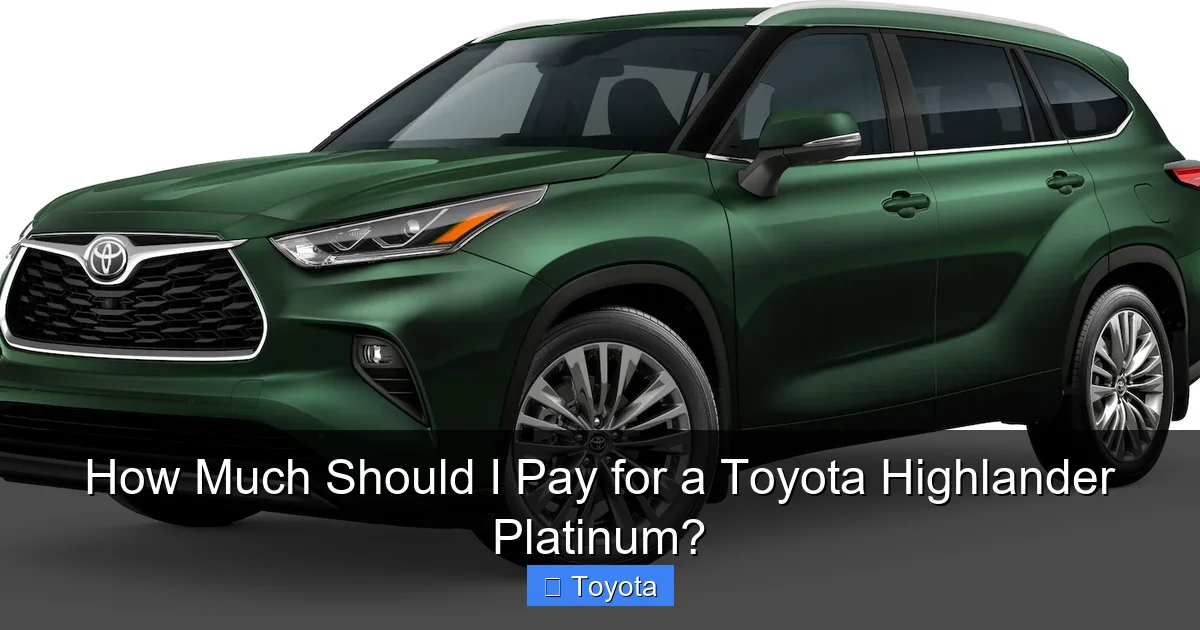
How Much Should I Pay for a Toyota Highlander Platinum?

Contents
- 1 Key Takeaways
- 2 📑 Table of Contents
- 3 Decoding the Price Tag: MSRP, Invoice, and True Market Value
- 4 The Market Dynamics: Why Prices Fluctuate (And How to Time Your Purchase)
- 5 Negotiation Strategies: From Initial Offer to Final Signature
- 6 The Total Cost of Ownership: Beyond the Sticker Price
- 7 Putting It All Together: A Sample Price Breakdown for 2024
- 8 Conclusion: Your Confidence is Your Greatest Asset
- 9 Frequently Asked Questions


Paying the right price for a Toyota Highlander Platinum requires understanding its Manufacturer’s Suggested Retail Price (MSRP), the dealer’s invoice cost, and current market forces. For the 2024 model, the Platinum trim starts at an MSRP of approximately $51,420, but the final out-the-door price can vary significantly based on location, dealer inventory, incentives, and your negotiation skills. Always research, get multiple offers, and focus on the total drive-off cost, not just the monthly payment, to secure the best deal.
So, you’ve set your sights on the top of the line. The Toyota Highlander Platinum. You want the panoramic moonroof, the heated and ventilated front seats, the premium audio, the 20-inch alloy wheels—the whole shebang. It’s a fantastic choice, a three-row SUV that blends Toyota reliability with a luxury-feeling cabin. But then you glance at the window sticker and your heart skips a beat. “How much should I really pay for this?” you wonder, feeling a mix of excitement and sticker shock. You’re not alone. Figuring out the true, fair price for a Highlander Platinum is one of the biggest hurdles for any car buyer. This guide will walk you through every layer of pricing, from factory floor to your driveway, so you can walk into the dealership with confidence and walk out with a deal that makes you smile.
Key Takeaways
- The MSRP is just a starting point: The window sticker price ($51,420 for 2024) is not what you should expect to pay. The dealer’s actual cost (invoice) is lower, creating room for negotiation.
- Market conditions dictate your leverage: High inventory and slow sales give you power; low supply and high demand favor the dealer. Check local and national inventory levels before buying.
- Incentives are your best friend: Factory cash rebates, low APR financing, and lease deals can drastically reduce your effective cost. Always apply these before negotiating.
- Focus on the “out-the-door” price: This includes all fees, taxes, registration, and destination charges. Negotiate this single number to avoid hidden costs ballooning your budget.
- Total cost of ownership matters: A higher purchase price means higher insurance, potential loan interest, and sometimes higher registration fees. Factor these into your long-term budget.
- Certified Pre-Owned (CPO) offers significant value: A lightly used 1-2 year old Highlander Platinum can save $8,000-$12,000 while still offering a robust warranty and near-new condition.
- Patience and multiple quotes are key: Get written offers from at least 3-5 dealers, even if they are out of your area. Use them against each other to drive the price down.
📑 Table of Contents
- Decoding the Price Tag: MSRP, Invoice, and True Market Value
- The Market Dynamics: Why Prices Fluctuate (And How to Time Your Purchase)
- Negotiation Strategies: From Initial Offer to Final Signature
- The Total Cost of Ownership: Beyond the Sticker Price
- Putting It All Together: A Sample Price Breakdown for 2024
- Conclusion: Your Confidence is Your Greatest Asset
Decoding the Price Tag: MSRP, Invoice, and True Market Value
Before you can negotiate, you need to speak the language of car pricing. There are three critical numbers you must understand.
Manufacturer’s Suggested Retail Price (MSRP)
This is the number you see advertised and on the window sticker. For the 2024 Toyota Highlander Platinum, the MSRP starts at $51,420. This is Toyota’s recommended selling price, but it is not, and never has been, the final word. Think of it as the ceiling, not the floor. Dealers are not required to sell at this price, and in most cases, they have no desire to.
Dealer Invoice Price
This is the amount the dealer pays the manufacturer for the vehicle. It’s often lower than the MSRP. For a Highlander Platinum, the invoice might be in the range of $47,000-$48,500, depending on options. However, this number is also a bit of a mirage. Dealerships receive various incentives from the manufacturer (called “holdbacks” and “floor plan” assistance) that effectively lower their true net cost even further. You, as a consumer, will never have access to these exact backend figures. Your goal is not to know the dealer’s absolute bottom dollar, but to know a fair market price that sits between MSRP and invoice.
True Market Value (TMV) / Fair Market Price
This is the number you should care about. It’s what similar vehicles are actually selling for in your specific region right now. Websites like Edmunds, Kelley Blue Book (KBB), and TrueCar provide this data. They analyze thousands of real transactions to give you an average, good, and excellent price you can expect to pay. For a popular, in-demand trim like the Platinum, the TMV might be closer to invoice. If the model is sitting on the lot for 90+ days, it could be below invoice. This is your most powerful research tool.
For example, let’s say KBB shows the following for a 2024 Highlander Platinum in your zip code: MSRP $51,420, Average Selling Price $49,850, and Incentives $1,500. Your target “excellent” price would be around $48,350 before fees. That’s a $3,070 discount from MSRP before you even step into the dealership. This is the power of research. When you start your search, you should also consider how long your current vehicle might last. If you’re thinking about an older model, you might want to check out our article on how much a 2009 Toyota Highlander is worth to understand depreciation trends.
The Market Dynamics: Why Prices Fluctuate (And How to Time Your Purchase)
Car pricing isn’t static. It’s a living, breathing ecosystem of supply, demand, and corporate strategy. Understanding these forces is how you time your purchase for maximum savings.
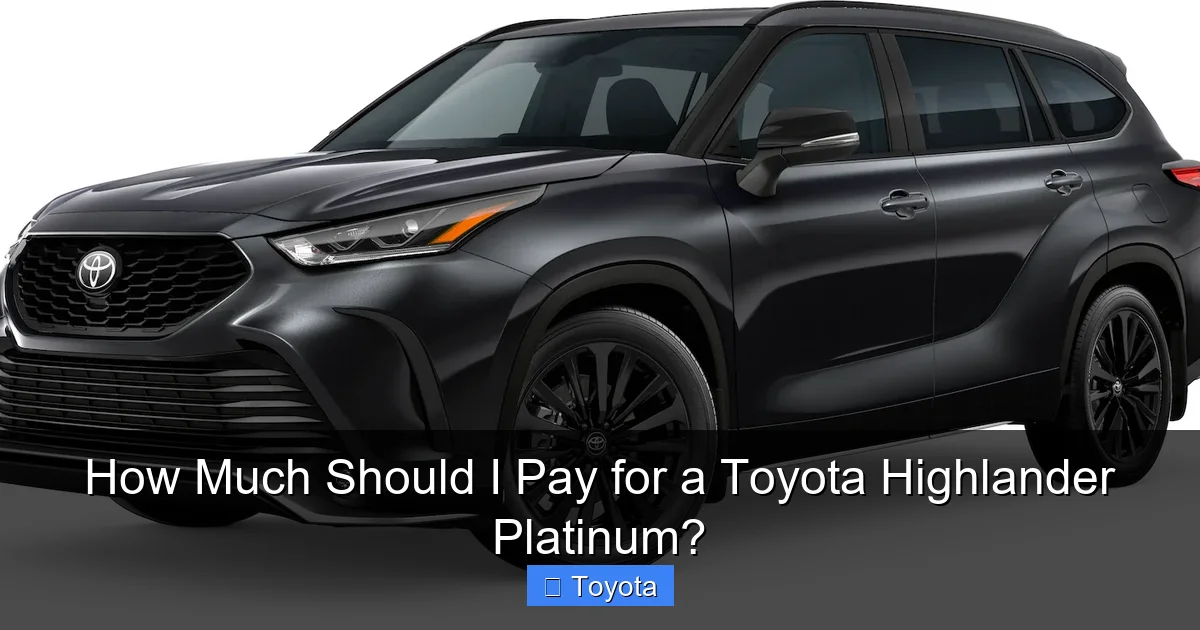
Visual guide about How Much Should I Pay for a Toyota Highlander Platinum?
Image source: di-enrollment-api.s3.amazonaws.com
The Supply and Demand Dance
This is Economics 101. When the Highlander Platinum is hot and inventory is low (think post-pandemic chip shortage, or a brand-new redesign launch), dealers have less incentive to discount. You’ll be lucky to get $500 off MSRP. Conversely, if there’s a glut of inventory on the lot—perhaps due to a slowing economy or a model year changeover—dealers are motivated to move metal. They may sell at or below invoice to meet sales quotas and earn manufacturer bonuses. Check online inventory at your local dealers. If you see 10+ Platinum trims on one lot, that’s a green light for serious negotiation. If a dealer only has one or two and it’s a popular color/package, expect less wiggle room.
Model Year and Calendar Timing
The best deals are almost always on the previous model year when the new one is arriving (August-October). Dealers need to clear out old stock. A leftover 2023 Highlander Platinum when the 2024s are flooding the lot can be a bargain hunt. Also, consider the end of the month, end of the quarter, and end of the year. Dealerships have sales targets to hit. On the last day of the month, a sales manager might approve a deal at a loss just to get one more unit sold and hit their bonus. Holiday weekends (Memorial Day, 4th of July, Labor Day) often feature advertised specials, but read the fine print—they may be on base models only.
Regional Differences
Where you live matters. A Highlander Platinum in rural Texas or the Midwest might sell for less than the same vehicle in San Francisco or New York City, simply because competition is fiercer and cost of doing business is higher on the coasts. Use online tools to see the average selling price in your specific zip code versus a neighboring state. Sometimes, it’s worth a 2-3 hour drive to save $1,500-$2,000, especially if you can combine it with a pre-negotiated online quote.
Negotiation Strategies: From Initial Offer to Final Signature
Now for the实战 (real combat). Knowledge is your armor, but strategy is your weapon.
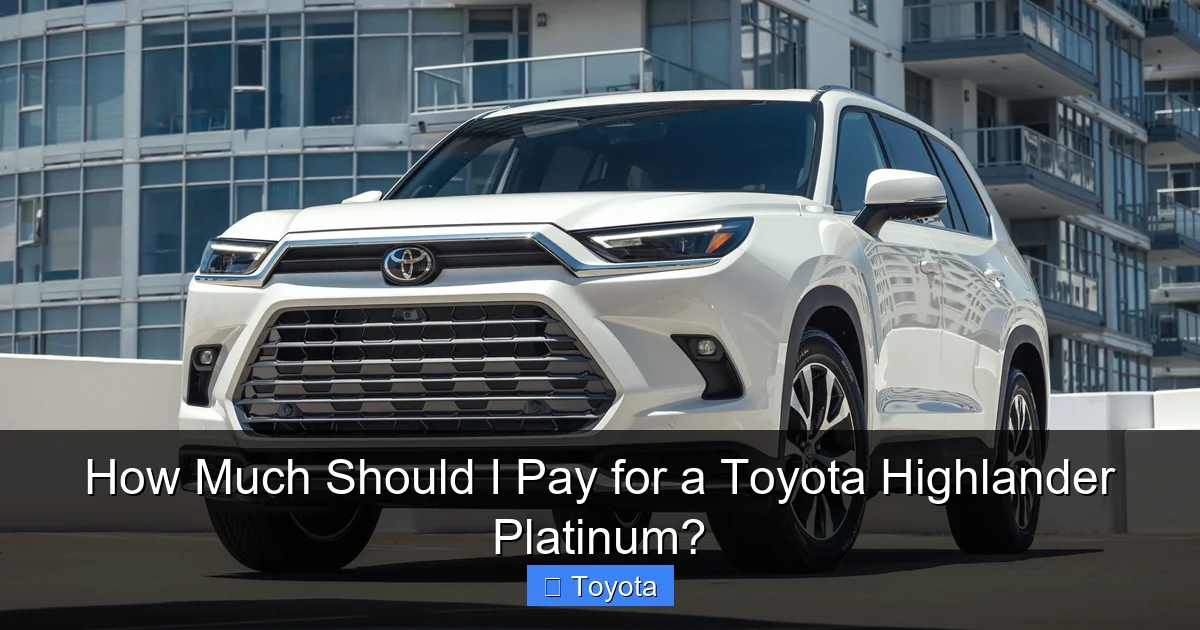
Visual guide about How Much Should I Pay for a Toyota Highlander Platinum?
Image source: motortrend.com
Get Pre-Approved and Know Your Absolute Max
Before you ever call a dealer, secure a pre-approval from your bank or credit union. This gives you a baseline interest rate to beat and, more importantly, a concrete number for your total budget. If you know your absolute maximum out-the-door payment is $1,000/month or $45,000 total, you have an unemotional line in the sand. This prevents you from getting swept up in the excitement and overpaying. While you’re planning your finances, it’s wise to use a calculator to determine how much car you can truly afford based on your income, debts, and other expenses.
Negotiate the “Out-the-Door” Price, Not the Monthly Payment
This is the cardinal rule. The salesperson will ask, “What do you want your monthly payment to be?” Do not answer. Instead, say, “I’m focused on the total purchase price. Let’s negotiate the out-the-door cost.” The out-the-door price includes: vehicle price, destination fee, documentation fee, title/registration, sales tax, and any add-ons (like fabric protection, window etching). By locking down this single number first, you eliminate the “payment packing” trick where they add $50/month for 72 months to sneak in an extra $3,600 in fees. Get the final, all-in price in writing before discussing financing or trade-in.
Use Email/Online Quotes to Create a Bidding War
Do not go to a dealership unprepared. Use the dealer’s own online inventory tool. Find 5-7 dealers within a 200-mile radius. Send each a standardized email: “I am in the market for a new 2024 Toyota Highlander Platinum. I have a pre-approved financing offer at X% APR. Can you please provide your best, all-in, out-the-door price for this vehicle, including all fees and taxes? This is a cash-equivalent transaction.” You will be amazed at the replies. Some will be weak. One or two will come in aggressively low. You now have leverage. Call the low bidders and say, “Dealer X offered me $Y. Can you beat it?” This process can save you thousands and removes the high-pressure, face-to-face game-playing.
The Total Cost of Ownership: Beyond the Sticker Price
Paying $48,000 for the car is just the first check. The true cost stretches over years of ownership.
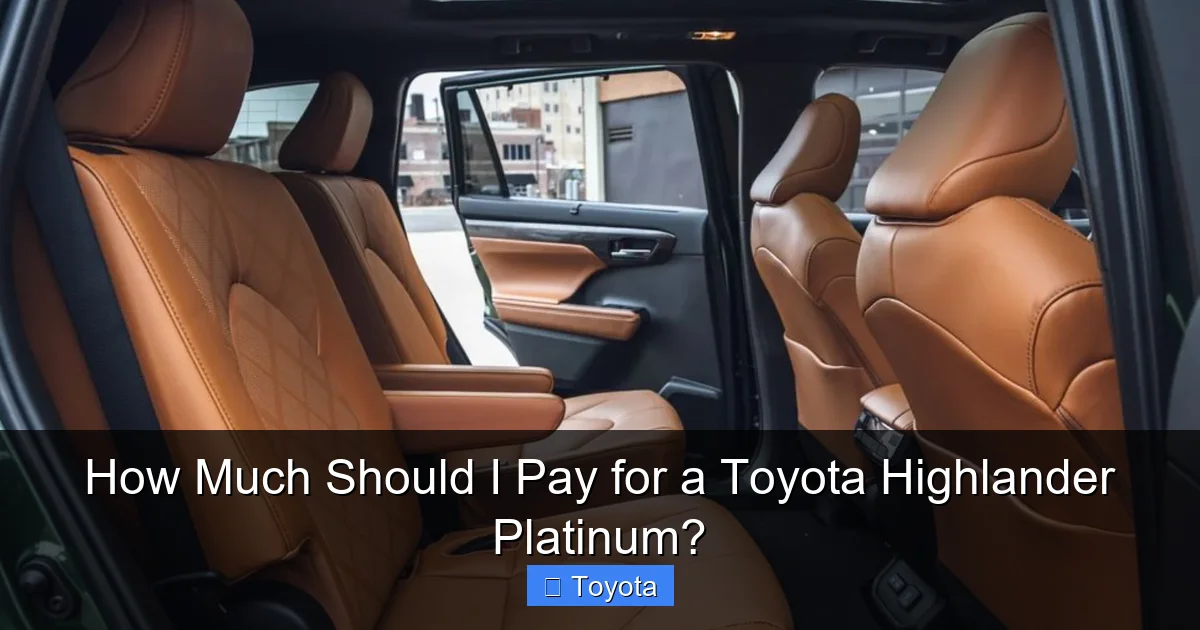
Visual guide about How Much Should I Pay for a Toyota Highlander Platinum?
Image source: insidethehood.com
Financing, Insurance, and Fees
If you finance, that $48,000 becomes more. At 5% APR for 60 months, you’ll pay over $3,200 in interest. A lower rate saves you money. Your insurance premium for a Highlander Platinum will be higher than for a base LE model due to its higher replacement value. Expect to pay $1,600-$2,200 annually for full coverage. Don’t forget sales tax (6-10% depending on state), registration fees ($200-$600), and a typically non-negotiable dealer documentation fee ($300-$800). All of this adds $4,000-$7,000 to your first-year cost.
Fuel, Maintenance, and Long-Term Reliability
The Highlander’s 3.5L V6 gets about 22-25 MPG combined. With gas at $3.50/gallon, you’re looking at ~$2,800-$3,200 annually for 15,000 miles. Maintenance on a new Toyota is relatively inexpensive for the first few years, with just oil changes and tire rotations. However, as it ages, parts for the Platinum’s more premium features (like the adaptive suspension or panoramic roof) can cost more. A great resource is our guide on how much an oil change at Toyota typically costs to gauge routine service expenses. For long-term upkeep, understanding wear items is key. For instance, knowing how long brakes should last on a Toyota Highlander helps you budget for that future repair. A Platinum’s larger brakes and alloys might have a slightly different replacement cost than a base model’s.
Depreciation: The Silent Cost
This is the big one. A new car loses value the moment you drive it off the lot. A Highlander holds its value exceptionally well (around 60% after 5 years), but that still means a $48,000 Platinum will be worth about $28,800 in five years. You’ve “lost” nearly $20,000 in value. This is why many savvy buyers opt for a Certified Pre-Owned (CPO) Platinum from 1-2 years prior. You avoid the steepest part of the depreciation curve, get a factory-backed warranty, and pay significantly less. You can often find a CPO 2022 Highlander Platinum with low miles for $38,000-$42,000, saving $6,000-$10,000 upfront.
Putting It All Together: A Sample Price Breakdown for 2024
Let’s synthesize this into a realistic scenario. You’re buying a new 2024 Toyota Highlander Platinum in a moderately competitive market (not a shortage, not a glut).
- MSRP: $51,420
- Destination & Delivery: $1,350 (non-negotiable)
- Desired Options: (Assume none, Platinum is loaded) $0
- Manufacturer Incentives: -$1,000 (cash rebate)
- Target Negotiated Price (before fees): $49,200 (approx. $2,220 off MSRP + incentive)
- Documentation Fee: $500 (often capped by state)
- Title/Registration/Plates: $400 (estimate)
- Sales Tax (6%): $2,976 (on $49,200 + $500 doc fee)
- TOTAL OUT-THE-DOOR PRICE: ~$53,076
This $53,076 is your battle number. If a dealer quotes you $54,500 out-the-door, you know you have work to do. If they hit $52,800, you’re in excellent territory. Remember, the Platinum trim’s value is in its features. If you can live without the top-tier audio or ventilated seats, the Limited trim ($47,825 MSRP) offers a massive savings for a minimal feature drop, which you could then spend on a superior warranty or accessories.
Conclusion: Your Confidence is Your Greatest Asset
So, how much should you pay for a Toyota Highlander Platinum? The definitive answer is: less than MSRP, and as close to the True Market Value as your local market and negotiation skills allow. For a new 2024 model in a typical market, that means targeting an out-the-door price in the low-$52,000 to mid-$53,000 range after incentives, with the potential to go lower on a previous model year or with strong dealer competition. For a Certified Pre-Owned, aim for the high $30,000s to low $40,000s.
The process isn’t about tricking the dealer; it’s about being an informed consumer. You are not fighting the salesperson—you are aligning your goal (a fair price) with their goal (selling a car). By doing your homework on TMV, securing your own financing, obtaining multiple written quotes, and fixating on the final out-the-door number, you remove the mystery and the pressure. You transform from a hopeful buyer into a prepared negotiator. The Toyota Highlander Platinum is a reward for your family or your lifestyle. Paying the right price makes that reward even sweeter. Now, go forth and negotiate with knowledge.
Frequently Asked Questions
Is the Toyota Highlander Platinum worth the extra money over the Limited trim?
It depends on your priorities. The Platinum adds about $3,600 over the Limited and includes premium features like a 12.3″ touchscreen, JBL® audio, heated/ventilated front seats, a panoramic moonroof, and 20-inch wheels. If these luxury and tech features are important to you, it’s worth it. If you’re focused on value and three-row utility, the Limited is exceptionally well-equipped and saves you significant money.
Should I buy a new or Certified Pre-Owned (CPO) Highlander Platinum?
CPO offers tremendous value. A 1-2 year old Highlander Platinum will be $8,000-$12,000 less than a new one, has already absorbed the steepest depreciation, and comes with a factory-backed warranty (often extending the original power train coverage to 7 years/100,000 miles). Buy CPO if you want max value. Buy new if you want the absolute latest features, full warranty, and the “new car” experience without question.
What is a fair discount off MSRP for a Highlander Platinum?
In a balanced market, a fair discount is typically 3-5% off MSRP before applying any manufacturer incentives. On a $51,420 Platinum, that’s a $1,500-$2,500 discount. During high inventory periods, discounts of 6-8% or more are possible. Always subtract any available manufacturer rebates from your final negotiated price to calculate your true savings.
Are dealer-installed add-ons like VIN etching or fabric protection worth it?
Almost always, no. VIN etching is a cheap deterrent ($200-$400 at the dealer) that you can often get for free from your insurance company. Fabric protection is an overpriced topical solution you can buy online for $20. These are high-profit, low-value items for the dealer. Politely decline all pre-delivery inspection (PDI) fees and market adjustment fees. They are pure profit.
How does leasing a Highlander Platinum compare to buying?
Leasing can offer lower monthly payments because you’re only paying for the vehicle’s expected depreciation during the lease term (plus interest/fees). For a Platinum, the high residual value (what it’s worth at lease-end) works in your favor. You can often lease for $500-$650/month with a modest down payment. However, you never own the car, have mileage limits, and must maintain it meticulously. Use a lease vs. buy calculator. If you want to keep the car long-term, buying is usually better. If you like a new car every 2-3 years and want lower payments, leasing is a strong option. You can explore what monthly payment range fits your budget with our article on how much car you can lease for $300 a month.
What are the biggest hidden costs I should watch for on the contract?
The biggest are: 1) Extended warranties/service contracts (often overpriced; you can buy them later or skip), 2) High dealer documentation fees (research your state’s limit), 3) “Dealer prep” or “market adjustment” fees (push back), 4) Including your tax credit/trade-in value in the wrong place (always apply trade-in *after* negotiating the vehicle price to avoid taxing the discount), and 5) Low-ball trade-in offers. Always negotiate the trade-in value separately, using your own research from KBB or Edmunds.