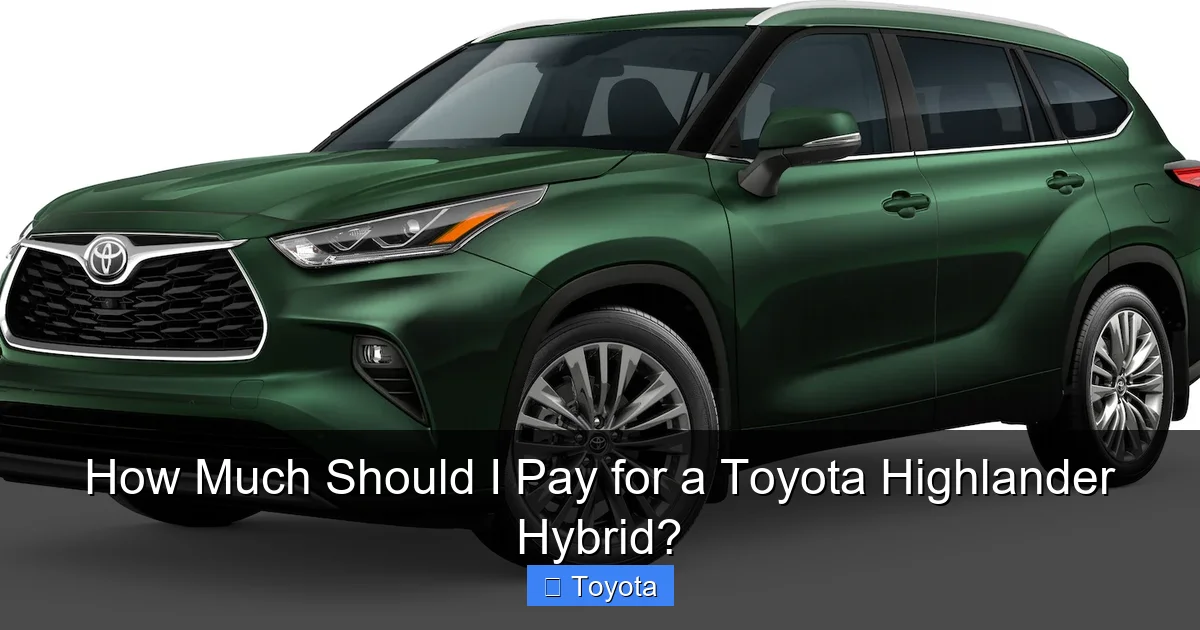
How Much Should I Pay for a Toyota Highlander Hybrid?

Contents
- 1 Key Takeaways
- 2 📑 Table of Contents
- 3 Understanding the Manufacturer’s Suggested Retail Price (MSRP)
- 4 New vs. Used: The Great Value Divide
- 5 Decoding Incentives, Rebates, and the Dealer’s True Cost
- 6 The Real Cost of Ownership: Beyond the Purchase Price
- 7 Smart Buying Strategies: How to Get Your Best Deal
- 8 Conclusion: Your Fair Price is a Personal Calculation
- 9 Frequently Asked Questions

Jack Stands

Liquid Car Polish

Car Glass Cleaner
Reflective Safety Triangle
Figuring out what to pay for a Toyota Highlander Hybrid means looking beyond the sticker price. The 2024 model starts around $47,000 for the base LE trim and can exceed $55,000 for the loaded Platinum Hybrid. Your final cost depends heavily on trim level, dealer incentives, regional demand, and whether you buy new or used. Always factor in long-term ownership costs like fuel savings, hybrid-specific maintenance, and insurance to determine the true value.
So, you’re eyeing a Toyota Highlander Hybrid. Smart move. It’s one of the most reliable, fuel-efficient, and family-friendly three-row SUVs on the market. But then you log on to Toyota’s configurator or walk onto a dealer lot and are hit with a wall of numbers. MSRP, destination, dealer fees, options, incentives… it’s dizzying. The big question looms: How much should I actually pay for a Toyota Highlander Hybrid? Let’s cut through the noise. This isn’t about finding the lowest possible number; it’s about finding the right number for the value you’re getting. We’ll break down every piece of the pricing puzzle, from the base window sticker to the total cost of keeping it on the road for five years.
Key Takeaways
- The 2024 Toyota Highlander Hybrid starts at an MSRP of approximately $47,000 for the LE trim. This base price includes the 2.5-liter hybrid powertrain and a solid set of standard features, but popular options quickly add cost.
- Trim levels significantly impact price. Moving up from LE to XLE adds about $3,000, Limited adds another $3,000, and the top Platinum Hybrid trim commands a $5,000+ premium over Limited.
- Dealer incentives and manufacturer rebates can save thousands. Always check Toyota’s current national offers and negotiate based on the vehicle’s invoice price, not just MSRP.
- Used Highlander Hybrids (2020-2023) offer tremendous value. Depreciation hits hardest in the first 2-3 years, allowing you to get a like-new CPO model for 20-30% less than a new one.
- The hybrid system saves significantly on fuel but has unique maintenance considerations. Expect excellent real-world MPG (35+ combined) and plan for potential hybrid battery costs far in the future, typically after 100,000+ miles.
- Your total cost of ownership is what truly matters. Calculate fuel, insurance, maintenance (like oil changes), and potential repairs over 5 years to compare against other SUVs.
- Negotiation is key, especially on in-demand hybrids. Be prepared to walk away, focus on the out-the-door price, and consider financing/leasing separately from the vehicle price negotiation.
📑 Table of Contents
- Understanding the Manufacturer’s Suggested Retail Price (MSRP)
- New vs. Used: The Great Value Divide
- Decoding Incentives, Rebates, and the Dealer’s True Cost
- The Real Cost of Ownership: Beyond the Purchase Price
- Smart Buying Strategies: How to Get Your Best Deal
- Conclusion: Your Fair Price is a Personal Calculation
Understanding the Manufacturer’s Suggested Retail Price (MSRP)
Everything starts with the MSRP. This is Toyota’s recommended selling price for each specific configuration. For the 2024 Toyota Highlander Hybrid, the lineup is beautifully simple but with significant jumps between trims.
The 2024 Highlander Hybrid Trim Ladder and Starting Prices
Here’s the current breakdown (all prices include the mandatory $1,450 destination charge):
- Toyota Highlander Hybrid LE: Starts at $47,410. This is your entry point. It comes standard with the powerful 2.5-liter hybrid engine (245 net horsepower), Toyota Safety Sense 3.0, a 12.3-inch digital driver display, and a 8-inch infotainment screen with wireless Apple CarPlay/Android Auto. It’s an incredibly well-equipped base model.
- Toyota Highlander Hybrid XLE: Starts at $50,450. This is the popular middle child. For the ~$3,000 premium, you gain SofTex synthetic leather seats, heated front seats, a power liftgate, a 4-way power passenger seat, and the handy 360-degree overhead camera view.
- Toyota Highlander Hybrid Limited: Starts at $53,745. The luxury step-up adds perforated leather, heated and ventilated front seats, a heated steering wheel, a 10-inch color Head-Up Display, and a premium JBL audio system.
- Toyota Highlander Hybrid Platinum: Starts at $58,825. The king of the hill. This adds a panoramic moonroof, semi-aniline leather, a rear seat entertainment system, and a 12.3-inch touchscreen (vs. 8-inch on lower trims). The jump from Limited to Platinum is a hefty $5,000+.
Key Insight: The XLE trim is the value sweet spot for most buyers. The jump from LE to XLE gets you the most desired comfort and convenience features for a reasonable price increase. The Platinum’s premium is for absolute luxury tech, which may not be necessary for a family hauler.
Options and Packages: Where the Price Balloons
The starting prices are just the beginning. Almost every Highlander Hybrid you see on the lot will have options. Common additions include:
- All-Weather Floor Liners & Cargo Mat: ~$500
- Advanced Technology Package: (Includes Bird’s Eye View, digital key, etc.) ~$1,000 – $2,000 depending on trim.
- Trailer Hitch: ~$650 (the Hybrid can tow up to 3,500 lbs).
- Premium Audio (JBL): Already standard on Limited/Platinum, but an ~$800-$1,000 upgrade on XLE.
- Second-Row Captain’s Chairs: A ~$1,000 option that replaces the bench, reducing seating from 8 to 7 but adding easy third-row access.
A well-optioned XLE Hybrid can easily touch $54,000 before any fees or negotiations. A Platinum Hybrid with most boxes checked can sail past $62,000. Your mission is to identify the essential options for your family and skip the “nice-to-haves” that inflate the monthly payment.
New vs. Used: The Great Value Divide
This is the most critical decision point. The Highlander Hybrid has only been in its current, highly efficient generation since 2020. This works massively in your favor if you’re open to used.

Visual guide about How Much Should I Pay for a Toyota Highlander Hybrid?
Image source: 2024toyota.net
The Depreciation Curve is Your Friend
New cars depreciate the fastest in their first 2-3 years. A brand-new $50,000 Highlander Hybrid XLE will likely be worth about $38,000-$40,000 after three years (assuming average mileage). That’s a loss of $10,000+.
But here’s the opportunity: you can buy that same three-year-old model from a certified pre-owned (CPO) program for that $38,000-$40,000 price tag. It still has 2 years of the original 5-year/60,000-mile powertrain warranty left, plus an extended CPO bumper-to-bumper warranty from Toyota. You get 90% of the car’s life for 75% of the original price. For a model like the Highlander Hybrid, whose hybrid battery has proven exceptionally durable, this is a winning strategy.
Where to Look and What to Expect
Focus on model years 2020-2023. The 2020-2023 models are nearly identical. A 2021 or 2022 with low miles (under 30k) will feel virtually new. Prices vary by region, but here are realistic private-party and CPO ranges (as of early 2024):
- 2020-2021 LE Hybrid: $32,000 – $36,000
- 2021-2022 XLE Hybrid: $37,000 – $42,000
- 2022-2023 Limited Hybrid: $42,000 – $48,000
Always get a vehicle history report (Carfax or AutoCheck) and have any used hybrid inspected by a trusted mechanic, even if it’s a CPO. Look for a clean title, full service history, and no accident records. You can also use our guide on how to value a older Highlander to understand broader market trends, though that focuses on gas models.
Decoding Incentives, Rebates, and the Dealer’s True Cost
Knowing the MSRP is step one. Step two is understanding what the dealer actually paid and what incentives are available to lower your cost.

Visual guide about How Much Should I Pay for a Toyota Highlander Hybrid?
Image source: motortrend.com
The Invoice Price is a Starting Point, Not the Floor
The “invoice price” is what the dealer supposedly paid the manufacturer. It’s a useful benchmark, but it’s not the dealer’s true cost. Dealers often receive hidden holdbacks (a percentage of MSRP paid quarterly by the manufacturer) and various bonuses for meeting sales targets. This means their actual cost is often 2-4% below invoice. Your negotiation goal is to get as close to that true cost as possible, not just below invoice.
You can find estimated invoice prices on sites like Edmunds or Kelley Blue Book (KBB). For a 2024 Highlander Hybrid XLE with common options, invoice might be around $48,500 on a $52,000 MSRP vehicle. A great deal would be within $500-$1,000 of that invoice number before applying any public rebates.
Manufacturer Incentives and Cash Rebates
This is where you save real money. Toyota periodically offers:
- Low APR Financing: E.g., 0.9% for 36 months on new Highlander Hybrids for well-qualified buyers. This can be better than a cash rebate if you were planning to finance.
- Cash Rebates: Sometimes $500 – $1,500 off. These are often stackable with low APR financing for certain buyer segments (military, recent graduates, etc.).
- Lease Specials: Toyota often offers attractive money factors and residual values on leases for hybrids. If you prefer lower monthly payments and driving a new car every few years, this is worth exploring. Our article on what you can lease for $300/month provides a useful framework.
Action Step: Check Toyota’s official “Specials” page for your region before ever stepping foot on a lot. These are your baseline savings.
The Real Cost of Ownership: Beyond the Purchase Price
Paying $50,000 for a Highlander Hybrid might feel steep until you calculate the ownership savings versus a gas V6 Highlander. This is where the hybrid pays off.
Visual guide about How Much Should I Pay for a Toyota Highlander Hybrid?
Image source: di-enrollment-api.s3.amazonaws.com
Fuel Savings: The #1 Financial Benefit
This is the big one. A gas-only 2024 Highlander V6 gets an EPA-estimated 22-24 MPG combined. The Hybrid consistently delivers 35-36 MPG combined in real-world driving. If you drive 15,000 miles per year and gas averages $3.50/gallon:
- Gas Highlander: 15,000 miles / 23 MPG = 652 gallons. 652 gal * $3.50 = $2,282 per year.
- Highlander Hybrid: 15,000 miles / 35 MPG = 429 gallons. 429 gal * $3.50 = $1,502 per year.
Annual Savings: ~$780. Over 5 years, that’s nearly $4,000 back in your pocket, which can offset a significant chunk of the hybrid’s initial price premium. Use our fuel cost calculator mindset when comparing models.
Maintenance and Repairs: Hybrid Nuances
This is a common worry. Are hybrids more expensive to fix? For the Highlander Hybrid, the routine maintenance is very similar to the gas model—just with fewer moving parts in the engine bay. You’ll still need:
- Oil Changes: Every 5,000-10,000 miles. The cost is comparable to a gas four-cylinder engine, typically $70-$120 at a dealer with synthetic oil.
- Tire Rotations, Brake Pads, Wiper Blades, Cabin Air Filter: Costs are identical to the gas model.
The big question is the hybrid battery. This is not a regular 12V battery; it’s the large, high-voltage traction battery pack under the floor. The fantastic news? Toyota’s hybrid batteries have an exceptional track record. Failure before 150,000 miles is extremely rare. Replacement costs are high (historically $3,000-$5,000+), but they are often covered by a separate 8-year/100,000-mile warranty. For a used Highlander Hybrid, check if this warranty is transferable. The likelihood of needing it is low, but it’s a potential long-term cost to be aware of, similar to concerns about a Camry Hybrid battery.
Insurance and Other Ownership Costs
Insurance for a Highlander Hybrid is typically on par with, or slightly higher than, the gas-powered Highlander. It’s a large, safe SUV, but the hybrid powertrain can slightly increase repair costs in an accident, which insurers factor in. Get quotes before you buy. Other costs like registration, taxes, and potential diagnostic fees are standard for any vehicle in its class.
Smart Buying Strategies: How to Get Your Best Deal
Now that you know the numbers, how do you execute?
Timing is Everything
The absolute best times to buy a new Highlander Hybrid are:
- End of Quarter/Year (March, June, September, December): Dealerships have sales targets to meet. They are more motivated to move metal, especially on slower-selling colors or less popular trims.
- During Major Manufacturer Incentive Periods: Usually around holidays (Memorial Day, Labor Day) or when Toyota needs to clear inventory for new model year arrivals.
- Model Year Transition: In August/September, dealers are clearing out current model years to make room for next year’s. They’ll offer deeper discounts.
The Negotiation Dance: Separate the Variables
Never negotiate solely on the monthly payment. The dealer can stretch the loan term to make any payment seem affordable. Instead:
- Negotiate the “Out-The-Door” Price of the Vehicle First. This is the total purchase price including all fees, taxes, and the vehicle cost itself, but EXCLUDING financing and trade-in. Get this in writing.
- Then, Shop for Financing Separately. Get pre-approved from your credit union or bank (this gives you a benchmark rate). Let the dealer try to beat it. This prevents them from making money in the finance office (F&I) to compensate for a low vehicle price.
- Handle the Trade-In Last. Research your trade’s value (use KBB, Edmunds) beforehand. Negotiate the trade-in value as a separate line item after you’ve agreed on the out-the-door price for the new Highlander. This prevents them from low-balling your trade to give you a “good deal” on the new car.
Test Drive the Hybrid System
It’s not just about the cabin. Pay attention to the hybrid powertrain’s behavior. Does it transition smoothly between electric and gas? Is the regenerative braking feel consistent? The Highlander’s system is polished, but you should feel comfortable with the unique characteristics of a hybrid—the quiet EV mode at low speeds, the slight engine drone under hard acceleration. A test drive is also your chance to verify which options you truly need.
Conclusion: Your Fair Price is a Personal Calculation
So, how much should you pay for a Toyota Highlander Hybrid? There is no single magic number. For a brand-new 2024 XLE Hybrid with a few popular options, a fair out-the-door price after all public incentives but before any dealer-added fees would be in the range of $51,000 – $53,000. For a Platinum, you’re looking at $56,000-$59,000. But if you can score a certified pre-owned 2022 XLE Hybrid with low miles for $39,000-$42,000, you are getting phenomenal value.
Your final decision hinges on your budget, how you value that new-car smell and full warranty, and your long-term ownership plan. The Highlander Hybrid’s reputation for reliability and its stellar fuel economy make it a financially savvy choice in the three-row segment, whether new or used. Do your homework on incentives, negotiate the out-the-door price with confidence, and you’ll land a fantastic SUV that will serve your family well for a decade or more. Remember, the goal isn’t just the lowest purchase price—it’s the lowest total cost of ownership for the vehicle that meets all your needs.
Frequently Asked Questions
What is the best time of year to buy a Toyota Highlander Hybrid?
The best times are typically the end of the calendar year (December) and the end of each quarter (March, June, September), when dealers are most motivated to meet sales targets. Major holiday weekends like Memorial Day and Labor Day also often feature strong manufacturer incentives.
Should I lease or buy a Highlander Hybrid?
Leasing can offer lower monthly payments and the ability to drive a new car every few years, which is great if you want the latest tech and always have a vehicle under warranty. Buying is better for long-term value if you plan to keep the car for 5+ years, as you’ll eventually own a reliable, fuel-efficient asset with no monthly payments. Compare lease money factors and residual values to loan interest rates for your specific situation.
How much does a Highlander Hybrid battery replacement cost if it fails?
While failures are extremely rare before 150,000 miles, replacement costs for the high-voltage traction battery can range from $3,000 to $5,500 at a dealership. However, this component is covered by an 8-year/100,000-mile warranty in most states. Always check if this warranty is transferable when buying a used model.
What is the real-world MPG for the Highlander Hybrid?
The EPA rates it at 36 MPG combined (34 city/36 highway). In real-world mixed driving, most owners report achieving 33-36 MPG, which is excellent for a large, heavy, three-row SUV. Your mileage will vary with driving style, terrain, and climate, but it consistently outperforms the gas V6 model by 10-12 MPG.
Are maintenance costs higher for the Highlander Hybrid versus the gas model?
For routine maintenance like oil changes, tire rotations, and brake pads, costs are nearly identical. The hybrid may even save money over time as regenerative braking reduces brake wear. The only potential higher cost is the long-term hybrid battery, but its exceptional reliability and long warranty make that a minor concern for most owners.
How does the Highlander Hybrid’s resale value hold up?
Exceptionally well. Toyota hybrids have some of the strongest resale values in the industry. The Highlander Hybrid consistently ranks at the top of its class for projected 5-year residual value. This strong demand in the used market is a key reason why buying a lightly used model is such a smart financial move.