
How Much Oil Does a Toyota Corolla Need for an Oil Change

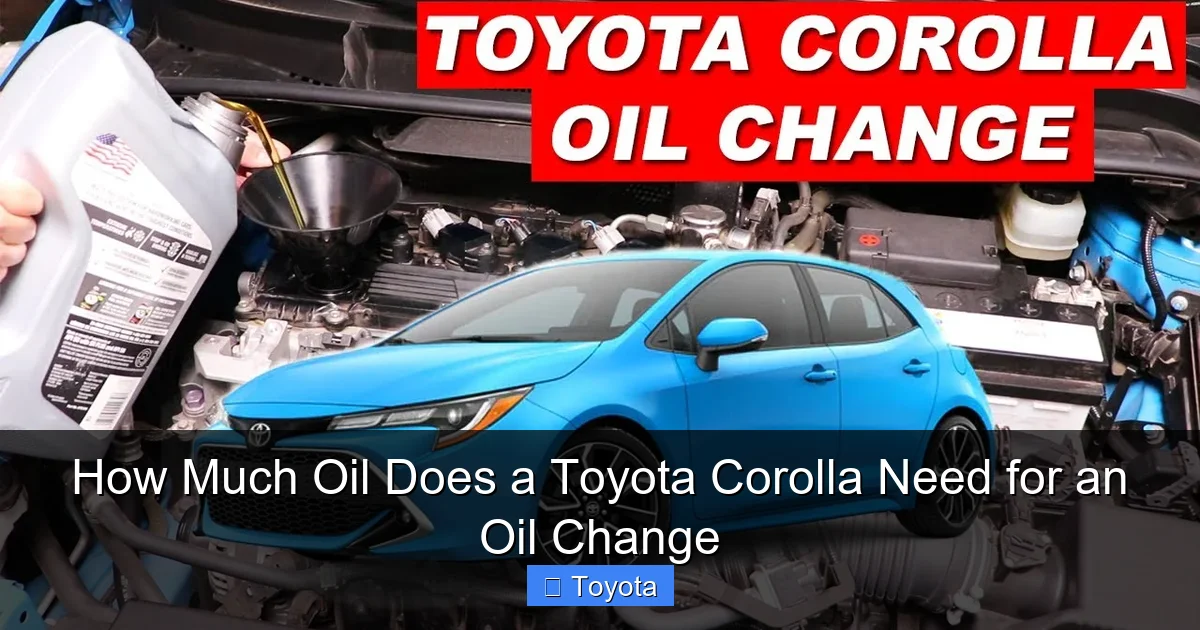
Knowing the correct oil capacity for your Toyota Corolla is crucial for engine health. This varies by model year and engine type, typically ranging from 4.0 to 5.1 quarts. Always use Toyota-recommended oil viscosity, usually 0W-20 for recent models. Check your owner’s manual for specifics, and never guess—overfilling or underfilling can cause serious damage. Regular oil changes with the right oil keep your Corolla running smoothly for years.
Hey there, fellow car enthusiast! If you’re staring at that dipstick or opening your hood wondering, “Just how much oil does my Toyota Corolla need?” you’re not alone. It’s one of the most common—and important—questions for any owner. Getting this wrong isn’t just a minor inconvenience; using the wrong amount or type of oil can lead to premature engine wear, poor performance, or even catastrophic failure down the line. The simple answer is that it depends. Your Corolla’s oil capacity isn’t a one-size-fits-all number. It shifts based on its age, the exact engine under the hood, and even whether you’re replacing the oil filter.
Think of it like baking a cake. The recipe (your owner’s manual) calls for a specific amount of flour (oil) for your particular pan size (engine). Guess, and you might end up with a dense mess or a collapsed disaster. In this complete guide, we’re going to clear up all the confusion. We’ll break down the oil capacities for every major Corolla generation from the last two decades, explain the critical difference between oil quantity and oil quality, and walk you through the entire oil change process. By the end, you’ll know exactly what your trusty Corolla needs to keep running like the reliable champ it is. Let’s pop the hood and dive in.
Key Takeaways
- Oil capacity varies by model year and engine: A Toyota Corolla typically needs between 4.0 and 5.1 quarts, but your specific year and engine size determine the exact amount.
- Your owner’s manual is the ultimate authority: Always consult it for the precise oil capacity, recommended viscosity, and specifications for your specific vehicle.
- Oil type matters as much as quantity: Modern Corollas almost exclusively require 0W-20 synthetic oil, while older models may use 5W-30 conventional or synthetic blend.
- Always check the dipstick after filling: Add oil gradually, check the level, and avoid overfilling, which can cause foaming, pressure issues, and seal damage.
- Replace the oil filter with every change: A new filter ensures clean oil circulation and is a critical part of the service, holding about 0.25-0.5 quarts of oil itself.
- Professional service has merits: While DIY saves money, a dealership or certified shop ensures proper disposal, warranty compliance, and a multi-point inspection.
- Capacity includes the filter: The “engine oil capacity” listed in manuals typically includes the standard oil filter replacement.
📑 Table of Contents
- Understanding Oil Capacity: It’s Not Just a Number
- Oil Capacity by Generation: A Detailed Breakdown
- Choosing the Right Oil: Viscosity, Type, and Specifications
- The Step-by-Step Oil Change Process for Your Corolla
- Common Mistakes and How to Avoid Them
- When to Seek Professional Help: The Dealership Advantage
Understanding Oil Capacity: It’s Not Just a Number
Before we list quarts, let’s get on the same page about what “oil capacity” actually means. In automotive terms, the oil capacity for an engine is the total volume of oil required to fill the engine’s lubrication system—including the oil pan, galleries, and the new oil filter—to the proper level indicated on the dipstick. This is a crucial distinction. When you read “4.4 quarts” in your manual, that’s the total system capacity with a new filter installed. If you change the filter but only add 4.0 quarts, you’ll be low. If you add 4.4 quarts without changing the filter (which you should always do), you’ll be overfilled because the old filter still holds about a quarter-quart of sludge-filled oil.
Why does this number change between models? Primarily due to two factors: engine displacement and design. A 1.8-liter 4-cylinder engine has less internal volume than a 2.0-liter engine, so it simply holds less oil. Additionally, internal engine design changes—like different oil pan shapes, cooler configurations, or turbocharger lubrication systems (though rare in standard Corollas)—can alter the total volume. This is why a 2015 Corolla and a 2022 Corolla, despite looking very similar, might have slightly different capacities. It’s also why you must verify for your specific Vehicle Identification Number (VIN) or model year.
The Critical Role of the Oil Filter
Let’s hammer this point home because it’s the source of many mistakes. The oil filter is not just a passive component; it’s an integral part of the oiling system’s volume. A standard cartridge or spin-on filter for a Corolla will hold between 0.25 and 0.5 quarts of oil when primed. When you drain the old oil, that filter retains a significant amount of the old, dirty oil. If you simply pour in the manual’s stated capacity without accounting for the new, empty filter, you are short-changing your engine. The proper procedure is: drain old oil and filter, install new filter (lightly pre-filled with fresh oil to prime it and reduce dry start-up), then fill the engine with the specified total capacity of new oil. You will then check the dipstick, as small variances in manufacturing and drain-back can mean you need a few ounces more or less.
Oil Capacity by Generation: A Detailed Breakdown
Now for the meat and potatoes. Below are the typical oil capacities for the vast majority of Toyota Corollas you’ll encounter on the road today. We’ve segmented them by their major generational shifts. Remember, these are general guidelines. Your owner’s manual is the only 100% definitive source. When in doubt, use the manual’s figure.

Visual guide about How Much Oil Does a Toyota Corolla Need for an Oil Change
Image source: autozonic.com
E210 Generation (2019-Present)
This is the current, eleventh-generation Corolla. It’s available with two primary engines in the U.S. market:
- 2.0L 3ZR-FAE I4 (Most models): This is the standard engine in the L, LE, and XLE trims. Its total oil capacity, with filter, is 4.4 quarts (4.2 liters). This is the figure you’ll use for a standard oil change.
- 2.0L M20A-FKS I4 (2023+ Hybrid models): The hybrid system uses a modified version of the 2.0L engine. Its capacity is very similar, typically 4.4 quarts (4.2 liters) with filter. Always double-check the manual for hybrid-specific procedures.
- 1.8L 2ZR-FXE I4 (Hybrid models prior to 2023): For the previous hybrid powertrain, the capacity is slightly lower at 4.0 quarts (3.8 liters) with filter.
Pro Tip: For these newer models, Toyota’s official specification is almost always 0W-20 synthetic oil meeting the API SP and ILSAC GF-6 standards. Using the correct viscosity is non-negotiable for fuel efficiency and engine protection.
E170/E180 Generation (2014-2018)
This generation marked a significant redesign and was sold alongside the older platform for a few years (2014-2016 as “Corolla” and “Corolla iM”). The engine lineup was simpler:
- 1.8L 2ZR-FE I4: This workhorse engine powered the vast majority of Corollas in this span. Its oil capacity with a filter is 4.4 quarts (4.2 liters). Yes, the same as the newer 2.0L! Engine size isn’t the only factor; internal design plays a big role.
- 1.8L 2ZR-FXE I4 (Hybrid): The hybrid model of this generation also used a 1.8L, but its Atkinson-cycle design and hybrid system integration gave it a capacity of 4.0 quarts (3.8 liters) with filter.
For these models, Toyota recommended 0W-20 synthetic oil for the 2ZR-FE starting around 2016-2017 model years. Earlier models in this generation (2014-2015) might still have specified 5W-30. This is a perfect example of why your manual is key. If you have a 2015 Corolla, you might need 5W-30, while a 2017 needs 0W-20. The capacity, however, remained the same for the 1.8L.
Pre-2014 Models (E120/E140 Generations)
We’ll group the older models here, as capacities become even more variant by specific year and trim. The most common engines were:
- 1.8L 1ZZ-FE I4 (2003-2008): Capacity is 4.0 quarts (3.8 liters) with filter.
- 1.8L 2ZR-FE I4 (2009-2013): Capacity is 4.4 quarts (4.2 liters) with filter. This engine introduced Dual VVT-i and was a major update.
- 2.4L 2AZ-FE I4 (2005-2010, in some trims): Less common, but if you have a Corolla with the larger 2.4L (like some 2005-2006 models), its capacity is 4.6 quarts (4.4 liters) with filter.
Oil specification for these older models was typically 5W-30 (conventional or synthetic blend). The move to 0W-20 began with the 2ZR-FE engine in the late 2000s/early 2010s and became ubiquitous later.
Choosing the Right Oil: Viscosity, Type, and Specifications
You’ve got the quart count down, but filling your Corolla with the wrong *type* of oil is just as bad as using the wrong amount. Let’s decode the oil bottle. The most critical piece of information is the viscosity grade, like 0W-20 or 5W-30. This number tells you how the oil flows at cold (W for winter) and hot temperatures.
Visual guide about How Much Oil Does a Toyota Corolla Need for an Oil Change
Image source: i.ytimg.com
Decoding the Numbers: 0W-20 vs. 5W-30
The first number (0W or 5W) indicates cold-weather flow. A 0W oil flows better at extreme cold than a 5W, providing faster lubrication on startup—a key factor for modern, tight-tolerance engines designed for fuel efficiency. The second number (20 or 30) indicates the oil’s thickness at 100°C (operating temperature). A 20-weight is thinner than a 30-weight at high temps. Thinner oil reduces internal friction, which improves fuel economy but must still provide adequate film strength to protect engine parts.
For your Corolla, follow the manual explicitly. Using 5W-30 in an engine designed for 0W-20 can cause increased fuel consumption and potentially trigger check engine lights related to variable valve timing systems, which are sensitive to oil flow. Using 0W-20 in an older engine designed for 5W-30 is generally safe in a pinch but not ideal for long-term use in very high-mileage engines with worn seals, as the thinner oil might burn or leak more easily. For a definitive answer on your specific model, you can reference our detailed guide on how much oil a Toyota Corolla takes, which includes viscosity specs.
Conventional, Synthetic Blend, or Full Synthetic?
Modern Corollas (roughly 2011 and newer) almost exclusively require or strongly recommend full synthetic oil. This is because synthetic oils have superior properties: they resist breakdown at high temperatures, flow better at low temperatures, and have longer service intervals. They contain fewer impurities and a more consistent molecular structure. For older Corollas (pre-2010), conventional oil was standard, but using a high-quality synthetic blend or full synthetic is still a great upgrade for better protection and potentially longer drain intervals. Always use oil that meets Toyota’s specifications, such as API SP and ILSAC GF-6 (the latest standards for gasoline engines). Look for these logos on the bottle.
The Step-by-Step Oil Change Process for Your Corolla
Armed with the correct oil and filter, let’s get our hands dirty. Changing your Corolla’s oil is one of the most rewarding DIY maintenance tasks. It’s straightforward, saves you money, and helps you bond with your car. Here’s a complete walkthrough.

Visual guide about How Much Oil Does a Toyota Corolla Need for an Oil Change
Image source: oilcapacityguide.com
Tools and Supplies You’ll Need
- Correct oil: The exact type and quantity (e.g., 4.4 quarts of 0W-20). Buy a little extra (a half-quart) to account for spillage or a slightly low reading.
- Correct oil filter: Use a high-quality filter from brands like Toyota OEM, WIX, Mobil 1, or Fram. Check the part number for your specific year/engine. A common part for recent 2.0L engines is Toyota part #90915-YZZF1 or equivalent.
- Socket wrench and drain plug socket: Usually 14mm or 17mm for the drain plug.
- Oil filter wrench: For a cartridge-style filter (common on newer Corollas), you’ll need a special cap wrench (often 64mm or 65mm). For a spin-on filter, a cup-style wrench works.
- Drain pan: At least 6-quart capacity.
- Funnel: For clean oil pouring.
- Gloves and safety glasses.
- Jack and jack stands or ramps: The Corolla has low ground clearance. You’ll need to safely lift the front end to access the drain plug. Never work under a car supported only by a jack.
- Torque wrench (highly recommended): To properly tighten the drain plug and filter cap to specification.
Procedure: From Start to Finish
- Warm the Engine: Run the car for 5-10 minutes. Warm oil flows faster and drains more completely, carrying more suspended contaminants with it.
- Lift and Secure: Drive onto level ground. Use the jack at the designated front jacking point (consult manual) and support the car on jack stands under the reinforced sills. Give the car a firm shake to ensure it’s stable.
- Locate and Position Drain Pan: Find the oil drain plug on the bottom of the oil pan. Place your drain pan directly beneath it. Consider that oil will shoot out at an angle.
- Remove Drain Plug: Using your socket wrench, carefully loosen (but don’t remove yet) the drain plug. Once loose, finish removing it by hand quickly and pull it away to avoid a hot oil blast. Let the oil drain completely (10-15 minutes).
- Replace the Drain Plug Washer: This is critical. The drain plug uses a crush washer. Always install a new washer (available at any auto parts store). Reinstall the plug and tighten to the manual’s torque specification (usually around 30 ft-lbs). Overtightening can strip the pan; undertightening causes leaks.
- Remove the Old Oil Filter: This is often the trickiest part. For a cartridge filter, remove the filter cap (it holds the filter element). Be prepared for oil to drip from the cap. For a spin-on filter, use the wrench to unscrew it. Have a small catch basin ready. Before removing, wipe the filter housing area clean to prevent dirt from falling in.
- Prepare the New Filter: Lightly coat the rubber gasket on the new filter with fresh oil. This creates a better seal and prevents sticking. For a cartridge system, place the new element in the cap.
- Install the New Filter: Hand-screw the new filter or cap until the gasket contacts the surface, then give it a 3/4 turn (for most spin-on filters). Consult your manual for the exact specification—some require a specific torque. Do not overtighten.
- Add New Oil: Remove the engine oil filler cap. Place your funnel and slowly pour in about 75-80% of the specified capacity (e.g., 3.5 quarts for a 4.4-quart capacity). Wait a minute for the oil to settle.
- Check the Level: Pull the dipstick, wipe it, reinsert fully, and pull again. The oil should be between the “L” (Low) and “F” (Full) marks, ideally near the top but not over. If it’s low, add oil in 0.25-quart increments, rechecking each time.
- Final Steps: Replace the filler cap. Start the engine and let it idle for 30 seconds. Check for leaks around the drain plug and filter. Turn off the engine and wait 2-3 minutes for oil to drain back. Re-check the dipstick level one final time and top off if necessary. Lower the car, properly dispose of the old oil and filter at a recycling center, and reset your maintenance reminder system.
Common Mistakes and How to Avoid Them
Even seasoned DIYers can slip up. Here are the most frequent pitfalls and how to sidestep them.
- Overfilling the Oil: This is the #1 error. More oil is NOT better. When the crankcase is overfilled, the spinning crankshaft aerates the oil, turning it into a frothy, ineffective foam that can’t lubricate properly. This leads to increased wear, oil pressure problems, and can even cause seals to blow. Solution: Always add oil gradually and check the dipstick frequently. It’s easier to add more than to remove it.
- Using the Wrong Filter: An incorrect filter can have the wrong gasket size, anti-drainback valve, or flow rate. Solution: Use your VIN or exact year/make/model/engine at the auto parts store counter or online to guarantee the correct part.
- Skipping the Washer: Reusing the old, compressed crush washer is a guaranteed slow leak. Solution: Make a new washer part of every oil change kit. They cost pennies.
- Not Tightening the Drain Plug/Filter: A loose plug or filter will spew oil all over your driveway and engine bay. Solution: Use a torque wrench. If you don’t have one, tighten the plug firmly by hand with a ratchet—snug is fine, but don’t muscle it. For the filter, follow the “3/4 turn after hand-tight” rule unless the manual specifies otherwise.
- Forgetting to Prime the Filter (for cartridge systems): Some cartridge filters sit upside down. Filling the cap with a little oil before installation helps prevent a brief moment of dry start-up. Solution: Check your service manual; if the filter housing is above the oil level, priming is beneficial.
- Ignoring Oil Specs for High-Mileage Engines: If your Corolla has over 100,000 miles, consider a high-mileage oil. These contain seal conditioners that can help reduce minor leaks and consumption. The viscosity should still match the manual (0W-20 or 5W-30).
When to Seek Professional Help: The Dealership Advantage
DIY is great, but there are times when handing the keys to a pro is the smarter move. If you lack the tools, space, or confidence, a professional oil change is a perfectly valid choice. But not all shops are created equal. A Toyota dealership service department offers distinct advantages. Their technicians are factory-trained on your specific model, they use genuine Toyota parts and filters, and they perform a comprehensive multi-point inspection that often includes checking fluid levels, tire pressure, brakes, and belts. This can catch small issues before they become big, expensive problems. Furthermore, if your Corolla is still under the original powertrain warranty, having the oil changed at the dealer (or by a certified technician using OEM-spec fluids and parts) helps maintain that warranty coverage without dispute. The cost difference between a quick-lube shop and a dealership isn’t as vast as it used to be, especially when you factor in the inspection and peace of mind. You can get a clear idea of current pricing by checking our report on how much an oil change costs at Toyota.
Frequently Asked Questions
What happens if I accidentally overfill my Toyota Corolla’s oil?
Overfilling is serious. The excess oil gets churned into a foam by the spinning crankshaft, which destroys its lubricating ability and can cause a loss of oil pressure, leading to severe engine wear. If you suspect an overfill, drain the excess immediately by removing the drain plug until the level is correct on the dipstick.
Can I use 5W-30 oil in my newer Corolla that calls for 0W-20 in an emergency?
In a true emergency (you’re stranded and only 5W-30 is available), a short-term top-off is acceptable to reach a service station. However, you should change the oil back to the correct 0W-20 as soon as possible. Using the wrong viscosity long-term can affect fuel economy, variable valve timing performance, and could potentially cause long-term damage.
Do I need a special filter for a Toyota Corolla, or is any brand okay?
You need a filter that meets Toyota’s specifications for fit, flow, and filtration efficiency. Stick with reputable brands like Toyota OEM (Original Equipment Manufacturer), WIX, Mobil 1, Fram, or Bosch. Avoid the cheapest, no-name filters. The part number is critical—a filter for a 2020 Corolla is different from one for a 2015.
How often should I change the oil in my Toyota Corolla?
Follow your owner’s manual’s maintenance schedule. For modern Corollas using synthetic oil, the interval is typically every 10,000 miles or 12 months, whichever comes first. For older models using conventional oil, it’s usually every 5,000 miles or 6 months. Severe driving conditions (lots of short trips, extreme temps, dusty roads) may require more frequent changes.
What’s the best way to check my Corolla’s oil level to ensure it’s correct?
Park on level ground, engine off but slightly warm (after a short drive and 5-10 minute wait). Pull the dipstick, wipe it clean, reinsert it fully, then pull it out again. Read the oil level against the marks. It should be between the “L” and “F” marks, ideally closer to “F.” Check it at every gas fill-up for best practice.
Is it better to change my Corolla’s oil at the dealership or a quick-lube shop?
Both have pros and cons. A dealership uses factory-trained techs, genuine parts, and includes a thorough inspection, which is ideal for warranty maintenance and comprehensive care. A reputable independent shop or quick-lube can be more convenient and sometimes less expensive, but quality varies widely. For maximum assurance and record-keeping, the dealership is the gold standard, especially for newer vehicles.
