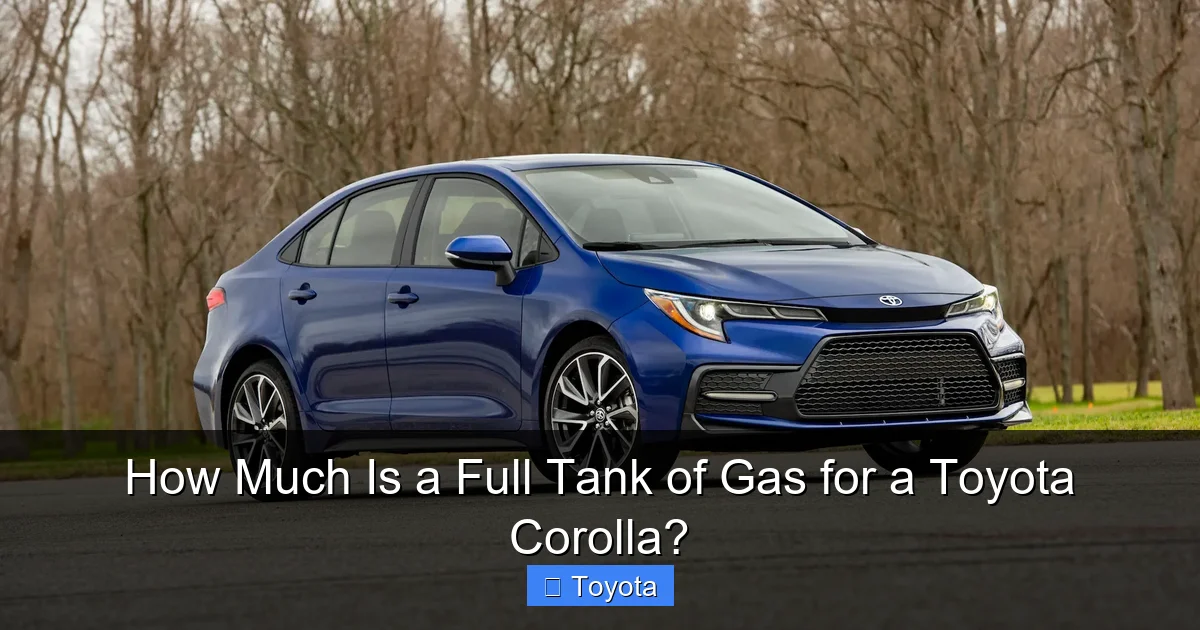
How Much Is a Full Tank of Gas for a Toyota Corolla?

Contents
- 1 Key Takeaways
- 2 📑 Table of Contents
- 3 Understanding Your Corolla’s Fuel Tank Capacity
- 4 The Current Price of Gasoline: A Moving Target
- 5 Calculating the Cost: A Simple Formula
- 6 Factors That Influence Your Fuel Costs
- 7 Comparing the Corolla to Other Vehicles
- 8 Practical Tips to Maximize Every Gallon
- 9 Conclusion
- 10 Frequently Asked Questions

Windshield Washer Fluid

LED Indicator Light

Car Battery Tester

Dash Cam
The cost to fill a Toyota Corolla’s gas tank isn’t a fixed number—it depends on your model year’s tank capacity and local gas prices. A 2023 Corolla holds about 13.2 gallons, so at a national average of $3.50/gallon, a full tank costs roughly $46.20. However, prices fluctuate wildly by region, and your driving habits directly impact how often you’ll be at the pump.
So, you’re wondering, “How much is a full tank of gas for a Toyota Corolla?” It’s one of the most common questions for any car owner, and for good reason. Fuel costs are a major part of your vehicle’s total cost of ownership. For a car celebrated for its efficiency like the Corolla, understanding that fill-up cost helps you budget and maybe even save a few dollars. The short answer is: it depends. But don’t worry, we’re going to break down every single factor so you’ll know exactly what to expect when you pull up to the pump, no matter what year Corolla you drive.
Think of it this way: asking the cost of a full tank is like asking the cost of a full grocery bag. It depends on what you’re buying (gas price per gallon) and the size of the bag (your car’s fuel tank capacity). The Toyota Corolla has a reputation for being an economical grocery bag, but the price of what’s inside changes every day. Let’s pop the hood and look under the financial fuel cap.
Key Takeaways
- Tank Size Varies by Year: Most modern Toyota Corollas (2014+) have a 13.2-gallon tank, but older models like the 2010-2013 may have a 13.2 or 14.5-gallon capacity. Always check your owner’s manual for your specific vehicle.
- Cost = Tank Size x Gas Price: The formula is simple. Multiply your Corolla’s fuel capacity in gallons by the current price per gallon at your local station to get your exact fill-up cost.
- Gas Prices Are Highly Regional: The national average is just a starting point. Prices can differ by over $1.00 per gallon between states and even neighboring towns due to taxes, refining costs, and distribution logistics.
- Efficiency Reduces Fill-Up Frequency: The Corolla’s excellent EPA-estimated MPG (up to 31 city/40 highway) means you’ll purchase fewer gallons per mile driven compared to less efficient vehicles, lowering your overall fuel expenditure.
- Maintenance Directly Affects Fuel Economy: Under-inflated tires, a dirty air filter, or overdue oil changes can drop your MPG by 10% or more, meaning you’ll need gas more often and spend more per mile.
- Resale Value is Tied to Care: A well-maintained Corolla with consistent fuel economy records often commands a higher trade-in value. You can learn more about your specific model’s worth through resources like our value guides.
- Driving Style Has a Big Impact: Aggressive acceleration and speeding can lower your highway MPG significantly. Smooth, steady driving maximizes the distance you get from each gallon, stretching your fuel dollar further.
📑 Table of Contents
Understanding Your Corolla’s Fuel Tank Capacity
Before we can talk money, we need to talk volume. Your Toyota Corolla’s fuel tank capacity is the fixed number in our equation. This is how many gallons of gasoline your tank can hold when you fill it from the “empty” warning light. For most drivers, this is a number you might not think about often, but it’s crucial for calculating your fuel costs.
Tank Size Across Model Years
The good news is that Toyota has kept the Corolla’s fuel tank size remarkably consistent over the last decade. For the vast majority of models from the 2014 model year onward—including the current 2023 and 2024 models—the fuel tank capacity is 13.2 US gallons. This applies to the standard L, LE, XLE, and even the sportier SE and XSE trims.
If you own an older Corolla, specifically from the 2010 to 2013 model years (the ninth generation), the tank size was slightly larger at 14.5 US gallons. Some very early tenth-generation models (2014) might also show 14.5 gallons in certain specifications, but 13.2 gallons became the standard. For the classic eighth-generation models (2008-2009), the capacity was typically 13.2 gallons as well. The simplest way to be 100% certain is to open your fuel filler door and look for a sticker that says “Fuel Capacity: XX gal” or to consult your owner’s manual. This small step eliminates guesswork from your cost calculations.
Why Capacity Matters for Your Budget
Why does a gallon or two matter? On the surface, the difference between a 13.2-gallon and a 14.5-gallon tank might seem minor. But at $3.50 per gallon, that’s a difference of $4.55 per full tank. Over a year of regular fill-ups, that adds up to hundreds of dollars. Furthermore, a larger tank generally means a longer driving range between fill-ups. For a commuter who hates stopping for gas, that extra range can be a real quality-of-life benefit. However, a larger tank also means you’re carrying more weight (gasoline is heavy!), which can have a very minor, almost negligible impact on fuel economy. The primary budget impact is simply the upfront cost per fill-up.
The Current Price of Gasoline: A Moving Target
This is the wild card. Gas prices are famously volatile, changing not just month-to-month but sometimes day-to-day and station-to-station. The price you pay per gallon is the single biggest factor determining your total fill-up cost. As of this writing, the national average for regular unleaded gasoline in the United States hovers around the $3.50 per gallon mark, but this is a broad average with massive local variations.

Visual guide about How Much Is a Full Tank of Gas for a Toyota Corolla?
Image source: auto-data.net
Regional Price Variations
You could drive across a state line and see the price jump or drop significantly. California consistently has the highest gas prices in the continental U.S., often exceeding $5.00 per gallon due to stringent environmental regulations and higher taxes. States like Texas, Oklahoma, and Mississippi frequently have some of the lowest prices, sometimes dipping below $3.00 per gallon. Why such a difference? It boils down to three main things: state and local taxes, the proximity to oil refineries, and regional supply chain logistics. A state with its own refineries and low taxes will naturally have lower pump prices. To find the best price in your area, use gas price apps like GasBuddy or Google Maps, which show real-time prices at stations near you.
Gas Grades and Their Impact
Your Toyota Corolla is designed to run on regular unleaded gasoline, typically with an octane rating of 87. This is the cheapest grade and the one we’re using for our base calculations. Some higher-trim Corollas or models in certain markets might recommend or require premium fuel (91 octane or higher). Using a higher octane than required provides no benefit to your engine or fuel economy and simply costs more—often 50 cents to a dollar more per gallon. Always follow the fuel recommendation in your owner’s manual. For a standard Corolla, stick with regular 87 octane to keep your fill-up cost as low as possible.
Calculating the Cost: A Simple Formula
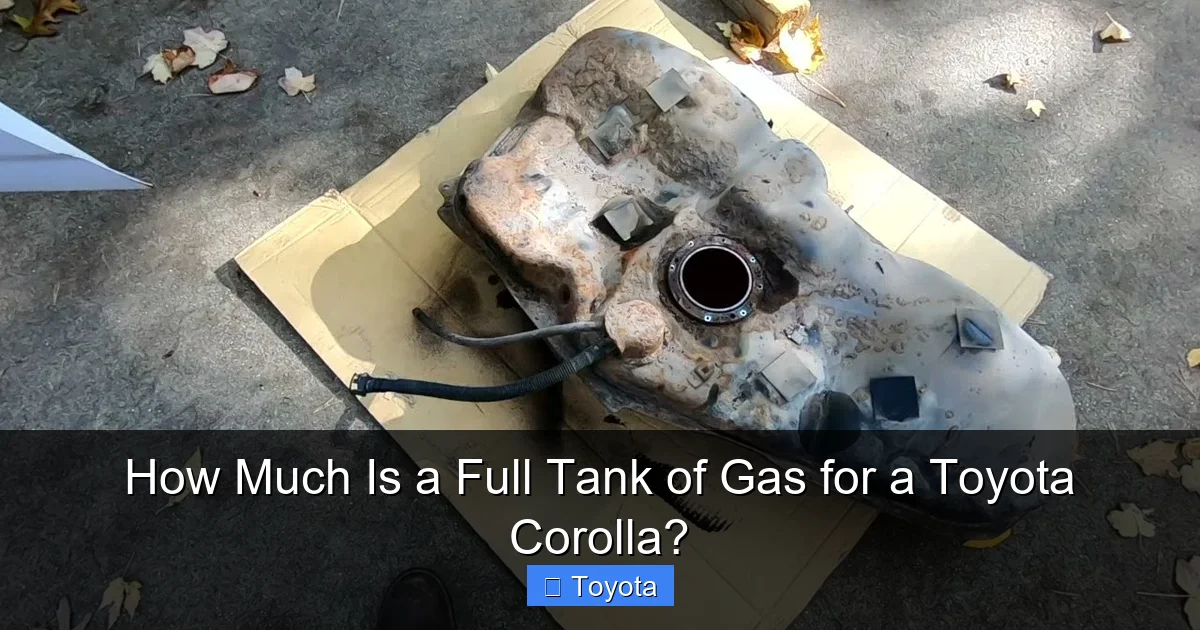
Now for the math. It’s easier than you think. The formula to find the cost of a full tank is beautifully simple:
Visual guide about How Much Is a Full Tank of Gas for a Toyota Corolla?
Image source: i.ytimg.com
Total Cost = Fuel Tank Capacity (in gallons) x Price Per Gallon
Step-by-Step Calculation Example
Let’s walk through a real-world example for a common scenario: a 2022 Toyota Corolla LE with a 13.2-gallon tank.
- Step 1: Identify your tank capacity. We’re using 13.2 gallons.
- Step 2: Find your local gas price. Let’s say you see regular unleady for $3.45 per gallon at your favorite station.
- Step 3: Multiply. 13.2 gallons x $3.45/gallon = $45.54.
So, in this example, a complete fill-up from the “E” would cost you about $45.54. If you have an older 2011 Corolla with a 14.5-gallon tank at the same price, your cost would be 14.5 x $3.45 = $50.03. That’s a $4.49 difference for essentially the same car! Now, imagine if gas prices spike to $4.00/gallon. The 2022 Corolla fill-up jumps to $52.80, while the 2011 model costs $58.00. This exercise shows how both your car’s specs and the market price work together to determine your cost.
Using Online Tools for Accuracy
You don’t have to do the math by hand every time. A quick internet search for “Toyota Corolla fuel cost calculator” will yield several tools. You can input your specific model year and zip code, and these calculators will pull current local gas prices to give you an instant estimate. They’re great for planning monthly fuel budgets or comparing the potential cost of ownership between different vehicles you might be considering.
Factors That Influence Your Fuel Costs
The cost of a *single fill-up* is straightforward math. But your *overall fuel expenditure*—the real number that hits your wallet each month—is influenced by many other factors. Understanding these can help you spend less on gas over time, regardless of the price at the pump.

Visual guide about How Much Is a Full Tank of Gas for a Toyota Corolla?
Image source: i.ytimg.com
Driving Habits and Conditions
How you drive is huge. The EPA’s estimated MPG for your Corolla is achieved under ideal, controlled conditions. Real-world driving is different. City driving with lots of stops and starts will lower your fuel economy significantly compared to steady highway cruising. Speeding is a major fuel thief; aerodynamic drag increases exponentially with speed, so driving 75 mph instead of 65 mph can reduce your MPG by 10-15%. Using roof racks or carrying heavy cargo creates wind resistance and weight, lowering efficiency. Extreme temperatures (both hot and cold) can also reduce MPG as your engine works harder and uses more fuel for climate control. Being mindful of these conditions helps you get closer to that EPA estimate, meaning fewer gallons purchased per mile.
Vehicle Maintenance Matters
A neglected Corolla is a thirsty Corolla. Simple, regular maintenance is one of the best ways to protect your fuel economy. Proper tire inflation is critical. Under-inflated tires increase rolling resistance, forcing your engine to work harder. Check your tire pressure monthly; the recommended PSI is on a sticker inside your driver’s door jamb. A clean air filter ensures your engine gets the right amount of air for optimal combustion. A clogged filter can reduce MPG by 10%. Regular oil changes with the correct viscosity of oil reduce internal engine friction. Using the manufacturer-recommended oil, as detailed in your manual, is key. Skipping these basic services costs you more at the pump in the long run. For specific service intervals and costs, resources like our guide on oil changes for Toyota vehicles can be helpful, as the principles are similar across the brand.
The Resale Value Connection
Here’s an interesting link: your fuel economy history and maintenance records directly impact your Corolla’s resale value. A vehicle with a well-documented service history, including consistent oil changes and tire rotations, is more attractive to future buyers. They associate that care with long-term reliability and expected fuel efficiency. A car that has been poorly maintained may have hidden issues affecting MPG, which a savvy buyer will check for (like scanning for engine codes or reviewing fuel trim data). When it comes time to sell or trade, a well-cared-for Corolla with demonstrably good real-world MPG will fetch a higher price. You can research your specific model’s retained value using tools like our article on how much a 2016 Toyota Corolla is worth, which highlights how condition and history play into valuation.
Comparing the Corolla to Other Vehicles
To put the Corolla’s fuel costs into perspective, it’s useful to compare it to other popular vehicles, both within the Toyota family and in the competitive compact sedan segment.
Corolla vs. Camry: Tank Size and Cost
The Toyota Camry is the Corolla’s larger, midsize sibling. How do they compare on tank size? A modern Camry has a larger fuel tank, typically holding about 15.8 gallons. Let’s do the math. At $3.45/gallon, a full Camry tank costs 15.8 x $3.45 = $54.51. That’s about $9 more than the Corolla’s fill-up. However, the Camry’s larger engine (a standard 2.5L 4-cylinder vs. the Corolla’s 1.8L or 2.0L) generally gets slightly lower combined MPG. So, while you pay more per tank, you also get a different driving experience and potentially a longer range per tank due to the extra capacity. The choice between them often comes down to space needs vs. ultimate fuel frugality. For a deep dive into Camry tank specs, you can read our detailed look at how big the gas tank on a Toyota Camry is.
How the Corolla Stacks Up Against Competitors
How does our calculation compare to a Honda Civic or a Hyundai Elantra? The Honda Civic’s tank is very similar, usually around 12.4 gallons for recent models. At $3.45/gallon, that’s a fill-up cost of about $42.78—slightly less than the Corolla due to the smaller tank, though Civic MPG ratings are very close. A Hyundai Elantra also has a roughly 12.4-gallon tank. The key takeaway? The Toyota Corolla is competitively sized and efficient. Its fill-up cost is right in the middle of the compact sedan pack. Where it often wins is in long-term reliability and resale value, which indirectly affects your “cost per mile driven” over the life of the car.
Practical Tips to Maximize Every Gallon
Knowing the cost is one thing. Keeping that cost as low as possible over time is the goal. Here are actionable tips to maximize the value of every gallon you put in your Corolla.
Smart Refueling Strategies
First, don’t wait for the tank to be completely empty. Running on fumes can strain your fuel pump and potentially suck up sediment from the bottom of the tank. Try to refuel when you’re down to about 1/4 tank. This is also a good habit to avoid getting stranded. Second, fill up during cooler times of day (early morning or late evening). Gasoline is denser when it’s cool, meaning you get slightly more energy (and thus more miles) per gallon pumped. The difference is small, but it’s a free tip. Third, use the correct fuel grade** and **find the cheapest station** using apps, but don’t drive 10 miles out of your way for a few cents—the extra mileage may erase your savings. Finally, a simple but often overlooked tip: when you refuel, make sure your gas cap is tightened properly until it clicks. A loose cap can trigger your “check engine” light and cause fuel to evaporate from the system, wasting money. If you’re ever unsure about the process, a quick guide on how to open the gas tank on a Toyota Corolla can clarify the steps for your specific model year.
Long-Term Savings Through Maintenance
We touched on this, but it bears repeating: stick to your maintenance schedule. The single most effective way to control your fuel costs is to keep your Corolla in peak mechanical condition. This includes:
- Timely Oil Changes: Use the oil viscosity specified by Toyota (often 0W-20 for newer models). Clean oil reduces friction.
- Tire Care: Check pressure monthly and rotate tires every 5,000-7,000 miles. Properly inflated and balanced tires are crucial for efficiency.
- Air Filter Replacement: Check it at every oil change; replace it as needed, typically every 15,000-30,000 miles.
- Spark Plugs: Worn spark plugs can misfire, wasting fuel. Replace them according to your manual’s schedule (often 60,000+ miles on modern iridium plugs).
- Address Check Engine Lights Immediately: A faulty oxygen sensor or evaporative emissions (EVAP) system component can drastically hurt MPG. Get diagnostics done promptly.
Investing a little in scheduled maintenance saves you a lot at the pump over the life of your car. It also preserves the value we discussed earlier, making your Corolla a smarter financial asset.
Conclusion
So, how much is a full tank of gas for a Toyota Corolla? The precise number is a simple calculation: take your tank’s capacity (almost certainly 13.2 gallons for 2014+ models) and multiply it by the price per gallon at your local pump. Today, that’s likely somewhere between $40 and $55 for a complete fill-up, depending entirely on where you live and the current market price.
But the real story isn’t just that one-time cost. The true cost of fuel for your Corolla is shaped by how you drive, how well you maintain your car, and how diligently you search for the best local prices. The Corolla’s legendary fuel efficiency is your greatest ally in keeping these costs low. By understanding your tank size, staying on top of maintenance, and driving mindfully, you ensure that every gallon you purchase takes you as far as possible. This turns the simple act of filling up from a budget worry into a predictable, manageable expense, allowing you to enjoy the reliable, economical driving experience that makes the Toyota Corolla a perennial favorite.
Frequently Asked Questions
Does the model year affect a Toyota Corolla’s gas tank size?
Yes, slightly. Most Corollas from 2014 to the present have a 13.2-gallon tank. Models from 2010-2013 typically have a 14.5-gallon tank. Always verify your specific vehicle’s capacity in the owner’s manual or on the fuel filler door sticker.
How often should I fill up my Toyota Corolla’s tank?
It’s best to refuel when your fuel gauge reaches about 1/4 tank. This prevents running the fuel pump dry (which can cause damage) and gives you a buffer. With a 13.2-gallon tank and excellent MPG (around 30-40), you can often go 350-500 miles between fill-ups under normal driving conditions.
How does my driving style change the cost per mile?
Significantly. Aggressive driving (rapid acceleration, hard braking, speeding) can lower your fuel economy by 15-30% in city driving. This means you’ll burn through your tank faster, requiring more frequent fill-ups and increasing your total fuel cost per mile. Smooth, steady driving maximizes your miles per gallon.
Is it cheaper to fill up at a supermarket or a brand-name station?
Not necessarily. Prices are set by the local market and franchise owners. Supermarket or warehouse club stations (like those attached to Costco or Walmart) often have lower prices due to volume sales, but this isn’t a rule. Always use a gas price comparison app to find the best price near you, regardless of the brand.
Can using a higher octane fuel improve my Corolla’s MPG?
No. Your Toyota Corolla is designed for regular 87-octane fuel. Using a higher octane (like 89 or 91) provides no benefit in power or fuel economy for this engine. It simply costs more. The only exception is if your owner’s manual specifically calls for premium fuel, which is rare for standard Corolla models.
How much does it cost to fill a Toyota Corolla in California versus Texas?
There can be a dramatic difference. As of recent averages, California gas prices are often $1.00 to $1.50 per gallon higher than Texas. Filling a 13.2-gallon Corolla tank in California at $5.20/gallon would cost about $68.64. The same fill-up in Texas at $3.40/gallon would cost about $44.88—a difference of over $23 per tank. This highlights the importance of checking your local prices.