
How Much Is a 2003 Ford F150 Worth

The 2003 Ford F150’s worth ranges from $2,000 to $10,000 based primarily on condition, mileage, trim level, and geographic location. Condition is the single most critical factor, with a well-maintained, rust-free truck commanding a significant premium over a neglected one. Market demand for reliable used trucks also keeps values steadier than many sedans from the same era. Always consult multiple valuation sources and recent local sales for an accurate price.
Key Takeaways
- Condition is King: A 2003 F150 in excellent, rust-free condition with a clean interior can be worth double or triple a similar truck with major issues or corrosion.
- Mileage Matters, But Isn’t Everything: While lower mileage is preferred, a high-mileage truck with impeccable maintenance records can be more valuable than a neglected low-mileage example.
- Trim Level Drives Price: The luxurious Lariat or King Ranch trims hold value much better than the base XL or STX models due to premium features and comfort.
- Engine Choice Impacts Desirability: The 5.4L V8 (especially the 2-valve) is the most common and sought-after for its balance of power and reliability, while the 4.6L V8 is less desirable for heavy-duty work.
- Location & Season Dictate Demand: Values are consistently higher in rural areas and the South/Southwest where rust is minimal, and they spike in winter months in northern climates.
- Modifications Can Hurt Value: Aftermarket lifts, large tires, and engine tunes often decrease value for the average buyer, though they may appeal to a niche enthusiast market.
- History is Crucial: A truck with a clean title, no accident history, and complete service records will always fetch a higher price than one with an unknown or problematic past.
📑 Table of Contents
- Understanding the 2003 Ford F150: A Legacy of Toughness
- The Core Factors That Determine a 2003 F150’s Value
- Current Market Pricing: What You Can Actually Expect to Pay (or Get)
- Buying a 2003 F150: A Practical Guide to a Smart Purchase
- Selling Your 2003 F150: How to Maximize Your Return
- Conclusion: The Enduring Worth of a Workhorse
Understanding the 2003 Ford F150: A Legacy of Toughness
Let’s talk about the 2003 Ford F150. This isn’t just any old truck; it’s part of the legendary 10th generation that Defined a decade of pickup trucks. Produced from 1997 to 2004, this generation was a massive leap forward from its predecessor, offering a more car-like ride, improved aerodynamics, and a cab that was genuinely comfortable for a family. The 2003 model year sits right in the sweet spot of this generation, benefiting from years of refinement while still being old enough to be incredibly affordable on the used market.
For many, the 2003 F150 represents the last of the “simple” trucks before the wave of complex emissions systems and advanced electronics became standard. It’s a workhorse. You’ll find these trucks everywhere: as trusted work vehicles on job sites, as family haulers with a bed, and as the first truck for a teenager learning to drive. This ubiquity is a double-edged sword for value. On one hand, parts are plentiful and cheap. On the other, the sheer number of them means you’re not dealing with a rare collector’s item—value is dictated by pure utility and condition.
Under the hood, you had two main engine choices. The workhorse was the 5.4L Triton V8, producing 260 horsepower and 365 lb-ft of torque. This was the engine most buyers wanted, and it’s the one that most people seek today. The other option was the 4.6L Triton V8, with 231 horsepower and 294 lb-ft of torque. While capable, the 4.6L is noticeably underpowered when the bed is loaded or when trying to merge onto a highway. For towing or hauling, the 5.4L is the clear choice and directly influences a truck’s 2003 Ford F150 worth.
Transmissions were mostly the reliable 4-speed automatic (4R70W or 4R75W), though a 5-speed manual was available in some regular cab, 4×2 models. Drivetrain options included rear-wheel drive and part-time four-wheel drive. The 2003 model also saw the introduction of the “SuperCrew” cab (4 full doors) on certain trims, a revolutionary layout at the time that added immense practicality for families.
Trim Levels and Their Value Tiers
Understanding the trim hierarchy is non-negotiable for pricing. From basic to luxurious, the 2003 trims were:
- XL: The work truck. Vinyl seats, manual everything, basic AM/FM radio. The most plentiful and lowest valued.
- STX: A sportier appearance package for the XL, with color-matched bumpers and alloy wheels. Slight premium over XL.
- XLS: Added more comfort features like cloth seats and an upgraded audio system. A popular mid-range choice.
- XLT: The quintessential “average” F150. Cloth seats, power windows/locks, keyless entry, and more. This is the volume seller and a key benchmark for pricing.
- Lariat: The luxury king for 2003. Leather seats, dual power seats, automatic climate control, and often a premium sound system. Holds value exceptionally well.
- King Ranch: The top trim, distinguished by its unique leather (with King Ranch logo), wood-grain interior trim, and exclusive badging. The most valuable stock model.
When you see a 2003 F150 listed, the first thing you check is the tailgate badge. A King Ranch in good shape is a completely different ballgame in terms of how much a 2003 Ford F150 is worth compared to a base XL.
The Core Factors That Determine a 2003 F150’s Value
So, you’ve found a 2003 F150. Why does one with 150,000 miles cost $4,000 and another with 180,000 miles cost $7,000? It all comes down to a handful of critical factors that we can break down. Think of these as the value pillars.
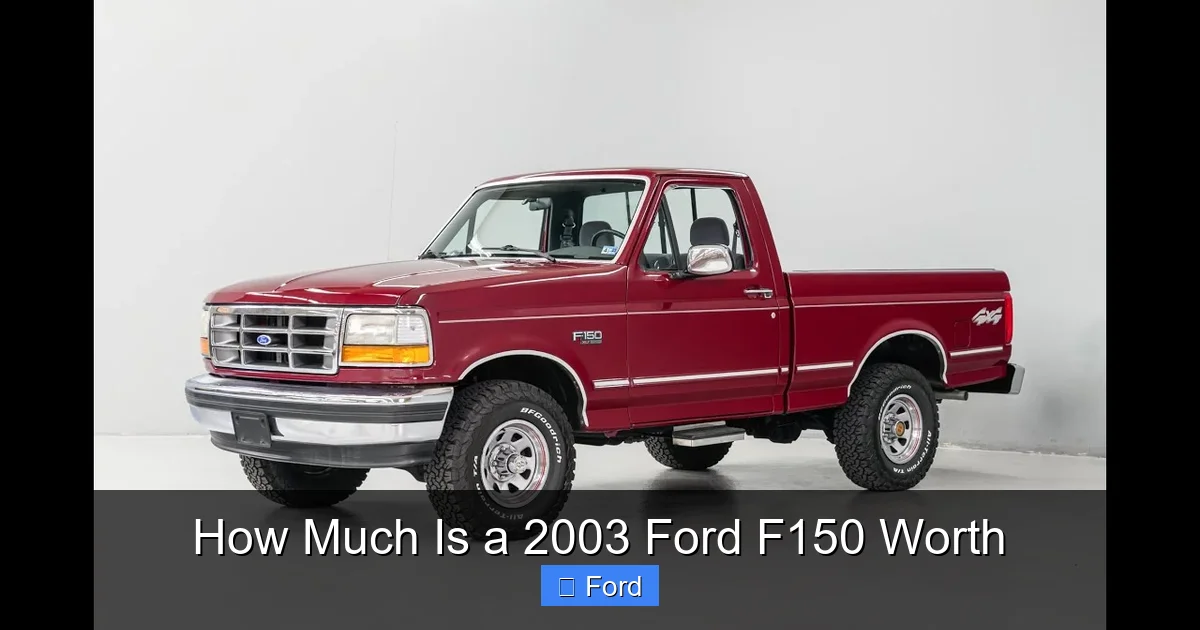
Visual guide about How Much Is a 2003 Ford F150 Worth
Image source: carglassadvisor.com
1. Mechanical & Cosmetic Condition (The #1 Factor)
This cannot be overstated. A 2003 F150 is a 21-year-old vehicle. Its value is a direct reflection of how well it has been loved (or neglected). We must split condition into two parts:
Mechanical Condition: Does the engine run smoothly? Is the transmission shifting correctly? Are there any ominous noises, leaks, or warning lights? A truck that needs a new transmission or has a knocking engine is essentially a parts donor and has very little value beyond scrap. Conversely, a truck with a freshly serviced drivetrain, new spark plugs (a known maintenance item for the 5.4L), and a clean title is worth a fortune in this segment. Always, always get a pre-purchase inspection from a trusted mechanic. The $150 you spend can save you from buying a $3,000 problem.
Cosmetic & Rust Condition: This is where Northern and Southern trucks differ dramatically. Rust is the arch-nemesis of vehicle value. Check the frame, cab corners, rocker panels, and rear wheel wells. Surface rust is one thing; structural rot through the frame is a deal-breaker that can render a truck unsafe and nearly worthless. Also, assess the interior. Is the headliner sagging? Are the seats torn? Is the carpet stained and mildewy? A clean, odor-free, undamaged interior adds hundreds, if not thousands, to the value.
2. Mileage: The Odometer’s Story
Mileage is a proxy for wear. The average American puts about 12,000-15,000 miles on a car per year. For a 2003 model, that means a “typical” mileage would be around 210,000 – 255,000 miles. So, a 2003 F150 with 150,000 miles is actually low mileage for its age and is a major selling point. One with 300,000 miles is high mileage, but not automatically a junker if it has a verifiable history of rigorous maintenance (oil changes, transmission services, etc.).
The market perceives mileages in bands:
- Under 150k: Considered low. Commands a premium.
- 150k – 200k: Average/Acceptable. The sweet spot for value where price meets reliability.
- 200k – 250k: High mileage. Price drops significantly unless exceptional maintenance is proven.
- 250k+: Very high mileage. Value is minimal unless it’s a pristine, rust-free, one-owner truck with full records.
3. Trim Level, Options, and Powertrain
We touched on trims, but options matter too. Does it have the 5.4L V8? That’s a must-have for most buyers. Does it have four-wheel drive? That adds $1,000-$2,000 in value almost everywhere, especially in snowy regions. Other desirable options that boost value include:
- Sliding rear window
- Trailer tow package (includes hitch, wiring, and upgraded cooling)
- Extended range fuel tank
- Premium stereo (especially the Alpine or Mach systems)
- Alloy wheels (vs. steel)
- Bedliner (factory or high-quality spray-in)
A fully loaded Lariat 4×4 with the 5.4L, tow package, and a clean history is the holy grail for used truck shoppers and will hold the strongest 2003 Ford F150 worth.
4. Geographic Location and Seasonality
Where you live (and sell) matters immensely. Rust is the ultimate value killer. A truck from Arizona, Texas, or Florida—states with minimal road salt use—will be worth $1,500-$3,000 more than an identical truck from Michigan, New York, or the Northeast where salt eats through frames and body panels. Always inspect for rust in the wheel wells and along the frame rails.
Seasonality is a real phenomenon. In the spring and summer, prices can be softer. As soon as fall arrives and people start thinking about snow removal, towing boats, or holiday hauling, demand—and prices—for used trucks spike. You’ll often see a 10-15% price increase from October through February in colder climates. If you’re buying, shop in the summer. If you’re selling, list in the early fall.
Current Market Pricing: What You Can Actually Expect to Pay (or Get)
Enough theory. Let’s talk real numbers. These are national average estimates for a private party sale in average condition for its mileage/age. Local markets will vary.
Visual guide about How Much Is a 2003 Ford F150 Worth
Image source: m.media-amazon.com
- Running, But High-Mileage/Needs Work (200k+ miles, cosmetic issues, some rust): $1,500 – $3,500. These are project trucks or beater work trucks.
- Fair Condition (150k-200k miles, running well, average interior, some surface rust): $3,000 – $5,500. The most common transaction range.
- Good Condition (120k-180k miles, clean interior, minimal rust, all major systems functional): $5,000 – $7,500. The target for a reliable daily driver.
- Excellent Condition (Under 120k miles, immaculate interior/exterior, no rust, full service history, desirable trim): $7,500 – $10,000+. These are the cream of the crop.
Remember, a 2003 F150 with the 4.6L V8 in an XL trim will be at the very bottom of these ranges. A 2003 F150 King Ranch 4×4 with the 5.4L, under 100k miles, and a clean history in a non-rust state could easily break $10,000.
How to Get an Accurate Value for YOUR Specific Truck
National averages are just a starting point. You need to drill down.
Use the Big Three Valuation Tools: Start with Kelley Blue Book (KBB), the National Automobile Dealers Association (NADA) Guides, and Edmunds. Input your truck’s exact details: year, make, model, trim, engine, 2WD/4WD, mileage, and—most importantly—condition. Be brutally honest with yourself. Is it “Good” or just “Fair”? These tools give you a solid price range.
Scour Local Listings: This is the most important step. Go to Facebook Marketplace, Craigslist, and Autotrader. Search for “2003 Ford F150” within a 200-mile radius of you. Don’t just look at the asking price; see what similar trucks actually sell for. Listings that are priced too high sit forever. Find the ones that have been posted for less than a week or have “Sold” stickers. That’s your real market value. Pay special attention to trucks in your specific state to account for rust differences.
Check Auction Results: Websites like Manheim (for dealers) or even watching eBay Motors completed listings can show you what people are truly paying. You’ll often see lower prices at auction, but those are typically dealer-to-dealer prices or cars with issues.
Buying a 2003 F150: A Practical Guide to a Smart Purchase
Buying a 20-year-old truck is about managing risk. You’re not buying a new car; you’re buying a collection of wear items. Here’s your battle plan.
Visual guide about How Much Is a 2003 Ford F150 Worth
Image source: m.media-amazon.com
The Non-Negotiable Pre-Purchase Inspection (PPI)
Do not skip this. Ever. For $100-$200, a mechanic will put the truck on a lift and check everything: engine compression, transmission health, suspension components, brakes, and most importantly, the frame for rust and damage. The PPI report is your negotiating weapon and your peace of mind. If a seller refuses a PPI, walk away. That’s a giant red flag.
Critical Inspection Points You Can Do Yourself
Before you even pay for a PPI, do this walk-around:
- The Fluid Check: Open the hood. Check oil (should be clean, not muddy or frothy), coolant (should be green/orange, not rusty or oily), transmission fluid (red and sweet-smelling, not burnt or brown), and power steering fluid. Low or dirty fluids are signs of neglect.
- The Test Drive: Drive it on different road surfaces. Does it pull to one side? Do the brakes pulsate? Does the transmission shift harshly, especially from 2nd to 3rd gear (a common failure point on the 4R70W)? Listen for whining differentials or ticking engines (the 5.4L has a known “tick” but it should be consistent, not a knock).
- The Rust Hunt: Get on your hands and knees. Use a magnet to check for bondo (it won’t stick). Probe the frame behind the front tires and along the rear axle with a screwdriver. If it goes through easily, run. Check the inside of the cab at the floor seams and the spare tire well.
- The Interior & Electronics: Test every switch: windows, locks, mirrors, HVAC, stereo. Do the power seats work? Is the air conditioning cold? A non-working A/C can be a $1,000+ fix.
- Under the Bed: Look at the bed for damage, rust, and the condition of the bedliner. Check the spare tire and jack.
Common 2003 F150 Problem Areas to Ask About
Be a knowledgeable buyer. Ask the seller directly:
- “Has the spark plugs and coil packs been replaced?” The 5.4L has aluminum heads that can strip if not removed properly. This is a $1,000+ job if done wrong.
- “Has the transmission ever been serviced?” A transmission fluid and filter change every 50k miles is ideal. No records? Cautious.
- “Any history of the camshaft bore wear issue?” Some early 5.4L engines had a defect causing camshaft bore wear. A mechanic can check for this during a PPI.
- “Is the rear axle the 8.8″ or the 9.75″?” The 9.75″ is stronger for towing. It’s a good question to gauge the seller’s knowledge.
Knowing these specifics shows you’re serious and helps you gauge the truck’s history.
Selling Your 2003 F150: How to Maximize Your Return
Got a 2003 F150 to sell? You’re in luck because demand for affordable, reliable trucks is high. Follow this process to get top dollar.
Step 1: Prep for Success
First impressions are everything. Spend $50 on a professional-grade wash and wax. Clean the interior thoroughly—vacuum every nook, clean all surfaces, remove any odors (baking soda helps). Fix the little things: replace a cracked windshield if needed (check local laws), fix any burnt-out bulbs, top off all fluids. If you have receipts for recent work (tires, brakes, service), gather them. A clean, well-presented truck signals a caring owner and can add $500-$1,000 to the sale price.
Step 2: Price It Right from Day One
Overpricing is the #1 reason trucks sit unsold. Use the research method from the previous section. Find 3-5 trucks nearly identical to yours (same trim, engine, 4×2/4×4, similar mileage) in your region that have sold recently (within 30 days). Price yours 5-10% below the highest of those sold prices to generate immediate interest. You can always accept offers, but a competitive list price gets the phone ringing.
Step 3: Create an Irresistible Listing
Take photos in good, bright daylight. Get shots of: front, rear, both sides, the bed, the interior (dash, seats, bed), the engine bay, and the VIN plate. Be honest in the description. List all the good: “5.4L V8, 4×4, 165k miles, new tires, clean title, no rust.” Then, be transparent about the bad: “Minor scratch on driver’s fender, original spark plugs.” Honesty builds trust and filters out tire-kickers.
Step 4: The Sale and Paperwork
Meet in a safe, public place like a shopping center parking lot during the day. Have all your paperwork ready: title (signed over), bill of sale, and any maintenance records. In most states, you are responsible for providing a valid title and sometimes a basic smog certificate. Check your local DMV website. For a private sale, cash is king, but a cashier’s check from a local bank is also secure. Never accept a personal check. Once payment clears, sign the title over, give them the bill of sale, and remove your license plates.
Conclusion: The Enduring Worth of a Workhorse
The 2003 Ford F150 worth is a story of practicality meeting nostalgia. It’s not a classic that will appreciate in a vault. Its value is rooted in its fundamental capability: it can haul, it can tow, it can be a daily driver, and it can be fixed with simple tools and affordable parts. It represents an era of trucks that were tools first and luxury second.
For a buyer, a well-sourced 2003 F150 can be one of the smartest automotive purchases you can make. For a few thousand dollars, you get a massive, safe, and versatile vehicle. For a seller, a clean, reliable example will always find a buyer who needs a no-nonsense truck. The key, as with any used vehicle, is knowledge. Arm yourself with an understanding of condition, trim levels, and your local market. Get a pre-purchase inspection if buying, and prep and price honestly if selling. Do that, and you’ll navigate the market for this iconic American truck with confidence, ensuring you get fair value whether you’re buying or selling.
Frequently Asked Questions
What is the average price for a 2003 Ford F150 in 2024?
The national average private party price ranges from about $3,500 for a high-mileage, fair-condition truck to $8,000 for a good-condition, lower-mileage, 4×4 model. Exceptional, low-mileage Lariat or King Ranch models can reach $10,000 or more. Your specific price depends heavily on the factors outlined above.
How does the 4×4 option affect the value of a 2003 F150?
Four-wheel drive adds significant value, typically $1,000 to $2,500 over a similar 2WD model. This premium is consistent across most of the country but is even higher in regions with harsh winters and snowy conditions where 4×4 is a practical necessity.
Which engine is best and most valuable in a 2003 F150?
The 5.4L Triton V8 is the most desirable and valuable engine option. It provides significantly more power and torque than the 4.6L, making it better for towing and hauling. The 4.6L is adequate for light duty but is less sought after and lowers the truck’s overall worth.
What are the most common problems to look out for?
The biggest concerns are rust (especially on frames from northern states), transmission issues (harsh shifting, slipping), and spark plug/coil pack failures on the 5.4L V8. Also, listen for camshaft noise and check for oil consumption. A thorough pre-purchase inspection is essential to identify these.
How can I increase the resale value of my 2003 F150?
Focus on the basics: address any rust proactively, ensure all maintenance is up-to-date (especially transmission fluid and spark plugs), fix any mechanical issues, deep clean the interior and bed, and replace worn-out tires. Having a complete folder of service records is the single best way to build buyer confidence and command a higher price.
Is it better to buy from a dealer or a private seller?
Private sellers typically offer lower prices, as they have no overhead. You can often find a better deal and get more honest history from an owner. Dealers may charge more but often provide a limited warranty or return policy and handle all the paperwork. For a $3,000-$6,000 truck, a private sale with a PPI is usually the most cost-effective route. When comparing, you might look at how much a 2007 Ford F150 is worth to see if a slightly newer model fits your budget, as the value difference might be smaller than you think.
