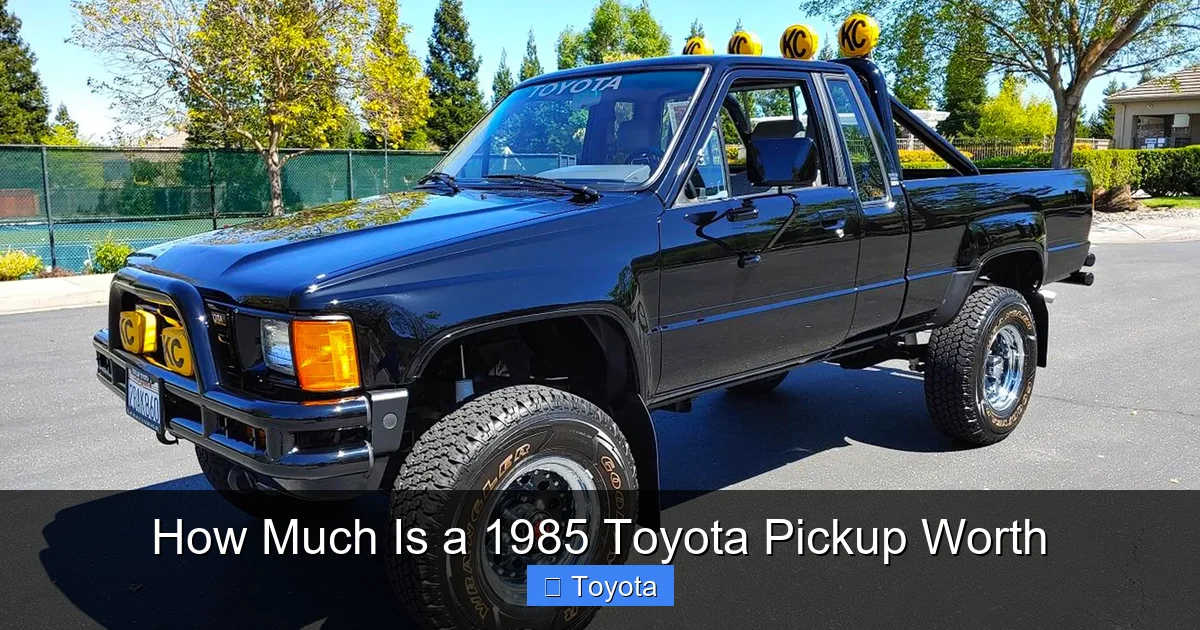
How Much Is a 1985 Toyota Pickup Worth

Contents
- 1 Key Takeaways
- 2 📑 Table of Contents
- 3 Understanding the 1985 Toyota Pickup: A Brief Overview
- 4 Factors That Determine the Value of a 1985 Toyota Pickup
- 5 Current Market Prices for a 1985 Toyota Pickup
- 6 How to Determine the Value of Your 1985 Toyota Pickup
- 7 Tips for Buying or Selling a 1985 Toyota Pickup
- 8 Conclusion: A Classic That Keeps Its Value
- 9 Frequently Asked Questions

Car Glass Cleaner

Car USB Charger

Windshield Washer Fluid

Brake Cleaner Spray
The value of a 1985 Toyota Pickup ranges from $3,000 to over $15,000, depending on condition, mileage, and originality. Well-maintained, low-mileage models with factory specs command top dollar, especially among collectors and off-road enthusiasts.
If you’ve ever stumbled across a dusty 1985 Toyota Pickup parked in a garage or sitting on cinder blocks in a backyard, you might have wondered: “How much is this old truck actually worth?” You’re not alone. These rugged, no-nonsense pickups from the mid-80s have become icons of reliability, simplicity, and timeless design. Whether you’re a collector, a restorer, or just someone who appreciates a vehicle that refuses to quit, the 1985 Toyota Pickup holds a special place in automotive history.
But here’s the thing—value isn’t just about age. It’s about condition, originality, demand, and a little bit of nostalgia. Unlike flashy sports cars or luxury sedans, the 1985 Toyota Pickup earns its worth through durability and charm. It’s the kind of truck that people buy not just to drive, but to preserve. And as more people rediscover the appeal of analog vehicles in a digital world, these trucks are becoming harder to find in good shape—and that’s driving prices up.
So, how much is a 1985 Toyota Pickup worth today? The short answer: it depends. But the long answer? That’s what this guide is for. We’ll break down everything you need to know—from average market prices to what makes one truck worth more than another. Whether you’re looking to buy, sell, or just satisfy your curiosity, you’ll walk away with a clear understanding of what these classic Toyotas are really worth.
Key Takeaways
- Condition is king: A rust-free, mechanically sound 1985 Toyota Pickup in excellent shape can fetch $12,000–$18,000, while project trucks may only be worth $2,000–$4,000.
- Mileage matters—but not always: Lower mileage generally increases value, but a well-documented, high-mileage truck with full service history can still be highly desirable.
- Originality boosts value: Unmodified trucks with original paint, interior, and engine are more valuable than heavily customized versions, especially to purists.
- 4WD models command premiums: Four-wheel-drive versions, especially the SR5 trim, are more sought after and typically sell for 20–30% more than 2WD counterparts.
- Market demand is rising: Classic Toyota trucks are gaining popularity, with prices increasing steadily over the past decade due to nostalgia and reliability reputation.
- Location impacts price: Trucks in dry climates (like Arizona or California) with minimal rust sell for significantly more than those from snowy, salt-heavy regions.
- Documentation adds value: Original manuals, service records, and ownership history can increase a truck’s worth by 10–15%.
📑 Table of Contents
- Understanding the 1985 Toyota Pickup: A Brief Overview
- Factors That Determine the Value of a 1985 Toyota Pickup
- Current Market Prices for a 1985 Toyota Pickup
- How to Determine the Value of Your 1985 Toyota Pickup
- Tips for Buying or Selling a 1985 Toyota Pickup
- Conclusion: A Classic That Keeps Its Value
Understanding the 1985 Toyota Pickup: A Brief Overview
Before we dive into pricing, let’s get familiar with the truck itself. The 1985 Toyota Pickup was part of the second generation of Toyota’s compact pickup line, known internally as the HJ40 series. It was available in several configurations, including two-wheel drive (2WD) and four-wheel drive (4WD), with options for short or long beds, regular or extended cabs, and different trim levels like the base model, DLX, and the more upscale SR5.
Under the hood, most 1985 models came equipped with the legendary 2.4L 22R inline-four engine—a carbureted workhorse known for its bulletproof reliability and ease of maintenance. Some later models in the year began transitioning to fuel injection, but the 22R remained the dominant powerplant. Transmission options included a 5-speed manual or a 4-speed automatic, with the manual being far more common and preferred by enthusiasts.
What made the 1985 Toyota Pickup stand out wasn’t speed or luxury—it was simplicity. These trucks were built to last. No fancy electronics, no complex computer systems, just straightforward mechanics that even a weekend mechanic could work on. That’s one reason they’ve survived so well into the 21st century. Many are still on the road today, some with well over 300,000 miles.
Why the 1985 Model Year Matters
You might be wondering—why focus on 1985 specifically? After all, Toyota made pickups for years before and after. But 1985 sits at a sweet spot in the timeline. It’s late enough to have benefited from Toyota’s refinements in suspension, comfort, and build quality, but early enough to retain the analog, no-frills charm that collectors love.
This was also a transitional year. Toyota was beginning to modernize its lineup, introducing features like improved interiors, better sound insulation, and optional air conditioning. Yet, the 1985 model still lacked the electronic complexity of later years, making it easier and cheaper to maintain. For many buyers, that’s a huge selling point.
Additionally, 1985 models often came with the desirable 22R engine in its most refined carbureted form. The fuel-injected 22RE didn’t become widespread until 1986, so 1985 trucks are often seen as the last of the “pure” carbureted classics. That distinction matters to purists and restorers who prefer simplicity over modern tech.
Factors That Determine the Value of a 1985 Toyota Pickup

Visual guide about How Much Is a 1985 Toyota Pickup Worth
Image source: static.cargurus.com
Now that we know what makes the 1985 Toyota Pickup special, let’s talk about what determines its value. It’s not just about how old it is—it’s about how well it’s been cared for, how original it is, and how much people want it. Here are the key factors that influence pricing.
1. Condition: The Single Biggest Factor
Let’s be honest—condition is everything. A 1985 Toyota Pickup in pristine, showroom-like condition will always be worth more than one that’s rusty, dented, or mechanically questionable. But what does “condition” really mean?
It breaks down into three main areas: exterior, interior, and mechanical.
The exterior includes the body, paint, trim, and frame. Rust is the enemy here. Surface rust can be manageable, but frame rust—especially in the wheel wells, cab corners, or rocker panels—can drastically reduce value. A truck with a solid, rust-free frame is worth significantly more than one that’s been patched or welded.
Paint condition also matters. Original paint in good shape is a big plus. Repaints can be okay if done professionally, but they often raise questions about why the truck needed one—was it to cover rust? Was it in an accident? Buyers prefer originality when possible.
The interior includes the seats, dashboard, carpet, and electronics. A truck with intact upholstery, a crack-free dash, and working gauges is far more desirable. Missing or broken parts—like a cracked steering wheel or non-functional heater—can lower value, especially if replacements are hard to find.
Mechanically, the engine, transmission, suspension, and drivetrain need to be in good working order. A truck that starts easily, shifts smoothly, and drives straight is worth more than one that needs a rebuild. Even if it’s not perfect, a well-documented service history can reassure buyers.
2. Mileage: Lower Is Better—But Not Always
Mileage plays a role, but it’s not the final word. A 1985 Toyota Pickup with 80,000 miles is generally more valuable than one with 200,000 miles. But here’s the twist: these trucks are known for lasting forever. A high-mileage truck that’s been well-maintained can still be a great buy.
For example, a 250,000-mile truck with full service records, a recent engine rebuild, and no major issues might be worth more than a 100,000-mile truck with unknown history and signs of neglect. Enthusiasts often say, “It’s not the miles—it’s the maintenance.”
That said, ultra-low mileage (under 50,000 miles) can command a premium, especially if the truck has been garage-kept and driven sparingly. These are often called “survivor” trucks and are highly sought after by collectors.
3. Originality vs. Modifications
This is a big one. Some people love modified trucks—lifted suspensions, big tires, custom paint jobs. But when it comes to value, originality usually wins.
An unmodified 1985 Toyota Pickup with factory paint, original interior, and stock engine is typically worth more than a heavily customized version. Why? Because it’s rarer. Most trucks of this era have been modified over the years—lifted, re-geared, or engine-swapped. Finding one that’s still “as Toyota built it” is special.
That doesn’t mean modifications have no value. A tastefully done lift with quality parts, or a period-correct engine swap (like a 20R or 22R turbo), can add appeal to the right buyer. But for the average collector or restorer, stock is king.
4. 4WD vs. 2WD: The Premium for Capability
Four-wheel-drive models are almost always worth more than two-wheel-drive versions. In 1985, the 4WD system was a part-time setup with a manual transfer case—simple, reliable, and effective.
4WD trucks are more versatile. They can go off-road, handle snow, and tackle rough terrain. That makes them more desirable to outdoor enthusiasts, overlanders, and farmers. As a result, 4WD models typically sell for 20–30% more than comparable 2WD trucks.
The SR5 trim, which often came with 4WD, upgraded suspension, and nicer interior features, is especially valuable. An SR5 in good condition can easily top $15,000, while a base 2WD model might struggle to reach $8,000.
5. Location and Climate: Rust Is the Enemy
Where a truck has lived makes a huge difference. Trucks from dry, warm climates like Arizona, Nevada, or Southern California tend to have far less rust than those from snowy, salt-heavy regions like the Northeast or Midwest.
Salt used on roads in winter accelerates corrosion, especially on the frame and undercarriage. A truck from Minnesota with frame rust might be worth half as much as an identical model from Arizona with a clean frame.
This is why you’ll often see ads for “rust-free” trucks from the Southwest commanding premium prices. Buyers are willing to pay more for a truck that hasn’t been eaten away by salt.
6. Documentation and History
A truck with a detailed history is worth more. Original owner’s manuals, service records, repair receipts, and even photos of the truck over the years add credibility and value.
Documentation proves the truck hasn’t been abused or neglected. It shows that the owner cared for it. For collectors, this is gold. A well-documented truck can sell for 10–15% more than one with no history.
Even something as simple as a clean title with no salvage or flood damage history can make a big difference. Buyers want peace of mind.
Current Market Prices for a 1985 Toyota Pickup

Visual guide about How Much Is a 1985 Toyota Pickup Worth
Image source: media.carsandbids.com
So, what are people actually paying for these trucks today? Let’s look at real-world pricing based on recent sales, listings, and market trends.
Average Price Ranges by Condition
Here’s a general breakdown of what you can expect to pay (or get) for a 1985 Toyota Pickup, based on condition:
– Project Truck (Needs Work): $2,000–$4,000
These are trucks that don’t run, have major rust, missing parts, or need significant mechanical work. They’re for restorers or DIYers with time and skills.
– Fair Condition (Runs, But Needs TLC): $4,000–$7,000
These trucks start and drive but may have cosmetic issues, minor rust, or mechanical quirks. They’re good for daily drivers or light restoration projects.
– Good Condition (Solid, Reliable, Some Wear): $7,000–$12,000
These are well-maintained trucks that are roadworthy and presentable. They may have some wear but no major issues. Great for daily use or weekend adventures.
– Excellent Condition (Near Showroom, Low Mileage): $12,000–$18,000+
These are the cream of the crop. Low mileage, minimal wear, original or professionally restored, with documentation. Highly sought after by collectors.
– Concours/Show Quality (Restored or Survivor): $18,000–$25,000+
These are museum-quality trucks, often fully restored to factory specs or preserved in original condition. Rare and valuable.
Real-World Examples
Let’s look at a few real examples to put these numbers in context.
In 2023, a 1985 Toyota Pickup SR5 4WD with 98,000 miles, original paint, and full service records sold at auction for $16,500. The truck had no rust, a clean interior, and a recently rebuilt carburetor. It was from California, which helped.
Another example: a 2WD base model with 180,000 miles, surface rust on the bed, and a cracked dash sold privately for $5,200. It ran well but needed cosmetic work.
On the higher end, a fully restored 1985 Toyota Pickup with a period-correct lift, new paint, and a rebuilt 22R engine sold for $22,000 at a classic truck show. While modified, the work was high-quality and documented.
These examples show how much condition, originality, and presentation matter.
Market Trends: Prices Are Rising
Over the past decade, prices for classic Toyota trucks have been steadily climbing. In 2013, a good-condition 1985 model might have sold for $6,000. Today, that same truck could fetch $12,000 or more.
Why? Several reasons:
– Nostalgia: People who drove these trucks in the 80s and 90s are now in their 40s and 50s—prime earning years—and want to relive their youth.
– Reliability Reputation: Toyota’s reputation for building trucks that last has only grown over time.
– Off-Road Popularity: The overlanding and off-road community loves these trucks for their simplicity and capability.
– Limited Supply: As older trucks rust away or get scrapped, good examples are becoming rarer.
This trend is likely to continue. As long as there’s demand and limited supply, prices will rise.
How to Determine the Value of Your 1985 Toyota Pickup

Visual guide about How Much Is a 1985 Toyota Pickup Worth
Image source: cdn1.mecum.com
If you own a 1985 Toyota Pickup and want to know how much it’s worth, here’s a step-by-step guide to help you assess its value.
Step 1: Inspect the Truck Thoroughly
Start with a detailed inspection. Look for:
– Rust (especially frame, cab corners, wheel wells)
– Paint condition (original vs. repaint)
– Interior wear (seats, dash, carpet)
– Mechanical condition (engine, transmission, suspension)
– Tire condition and tread depth
Take photos of any damage or issues. Be honest with yourself—overestimating condition will hurt you when it’s time to sell.
Step 2: Check the VIN and Documentation
Look up the Vehicle Identification Number (VIN) to confirm the year, model, and engine type. You can use free online VIN decoders or Toyota-specific tools.
Gather all documentation: manuals, service records, repair receipts, title history. The more you have, the better.
Step 3: Research Comparable Sales
Search online marketplaces like Bring a Trailer, eBay Motors, Facebook Marketplace, and Craigslist for similar trucks. Filter by year, model, mileage, and condition.
Look at both asking prices and final sale prices. Asking prices are often inflated; sale prices reflect real market value.
Step 4: Use Valuation Tools (With Caution)
Websites like Kelley Blue Book (KBB) and NADA Guides offer classic car valuations, but they’re not always accurate for trucks this old. They tend to undervalue rare or well-preserved models.
Use them as a starting point, but don’t rely on them entirely. Real-world sales data is more reliable.
Step 5: Get a Professional Appraisal
For high-value trucks, consider hiring a professional appraiser who specializes in classic vehicles. They’ll provide a detailed report that can help with selling, insurance, or estate planning.
Appraisals typically cost $100–$300 but can be worth it for peace of mind.
Tips for Buying or Selling a 1985 Toyota Pickup
Whether you’re buying or selling, here are some practical tips to get the best deal.
For Buyers: What to Look For
– Check for rust: Bring a flashlight and inspect the frame, cab, and bed. Tap on metal—hollow sounds mean rust.
– Test drive it: Listen for unusual noises, check how it shifts, and see how it handles.
– Ask for records: A truck with service history is always a better bet.
– Verify the engine: Make sure it’s the original 22R or a period-correct replacement.
– Be patient: The best deals go to those who wait. Don’t rush into a purchase.
For Sellers: How to Maximize Value
– Clean it thoroughly: A detailed wash, wax, and interior cleaning can add hundreds to the value.
– Fix minor issues: Replace broken bulbs, fix cracked glass, and repair small dents.
– Highlight originality: Emphasize factory parts, original paint, and low mileage in your listing.
– Take great photos: Use natural light, shoot from multiple angles, and show the engine, interior, and undercarriage.
– Be transparent: Disclose any issues upfront. Honesty builds trust and prevents disputes.
Conclusion: A Classic That Keeps Its Value
The 1985 Toyota Pickup isn’t just a truck—it’s a piece of automotive history. Built to last, loved by enthusiasts, and increasingly rare in good condition, it’s no surprise that these trucks are holding their value—and even appreciating.
Whether you’re buying, selling, or just admiring one, understanding what makes a 1985 Toyota Pickup worth its price tag is key. Condition, originality, mileage, and market demand all play a role. And while prices vary, one thing is clear: these trucks are more than just transportation. They’re symbols of reliability, simplicity, and timeless design.
So, how much is a 1985 Toyota Pickup worth? If it’s in great shape, original, and well-documented, it could be worth $15,000 or more. If it’s a project in need of love, maybe $3,000. But no matter the price, one thing’s for sure—this is a truck that refuses to be forgotten.
Frequently Asked Questions
What is the average price of a 1985 Toyota Pickup?
The average price ranges from $7,000 to $12,000 for a truck in good, drivable condition. Prices can go higher for low-mileage, original, or 4WD models.
Is a 1985 Toyota Pickup a good investment?
Yes, especially if it’s in excellent condition. Classic Toyota trucks are gaining popularity, and well-preserved models are likely to increase in value over time.
How can I tell if my 1985 Toyota Pickup is original?
Check for matching VINs, original paint, factory stickers, and documentation. Original parts, unmodified engine, and stock suspension are strong indicators.
Are 4WD models worth more than 2WD?
Yes, 4WD models typically sell for 20–30% more due to their off-road capability and higher demand among enthusiasts.
Can I still get parts for a 1985 Toyota Pickup?
Yes, many parts are still available through Toyota dealers, aftermarket suppliers, and online retailers. The 22R engine is especially well-supported.
Should I restore a 1985 Toyota Pickup?
Restoration can be rewarding, but it’s costly. Only restore if you’re passionate about the project or plan to sell for a profit. A full restoration can cost $10,000–$20,000.