How Much Does It Cost to Replace the Air Filter in a Toyota Camry?

Contents
- 1 Key Takeaways
- 2 📑 Table of Contents
- 3 Understanding Your Camry’s Air Filtration System
- 4 Breaking Down the Costs: Engine vs. Cabin Air Filter
- 5 DIY vs. Professional: Which Saves You More?
- 6 Factors That Influence the Final Price
- 7 A Step-by-Step Guide to Replacing Your Engine Air Filter
- 8 Maintenance Tips to Extend Filter Life and Save Money
- 9 Common Mistakes and How to Avoid Them
- 10 Frequently Asked Questions

Liquid Car Polish

Car Back Support Cushion

Car USB Charger

Car Interior LED Light
Replacing the air filter in a Toyota Camry is one of the most affordable and straightforward maintenance tasks you can perform. The total cost typically falls between $20 and $150, depending heavily on whether you do it yourself (DIY) or pay a professional. A standard engine air filter costs $15-$40 for the part, while a cabin air filter runs $20-$50. Labor adds $50-$110 if you visit a shop. Regular replacement, every 15,000-30,000 miles, is crucial for protecting your engine, maintaining fuel efficiency, and ensuring clean cabin air.
Let’s talk about one of the unsung heroes of your Toyota Camry’s performance: the humble air filter. It might not be as flashy as a new set of wheels or as techy as an infotainment upgrade, but this simple component plays a massive role in how your car runs, how much you spend at the pump, and even the air you breathe inside the cabin. If you’ve ever wondered, “How much does it cost to replace the air filter in a Toyota Camry?” you’re asking a smart, practical question. The answer is reassuringly simple: it’s one of the cheapest and easiest maintenance items you’ll encounter. But there’s more to it than just a number. There are actually two distinct air filters in most modern Camrys, each with its own job, schedule, and price point. Let’s break it all down, from the parts store to the final bolt, so you know exactly what to expect and how to save the most money.
First, a quick clarity check. When people say “air filter” in the context of routine maintenance, they are usually referring to the engine air filter. This is the filter that sits in your engine’s air intake system, stopping dust, pollen, bugs, and debris from entering the combustion chambers. However, your Camry also has a cabin air filter (sometimes called a pollen filter), which cleans the air that comes through your HVAC system into the passenger compartment. They are not the same part, they are not in the same location, and they are not changed on the same schedule. Confusing them is a common mistake, and it can lead to buying the wrong part. Throughout this guide, we’ll separate the costs and procedures for each clearly. By the end, you’ll be an expert on keeping both your engine and your lungs happy.
Key Takeaways
- Cost Range is Wide: Expect to pay just $20-$40 for the part if you DIY, or $70-$150 total at a professional service center including labor.
- Two Filters, Two Costs: Your Camry has both an engine air filter (protects the motor) and a cabin air filter (filters incoming air). They have different replacement intervals and costs.
- DIY Saves Significant Money: The job usually takes 10-30 minutes with basic tools. Doing it yourself eliminates the $50-$110 labor fee entirely.
- Filter Quality Matters: OEM Toyota filters or premium brands like K&N or Purolator cost more than generic store brands but often provide better filtration and longevity.
- Location & Model Year Affect Price: Costs can be higher at a dealership, in major metro areas, or for newer Camry models with less accessible filter locations.
- Ignoring It Is Costly: A clogged filter reduces power, hurts gas mileage, and can allow dirt into the engine, leading to expensive repairs far exceeding the filter’s cost.
- Professional Service Includes Peace of Mind: A mechanic will also inspect the air intake system for cracks or leaks during the swap, which a DIYer might miss.
📑 Table of Contents
- Understanding Your Camry’s Air Filtration System
- Breaking Down the Costs: Engine vs. Cabin Air Filter
- DIY vs. Professional: Which Saves You More?
- Factors That Influence the Final Price
- A Step-by-Step Guide to Replacing Your Engine Air Filter
- Maintenance Tips to Extend Filter Life and Save Money
- Common Mistakes and How to Avoid Them
Understanding Your Camry’s Air Filtration System
Before we dive into dollars and cents, it’s vital to understand what you’re replacing and why it matters. Thinking of your engine as a powerful, air-breathing beast helps. It needs a massive volume of clean air to mix with fuel for efficient combustion. The engine air filter is its primary defense. A clogged filter is like you trying to run a marathon while breathing through a thin straw—performance plummets, and the engine works much harder than it should.
The cabin air filter, on the other hand, is all about your comfort and health. It traps exhaust fumes, allergens, dust, and pollutants before they enter the cabin through the vents. In areas with heavy traffic, construction, or high pollen counts, this filter becomes critically important for a pleasant driving experience.
The Engine Air Filter: Your Engine’s First Line of Defense
The engine air filter is typically housed in a large, black plastic box called the air filter housing, connected to the throttle body via a large rubber or silicon hose. In the Toyota Camry, this box is almost always located in the engine bay, usually near the front of the engine on the driver’s side or center. It’s designed for easy access. You’ll usually undo a few clips or a couple of screws to open the box, lift out the old filter, and drop in the new one. The simplicity is why it’s such a popular DIY job. Its primary job is filtration. Modern filters are made of pleated paper, foam, or cotton gauze (in high-performance reusable filters like K&N). They are rated to capture 95-99% of particulate matter down to a specific micron size. A restricted filter doesn’t just hurt performance; it can cause your engine’s computer to run a “rich” fuel mixture (more gas than air) to compensate, leading to carbon buildup, fouled spark plugs, and even damage over time.
The Cabin Air Filter: Your Personal Breathing Room
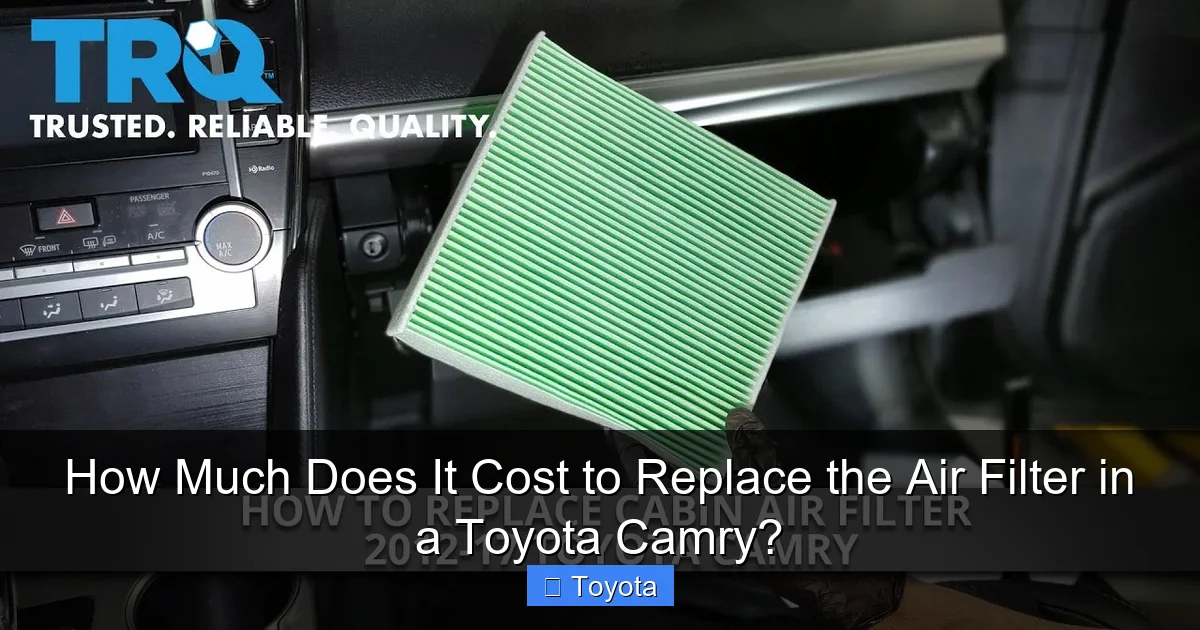
The cabin air filter is a different beast entirely. It’s usually located behind the glove compartment, under the dashboard on the passenger side, or sometimes at the base of the windshield under the cowl vent. Access is often slightly more involved than the engine filter, requiring you to remove trim panels or the glove box itself. Its media is typically a finer, multi-layered blend of activated carbon (to absorb odors and gases) and microfibers to trap ultra-fine particles. For Camry owners, replacing this filter is a key part of maintaining HVAC system efficiency and ensuring that the air conditioning and heating blow strongly and cleanly. A clogged cabin filter puts extra strain on the blower motor and can lead to musty smells from mold and mildew growing on the trapped organic material. While it doesn’t directly affect engine performance, it has a huge impact on your daily driving comfort and, for those with allergies or asthma, your well-being.
Breaking Down the Costs: Engine vs. Cabin Air Filter
Now, to the numbers. The cost for your Toyota Camry air filter replacement is a combination of parts cost and labor cost. Labor is where the massive DIY vs. professional split happens. Let’s itemize both filters separately.

Visual guide about How Much Does It Cost to Replace the Air Filter in a Toyota Camry?
Image source: down-th.img.susercontent.com
Engine Air Filter Replacement Cost
This is the cheaper and simpler of the two. For the part itself:
- OEM (Original Equipment Manufacturer) Toyota Filter: Expect to pay between $25 and $45 at a dealership or online. This is the exact filter that was in your car when it left the factory.
- Premium Aftermarket Brands (K&N, Purolator, WIX, Bosch): These range from $20 to $50. K&N’s reusable cotton filter costs more upfront ($40-$60) but can be washed and re-oiled, theoretically lasting the life of the car.
- Standard Store Brands (Duralast, Fram, STP): These are your budget options, typically $15 to $30. They are perfectly adequate for most drivers and meet OEM specifications for filtration.
If you have a professional do it, the labor time is usually 0.3 to 0.5 hours. At a standard shop labor rate of $100-$150 per hour, that adds $30 to $75. Dealerships often have a flat rate for this service, which might be $50-$90 just for labor, plus the part. Therefore, a professional engine air filter replacement at an independent shop will likely cost $60 to $120 total. At a dealership, it could be $75 to $150 total. Doing it yourself brings the cost down to just the $15-$60 for the filter.
Cabin Air Filter Replacement Cost
The cabin filter is generally a bit more expensive for the part due to its more complex media and smaller size. Labor is also slightly higher because access can be trickier.
- OEM Toyota Cabin Filter: Costs between $35 and $65.
- Premium Aftermarket Brands: Similar range, $30 to $70. Brands like Mann, Mahle, and Fram are excellent choices.
- Carbon-Infused Filters: Filters with activated carbon for odor removal are on the higher end, often $45 to $80.
Labor time is typically 0.5 to 0.8 hours. This means an additional $50 to $120 in labor. Total cost at an independent shop: $80 to $190. At a dealership: $100 to $225+. The DIY cost is simply the $30-$80 for the filter. Some Camry models (particularly older ones) make the cabin filter very easy to access from the glove box, while others require more disassembly. This affects labor time and your personal DIY confidence.
DIY vs. Professional: Which Saves You More?
This is the million-dollar question. The answer, for the vast majority of Toyota Camry owners, is that DIY is the overwhelming winner for savings. The engine air filter swap is arguably the easiest maintenance task on the car. The cabin filter is only slightly more involved. Let’s compare.

Visual guide about How Much Does It Cost to Replace the Air Filter in a Toyota Camry?
Image source: assets.howtune.com
The DIY Advantage: Tools, Time, and Savings
For the engine air filter, you likely need zero tools. Most Camry housings are secured with simple metal clips that you can pry open with your fingers or a flat-head screwdriver if they’re tight. The job involves: 1) Open the hood. 2) Locate the black air filter box. 3) Release the clips or screws. 4) Lift out the old filter (note its orientation). 5) Clean any large debris from the housing with a rag. 6) Place the new filter in the same orientation. 7) Secure the box. Total time: 5-15 minutes. Your only cost is the filter itself.
For the cabin air filter, you might need a Phillips-head screwdriver and possibly a plastic trim removal tool. The process usually involves: 1) Open the glove box and empty it. 2) Remove the glove box damper arm (a small plastic clip). 3) Let the glove box drop down fully to access the filter cover behind it. 4) Remove the cover screws/clips. 5) Slide out the old filter, noting airflow direction arrows. 6) Insert the new filter with arrows pointing down. 7) Reassemble. Total time: 15-30 minutes. Again, your cost is only the filter.
By DIY’ing both filters, you save $50 to over $200 in labor. That’s enough to buy a premium K&N filter and have money left over. The risk is minimal if you follow a guide. The only “wrong way” is installing the filter backwards (cabin filter) or not seating the housing properly (engine filter), which can cause unfiltered air to enter or cause a whistling leak.
When to Call a Pro: Signs You Need Expertise
So, why would anyone pay more? There are valid reasons. First, convenience. If you don’t have a safe, clean place to work or simply value your time more than the savings, paying $80 for a 20-minute job might be worth it to you. Second, complex access. While most Camrys are easy, some model years or trims might have the cabin filter located under the cowl (at the base of the windshield), requiring removal of wiper arms or other components. This is a 45-minute to 1-hour job for a pro and might be daunting for a novice. Third, discovery of other issues. A mechanic might notice a cracked air intake hose, a damaged housing, or evidence of water ingestion while performing the service. They can fix these on the spot, preventing future problems. Finally, if your Camry is still under a warranty that requires “dealer-certified” service for certain maintenance (though air filter changes are almost always owner-serviceable), you might opt for the dealer to keep a pristine service record. For the vast majority of owners, however, this is a perfect first DIY project. If you’re unsure, watch a YouTube video for your specific Camry model year—there are hundreds—and you’ll see how simple it is.
Factors That Influence the Final Price
Even within the DIY and professional brackets, prices aren’t static. Several factors will push the cost up or down.
Visual guide about How Much Does It Cost to Replace the Air Filter in a Toyota Camry?
Image source: i.ytimg.com
Filter Type and Quality
As mentioned, an OEM filter from a Toyota dealer will almost always cost more than an identical-spec filter from an auto parts store. A standard paper filter is cheaper than a high-flow, reusable cotton filter like K&N. For the cabin filter, a basic dust filter is less expensive than a premium carbon-activated one designed for smokers or those in polluted areas. Your choice here depends on your budget and priorities. A standard OEM-spec filter from a reputable aftermarket brand (like Purolator or WIX) is usually the best value, offering excellent filtration at a lower price than the dealer’s box.
Your Camry’s Model Year and Engine
A 2012 Toyota Camry with a 2.5L 4-cylinder might have a different, less expensive filter than a 2023 Camry with the same engine, due to changes in housing design. V6 models sometimes have a slightly different air intake setup, but the filter part number and cost are usually identical. The biggest price influencer here is accessibility. A 2007-2011 Camry (XV40 generation) is famously easy for both filters. A 2018+ Camry (XV70) might have a cabin filter that’s a bit more tucked away, potentially adding 10-15 minutes of labor at a shop. Always check a parts database with your exact VIN to be sure.
Geographic Location and Service Center
This is a universal truth in auto repair: where you live matters. Labor rates in New York City or San Francisco can be 50-100% higher than in a small town in the Midwest. A dealership in an affluent area will charge more for the same part and labor than an independent shop in a less expensive region. Additionally, chain stores like Midas or Meineke may have national pricing for simple services like air filter installation, which can be slightly higher than a trusted local independent mechanic but often come with a warranty. Always get a specific quote for your vehicle and zip code.
A Step-by-Step Guide to Replacing Your Engine Air Filter
Let’s get hands-on. Here is a generalized, safe procedure for replacing the engine air filter on a Toyota Camry from the last 15 years. Always consult your owner’s manual for specifics for your exact model year.
Tools You’ll Need
- New engine air filter (correct part number for your Camry)
- Possibly a flat-head screwdriver (if clips are tight)
- A clean rag
- Optional: Gloves
Removal and Installation Process
1. Cool Down: Ensure the engine is cool. You don’t want to work on a hot engine.
2. Open the Hood: Secure it with the hood prop rod.
3. Locate the Air Filter Housing: It’s the large black plastic box on the side of the engine, connected to the throttle body by a large hose. It will have a lid secured by several metal clips or a couple of screws.
4. Open the Housing: Release all the clips or remove the screws. For clips, use your fingers or a screwdriver to gently pry them up. The lid should come off easily. Be mindful of any wiring or sensors attached to the housing; they should be fine, just don’t yank them.
5. Remove the Old Filter: Lift the old filter straight up. Note how it sits and which side faces the engine (the “dirty” side will be facing down, covered in debris).
6. Clean the Housing: Use your rag to wipe out any loose dirt, leaves, or debris from inside the housing and around the area where the filter seals. Do not use compressed air or any liquid cleaners.
7. Install the New Filter: Place the new filter in the housing, ensuring it sits flat and the rubber seal faces upward. It should fit snugly. The filter is designed to only go in one orientation; if it’s crooked, it won’t fit right.
8. Secure the Lid: Place the lid back on and press down firmly on all clips until they snap into place, or reinstall the screws. Ensure a tight seal to prevent unfiltered air from sneaking in.
9. Close the Hood: You’re done! Start the engine—it should run smoothly with no strange whistling noises. If you hear a whistle, re-check the lid seal.
That’s it. You just saved yourself a service bill and gained a better understanding of your car.
Maintenance Tips to Extend Filter Life and Save Money
Replacing your filters on schedule is the goal, but you can be smart about it to maximize value.
Regular Inspection Schedule
Don’t just blindly replace at 30,000 miles. Take 30 seconds during an oil change to visually inspect your engine air filter. Open the housing and look. If it’s lightly gray and you can still see the pleats, it’s fine. If it’s caked with black soot, pollen, or dirt, and you can’t see the pleats at all, replace it early. This is especially important if you drive in dusty, rural areas or heavy city traffic. For the cabin filter, a good rule is to check it every year or 15,000 miles. If you suffer from allergies or live in a high-pollen area, check it in the spring and fall. A musty smell from the vents is a dead giveaway it’s time for a change.
Driving Conditions That Affect Filter Longevity
The manufacturer’s interval (often 15,000-30,000 miles) is a general guideline for “normal” driving. If your Camry is subjected to “severe” conditions, shorten that interval. Severe conditions include: frequent driving on unpaved roads or in construction zones, heavy stop-and-go traffic, extremely dusty environments, or areas with high airborne pollution. These conditions load the filter with contaminants much faster. If you tow a trailer, your engine works harder and ingests more air, also shortening filter life. Being proactive based on your environment is a key way to protect your engine and avoid a clogged filter that hurts performance.
Common Mistakes and How to Avoid Them
Even a simple job can go wrong. Here are pitfalls to avoid.
Mistake 1: Installing the Cabin Filter Backwards. Cabin filters have an airflow arrow printed on the frame. It must point downward toward the cabin (or in the direction of airflow, which is typically down). Installing it backwards restricts airflow and reduces filtration efficiency. Double-check that arrow.
Mistake 2: Using a Poor-Quality Filter. The $5 “bargain” filter from an unknown online seller might have flimsy media that collapses or gaps in the seal. Stick to reputable brands. Your engine’s health is worth the extra $10.
Mistake 3: Forgetting to Clean the Housing. A quick wipe-down prevents old debris from falling into the throttle body when you remove the old filter. It takes 10 seconds.
Mistake 4: Not Securing the Housing Properly. A loose air filter box lid will cause a loud whistling noise as air is sucked through the gap. It also allows unfiltered air to bypass the filter entirely, defeating its purpose. Ensure all clips are fully engaged or screws are snug.
Mistake 5: Confusing the Two Filters. This is the big one. If you buy a “cabin filter” when you need an “engine filter,” you’ll have the wrong size and shape. Use your VIN or a parts store lookup tool to be 100% certain. The engine filter is large and in the engine bay. The cabin filter is smaller and inside the car.
Frequently Asked Questions
Can I use a universal air filter instead of an OEM one for my Camry?
Yes, you can use a high-quality aftermarket filter from brands like K&N, Purolator, or WIX. These are designed to meet or exceed OEM specifications. Just ensure the part number matches your specific Camry’s year, engine, and trim. Universal “custom fit” filters that require trimming are not recommended for this application.
How often should I really replace my Camry’s air filters?
Check your owner’s manual. The general guideline is every 15,000-30,000 miles for the engine filter and every 15,000-30,000 miles or every year for the cabin filter. However, if you drive in severe conditions (dusty roads, heavy traffic, high pollen), shorten that interval to 12,000-15,000 miles. Visual inspection is the best indicator.
Is replacing the cabin air filter on a Camry a difficult DIY job?
For most model years (2007-2023), it’s a straightforward 15-30 minute job requiring only basic hand tools. The most common procedure involves lowering the glove box to access the filter behind it. Some newer models may require removing a few cowl panels, which is slightly more involved but still very manageable for a DIYer with a guide for their specific year.
What are the signs of a bad engine air filter?
Look for reduced fuel economy, a noticeable lack of power or sluggish acceleration, a rough idle, a check engine light (often for a lean fuel mixture code like P0171), and visually, a filter that is heavily clogged with dirt and debris. You might also smell a slight “rich” fuel smell from the exhaust.
Does a dirty cabin filter affect AC performance?
Absolutely. A clogged cabin filter severely restricts airflow through your HVAC system. This causes weak air volume from the vents, puts extra strain on the blower motor (which can fail prematurely), and reduces the effectiveness of both the heater and air conditioner. It can also cause a musty, moldy odor.
Should I buy a reusable K&N filter for my Camry?
A K&N reusable filter can be a good investment if you plan to keep your Camry long-term and want to save money over the car’s life. However, they are more expensive upfront, require proper cleaning and re-oiling every 50,000 miles (or based on inspection), and their slightly higher airflow can sometimes cause a minor change in the engine’s air-fuel ratio, though modern Camrys compensate well. For most drivers, a quality disposable OEM-spec filter is the simplest and most cost-effective choice.