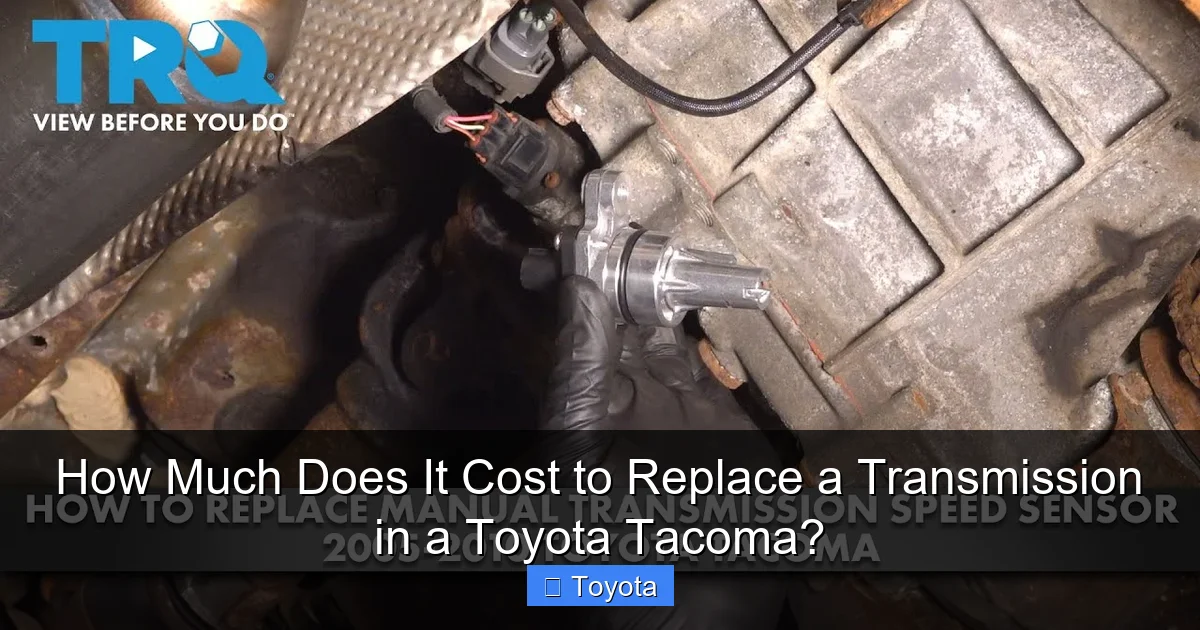
How Much Does It Cost to Replace a Transmission in a Toyota Tacoma?

Contents
- 1 Key Takeaways
- 2 📑 Table of Contents
- 3 Understanding Your Tacoma’s Heart: The Transmission
- 4 The Dreaded Signs: How Do You Know Your Transmission is Failing?
- 5 Rebuild vs. Replacement: Your Two Main Paths Forward
- 6 Breaking Down the Bill: What Exactly Are You Paying For?
- 7 DIY vs. Professional Installation: The High-Stakes Gamble
- 8 Protecting Your Investment: Long-Term Care & Final Thoughts
- 9 Frequently Asked Questions

Car Ambient Light Kit

Car Tissue Holder

Car Hydraulic Jack

Brake Cleaner Spray
Replacing a transmission in a Toyota Tacoma typically costs between $3,000 and $8,000+ for a new or remanufactured unit, including labor. The final price depends heavily on your truck’s specific model year, engine, and transmission type (manual vs. automatic). A full rebuild from a reputable shop can offer a more affordable, middle-ground solution, often costing $1,500 to $3,500. Always get multiple quotes and understand the warranty offered on parts and labor before committing.
Key Takeaways
- Cost Range is Wide: Expect to pay $3,000 to $8,000+ for a complete replacement with a new/remanufactured transmission and professional installation.
- Model Year & Transmission Type are Critical: A 2005 Tacoma with a 4-cylinder and manual transmission will cost far less than a 2023 V6 with an automatic.
- Rebuild vs. Replace: A professional rebuild (using your core) is often 30-50% cheaper than a full replacement and comes with a good warranty.
- Labor is a Major Cost Driver: Transmission removal and installation is intensive labor, typically taking 8-15+ hours at $75-$150/hour at most shops.
- Used Units are Risky: While cheaper upfront ($1,000-$2,500), used transmissions carry no warranty and unknown history, potentially leading to more cost.
- Preventive Maintenance is Key: Regular fluid changes and avoiding severe towing/heat stress are the best ways to delay this major expense.
- Always Get a Detailed Diagnosis: Don’t assume it’s the transmission. A proper scan and teardown diagnosis confirms the issue before you spend thousands.
📑 Table of Contents
- Understanding Your Tacoma’s Heart: The Transmission
- The Dreaded Signs: How Do You Know Your Transmission is Failing?
- Rebuild vs. Replacement: Your Two Main Paths Forward
- Breaking Down the Bill: What Exactly Are You Paying For?
- DIY vs. Professional Installation: The High-Stakes Gamble
- Protecting Your Investment: Long-Term Care & Final Thoughts
Understanding Your Tacoma’s Heart: The Transmission
Your Toyota Tacoma’s transmission is a marvel of mechanical engineering. It’s the critical link that takes the raw power from your engine and translates it into the controlled torque that spins your wheels. For a truck known for its rugged reliability, the transmission is what allows it to be both a competent daily driver and a capable off-road workhorse. When this complex system of gears, pumps, valves, and clutches fails, it brings your adventures—and your daily commute—to a complete halt. Understanding what you’re facing is the first step in navigating the repair process. The cost isn’t just a number; it’s an investment in getting your trusted Tacoma back on the road, and that investment varies dramatically based on several key factors.
The Two Main Families: Manual vs. Automatic
Tacomas have been offered with both manual and automatic transmissions over the years, and this is the single biggest initial cost divider. Manual transmissions are mechanically simpler. They have fewer moving parts and no complex valve bodies or torque converters. A manual transmission rebuild or replacement is generally less expensive. Automatic transmissions, especially modern ones with 5 or 6 speeds (like the A750E/F in 2005-2015 models or the 6-speed in later models), are far more intricate. They rely on hydraulic pressure, electronic solenoids, and complex clutch packs. This complexity means more parts that can wear out and higher labor times to disassemble and reassemble, directly impacting your final bill.
Generational Differences Matter
The Tacoma has evolved through three major generations. The first-gen (1995-2004) and second-gen (2005-2015) trucks are renowned for their simplicity and durability. Their transmissions, while old, are often easier and cheaper to source parts for and rebuild. The third-gen (2016-present) introduced more sophisticated transmissions paired with more powerful engines. These are more expensive to repair due to advanced electronics and tighter packaging in the engine bay, which increases labor time. A 2020 Tacoma’s transmission repair will carry a significantly different price tag than a 2010’s, even if the symptom (slipping, no gear) is the same.
The Dreaded Signs: How Do You Know Your Transmission is Failing?
Before you can talk cost, you need a firm diagnosis. Transmission problems rarely appear out of the blue; they whisper warnings first. Recognizing these signs early can sometimes save you from a catastrophic failure that contaminates the entire system with metal shavings, making a simple repair impossible and forcing a full replacement.

Visual guide about How Much Does It Cost to Replace a Transmission in a Toyota Tacoma?
Image source: lihpao.com
Common Symptoms of a Dying Transmission
Listen and feel for these red flags. Slipping gears is the most common. You’ll feel the engine RPMs surge (like you’re pressing the gas) but the truck doesn’t accelerate accordingly, or it feels like it’s downshifting on its own on the highway. Harsh or delayed shifts—where the truck slams into gear or takes a second to engage—point to solenoid or valve body issues. Fluid leaks are obvious; check for bright red or dark brown fluid under your parked truck. Grinding, whining, or clunking noises, especially in neutral or specific gears, indicate serious internal wear. Finally, a complete lack of movement in any gear (with a full fluid level) means the worst has likely happened inside.
The Critical Importance of a Proper Diagnosis
Never, ever authorize a transmission replacement based on symptoms alone. A reputable shop will start with a computer scan to check for solenoid or sensor-related trouble codes. They will then perform a road test to replicate the issue. The final, and most important, step is a teardown inspection. This involves removing the transmission pan to inspect the fluid and internal components. This is the only way to truly see the condition of clutch packs, bands, and gears. A shop that quotes a price over the phone without this step is not one you should trust. The diagnostic fee, usually $100-$200, is the best money you’ll spend in this process. For other diagnostic-related costs, you might find articles on common repairs like routine oil changes helpful for budgeting general maintenance versus major repairs.
Rebuild vs. Replacement: Your Two Main Paths Forward
Once a catastrophic internal failure is confirmed, you face two primary choices: a full replacement or a rebuild. Each has significant financial and warranty implications.

Visual guide about How Much Does It Cost to Replace a Transmission in a Toyota Tacoma?
Image source: i.ytimg.com
The Full Replacement: New or Remanufactured
A “replacement” typically means a brand-new unit from Toyota (extremely rare and prohibitively expensive) or, more commonly, a remanufactured transmission. These are core units that have been completely disassembled, all worn parts replaced with new ones, and reassembled to strict factory specifications by a large remanufacturing facility (like Jasper, AAMCO, or TransTec). They come with a nationwide warranty, usually 3 years/100,000 miles. The cost here is the highest: $2,500-$5,000+ for the remanufactured unit itself, plus 8-15 hours of labor. The advantage is predictability and a strong warranty. The disadvantage is cost and the fact that you’re getting a unit that, while rebuilt, has a history (the “core”).
The Rebuild: The Artisan’s Approach
A rebuild is performed by a local, specialized transmission shop. They remove your exact transmission, disassemble it in their shop, inspect every single part, and replace only what is worn or damaged. They machine surfaces as needed and reassemble it with new clutch packs, seals, and gaskets. A good rebuild shop will often upgrade certain components (like bands or valve body corrections) based on known weak points for your specific Tacoma model year. The cost is the parts (usually $1,000-$2,500) plus labor (same hours as a replacement). Total: $2,500-$4,500. The warranty is typically shorter and shop-local (e.g., 12 months/12,000 miles). The advantage is potential cost savings and a unit tailored to your exact failure. The risk is the shop’s quality varies wildly. Choosing a rebuild shop is the most critical decision you’ll make. Get references, ask about their machined equipment, and understand their warranty in writing. For other vehicle-specific repair insights, our piece on Toyota Tacoma paint costs demonstrates how model-specific factors heavily influence pricing.
Breaking Down the Bill: What Exactly Are You Paying For?
That final quote isn’t just a random number. It’s a sum of several distinct parts. Let’s peel back the layers on a typical $5,000 invoice for a remanufactured transmission replacement.

Visual guide about How Much Does It Cost to Replace a Transmission in a Toyota Tacoma?
Image source: images.cars.com
1. The Core Charge & Transmission Unit
When you buy a remanufactured transmission, you pay a “core charge.” This is a deposit (often $500-$1,500) that you get back when you return your old, rebuildable transmission to the remanufacturer. It incentivizes you to return the core. The net cost of the remanufactured unit after core return is the price you see. This covers the complete rebuild process at the factory. For a rebuild, this line item is replaced by the cost of individual parts: clutch kits, bands, seals, gaskets, and possibly a new torque converter.
2. Labor: The Hidden Giant
This is where the bill balloons. Removing a transmission from a Tacoma is not a simple unbolt. The driveshaft must be removed, the crossmember dropped, the transfer case (on 4WD models) unbolted and supported, the exhaust often needs moving, and the transmission must be carefully maneuvered out from under the truck. Reinstallation is the reverse, with the added precision of aligning the torque converter and ensuring the transmission mounts are perfect. Expect 10-15 billable hours for a 4WD automatic Tacoma. At a national chain’s labor rate of $125/hour, that’s $1,250-$1,875 alone. Independent shops may be $80-$110/hour, but may take longer. Always ask for an estimated labor time in hours.
3. Fluids, Seals, and Ancillary Parts
A proper job includes more than just the big metal box. You must replace all transmission fluid (8-12 quarts of specific Toyota WS fluid, ~$15/qt). A new filter (if applicable), all input and output shaft seals, the rear main seal (on the engine, often accessed during this job), and the transmission pan gasket are musts. The torque converter should almost always be replaced on an automatic, as it’s nearly impossible to inspect internally and is a common failure point. This adds $300-$600 in parts. Some shops will also recommend a new transfer case fluid and rear differential fluid while they have everything apart—a smart, preventive service.
4. Taxes, Shop Supplies, and Fees
Don’t forget sales tax on parts and labor (varies by state). Shops also add a small percentage for “shop supplies” like shop rags, adhesive, bolts, and cleaner—usually 5-10% of the labor total. There may also be a hazardous waste disposal fee for the old fluid. These can add a few hundred dollars to the final tab.
DIY vs. Professional Installation: The High-Stakes Gamble
Given the high parts cost, the idea of saving on labor by doing it yourself is tempting. For the vast majority of Tacoma owners, this is a terrible idea that will likely end in more cost and frustration.
The Allure and Reality of the DIY Route
Yes, you can find a used transmission for $1,200 and a junkyard engine hoist for $200. The perceived savings are huge. But the reality is brutal. You need a safe, level workspace, a proper transmission jack (a $200+ tool), countless specialty sockets and extensions, and the mechanical skill to handle 300+ lb components without injury or damage. The alignment process for the transmission to the engine is precise. Getting the torque converter seated correctly is critical—if it’s not fully engaged, it will destroy the pump on startup. You’ll also need to deal with wiring connectors, cooler lines, and the shift linkage. One mistake means pulling it all back out. For a manual, clutch adjustment and hydraulic bleeding add another layer of complexity. The risk of ruining your new (or used) part is extremely high. If you have to pay a shop to fix your DIY mistake, you’ve negated any savings and added more labor hours.
When Professional Installation is Non-Negotiable
For an automatic transmission, professional installation is the only sane choice. The tools, experience, and warranty are worth every penny. For a manual, a very experienced home mechanic with the right tools and a service manual *might* succeed, but the physical strain and risk remain. The professional shop’s warranty on their labor is the ultimate peace of mind. If the transmission they installed fails due to an installation error, they fix it at no extra cost. You have zero recourse on a DIY job. Think of the labor cost not as an expense, but as an insurance policy for your major parts investment.
Protecting Your Investment: Long-Term Care & Final Thoughts
Whether you choose a rebuild or a replacement, you’ve spent a small fortune. Your job isn’t done until you’ve installed it and have a plan to protect it.
Immediate and Future Maintenance
Follow the break-in procedure religiously if provided by the rebuilder/manufacturer. This usually means gentle driving for the first 500-1,000 miles—no hard acceleration, no towing, and avoiding sustained high RPMs. This allows clutch materials to seat properly. Then, adopt a strict fluid maintenance schedule. For a rebuilt transmission, many shops recommend the first fluid and filter change at 5,000 miles to flush any fine particles from the break-in period, then every 30,000 miles thereafter. Use only Toyota WS fluid (or the exact specification listed). Consider adding an auxiliary transmission cooler if you do any serious towing or live in a hot climate. This is one of the best upgrades you can make for longevity.
The Big Picture: Is It Worth It?
This is the ultimate question. For a late-model Tacoma with low miles and in otherwise excellent condition, a transmission replacement is often a clear financial win. You’re restoring a reliable, valuable asset. For a high-mileage, rusted-out, or otherwise worn truck, you might be pouring money into a sinking ship. Do the math. A $5,000 repair on a truck worth $12,000 makes sense. The same repair on a truck worth $4,000 does not. Also, consider the truck’s history. A well-maintained Tacoma with a single transmission failure at 180,000 miles is likely to last another 150,000 miles with a quality rebuild. A neglected truck that had its transmission fail at 100,000 miles may have other lurking issues.
Finally, shop around. Get at least three detailed, itemized quotes from independent transmission specialists. Ask about the specific brand of remanufactured unit, the warranty details (what’s covered, what’s not, is it nationwide?), and their experience with your exact Tacoma generation. A slightly higher price from a shop with a stellar reputation and a 3-year warranty is almost always better than the lowest bid from an unknown quantity. This isn’t a repair to bargain-hunt on. Your transmission is the gateway to your truck’s capability. Investing in a quality repair from a trusted provider will get your Tacoma back to being the reliable, adventurous partner it was meant to be.
Frequently Asked Questions
What is the absolute cheapest I can get a Tacoma transmission fixed for?
The absolute lowest end is a used, “as-is” transmission from a junkyard, installed by a low-cost independent mechanic. This could theoretically be done for $1,500-$2,500 total. However, this is extremely high-risk. The used unit could fail immediately, and you have no warranty. You could end up paying for the same repair twice. A basic, quality rebuild from a reputable local shop is the true minimum for a reliable, warranted repair, starting around $2,500-$3,500 for simpler older models.
Will my insurance or warranty cover this?
Almost certainly not. Standard auto insurance covers damage from accidents, not mechanical wear and tear. If you have an extended warranty (vehicle service contract), it *might* cover it, but you must read the contract meticulously. Many exclude “wear and tear” items or have very high deductibles for major components like transmissions. Factory power train warranties on new cars typically cover the transmission for 5 years/60,000 miles. If your Tacoma is outside that window, you are paying out of pocket.
Is a used transmission from a salvage yard a good idea?
For most people, no. The main advantage is low upfront cost. The massive disadvantages are: no warranty (usually 30-90 days at best), unknown history (was it maintained? was it abused?), and the high probability of it being a worn unit itself. You’re trading a known, diagnosed failure for an unknown one. The cost to remove and reinstall a used unit is the same labor as a new one. If it fails in 10,000 miles, you’ve paid for two removals and installations. It’s a gamble rarely worth taking on your daily driver.
How long does a transmission replacement or rebuild take?
A professional shop will typically need 1-3 business days for a straightforward rebuild or replacement if they have the remanufactured unit in stock. If they need to source a core for a rebuild or order a remanufactured unit, add another 1-3 days for shipping. The actual labor time is 8-15 hours, but shops schedule these jobs in their bays and may have a backlog. Always ask for an estimated completion time when you drop it off. Towing your Tacoma to and from the shop is an additional logistical and cost factor to consider.
Can I drive with a slipping transmission?
You can, but you absolutely should not. Driving with a slipping transmission causes extreme heat and rapid, catastrophic wear. Metal shavings will circulate through the fluid and destroy every other component—the valve body, pump, and clutch packs. What might have been a $2,500 rebuild becomes a $6,000+ replacement because the entire system is contaminated. If you detect slipping, stop driving immediately. Have it towed to a shop. The cost of a tow is infinitesimal compared to the additional damage you’ll cause by driving it.
What’s the difference between a “remanufactured” and “rebuilt” transmission?
A remanufactured transmission is done at a large, centralized factory. Every unit is rebuilt to identical specifications using all-new or certified remanufactured parts. The process is standardized. It comes with a long, nationwide warranty. A rebuilt transmission is done by a local shop. They disassemble your specific unit, inspect it, and replace only the worn parts. Quality depends entirely on the shop’s skill, equipment, and standards. Warranties are shorter and local. A remanufactured unit is like buying a new box; a rebuild is like a custom-tailored suit. Both can be excellent, but the rebuild’s quality is more variable and depends on your choice of shop.