How Much Does It Cost to Replace a Transmission in a Toyota Sienna?

Contents
- 1 Key Takeaways
- 2 📑 Table of Contents
- 3 Understanding the Beast: Why Transmission Replacement is So Expensive
- 4 How Your Specific Sienna Year & Model Drives the Price
- 5 New, Remanufactured, or Used: The Part That Defines Your Price
- 6 Labor Costs: The Invisible Giant on Your Invoice
- 7 The Hidden Costs & Smart Saving Strategies
- 8 Prevention: The Only True Money-Saver
- 9 Conclusion: Knowledge is Your Best Tool
- 10 Frequently Asked Questions


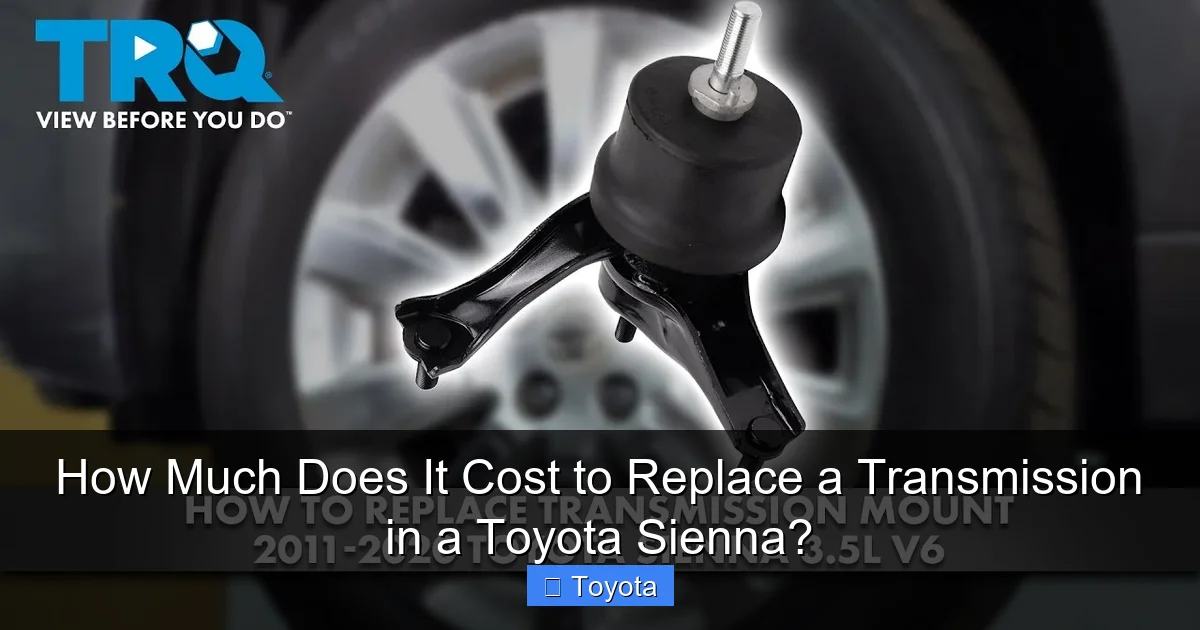
Replacing a transmission in a Toyota Sienna typically costs between $3,500 and $8,000+, with the final price depending heavily on your van’s specific model year, the type of transmission, and whether you choose a new, remanufactured, or used unit. Labor costs are a major factor, often ranging from $1,200 to $2,500 for the 8-15 hours of work required. Choosing a remanufactured transmission from a reputable supplier often provides the best balance of reliability and cost for this major repair.
Key Takeaways
- Cost Range is Wide: Expect to pay anywhere from $3,500 for a used unit to over $8,000 for a new OEM transmission with installation.
- Labor is a Huge Portion: Transmission R&R (Remove & Replace) is labor-intensive, costing $1,200-$2,500+ at standard shop rates.
- Model Year is Critical: The 2004-2010 models with the U250E 5-speed and 2011+ models with the 6-speed have different parts costs and labor complexities.
- Remanufactured is Often Best Value: A core-charge remanufactured unit with a solid warranty (e.g., 3 years/100k miles) offers peace of mind at a mid-range price.
- Used Transmissions are a Gamble: While cheapest upfront, used units carry high risk of failure and no long-term warranty, potentially costing more in the long run.
- Get Multiple Diagnoses: Always get a second or third opinion and a detailed written estimate before authorizing this major repair.
- Maintenance is Prevention: Following strict transmission fluid service intervals is the #1 way to avoid this extremely costly repair.
[FEATURED_IMAGE_PLACEHOLDER]
📑 Table of Contents
- Understanding the Beast: Why Transmission Replacement is So Expensive
- How Your Specific Sienna Year & Model Drives the Price
- New, Remanufactured, or Used: The Part That Defines Your Price
- Labor Costs: The Invisible Giant on Your Invoice
- The Hidden Costs & Smart Saving Strategies
- Prevention: The Only True Money-Saver
- Conclusion: Knowledge is Your Best Tool
Understanding the Beast: Why Transmission Replacement is So Expensive
Let’s be real. Hearing the words “you need a new transmission” is enough to make any Toyota Sienna owner’s stomach drop. It’s one of the most expensive repairs you can face on any vehicle, minivan or not. Your Toyota Sienna is a beloved, reliable family hauler, and its transmission is the complex, hardworking heart of its drivetrain. When that heart fails, the bill reflects the sheer scale of the job. This isn’t an oil change or a brake pad swap. This is a complete teardown and rebuild of a major mechanical system, often requiring the vehicle to be lifted, the exhaust dropped, and the entire unit wrestled out from under the van. The cost isn’t just for a part; it’s for hundreds of skilled labor hours, specialized tools, and the critical warranty that comes with a major component. In this guide, we’ll slice through the mystery and the fear, giving you a clear, itemized picture of what you’re really looking at when your Sienna needs a new transmission.
The Core Components of the Cost
Think of the total bill as having three main pillars: the part itself, the labor to install it, and the additional fees that always seem to pop up. The part cost varies wildly based on its source. A brand-new, direct-from-Toyota (OEM) transmission carries the highest price tag, often with a limited warranty. A remanufactured unit is built to spec, with all worn parts replaced, and comes with a much more robust warranty—usually the sweet spot for reliability. A used or “salvage” transmission from a junkyard is the cheapest upfront but is a total unknown quantity, with no warranty beyond maybe 30 days. Labor is where the real money burns. Your mechanic will charge anywhere from $85 to $150+ per hour, and this job takes a minimum of 8 hours for an experienced tech on a straightforward model, but it can easily hit 12-15 hours on a rusty, older van or if unexpected problems arise. Finally, you have the “extras”: new fluid, a new filter, seals, gaskets, possibly a new torque converter, and shop supplies. These can add $300-$800 to the final number.
How Your Specific Sienna Year & Model Drives the Price
Not all Toyota Siennas are created equal in the transmission world. The cost to replace one depends significantly on which generation you own, as Toyota used different transmissions with varying complexity and parts availability.
Visual guide about How Much Does It Cost to Replace a Transmission in a Toyota Sienna?
Image source: video-thumbnails-1a.s3.amazonaws.com
The 2004-2010 Models (XL40): The 5-Speed U250E Era
These are the first generation of the modern Sienna. They almost exclusively used the Aisin-built U250E 5-speed automatic transmission. This is a very robust, simple (by modern standards) unit. Parts are generally plentiful and less expensive than for the newer 6-speeds. Labor time is also typically on the lower end of the spectrum, often quoted at 8-12 hours. Because of this, you’ll find the lowest price points for transmission replacement on these model years. A remanufactured U250E might run $2,200-$3,500 for the part, leading to a total installed cost in the $3,800 to $5,500 range at an independent shop. A new OEM unit would push that total toward $6,000.
The 2011-2020 Models (XL30 & XL50): The 6-Speed U660E/UA80E Complexity
For the 2011 redesign and the subsequent 2015 refresh, Toyota moved to more complex 6-speed automatics (primarily the U660E and later the UA80E). These are more sophisticated, with more internal clutches and electronic solenoids. They are also more expensive. Parts prices are higher, and the labor time often increases by 2-4 hours due to more complex removal procedures and the need for specialized scan tools to program and calibrate the Transmission Control Module (TCM) after installation. For these vans, a remanufactured 6-speed part can easily be $3,500 to $5,000. With labor, you’re looking at a total of $5,500 to $7,500+ for a remanufactured job. A new OEM transmission for a 2018 Sienna, for example, could push the total installed cost past $8,500.
The 2021+ Hybrid Models (AXLA70): A Different Beast Entirely
The current hybrid-only Sienna uses a completely different system: the e-CVT, which is a planetary gearset combined with electric motor/generators. This is not a traditional automatic transmission. “Replacing” it is a vastly more complex and expensive procedure, often involving the hybrid battery system. Costs for this system are not widely published but are understood to be significantly higher, potentially starting in the $7,000 to $10,000+ range at a dealer due to the need for Toyota-trained hybrid technicians and specific safety protocols. For hybrid owners, prevention through meticulous maintenance is absolutely critical.
New, Remanufactured, or Used: The Part That Defines Your Price
This is your most important decision point, and it directly controls the budget. Let’s break down the options, from safest to riskiest.

Visual guide about How Much Does It Cost to Replace a Transmission in a Toyota Sienna?
Image source: jdmwestside.com
New OEM (Original Equipment Manufacturer)
This is a brand-new transmission straight from Toyota. It comes with a new parts warranty, typically 12 months/12,000 miles from Toyota, which is shockingly short for such a major component. The price is the highest. Pros: You get every single new part. It’s the “factory fresh” option. Cons: The warranty is inadequate for the investment, and the cost can be prohibitive. You’re paying a premium for the Toyota logo. For most Sienna owners, this is not the recommended path unless the vehicle is under a remaining power train warranty.
Remanufactured (The Smart Choice)
This is what you should strongly consider. A reputable remanufacturer (like Jasper, Cottman, TransTec, or a high-quality Toyota remanufactured core) takes a used core transmission, completely disassembles it, replaces all wear items (clutches, bands, seals, bearings, pumps, solenoids), inspects every housing and gear, and reassembles it to meet or exceed original specifications. It then undergoes rigorous testing on a dyno. The key here is the warranty. Look for a minimum 3-year/100,000-mile warranty that is nationwide and transferable. This part typically costs 25-40% less than a new OEM unit. For a 2012 Sienna, a remanufactured U660E might be $3,800 installed, versus $6,500+ for new OEM. The value proposition is undeniable.
Used / Salvage (The Gamble)
Pulling a transmission from a wrecking yard. The upfront cost is low—maybe $800-$1,500 for the part. But here’s the reality: you have no idea about its history. Was it neglected? Was it shifting harshly before the accident that sent it to the yard? Does it have 50,000 or 150,000 miles on it? The “as-is, where-is” nature means you’re buying a ticking time bomb. Most reputable shops will refuse to install a customer-supplied used transmission because if it fails a week later, you’ll blame them. You also get no meaningful warranty—maybe 30 days from the junkyard. When you factor in the labor cost to install a part that might fail, a used transmission can become the most expensive option of all. It’s only a consideration for a temporary fix on a van you plan to junk soon.
Labor Costs: The Invisible Giant on Your Invoice
You cannot escape labor. It’s the unavoidable cost of human expertise and time. The industry standard for transmission R&R on a front-wheel-drive minivan like the Sienna is high because of the cramped engine bay and the need to work from underneath.

Visual guide about How Much Does It Cost to Replace a Transmission in a Toyota Sienna?
Image source: i.ytimg.com
Why So Many Hours?
The process is a ballet of disassembly. The van must be safely lifted. The driveshaft (or half-shafts on FWD) must be disconnected. The exhaust system often needs to be dropped for clearance. The transmission cooler lines must be disconnected (and sometimes replaced if they corrode). The wiring harness and shift linkage must be unplugged. The subframe or engine support may need to be supported. Then, the heavy transmission (80-100 lbs) must be carefully maneuvered out. The new unit is prepped with new seals and fluid, then maneuvered back in, aligned perfectly, and everything reconnected. Finally, the TCM must be programmed or relearned, which requires a high-end scan tool and technician time. Any rust, broken bolts, or unexpected component failures (like a cracked flexplate) will add hours and cost.
Shop Rate Matters
A dealership will almost always have a higher hourly rate ($120-$180/hr) than a reputable independent transmission specialist ($90-$130/hr). However, the dealer has factory-trained technicians and direct access to OEM parts and software. For a complex job on a newer Sienna, the dealer’s expertise might be worth the premium. For a 2007 model, a proven independent shop is often the better value. Always ask for the estimated labor hours and the shop’s hourly rate upfront. A fair estimate for a mid-2010s Sienna might show 10-12 hours @ $110/hr = $1,100-$1,320 for labor alone.
The Hidden Costs & Smart Saving Strategies
The quoted “$5,500” isn’t always the final number. Be prepared for these potential add-ons and learn how to navigate them.
The “While We’re In There” Syndrome
A good mechanic will inspect the surrounding components once the transmission is out. They might find:
- Worn Engine/Transmission Mounts: The rubber is cracked. Replacing these now saves you from vibration issues later and is much easier with the transmission out. Cost: $200-$500.
- Leaking Front Seal or Rear Main Seal: If the old transmission leaked, the engine’s rear main seal might be compromised. Replacing it now prevents a future leak onto your new clutch. Cost: $300-$800.
- Damaged Flexplate (Automatic) or Clutch (Manual): Rare, but possible. A cracked flexplate must be replaced. Cost: $250-$600.
- Corroded Cooler Lines: The metal lines that carry fluid to the radiator often rust. Plastic replacements are cheap and easy to install at this stage. Cost: $50-$150.
These are often legitimate, smart repairs. Ask your mechanic to show you the worn parts. Get a separate, itemized quote for these “additional recommended repairs.” You can then approve or decline them based on your budget and the van’s overall condition.
How to Save (Without Getting Scammed)
1. Get 3 Detailed, Written Estimates: Never go with the first quote. Get one from a dealer, one from a specialized transmission shop, and one from a reputable general repair shop. Compare part type (new/reman), warranty length, and labor hours.
2. Ask About a Remanufactured Core: This is standard. You pay a core charge (e.g., $500) which is refunded when your old transmission is returned in acceptable condition. Factor this into your cash flow needs.
3. Consider the Van’s Overall Value: A 2005 Sienna with 250,000 miles needing a $4,500 transmission? It might be time to evaluate if the repair makes financial sense versus replacing the vehicle. A 2018 Sienna with 80,000 miles? Absolutely worth it.
4. Ask About a Rebuilt Unit: A local transmission shop may offer to “rebuild” your old core. This can be cheaper than a remanufactured unit from a big supplier, but the warranty (often 12 months/12k miles) and quality are highly variable. Vet the shop’s reputation meticulously.
5. Check for Technical Service Bulletins (TSBs): Sometimes, manufacturers acknowledge a widespread transmission issue and may cover part of the repair under an extended warranty or goodwill policy. A quick call to a dealer service department with your VIN can uncover this.
Prevention: The Only True Money-Saver
You are now armed with cost knowledge. The ultimate goal is to never need this information. Transmission failure is rarely sudden; it’s the result of years of neglect or abuse.
The #1 Rule: Fluid & Filter Service
This is non-negotiable. Toyota’s “lifetime” fluid claim for post-2010 models is widely disputed by transmission experts. Heat kills transmissions, and fluid breaks down. For a 2011-2020 Sienna, a conservative and highly recommended service interval is every 60,000 miles. This involves a full drain and fill (not just a pan drop) to replace ~40% of the fluid, and a new filter. Use only Toyota WS fluid or a premium equivalent approved for your specific transmission model. This single service, costing $200-$350, is the best insurance policy you can buy. For the 2004-2010 models with the U250E, a service every 30,000-40,000 miles is even more critical.
Driving Habits That Kill Transmissions
Your driving style matters. Avoid using your Sienna as a makeshift tow truck for excessive weight beyond its rated capacity. Never use the “L” or “2” gear to engine-brake down long mountain grades; this causes extreme heat. Let the transmission’s internal clutches cool. When towing a trailer, consider an additional transmission cooler. And for the love of all that is holy, do not rock the van back and forth in the snow by rapidly shifting between Drive and Reverse. This is a guaranteed way to destroy synchros and clutches quickly.
Listen and Feel
Early warning signs include: harsh or delayed shifts, slipping (engine revs but van doesn’t accelerate), a burning smell (overheated fluid), or fluid leaks (red or brown puddles). A check engine light with a P0700 series code (Transmission Control System) is a major red flag. Get these diagnosed immediately. Often, a solenoid or speed sensor failure can mimic a failing transmission and is far cheaper to fix. Catching a small leak and topping fluid can buy you thousands of miles and time to save for a proper repair.
Conclusion: Knowledge is Your Best Tool
A Toyota Sienna transmission replacement is a financial gut punch, there’s no sugar-coating it. The cost, typically between $3,500 and $8,000+, reflects the complexity of the job and the value of the part. Your specific model year dictates the baseline, with the newer 6-speed and hybrid systems commanding a premium. Your choice of part—new, remanufactured, or used—is the single biggest lever you have to control cost and risk. For the vast majority of owners, a remannufactured transmission with a multi-year, nationwide warranty offers the optimal balance of reliability and value. Labor is a fixed, high cost, so saving on the part is key.
Do not rush this decision. Get multiple, itemized estimates from trusted specialists. Ask pointed questions about warranty terms and what’s included. Be prepared for the “while we’re in there” recommendations and evaluate them rationally. And finally, let this painful experience be a lesson in preventive maintenance for every vehicle you own. Strict adherence to fluid service intervals is the cheapest and most effective way to ensure your family’s Sienna never leaves you stranded with a catastrophic transmission bill. If you’re proactive, your Sienna will reward you with hundreds of thousands of reliable miles. If you’re not, you now know the price of that neglect.
Frequently Asked Questions
What is the average lifespan of a Toyota Sienna transmission?
With proper maintenance, including regular fluid changes every 60,000 miles for 2011+ models, the transmission can easily last 200,000 miles or more. Neglecting fluid service is the primary cause of premature failure, especially in the 2004-2010 U250E models.
Is it better to rebuild or replace my Sienna’s transmission?
For most owners, a remanufactured replacement is superior. A remanufactured unit is built to new specs in a controlled factory environment with all new internal parts and comes with a strong nationwide warranty (e.g., 3 years/100k miles). A local rebuild’s quality and warranty (often 12 months/12k miles) depend entirely on the individual shop’s expertise.
Will my insurance cover a transmission replacement?
No. Transmission failure due to wear and tear is a mechanical breakdown, which is not covered by standard auto insurance. You would need a separate vehicle service contract (extended warranty) or mechanical breakdown insurance (MBI) policy to potentially cover it, and those must be purchased before the failure occurs.
Can I drive with a failing transmission?
You absolutely should not. Driving with symptoms like slipping, harsh shifting, or no engagement will cause rapid and catastrophic internal damage, turning a possibly repairable issue into a total loss. If you suspect failure, have it towed to a shop.
Does a transmission rebuild or replacement affect my Toyota Sienna’s value?
A properly done remanufactured replacement with a transferable, long-term warranty can actually *increase* value versus a vehicle with a known problematic transmission. A poorly done rebuild or a used transmission with no warranty will significantly decrease value and scare off savvy buyers.
Should I replace it at the dealership or an independent shop?
For a newer Sienna (2015+) with complex electronics, the dealer’s factory training and software access may be worth the higher labor rate. For older models (2004-2014), a reputable, specialized independent transmission shop often offers better value and equally skilled labor. Always check reviews and warranty terms regardless of where you go.