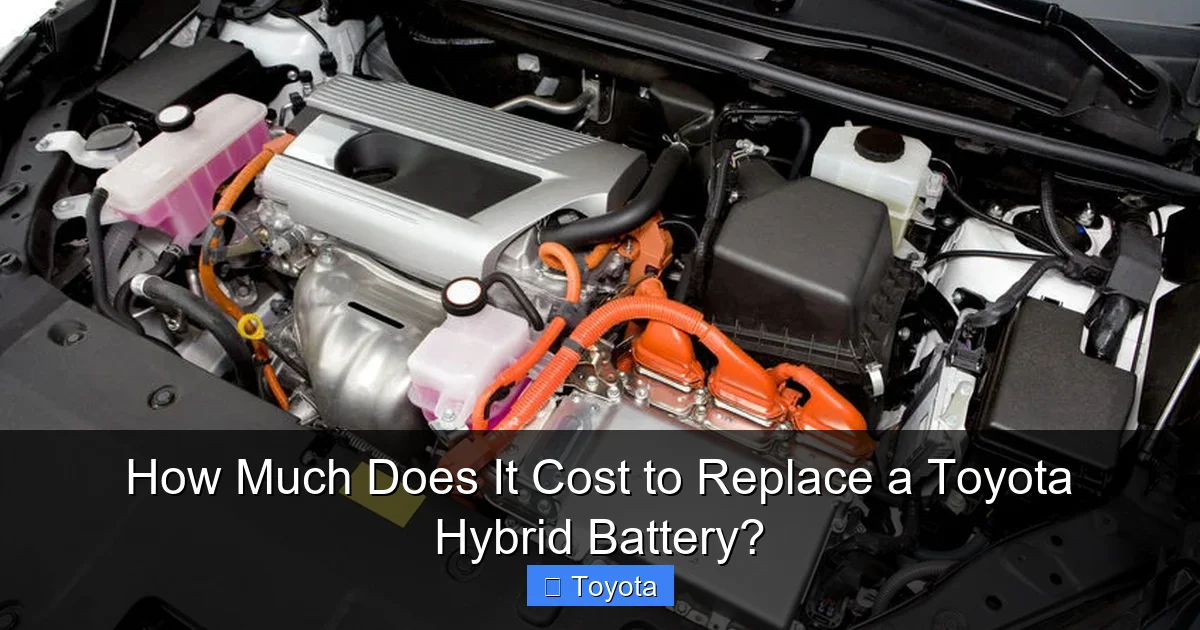
How Much Does It Cost to Replace a Toyota Hybrid Battery?

Contents
- 1 Key Takeaways
- 2 📑 Table of Contents
- 3 How Much Does It Cost to Replace a Toyota Hybrid Battery?
- 4 The Big Picture: Why Toyota Hybrid Battery Costs Vary So Much
- 5 Real-World Cost Examples: A Look at Popular Toyota Hybrids
- 6 Your Three Main Replacement Paths: Weighing the Options
- 7 Smart Saving Strategies: How to Reduce the Bill
- 8 Beyond the Battery: Additional Costs & Important Considerations
- 9 The Bottom Line: Knowledge is Your Best Defense
- 10 Frequently Asked Questions


Replacing a Toyota hybrid battery typically costs between $2,000 and $5,000, heavily influenced by your vehicle’s model year and whether you opt for OEM or aftermarket parts. Labor fees and warranty coverage are key factors, but refurbished batteries offer a cost-effective alternative without compromising reliability.
Key Takeaways
- Total replacement cost typically ranges from $2,000 to $5,000. This includes both parts and professional labor.
- New OEM batteries are the most expensive option. Expect to pay at the higher end of the total cost range.
- Used or refurbished batteries offer significant savings. They can cost 30-50% less than a new unit.
- Labor costs are substantial, often $500-$1,000. Complex hybrid systems require specialized technician time.
- Check your warranty coverage first. Many hybrid batteries have warranties lasting 8-10 years or 100,000+ miles.
- Never attempt a DIY hybrid battery replacement. High-voltage systems pose serious safety risks without proper training.
- Get multiple quotes from certified dealers or specialists. Prices vary widely by region and shop expertise.
📑 Table of Contents
- How Much Does It Cost to Replace a Toyota Hybrid Battery?
- The Big Picture: Why Toyota Hybrid Battery Costs Vary So Much
- Real-World Cost Examples: A Look at Popular Toyota Hybrids
- Your Three Main Replacement Paths: Weighing the Options
- Smart Saving Strategies: How to Reduce the Bill
- Beyond the Battery: Additional Costs & Important Considerations
- The Bottom Line: Knowledge is Your Best Defense
How Much Does It Cost to Replace a Toyota Hybrid Battery?
Let’s be real for a second. You love your Toyota hybrid. It’s quiet, it sips gas, and it’s been a rock-solid companion for years. But then, that little warning light pops on—the one that looks like a battery with an exclamation point. Your heart sinks a little. You know what it means: the big one, the hybrid battery, is on its last legs. The immediate question that follows is the one that keeps us all up at night: how much does it cost to replace a Toyota hybrid battery? It’s not just a number; it’s the difference between keeping your trusted car and facing a daunting major repair or, worse, a replacement. I’ve been there, friends have called me panicked, and I’ve spent hours digging through forums and dealer quotes to get the real story. This is your complete, no-nonsense guide to navigating that cost, understanding what you’re paying for, and coming out with your wallet and your sanity intact.
We’re going to break it down from every angle. We’ll talk about why the price varies so wildly, what the different options (new vs. remanufactured vs. used) actually mean for your car and your budget, and the sneaky additional costs that can turn a $2,000 quote into a $4,000 bill. We’ll look at real-world examples for popular models like the Prius, Camry Hybrid, and RAV4 Hybrid. By the end, you won’t just know the how much; you’ll know the why and the how to save. So take a deep breath. Your hybrid’s best days aren’t necessarily behind it.
The Big Picture: Why Toyota Hybrid Battery Costs Vary So Much
If you call three different shops for a quote on a Toyota hybrid battery replacement, you might get three wildly different numbers. One says $1,800. Another says $3,500. A third, a shady-looking deal on Craigslist, says $600. What gives? The cost isn’t arbitrary, but it’s influenced by a cocktail of factors. Understanding these is your first step in not getting taken for a ride.
Visual guide about How Much Does It Cost to Replace a Toyota Hybrid Battery?
Image source: shop.okacc.com
Your Specific Model, Year, and Battery Type
This is the single biggest driver. A 2005 Toyota Prius uses a completely different, smaller nickel-metal hydride (NiMH) battery pack than a 2020 RAV4 Hybrid, which uses a more advanced lithium-ion (Li-ion) system. Generally, newer models with larger battery packs for more electric-only driving range will cost more. For instance, the battery in a third-generation Prius (2010-2015) is a common and relatively affordable replacement. But the high-capacity battery in a current-model RAV4 Hybrid Prime? That’s a different, more expensive beast. The technology, cell count, and physical size all play a role.
New, Remanufactured, or Used: The Core Decision
This is where the price spectrum truly opens up. You have three main paths:
- New OEM (Original Equipment Manufacturer): This is the battery straight from Toyota, with a full manufacturer’s warranty (often 8 years/100,000 miles). It’s the gold standard for reliability and peace of mind, but you pay a premium. Think of it as buying a brand-new engine.
- Remanufactured/Reconditioned: This is the most popular middle ground. A reputable company disassembles a used core, tests every single cell, replaces the weak or failed ones, and rebuilds the pack to strict specifications. They then back it with a substantial warranty (typically 3-5 years/36k-100k miles). The cost is significantly lower than new, but quality varies wildly by the remanufacturer. A good one is essentially as good as new for most drivers.
- Used/”Salvage”: This is the cheapest option, pulling a battery from a wrecking yard. The risk is enormous. You have no idea about its history, state of health, or remaining lifespan. It could fail in six months. This is a gamble, not a smart financial decision for a critical component.
Labor Costs: The Hidden Variable
The battery itself isn’t the whole bill. Labor is a huge chunk. Replacing a hybrid battery is not a simple job. It involves:
- Disconnecting the high-voltage system (a safety-critical procedure requiring special tools and knowledge).
- Removing heavy components (the battery can weigh 50-100 lbs).
- Sometimes removing seats, carpet, or other interior trim to access the battery pack.
- The physical removal and installation of the pack.
- Reconnecting, testing, and often a software reset or recalibration with a dealer-grade diagnostic tool.
A skilled independent mechanic might charge $300-$600 for labor. A dealership, with their higher rates and mandatory diagnostic fees, will be at the top of that range or higher. This is where calling multiple shops for a complete parts-and-labor quote is essential.
Geographic Location and Shop Type
Costs are higher in major metropolitan areas and on the coasts. A dealership in California will almost certainly be more expensive than a trusted independent hybrid specialist in the Midwest. Always get local quotes.
Real-World Cost Examples: A Look at Popular Toyota Hybrids
Numbers are great, but concrete examples make it real. Below are estimated price ranges for complete replacement (parts + labor) for some of Toyota’s most popular hybrid models. Remember, these are estimates. Your actual quote will depend on the factors above, your local market, and the specific health of your current battery.
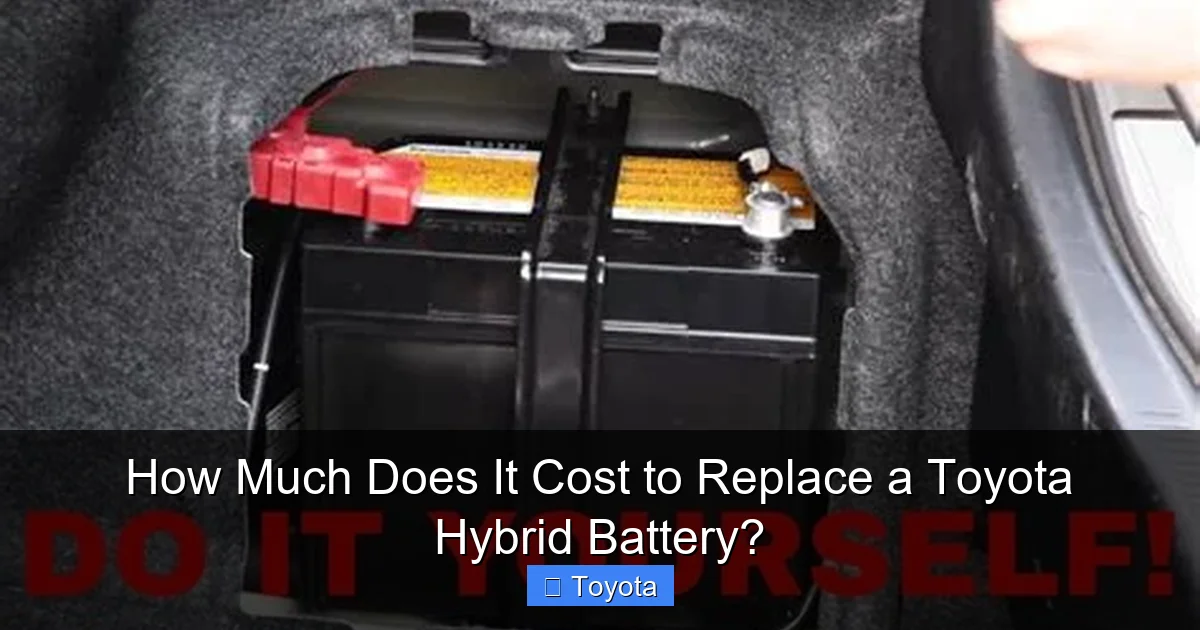
Visual guide about How Much Does It Cost to Replace a Toyota Hybrid Battery?
Image source: autozonic.com
| Model & Typical Years | Battery Type | New OEM (Parts & Labor) | Quality Remanufactured (Parts & Labor) | Notes |
|---|---|---|---|---|
| Toyota Prius (Gen 2: 2004-2009) | NiMH (Smaller Pack) | $2,800 – $3,800 | $1,600 – $2,400 | One of the most common and affordable replacements. Huge aftermarket for remans. |
| Toyota Prius (Gen 3: 2010-2015) | NiMH (Larger Pack) | $3,200 – $4,500 | $1,800 – $2,800 | Slightly more complex. Still very common. |
| Toyota Camry Hybrid (2012-2017) | NiMH | $3,000 – $4,200 | $1,900 – $2,900 | Pack is located under the rear seat. Labor is straightforward. |
| Toyota RAV4 Hybrid (2016-2020) | NiMH | $3,500 – $4,800 | $2,200 – $3,400 | Larger pack. Access is reasonable but the unit is heavy. |
| Toyota RAV4 Prime (2020+) | Li-ion (High Capacity) | $5,000 – $8,000+ | $3,500 – $5,500+ | The most expensive. Lithium-ion tech and larger size drive cost up. Fewer reman options. |
What about the Toyota Camry Hybrid specifically? Since it’s such a popular model, it’s worth a separate note. The cost to replace a Toyota Camry Hybrid battery typically falls in the mid-range of the spectrum shown above. For a 2012-2017 model, you’re firmly in that $1,900 – $2,900 range for a quality remanufactured unit with labor. The battery’s location under the rear seat makes access relatively simple for a mechanic, which helps keep labor costs more predictable compared to some models where the battery is buried. If you own a Camry Hybrid, you’re in a good position for affordable repair options. You can read more about the specific costs for that model in our dedicated guide on how much a Toyota Camry Hybrid battery costs.
Your Three Main Replacement Paths: Weighing the Options
Okay, you have a quote. But what does “remanufactured” really mean? Let’s dive deep into the three paths so you can choose with confidence.
Visual guide about How Much Does It Cost to Replace a Toyota Hybrid Battery?
Image source: carscoops.com
Path 1: The Dealer / New OEM Battery
Pros: Unmatched reliability. Full factory warranty (typically 8 years/100,000 miles from original in-service date, which may be extended by the replacement). Perfect compatibility. No “core charge” hassle (you just pay the price). The car’s hybrid system software knows exactly what it’s talking to.
Cons: The highest cost by a significant margin. You’re paying for the Toyota name, the warranty, and the fact that it’s brand new.
Best for: Drivers who plan to keep the car for many more years, want zero worry, or have a vehicle still under the original hybrid battery warranty (in which case it should be free!). Also necessary if your car has a software update that only a dealer can apply.
Path 2: The Reputable Remanufacturer
Pros: Excellent value. You get 80-95% of the performance and reliability of a new battery at 50-70% of the cost. Good warranties (3-5 years is standard from reputable companies). Environmentally better (recycling the core).
Cons: Requires research. Not all remanufacturers are created equal. A bad reman can be a money pit. Warranty is from the reman company, not Toyota. You may have a “core charge” (a deposit you get back when you return your old battery).
How to choose a good one: Look for companies with long histories (e.g., Green Bean Battery, Hymotion/PlugnSave, Bumble Bee Batteries). Read reviews. Ask about their testing process (they should test every cell/module). A warranty that covers parts and labor is a huge plus. Avoid the cheapest option on the market—it’s cheap for a reason.
Path 3: The Used or “Core” Battery
Pros: Very low upfront cost.
Cons: It’s a lottery. The battery could have 20% life left or 80%. No meaningful warranty. No testing was done (usually). You’re swapping one problem for another, likely very soon. The labor to install it is the same as a new one, so you’re paying full labor for a part that may fail.
Verdict: Not recommended for anyone who relies on their car daily. The risk far outweighs the minimal savings. This is a path for hobbyists with a second car or a project vehicle, not your primary transportation.
Smart Saving Strategies: How to Reduce the Bill
Feeling overwhelmed by the numbers? Don’t be. You have more leverage than you think.
Get Multiple, Itemized Quotes
Never, ever accept the first quote. Get at least three. One from the dealer (for a baseline OEM price), one from a reputable local hybrid shop, and one from a well-regarded national reman mail-order company (they often have partnered installers). Make sure each quote breaks down the cost of the battery itself and the labor separately. This allows you to compare apples to apples.
Consider the Core Charge
When you buy a remanufactured battery, you’ll often pay a “core charge” (e.g., $200-$400). This is a deposit you get back when you return your old, dead battery to the remanufacturer. Factor this into your cash flow. You’ll get the money back, but you need to have the cash upfront. The dealer doesn’t do this because they handle the core internally.
Ask About Warranty Extensions
Some national remanufacturers offer the option to purchase extended warranties for a few hundred dollars more. If you plan to keep the car for 5+ more years, this can be a smart investment for peace of mind.
Timing Can Matter
Independent shops may have slower periods (winter, early spring). Calling for a quote then might get you a slightly better labor rate or more flexibility. Dealerships often have service specials or loyalty discounts—it never hurts to ask.
The DIY Question: Should You Do It Yourself?
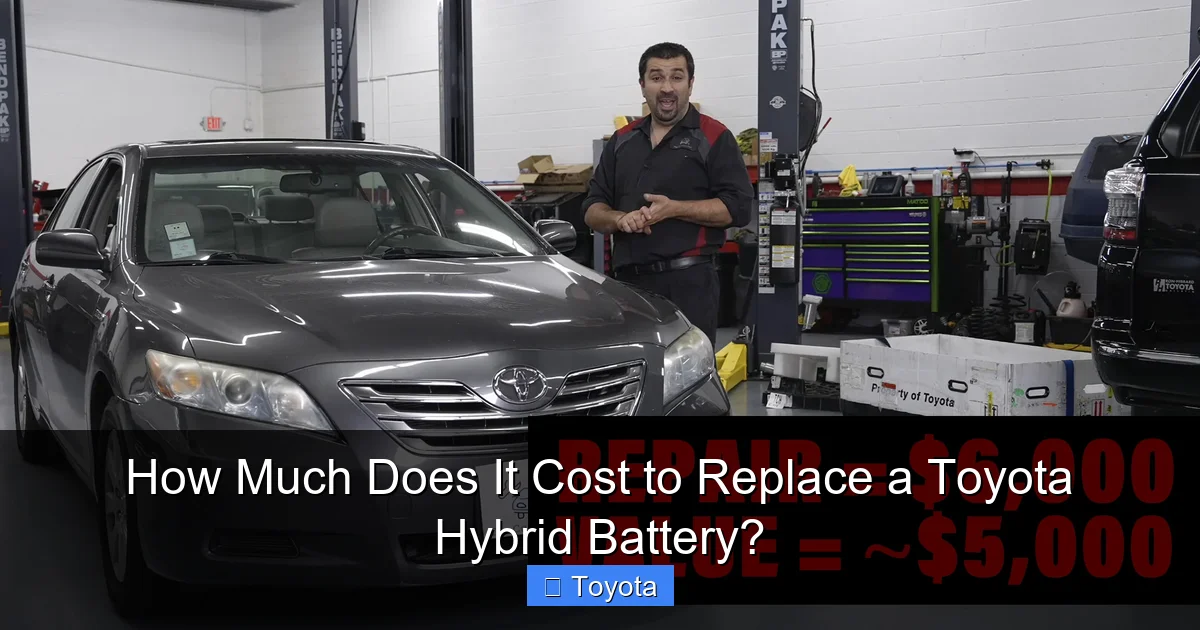
Short answer: No. The long answer is also no, unless you are a trained hybrid technician with the proper high-voltage safety equipment (insulated tools, safety gloves, etc.). You are dealing with a battery system that can carry hundreds of volts. One mistake can cause severe injury, death, or catastrophic damage to your car’s computer systems. The “savings” are not worth the extreme risk. Leave this to the professionals. While you might save on labor for simpler tasks like a Mercedes auxiliary battery, a hybrid traction battery is in a completely different league of complexity and danger.
Beyond the Battery: Additional Costs & Important Considerations
That quote isn’t always the final number. Here’s what else might pop up:
- Diagnostic Fee: Some shops charge a fee to confirm the battery is bad (e.g., $100-$150). This is often waived if you proceed with the repair with them.
- Software Updates/Recalibration: Especially on newer models, the hybrid system may need a software update or a specific recalibration procedure after battery replacement. Dealerships are almost always required for this and can charge $100-$300 for the time. Some independent shops with the right equipment can do it cheaper. Ask if this is included in the quote.
- Ancillary Parts: While you’re in there, a shop might recommend replacing the battery’s cooling fan filter or inspecting the high-voltage cable connections. These are minor costs ($20-$100) but can be prudent for long-term health.
- Tax and Disposal Fees: Sales tax applies to parts and labor in most states. There is also a fee for properly disposing of the old hazardous battery, usually handled by the remanufacturer or shop and folded into the core charge or parts cost.
Also, check your warranty! The hybrid battery in your Toyota is covered under the Hybrid System Warranty, which is typically 8 years/100,000 miles from the original sale date (in most states; California has a longer warranty). If your car is still within that original warranty period, the replacement should be free at a Toyota dealership. Call your dealer with your VIN to confirm before spending a dime. This is the single most important check you can make.
The Bottom Line: Knowledge is Your Best Defense
So, how much does it cost to replace a Toyota hybrid battery? The honest, infuriating answer is: it depends. But now you know what it depends on. You know that a remanufactured battery from a reputable source for a common Prius or Camry Hybrid will likely land you in the $1,800 – $2,800 range with labor. You know that a new RAV4 Prime battery can push $7,000. You know to get multiple quotes, to understand the warranty, and to verify your original warranty status first.
Your Toyota hybrid was an investment in efficiency and reliability. The battery replacement is a significant, but not necessarily catastrophic, cost of ownership for these fantastic vehicles. By approaching it with the information in this guide, you transform that daunting question mark into a manageable, informed decision. You’re not a victim of circumstance; you’re a savvy consumer. You’ve got this. Now, go get those quotes, check that VIN for warranty coverage, and get your trusted hybrid back on the road, sipping gas and purring quietly for years to come.
Frequently Asked Questions
How much does a Toyota hybrid battery replacement cost?
The total cost for a Toyota hybrid battery replacement typically ranges from $2,000 to $5,000 for most models. This price includes both the new or remanufactured battery pack and the labor required for installation, which can vary by region and dealer.
What factors affect the price of a Toyota hybrid battery replacement?
The final cost depends on your specific Toyota model and year, as battery size and design differ. Other factors include whether you choose a new OEM battery, a remanufactured unit, or a used one, with new batteries being the most expensive option.
Is a Toyota hybrid battery replacement covered under warranty?
Yes, in many cases. Federal emissions regulations mandate hybrid battery warranties for 8 years or 100,000 miles, and in California, it’s 10 years or 150,000 miles. If your vehicle is within this warranty period, the replacement cost may be reduced or covered entirely.
Can I save money with a remanufactured Toyota hybrid battery?
Yes, opting for a remanufactured Toyota hybrid battery can save you 30-50% compared to a brand-new OEM unit. These batteries are rebuilt to meet original specifications and often come with a solid warranty, offering a cost-effective alternative.
How long does a Toyota hybrid battery last before needing replacement?
A Toyota hybrid battery is designed to last for the life of the vehicle, often exceeding 150,000 miles. However, factors like extreme climates, driving habits, and the age of the vehicle can influence its lifespan and the eventual need for a replacement.
Where should I get my Toyota hybrid battery replacement done?
For a Toyota hybrid battery replacement, it’s best to use a certified Toyota dealer or a reputable specialist with hybrid vehicle experience. They ensure proper disposal of the old battery, use correct diagnostic tools, and provide warranties on both parts and labor.