
How Much Does It Cost to Replace a Catalytic Converter in a Toyota Corolla

Replacing a catalytic converter on a Toyota Corolla typically costs between $1,200 and $3,500, with the final price depending heavily on your Corolla’s model year, engine type, and whether you choose an OEM or aftermarket part. Labor rates in your area and any additional exhaust system damage also play a major role. While this is a significant expense, it’s often necessary to pass emissions tests and prevent engine damage. Understanding the breakdown of parts and labor can help you budget and find the best deal.
Key Takeaways
- High Cost Driver: The catalytic converter itself is the most expensive part, containing precious metals like platinum, palladium, and rhodium, which drive up the price dramatically.
- Model Year Matters: Corollas from 1996-2000 (OBD-II era) and newer hybrids have more complex and expensive converters than older, simpler models.
- Labor is Significant: Replacement is labor-intensive, often requiring 2-4 hours of work, especially on models where the converter is integrated with the front pipe or manifold.
- OEM vs. Aftermarket: OEM (Toyota) parts are the most expensive but guarantee fit and compliance. High-quality aftermarket converters can save 30-50% but must meet your state’s emissions standards.
- Underlying Causes: A failing converter is usually a symptom of another issue (e.g., oil burning, rich fuel mixture, faulty spark plugs). Fixing the root cause is critical to avoid replacing the new one prematurely.
- DIY is Rarely Feasible: While possible for experts, most owners should hire a professional due to the need for welding, proper alignment, and ensuring no exhaust leaks.
- Warranty Considerations: Check if your Corolla’s power train warranty (if still active) or an extended warranty might cover the failure, as it’s often considered a wear item excluded from basic warranties.
[FEATURED_IMAGE_PLACEHOLDER]
📑 Table of Contents
- Introduction: The Silent Guardian Under Your Car
- Decoding the Cost: Parts vs. Labor vs. Your Location
- Cost Breakdown by Toyota Corolla Generation and Engine
- Diagnosis First: Is It Really the Catalytic Converter?
- Your Options: Repair Strategies and Money-Saving Tips
- The Long Haul: Maintenance and Preventing Future Failure
- Conclusion: Weighing the Investment
Introduction: The Silent Guardian Under Your Car
Nestled somewhere in the exhaust system of your trusty Toyota Corolla is a unassuming, honeycomb-like metal canister. It’s not as glamorous as a turbocharger or as noticeable as a muffler, but it plays one of the most critical environmental roles in your vehicle: the catalytic converter. This component is your car’s silent guardian, working at high temperatures to transform harmful gases—carbon monoxide, hydrocarbons, and nitrogen oxides—into less harmful carbon dioxide, nitrogen, and water vapor. It’s not just about being eco-friendly; it’s a legal requirement for roadworthiness and a key component for your engine’s health and performance.
So, what happens when this vital part fails? For a Toyota Corolla, known for its reliability, a catalytic converter failure can feel like an unwelcome and expensive surprise. The dreaded “check engine” light might illuminate, often with a P0420 or P0430 code indicating catalyst system efficiency below threshold. You might notice a rotten egg smell (sulfur), poor acceleration, or even dark, smoky exhaust. Once confirmed, the big question looms: how much does it cost to replace a catalytic converter in a Toyota Corolla? The answer isn’t simple, as prices can range from a “manageable shock” to a “major financial event.” This comprehensive guide will break down every factor influencing that final bill, provide realistic price ranges for different Corolla generations, and arm you with the knowledge to make an informed, cost-effective decision.
Decoding the Cost: Parts vs. Labor vs. Your Location
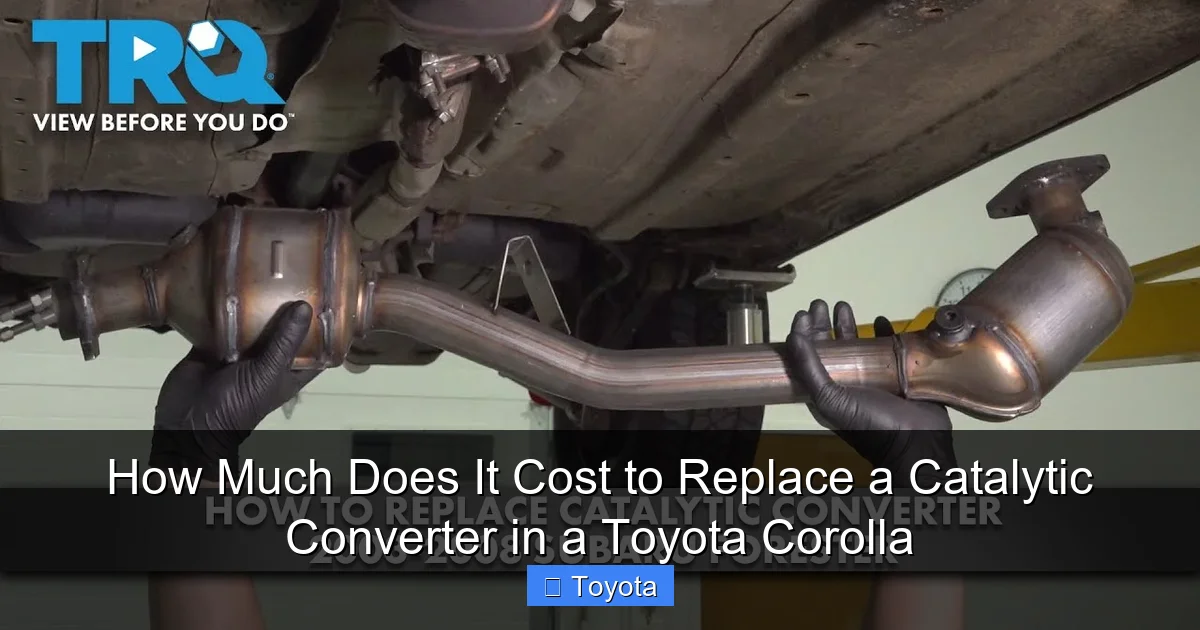
The total cost for a catalytic converter replacement is a sum of three primary components: the part itself, the labor to install it, and any necessary additional parts or taxes. Understanding this breakdown is the first step to avoiding sticker shock.
Visual guide about How Much Does It Cost to Replace a Catalytic Converter in a Toyota Corolla
Image source: i.ytimg.com
The Price of the Converter: Precious Metals and Precision Engineering
The catalytic converter’s core is a ceramic or metallic substrate coated with a washcoat impregnated with precious metals—platinum, palladium, and rhodium. These metals are not only rare but also traded on commodities markets, meaning their prices fluctuate based on global supply and demand. This is the single biggest reason for the high cost. A converter for a modern Corolla can contain several hundred dollars’ worth of these metals alone.
- OEM (Original Equipment Manufacturer): A genuine Toyota catalytic converter is the most expensive option, typically ranging from $800 to $2,000+ for the part alone. You are paying for guaranteed perfect fit, exact compliance with federal and state emissions standards (especially crucial in California and CARB-compliant states), and the peace of mind of a part that meets Toyota’s original specifications.
- Aftermarket (Direct Fit/Universal): High-quality aftermarket brands (like Bosal, MagnaFlow, AP Catalytic) offer significant savings. A direct-fit converter designed for your specific Corolla model year and engine will usually cost between $400 and $1,200. Universal converters are cheaper but require welding and fabrication, adding labor cost and potential for error. CRITICAL: Any aftermarket converter must be EPA-certified and, if you live in a strict emissions state (like CA, NY, VT, etc.), must also be CARB-certified. Using a non-compliant part will cause you to fail emissions testing and is illegal in those states.
- Used/Refurbished: Generally not recommended. A used converter’s core precious metals are already depleted, and its internal structure may be compromised. It’s a gamble that often leads to a repeat failure. Some companies “rebuild” converters by replacing the core, but the cost savings are minimal compared to a new aftermarket unit, and reliability is questionable.
The Labor Factor: More Than Just a Bolt-On Job
This is where the real variability comes in. Replacing a catalytic converter is rarely a simple 30-minute job. Labor time is measured in “book hours,” which are standardized estimates, but actual time can vary.
- Typical Labor Time: For most Corollas (2009-2019 with 1.8L or 2.0L engines), expect 2.0 to 3.5 book hours. For models where the converter is part of the exhaust manifold (like some early 2000s models) or is located in a tight, rust-prone area, this can jump to 4.0 or more hours.
- Labor Rates: Shops charge anywhere from $75 to $150+ per hour. Using a national average of $110/hour, a 3-hour job is $330 in labor alone. At a dealership in an urban area at $140/hour, that same 3-hour job is $420.
- The Rust Factor: This is a huge wild card, especially in northern states or coastal areas where salt is used on roads. Bolts can seize, flanges can break, and pipes can be corroded. A simple unbolt becomes a multi-hour process of cutting, grinding, and welding new hardware, dramatically increasing both parts (new gaskets, hardware, possibly pipe sections) and labor costs. Always ask the shop to inspect for rust before giving a final quote.
Regional and Shop Variations
Geography matters. Labor rates in California, New York, or Massachusetts are typically 20-40% higher than in the Midwest or Southeast. Additionally, independent repair shops are almost always less expensive than Toyota dealership service departments for this type of non-warranty work. Always get at least 3 detailed, written estimates from reputable shops (dealership, independent, and a specialized exhaust shop) to compare.
Cost Breakdown by Toyota Corolla Generation and Engine
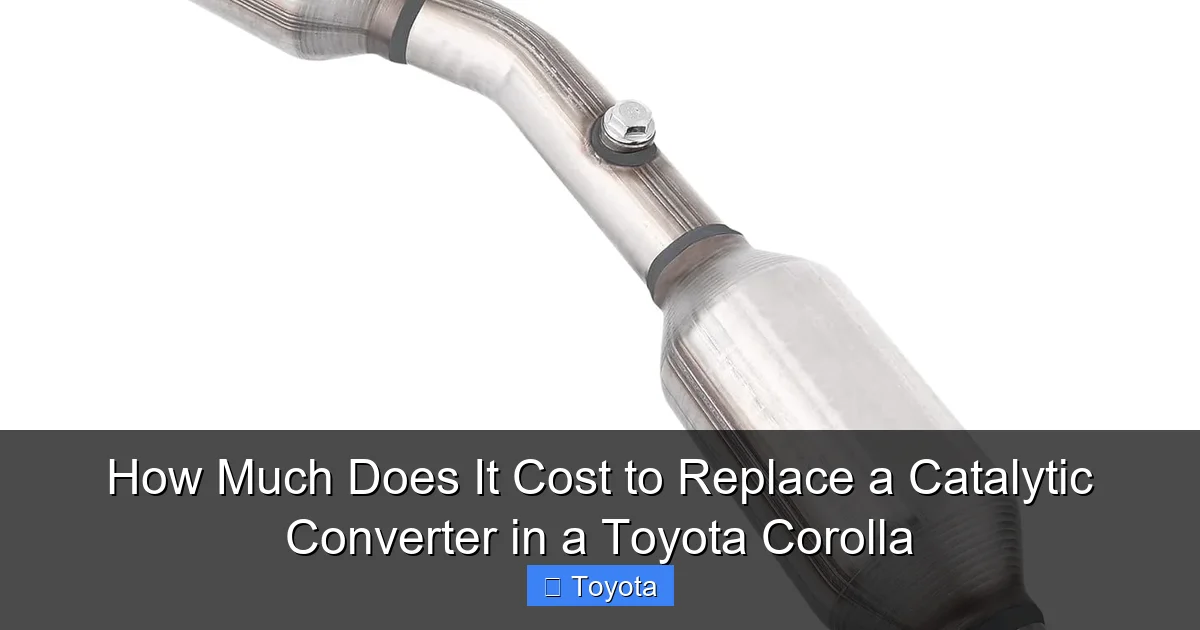
To give you a concrete starting point, here are estimated total replacement costs (parts + labor) for common Corolla engines. These are national averages; your local market will vary.
Visual guide about How Much Does It Cost to Replace a Catalytic Converter in a Toyota Corolla
Image source: m.media-amazon.com
7th Generation (E110): 2002-2007 Models
These Corollas typically came with the 1.8L 1ZZ-FE engine. The catalytic converter is usually a standalone unit located under the car, behind the flex pipe. It’s generally accessible but prone to rust.
- OEM Part + Labor: $1,500 – $2,800
- Aftermarket Direct-Fit + Labor: $1,000 – $2,000
- Key Note: The 2003-2007 models with the 1ZZ-FE are known for a specific issue: oil consumption due to piston ring failure. This oil burning can cause catalytic converter failure. If your Corolla is burning oil (more than 1 quart per 1,000 miles), you must address this first or your new converter will fail again quickly. This is a perfect example of why a proper diagnosis is essential. For context on other common Toyota issues, you might look at the cost to change oil in a car more frequently if you’re managing a vehicle with high oil consumption.
8th Generation (E120/E140): 2008-2013 Models
This generation introduced the 1.8L 2ZR-FE engine in most models. The design is similar to the previous gen, but parts pricing reflects updated emissions standards. Access is still fair.
- OEM Part + Labor: $1,600 – $3,000
- Aftermarket Direct-Fit + Labor: $1,100 – $2,200
- Key Note: Some 2009-2010 models had issues with exhaust manifold studs breaking, which can complicate the job if the converter is integrated. Always get a quote that includes a potential “worst-case scenario” for rust or broken hardware.
9th Generation (E170): 2014-2019 Models
The Corolla was redesigned for 2014. The standard engine was the 1.8L 2ZR-FE, but the 2017+ models got the more efficient 2.0L M20A-FKS Dynamic Force engine. The 2.0L models have a more complex exhaust system with a closer-coupled catalytic converter near the manifold, making access trickier and labor times longer.
- 1.8L (2014-2016) OEM + Labor: $1,700 – $3,200
- 1.8L (2014-2016) Aftermarket + Labor: $1,200 – $2,400
- 2.0L (2017-2019) OEM + Labor: $1,900 – $3,500+
- 2.0L (2017-2019) Aftermarket + Labor: $1,300 – $2,600+
- Key Note: The 2.0L’s converter is often more expensive due to its design and integration. For owners of these newer Corollas, the cost can approach the higher end of the spectrum.
The Toyota Corolla Hybrid (2020-Present)
This is a special case. The hybrid system uses a gasoline engine and electric motors. The catalytic converter is still present on the gasoline engine but is part of a more complex exhaust system that also serves the engine start-stop functionality. Parts are proprietary and less common in the aftermarket, leading to higher costs.
- Estimated Total Cost: $2,200 – $4,000+
- Key Note: Due to the complexity, dealership or highly specialized hybrid shop diagnosis and repair is strongly advised. The cost reflects the specialized nature of the part and labor.
Diagnosis First: Is It Really the Catalytic Converter?
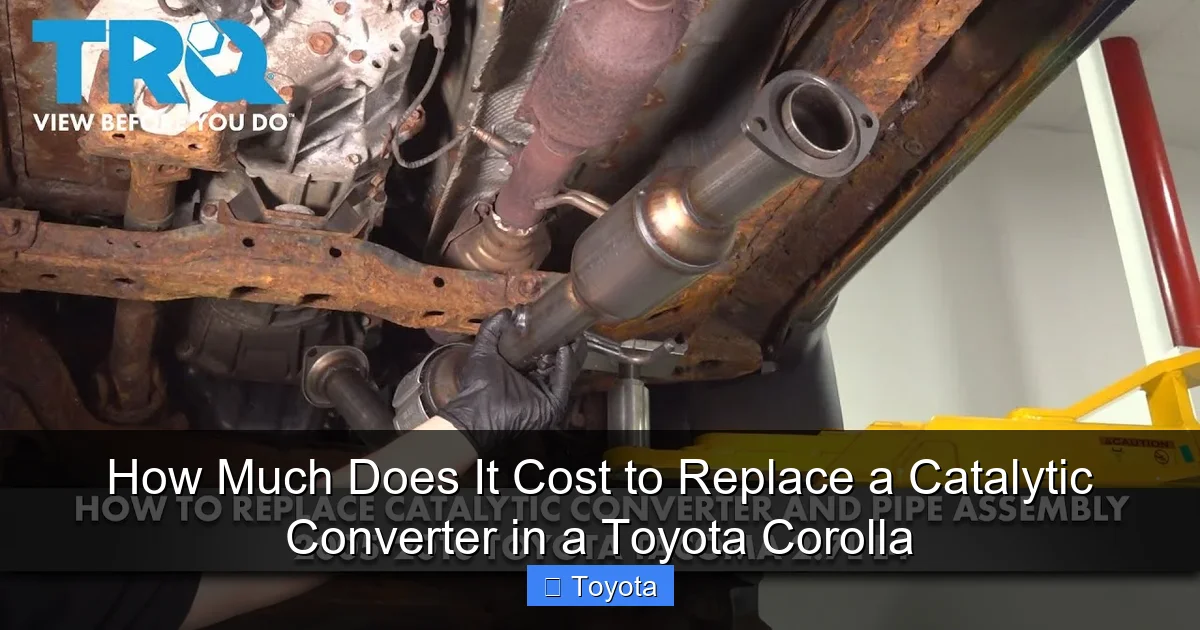
Before you spend a dime, you must be sure the catalytic converter is the culprit. A P0420 code is a starting point, not a definitive diagnosis. It means the oxygen sensor downstream of the converter is seeing similar readings to the upstream sensor, indicating the converter isn’t cleaning the exhaust effectively. However, many other issues can trigger this code.
Visual guide about How Much Does It Cost to Replace a Catalytic Converter in a Toyota Corolla
Image source: video-thumbnails-1a.s3.amazonaws.com
Common Mimics of Catalytic Converter Failure
- Faulty Oxygen (O2) Sensors: A lazy or dead O2 sensor, especially the upstream (before cat) sensor, can send bad data to the engine computer, making it think the converter is failing when it’s not. Replacing an O2 sensor is much cheaper ($200-$400).
- Exhaust Leaks: A leak before the downstream O2 sensor (like a cracked manifold or a bad gasket) allows extra oxygen into the exhaust stream, confusing the sensor and triggering the code. Fixing an exhaust leak is far less expensive.
- Engine Misfires: Unburned fuel entering the exhaust from a misfiring cylinder (due to bad spark plugs, coils, or injectors) can overheat and melt the converter’s substrate. You must fix the misfire first. A misfire code (P0300-P0304) will often accompany the catalyst code.
- Oil/Coolant Contamination: Burning oil (from worn rings, valve seals) or leaking coolant (from a head gasket) can coat the catalyst substrate, poisoning it and causing failure. This is a major engine issue that must be resolved.
The Proper Diagnostic Path
A responsible mechanic will perform a “live data” scan to monitor the O2 sensor voltage swings. A healthy converter shows a slow, steady oscillation from the downstream sensor. A failed one shows a flatline or a signal mimicking the upstream sensor. They will also perform a backpressure test using a pressure gauge in the O2 sensor port to see if exhaust flow is restricted. They will visually inspect for exhaust leaks, check for oil in the spark plug holes, and review maintenance history. Do not accept a diagnosis based solely on a code read. Insist on this verification process. If you’re dealing with a general repair and want to understand other common diagnostic scenarios, resources on fixing a tire with a nail show how a simple visual and diagnostic check can prevent unnecessary parts replacement.
Your Options: Repair Strategies and Money-Saving Tips
Once you have a confirmed diagnosis and a detailed quote, you have several paths forward. Your choice depends on your budget, how long you plan to keep the car, and local regulations.
1. Full Replacement with a New Converter
This is the standard, most reliable repair. You get a new, compliant converter with a warranty (typically 1-2 years/unlimited miles for aftermarket, 3-5/60k for some OEM). This is the best choice if you plan to keep the Corolla for several more years or if you live in a strict emissions state. Use the cost breakdowns from Section 2 as your guide.
2. Used or Refurbished Converter (High-Risk)
As mentioned, this is risky. Salvage yard converters have unknown histories and depleted precious metals. Some companies offer “refurbished” units where the old core is replaced. The cost savings might be 20-30% over a new aftermarket part. The risk of premature failure and the hassle of a repeat repair often outweigh the savings. Only consider this as a very temporary fix to get through an inspection if you’re selling the car soon.
3. Catalytic Converter Cleaner/Additive (Limited Effectiveness)
You’ve seen them at auto parts stores: bottles promising to clean your clogged cat. These fuel-system additives can sometimes help with mild carbon buildup if the failure is very early and caused by poor combustion. They will NOT fix a physically melted, broken, or poisoned converter. They are cheap ($10-$30) and worth a try if the failure is minor and you want to attempt a last-ditch effort before replacement, but manage your expectations.
4. Straight Pipe or “Test Pipe” (Illegal and Detrimental)
Some consider removing the converter entirely and installing a straight piece of pipe. This is illegal in all 50 states for on-road vehicles. It will cause an immediate check engine light (and failed emissions test), increase harmful emissions, hurt fuel economy, and often cause a loud, unpleasant exhaust note. It can also cause the engine computer to run in a default, less efficient “limp mode.” Do not do this if you intend to legally drive the car on public roads.
Money-Saving Action Plan
- Get Multiple Quotes: As stressed, get at least three. An independent shop might be $500 cheaper than the dealer for the same aftermarket part.
- Ask About the Part: “Is that an OEM, aftermarket, or remanufactured part? What brand? Is it CARB-certified for my state?”
- Clarify Labor: “What is the estimated labor time? Does the quote include new gaskets, bolts, and oxygen sensors if needed? Is there an extra charge if you find rust or broken bolts?”
- Consider a “Core Charge”: Some parts stores charge a refundable “core charge” for the old converter, which you get back when you turn in the old part. This is standard.
- Check for Warranties: If your Corolla is still under the original 5-year/60,000-mile (or similar) Toyota warranty, it might cover a failed converter, but they often exclude “wear items” like emissions components. Call the dealer with your VIN. Also, if you purchased an extended warranty, review its terms.
- Fix the Root Cause: This is the most important tip. Spending $2,000 on a new converter only to have it fail in 10,000 miles because you ignored a $300 oil consumption repair or a $150 spark plug job is the worst possible outcome. Ensure the diagnosis includes checking for the underlying problems listed in Section 3.
The Long Haul: Maintenance and Preventing Future Failure
A catalytic converter should last the life of the vehicle—often 100,000 miles or more—if the engine is properly maintained. Failures are almost always preventable. Here’s how to protect your investment after replacement and avoid needing another one.
The Golden Rules of Converter Longevity
- Address “Check Engine” Lights Immediately: Never ignore a warning light. A misfiring cylinder, a faulty sensor, or a rich-running condition (too much fuel) can poison or melt the converter in a matter of miles. The moment a light comes on, have the code read and diagnosed.
- Stick to a Rigorous Maintenance Schedule:
- Spark Plugs & Wires/Coils: Replace on schedule. Worn plugs cause misfires, dumping unburned fuel into the exhaust.
- Oxygen Sensors: Replace as recommended (often 60k-100k miles). Bad O2 sensors lead to incorrect fuel mixtures.
- Air Filter: A clogged filter restricts airflow, causing a rich mixture. Change it regularly.
- Fuel Injectors: Keep them clean. Leaking injectors cause rich conditions.
- PCV Valve: A stuck PCV valve can force oil vapors into the intake, leading to oil consumption and eventual converter contamination.
- Use the Correct Fuel: For your Corolla, this means Top Tier detergent gasoline. These fuels have superior detergent additives that help keep combustion chambers and injectors clean, promoting complete combustion and reducing contaminant buildup in the exhaust. Avoid cheap, low-quality fuels.
- Monitor for Oil Consumption: If you find yourself adding a quart of oil between regular changes (every 5,000 miles), have it checked. Excessive oil burning is a leading cause of converter failure. This is a known issue with some Toyota engines, like the 1ZZ-FE mentioned earlier. For general maintenance, understanding how much it costs to change oil in a car regularly is cheaper than a catalytic converter replacement.
- Avoid Short Trips and Idling: Catalytic converters need to reach a high operating temperature (600-800°F) to work efficiently and to burn off any carbon deposits. Frequent very short trips (less than 5-10 minutes) prevent the cat from fully heating up, leading to carbon buildup and eventual clogging. If your driving pattern consists mostly of short trips, occasionally take the car on a 20-30 minute highway drive to allow the converter to thoroughly “regen” itself.
Conclusion: Weighing the Investment
A catalytic converter replacement on your Toyota Corolla is one of the most expensive single-component repairs you’ll face. The cost, typically between $1,200 and $3,500, reflects the precious metals inside and the labor-intensive nature of the job. It’s a repair that tests both your wallet and your patience. However, it’s not an insurmountable obstacle. The key is knowledge. By understanding the factors that drive cost—OEM vs. aftermarket parts, your specific model year and engine, regional labor rates, and the ever-present specter of rust—you can walk into any repair shop with confidence and a fair expectation of price.
More importantly, remember that the converter is a symptom as much as it is a part. A failure is almost always preceded by another issue: a misfire, an oil leak, a neglected maintenance item. The cheapest and most effective catalytic converter repair is the one you never need. A commitment to diligent, on-schedule maintenance is the ultimate shield for your Corolla’s exhaust system. If you do face this repair, take your time, get multiple detailed quotes, insist on a thorough diagnosis of the root cause, and choose a reputable shop. Your Toyota Corolla is a remarkable machine, and with the right approach, you can get it back on the road, running cleanly and reliably for many more miles to come.
Frequently Asked Questions
Can I drive my Toyota Corolla with a bad catalytic converter?
You can drive it for a short distance to a repair shop, but prolonged driving is not advised. A severely clogged converter will cause major power loss and can overheat, potentially causing fire risk or catastrophic engine damage due to backpressure. It will also fail any emissions test immediately.
How long should a catalytic converter last in a Toyota Corolla?
With proper engine maintenance, a factory catalytic converter should last 100,000 miles or more, often the life of the vehicle. Failures before 80,000 miles are usually due to an underlying issue like oil burning, repeated misfires, or contaminated fuel that damaged the converter prematurely.
Will a cheaper aftermarket catalytic converter pass emissions in California?
Only if it is specifically CARB (California Air Resources Board) certified. California and several other states have the strictest emissions standards in the nation. An “EPA-only” aftermarket converter, which is legal in most states, will fail a California smog check. Always verify the part’s certification matches your state’s requirements before purchasing.
Is a catalytic converter covered under Toyota’s warranty?
It depends. The federal emissions warranty covers the converter for 8 years/80,000 miles (or 10 years/100,000 miles in some states). However, many standard Toyota power train warranties have exclusions for “wear and tear” items. You must check your specific warranty booklet. Failures due to neglect (like not fixing an engine misfire) are never covered.
What happens if I just put a straight pipe on my Corolla?
It will trigger a permanent check engine light (P0420), cause your vehicle to fail any required emissions inspection, and is illegal for public road use in all 50 states. It may also reduce fuel economy, trigger limp mode in the engine computer, and create excessive noise. It is not a viable solution for a daily driver.
Can the check engine light turn itself off after a converter replacement?
No. After a new converter is installed, the mechanic must clear the diagnostic trouble codes (DTCs) with a scan tool. The car’s computer will then begin monitoring the new converter. If the underlying problem is fixed, the light will stay off. If the root cause persists, the code and light will return, often within 50-100 miles of driving.
