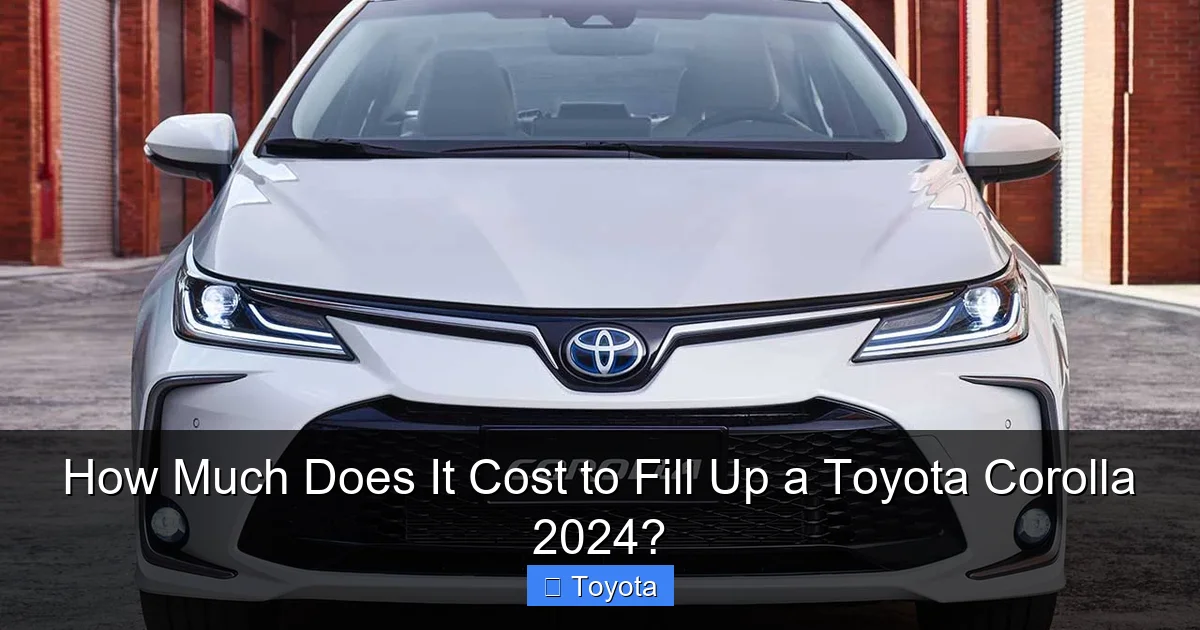
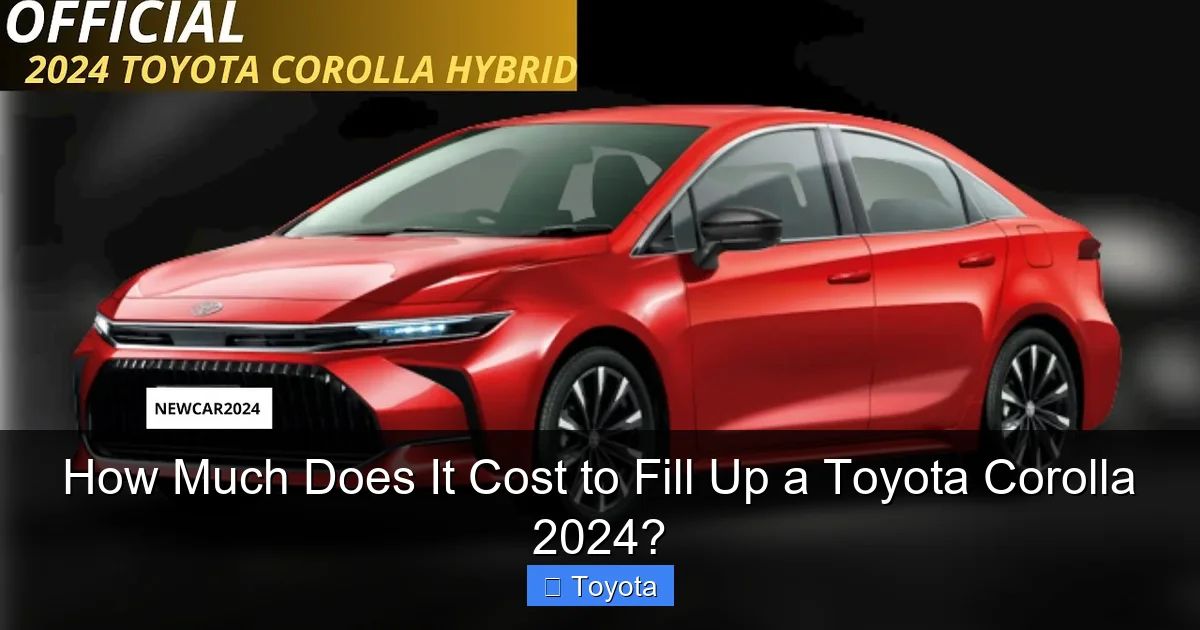
How Much Does It Cost to Fill Up a Toyota Corolla 2024?

Contents
- 1 Key Takeaways
- 2 📑 Table of Contents
- 3 Understanding the 2024 Corolla’s Fuel System: Tank Size and Fuel Types
- 4 The Wild Card: Current U.S. Gas Prices (A State-by-State Breakdown)
- 5 Doing the Math: Calculating Your Exact Fill-Up Cost
- 6 Hybrid vs. Gasoline: The Real Savings Equation
- 7 Smart Strategies to Reduce Your Per-Fill-Up Cost
- 8 The Big Picture: Total Cost of Ownership
- 9 Conclusion: Your Fill-Up, Your Formula
- 10 Frequently Asked Questions


The cost to fill up a 2024 Toyota Corolla depends entirely on your local gas prices and whether you choose the efficient hybrid or gasoline model. With a 13.2-gallon tank and excellent fuel economy, a typical fill-up ranges from $40 to $65 for gasoline, while the hybrid often costs slightly more per gallon but requires fewer fill-ups overall. Your actual cost will vary significantly by state and even neighborhood, making gas price apps essential tools for any Corolla owner.
So, you’re thinking about a 2024 Toyota Corolla, or you just bought one. Smart choice. It’s consistently one of the best-selling cars in America for a reason: it’s reliable, practical, and incredibly fuel-efficient. But the big question on everyone’s mind, especially with gas prices that seem to dance to their own unpredictable rhythm, is: “How much does it actually cost to fill up this thing?”
The answer isn’t a single number. It’s a range. It’s a math problem that changes every week. It depends on where you live, which engine is under the hood, and how you drive. But don’t worry. We’re going to break it all down, from the size of the tank to the price at the pump in your city. By the end, you’ll know exactly what to budget for and, more importantly, how to keep that cost as low as possible. Let’s pop the hood on the numbers.
Key Takeaways
- The 2024 Corolla’s fuel tank holds 13.2 gallons for both gas and hybrid models. This consistent size means the primary cost variable is the price per gallon at your local pump.
- Gasoline model owners can expect a fill-up cost between $40 and $65 in most of the U.S. This is based on average national gas prices and the Corolla’s combined 33 MPG rating.
- The 2024 Corolla Hybrid is even more fuel-efficient (up to 50 MPG combined) but often uses premium fuel. This can mean a higher cost per gallon but dramatically fewer trips to the station.
- Geographic location is the biggest factor. Filling up in California or New York can cost 30-50% more than in Texas or Oklahoma due to state taxes and refinery costs.
- Driving habits and vehicle maintenance directly impact your real-world cost per mile. Proper tire inflation, gentle acceleration, and regular maintenance can improve MPG by 10-15%, effectively lowering your fill-up cost.
- Long-term ownership cost favors the hybrid. While the hybrid’s fill-up might cost more each time, the total annual fuel expense is typically $200-$400 less than the gasoline model.
- Using real-time gas price apps can save you $5-$15 per fill-up. Shopping for the cheapest station within a few miles of your regular route is the easiest way to reduce your fuel bill.
📑 Table of Contents
- Understanding the 2024 Corolla’s Fuel System: Tank Size and Fuel Types
- The Wild Card: Current U.S. Gas Prices (A State-by-State Breakdown)
- Doing the Math: Calculating Your Exact Fill-Up Cost
- Hybrid vs. Gasoline: The Real Savings Equation
- Smart Strategies to Reduce Your Per-Fill-Up Cost
- The Big Picture: Total Cost of Ownership
- Conclusion: Your Fill-Up, Your Formula
Understanding the 2024 Corolla’s Fuel System: Tank Size and Fuel Types
Before we can calculate a cost, we need to know the capacity we’re filling. The 2024 Toyota Corolla has a unified fuel tank size across its lineup, which simplifies our math.
The Standard Fuel Tank Capacity
Every 2024 Corolla, whether it’s the base L trim with a 2.0-liter four-cylinder engine or the top-tier XLE Hybrid, comes equipped with a 13.2-gallon (50-liter) fuel tank. This is a slight increase from some previous model years, designed to give you more range between fill-ups without significantly impacting the car’s weight or efficiency. This consistency is great news—it means we’re comparing apples to apples when we look at different models.
To put that in perspective, a 13.2-gallon tank is slightly larger than the Honda Civic’s 12.4-gallon tank (a key competitor), which is one reason the Corolla often boasts a longer highway range. If you’re comparing vehicles, that’s a tangible benefit. For those curious about customization, some owners of cars like the Civic choose to wrap their Honda Civic for protection and style, but that’s a separate cost from the daily fuel expense we’re focusing on here.
Gasoline vs. Hybrid: Fuel Requirements
This is a critical distinction that directly affects your pump price.
- Gasoline Models (L, LE, XLE, XSE trims with 2.0L engine): These require regular unleaded gasoline (87 octane). This is the cheapest fuel available at almost every station.
- Hybrid Models (LE Hybrid, XLE Hybrid): The 2024 Corolla Hybrid is designed to run on regular unleaded (87 octane) as well. This is a change from some older hybrid models that recommended or required premium fuel. Toyota engineered this hybrid system to be efficient with standard 87-octane gas, which is excellent news for your wallet. However, it’s always best to double-check your owner’s manual, as specifications can occasionally change mid-model year.
Important Note: There is no 2024 Corolla model that requires or recommends premium (91 octane) fuel. Using premium in a regular-87 engine provides no benefit and is a waste of money. Stick to the manufacturer’s recommendation.
The Wild Card: Current U.S. Gas Prices (A State-by-State Breakdown)
Here’s where things get interesting. The national average price for a gallon of regular unleaded gas is a useful benchmark, but it’s almost meaningless for your personal budget. Prices are dictated by a complex mix of global oil markets, regional refinery capacity, state and local taxes, and even distribution logistics. A state like California, with its unique gasoline blends and high taxes, can have prices 60-80 cents per gallon higher than Texas.
Visual guide about How Much Does It Cost to Fill Up a Toyota Corolla 2024?
Image source: i.ytimg.com
Regional Price Averages (As of Late 2023 / Early 2024 Trends)
Let’s look at some typical price ranges to frame our calculations. Remember, these fluctuate daily.
- West Coast (CA, WA, OR, NV): $4.75 – $5.50 per gallon. California consistently leads the nation in prices.
- Rocky Mountain & Midwest (CO, IL, MI, OH): $3.25 – $3.85 per gallon. Often near or slightly above the national average.
- South & Southeast (TX, OK, FL, GA, NC): $3.10 – $3.60 per gallon. Typically the cheapest regions in the contiguous U.S.
- Northeast (NY, MA, PA, NJ): $3.50 – $4.10 per gallon. Higher taxes and delivery costs push prices up.
These are wide ranges. Within a single city, you might find stations 30-50 cents apart. That difference on a 13.2-gallon tank is $4 to $6. That’s a full meal or a movie ticket, just for shopping around. If you’re someone who frequently considers larger vehicle costs, like painting a Jeep Wrangler, you know how variable costs can be—fuel is no different.
Doing the Math: Calculating Your Exact Fill-Up Cost
Now for the simple formula. The cost to fill your empty tank is:
Visual guide about How Much Does It Cost to Fill Up a Toyota Corolla 2024?
Image source: di-sitebuilder-assets.s3.amazonaws.com
(Price per gallon in your area) x 13.2 gallons = Total Fill-Up Cost
But “empty” is a relative term. Most drivers don’t run the tank to bone-dry. Let’s calculate a few realistic scenarios.
Scenario 1: The “Low Fuel” Fill-Up
You see the low fuel light come on. Typically, you have about 1-2 gallons left (the light comes on with roughly 1.5-2 gallons remaining depending on driving conditions). So you’re adding about 11-12 gallons.
- In Texas ($3.30/gal): 11.5 gal x $3.30 = $37.95
- In California ($5.00/gal): 11.5 gal x $5.00 = $57.50
Scenario 2: The “Top-Off” from a Quarter Tank
You’re at a quarter tank. You have about 3.3 gallons left. You’re adding about 9.9 gallons.
- In Florida ($3.45/gal): 9.9 gal x $3.45 = $34.16
- In New York ($3.85/gal): 9.9 gal x $3.85 = $38.12
Scenario 3: The “Full Tank from Empty” (Rare)
For completeness, filling 13.2 gallons:
- National Average (~$3.50/gal): 13.2 x $3.50 = $46.20
- Premium California Price ($5.25/gal): 13.2 x $5.25 = $69.30
As you can see, the range is huge. Your personal “cost to fill up” is almost certainly between $35 and $70 for a gasoline 2024 Corolla.
Hybrid vs. Gasoline: The Real Savings Equation
This is where the analysis gets crucial. The Corolla Hybrid costs more upfront (about a $1,500-$2,500 premium over the comparable gas model). But its fuel economy is dramatically better.
Visual guide about How Much Does It Cost to Fill Up a Toyota Corolla 2024?
Image source: ccarprice.com
Fuel Economy Face-Off
- 2024 Corolla (Gas, 2.0L, CVT): EPA-estimated 33 MPG combined (31 city / 40 highway).
- 2024 Corolla Hybrid: EPA-estimated 50 MPG combined (53 city / 52 highway).
Let’s assume you drive 12,000 miles per year.
- Gas Corolla needs: 12,000 miles / 33 MPG = ~364 gallons per year.
- Corolla Hybrid needs: 12,000 miles / 50 MPG = ~240 gallons per year.
That’s a savings of 124 gallons per year. At a national average of $3.50/gallon, that’s $434 saved annually on fuel. At California prices ($5.00/gal), that’s $620 saved annually.
Breaking Even on the Hybrid Premium
If the hybrid costs you $2,000 more upfront, and you save $434 a year on gas, it will take about 4.6 years of ownership to break even on the fuel savings alone. If gas prices rise, that payback period shortens. This doesn’t even factor in potential hybrid tax incentives or higher resale value for hybrids. For high-mileage drivers, the hybrid’s payback is much faster. It’s a long-term play. While you’re planning long-term costs, you might also consider how leasing a Honda Civic compares to buying a Corolla in terms of monthly cash flow, though leasing has its own pros and cons.
Smart Strategies to Reduce Your Per-Fill-Up Cost
You can’t control the global oil market, but you can control how, when, and where you buy gas. Here are proven tactics for the Corolla owner.
1. Use Gas Price Apps Religiously
Apps like GasBuddy, Google Maps, and even the built-in navigation in many modern cars (including some Corolla trims) show real-time prices. Set a “price threshold” for your area. Don’t just buy gas because you’re at 1/4 tank; buy it when you see a price below your threshold within a reasonable distance.
2. Master the Art of “Fill-Up Timing”
Gasoline expands with temperature. Gas stored in underground tanks is cooler (and denser) than gas pumped into your hot car on a summer afternoon. The industry consensus is that filling up in the early morning or late evening (when the ground and tank temps are lowest) gives you slightly more molecules of gasoline for your money. The difference is small (1-2%), but it’s free efficiency.
3. Drive Efficiently. It’s the Ultimate “Mod.”
Your driving style is the biggest variable after the pump price. The EPA estimates that aggressive driving (speeding, rapid acceleration and braking) can lower your MPG by 15-30% at highway speeds and 10-40% in stop-and-go traffic. For a Corolla, that could mean needing a fill-up every 280 miles instead of every 400. That’s two extra fill-ups a month. Smooth acceleration, anticipating traffic lights, and using cruise control on highways are your best friends. This is a free performance upgrade.
4. Maintain Your Corolla to the Letter
A well-maintained car is an efficient car. This is non-negotiable.
- Tire Pressure: Under-inflated tires increase rolling resistance. Check monthly. Proper inflation can improve MPG by 3%.
- Motor Oil: Use the exact grade (0W-16 for 2024 Corolla) specified by Toyota. Thicker oil creates more internal friction.
- Air Filter: A clogged air filter starves the engine. Replace as scheduled.
- Spark Plugs: Worn plugs cause misfires and waste fuel.
These simple steps protect your investment and keep your MPG at or above the EPA estimate.
The Big Picture: Total Cost of Ownership
Focusing only on the fill-up cost misses the forest for the trees. The Corolla’s genius is its low total cost of ownership (TCO). Let’s frame the fill-up cost within that.
Assume a 5-year, 60,000-mile ownership period. Using our earlier annual gallon needs:
- Gas Corolla: 364 gal/yr x 5 yrs x $3.50/gal = $6,370 in fuel.
- Corolla Hybrid: 240 gal/yr x 5 yrs x $3.50/gal = $4,200 in fuel.
That’s a $2,170 fuel savings over five years for the hybrid, which likely covers most or all of its upfront price premium. Now, add in the Corolla’s legendary reliability—low repair costs, minimal depreciation, and cheap insurance. The cost of a single fill-up becomes a small, predictable line item in a very affordable budget. While some owners of performance or luxury vehicles might budget for significant modifications, like lifting a Jeep or wrapping a Tesla, the Corolla’s primary “mod” is choosing the right pump and driving gently.
Conclusion: Your Fill-Up, Your Formula
So, how much does it cost to fill up a 2024 Toyota Corolla? The honest answer is: it depends on you, your car, and your zip code.
For the vast majority of American drivers with the gasoline model, budgeting $45-$55 for a typical fill-up from a low tank is a safe, realistic range. If you’re in the high-cost West or Northeast, plan on $55-$70. If you’re in the Gulf Coast or Midwest, you might regularly pay $35-$45. For the hybrid owner, you’ll make fewer trips, and each fill-up will cost roughly the same (or slightly more if you’re in a state where 87-octane is priced similarly), but your annual fuel bill will be hundreds of dollars less.
The real takeaway isn’t the number itself—it’s the control you have. By choosing the efficient Corolla, maintaining it perfectly, driving smoothly, and using technology to find the cheapest gas, you transform fuel from a stressful variable into a manageable, predictable expense. That’s the true value of the 2024 Toyota Corolla: not just a low cost per fill-up, but a low cost per mile, year after year. Now, go enjoy those savings—maybe even put a few of them toward that weekend getaway the extra range allows.
Frequently Asked Questions
Does the 2024 Toyota Corolla require premium gas?
No. Both the standard gasoline and hybrid models of the 2024 Corolla are designed to run on regular unleaded gasoline with an 87 octane rating. Using premium fuel provides no performance or efficiency benefit and is not recommended.
How does the Corolla Hybrid’s fuel cost compare to the gasoline model over time?
While the hybrid model may have a slightly higher cost per gallon at some stations, its significantly better fuel economy (50 MPG vs. 33 MPG) means you need far fewer gallons to drive the same distance. Over a year, hybrid owners typically save $200-$600 on fuel compared to gasoline model owners, depending on driving distance and local gas prices.
What is the actual range of a 2024 Corolla on a full tank?
With its 13.2-gallon tank, the gasoline Corolla (33 MPG combined) has an estimated range of about 435 miles. The Corolla Hybrid (50 MPG combined) has an impressive estimated range of about 660 miles on a single tank. Real-world range varies with driving style, terrain, and weather.
Can I use ethanol blends like E15 in my 2024 Corolla?
Yes. The 2024 Corolla is certified to operate on gasoline blends containing up to 15% ethanol (E15). Most regular unleaded fuel sold in the U.S. already contains up to 10% ethanol (E10). Using E15 is generally safe and may be slightly cheaper, though some drivers report minimal MPG reduction with higher ethanol blends.
Why does my actual miles per gallon differ from the EPA estimate?
EPA estimates are achieved under controlled laboratory conditions. Your real-world MPG is affected by factors like your driving habits (aggressive driving lowers MPG), climate (extreme cold or heat reduces efficiency), tire pressure, vehicle load, and how many short trips you take (engines are less efficient when cold). The Corolla’s efficient design means it often meets or exceeds EPA estimates with gentle driving.
What is the single biggest factor affecting my cost per mile?
While gas price is the most obvious factor, your driving style is the biggest variable you can control. Aggressive driving (speeding, rapid acceleration and braking) can lower your fuel economy by 15-30%. Adopting a smooth, predictive driving style is the most effective way to lower your cost per mile, as it directly improves your MPG regardless of gas prices.