How Much Does a Toyota Camry Catalytic Converter Cost

Contents
- 1 Key Takeaways
- 2 📑 Table of Contents
- 3 Understanding the Heart of Your Exhaust: The Catalytic Converter
- 4 The Big Price Ranges: Why Costs Vary So Wildly
- 5 Real-World Cost Breakdowns for Popular Camry Years
- 6 Your Replacement Options: Navigating the Path Forward
- 7 Protecting Your Investment: Maintenance and Theft Prevention
- 8 Final Thoughts: Is It Worth the Investment?
- 9 Frequently Asked Questions


The cost to replace a Toyota Camry catalytic converter typically ranges from $1,200 to over $3,500, depending heavily on your model year, engine type, and whether you choose OEM or aftermarket parts. Hybrid models command the highest prices due to complex dual converter systems. Labor costs add $200-$600, and choosing the right replacement strategy is critical for both performance and budget.
Key Takeaways
- Hybrid models are significantly more expensive: A Toyota Camry Hybrid requires two catalytic converters (one for the engine, one for the battery system), doubling the parts cost compared to a standard gas model.
- Model year matters greatly: Newer Camrys (2018+) with stricter emissions standards use more advanced and expensive converters, while older models (2007-2011) are generally more affordable to replace.
- OEM parts are the most expensive but offer a perfect fit: Genuine Toyota catalytic converters ensure optimal performance and warranty but can cost 30-50% more than high-quality aftermarket alternatives.
- Labor is a major cost component: Installation is complex, often requiring removal of the exhaust manifold and other components, with shop rates adding $200 to $600+ to the total bill.
- Aftermarket “direct fit” converters offer a balance: Brands like MagnaFlow, Walker, and Bosal provide reliable, EPA-compliant converters that are cheaper than OEM but easier to install than universal fits.
- Used or “rebuilt” converters carry significant risk: While cheaper, they may fail emissions tests, lack warranty, and in some states, are illegal to install if they are not certified for your specific vehicle.
- Theft is a serious concern, especially for older models: The precious metals inside make them a target. Installing anti-theft plates or shields is a smart, relatively inexpensive preventative measure.
📑 Table of Contents
- Understanding the Heart of Your Exhaust: The Catalytic Converter
- The Big Price Ranges: Why Costs Vary So Wildly
- Real-World Cost Breakdowns for Popular Camry Years
- Your Replacement Options: Navigating the Path Forward
- Protecting Your Investment: Maintenance and Theft Prevention
- Final Thoughts: Is It Worth the Investment?
Understanding the Heart of Your Exhaust: The Catalytic Converter
Let’s talk about a part you probably never think about until it’s gone: your catalytic converter. Tucked under your Toyota Camry, this unassuming metal can is actually a marvel of chemical engineering and a legal requirement. Its job is to take the nasty pollutants from your engine’s exhaust—carbon monoxide, hydrocarbons, and nitrogen oxides—and, using a catalyst (usually platinum, palladium, and rhodium), transform them into much less harmful carbon dioxide, nitrogen, and water vapor. Without it, your Camry would spew out pollution far beyond legal limits.
But here’s the thing: this critical emissions component has a finite lifespan. It can get clogged, its catalyst can wear out, or it can be damaged by engine misfires or contaminated by bad fuel or oil. And when it fails, the cost to replace a Toyota Camry catalytic converter can be a real shock to the system. This isn’t like swapping out a battery or an air filter; we’re talking about a major exhaust system component loaded with expensive precious metals. So, what exactly are you looking at in terms of cost? We’re breaking it down, model by model, factor by factor, to give you a clear picture of what to expect when you get that dreaded check engine light.
The Big Price Ranges: Why Costs Vary So Wildly
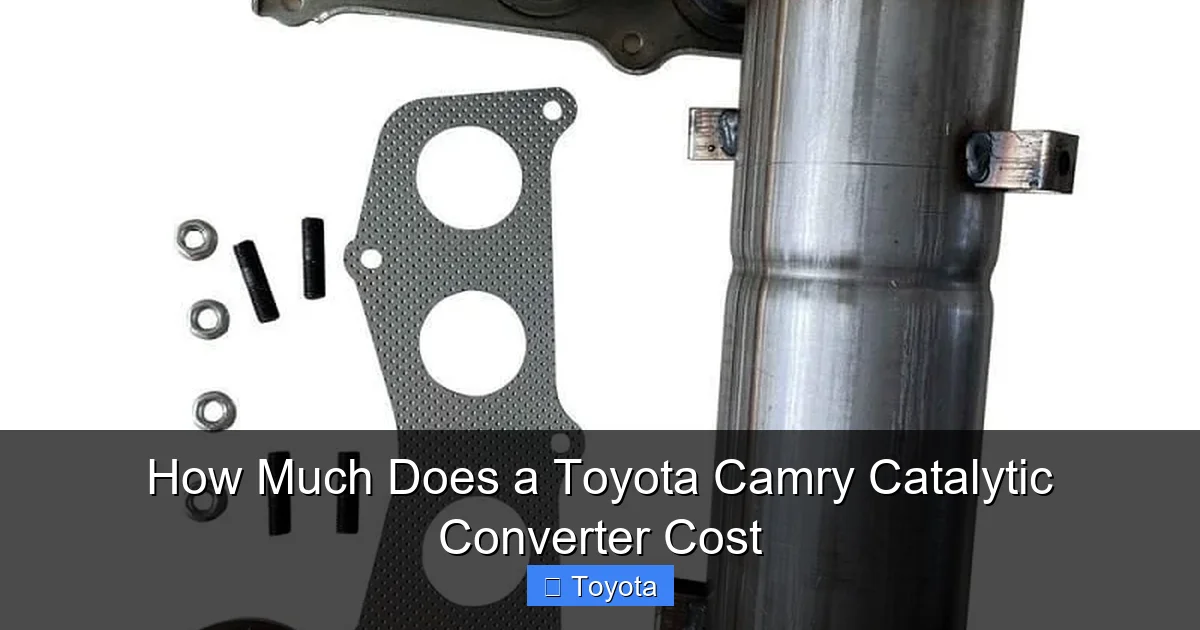
If you’ve started shopping around, you’ve probably seen quotes that are all over the map. One shop says $1,500, another says $3,200 for the same year Camry. Why the huge discrepancy? The Toyota Camry catalytic converter cost is not a single number. It’s a equation: Parts Cost + Labor Cost + Vehicle Specific Factors = Total. Let’s dissect each part.
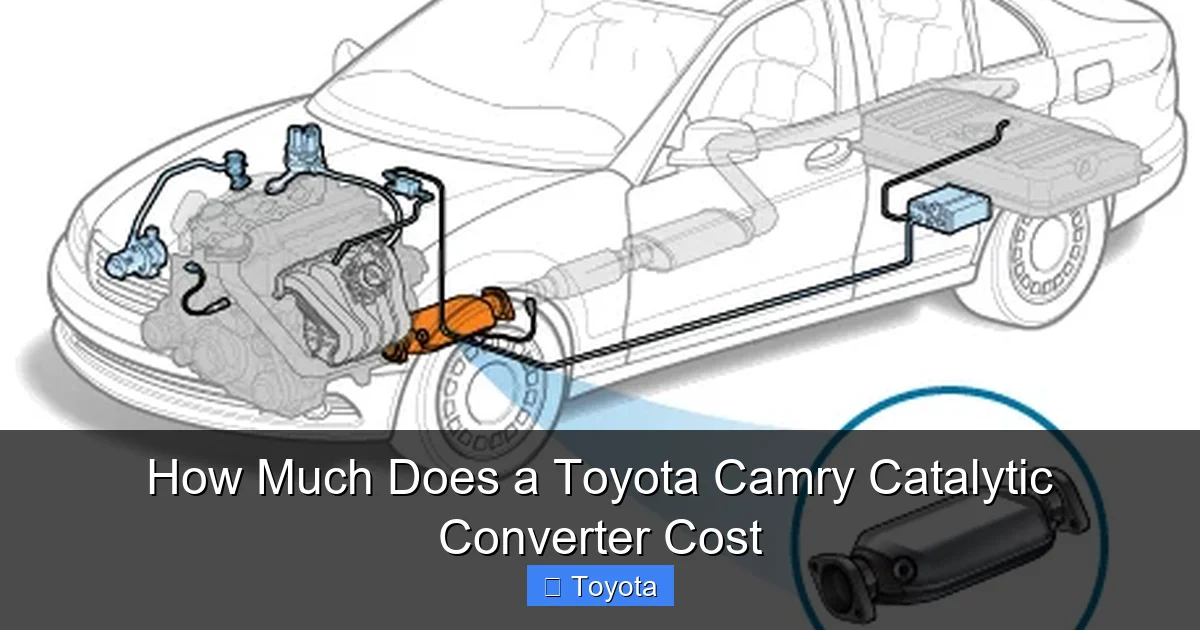
Visual guide about How Much Does a Toyota Camry Catalytic Converter Cost
Image source: guidemechanic.com
1. The Parts Themselves: OEM vs. Aftermarket vs. Used
This is the biggest variable. The raw catalytic converter core is expensive because of the precious metals inside. The amount and type of these metals are dictated by the emissions standards for your specific model year and engine.
- OEM (Original Equipment Manufacturer): This is the exact part Toyota put on your car at the factory. You order it from a Toyota dealership parts department. It’s guaranteed to fit perfectly and meet all emissions standards for your VIN. Expect to pay a premium. For a 2020-2024 Camry, an OEM front converter can run $1,800 to $2,800. The rear (if equipped) adds another $1,000-$1,500. For a 2012-2017 model, OEM might be $1,200-$2,000.
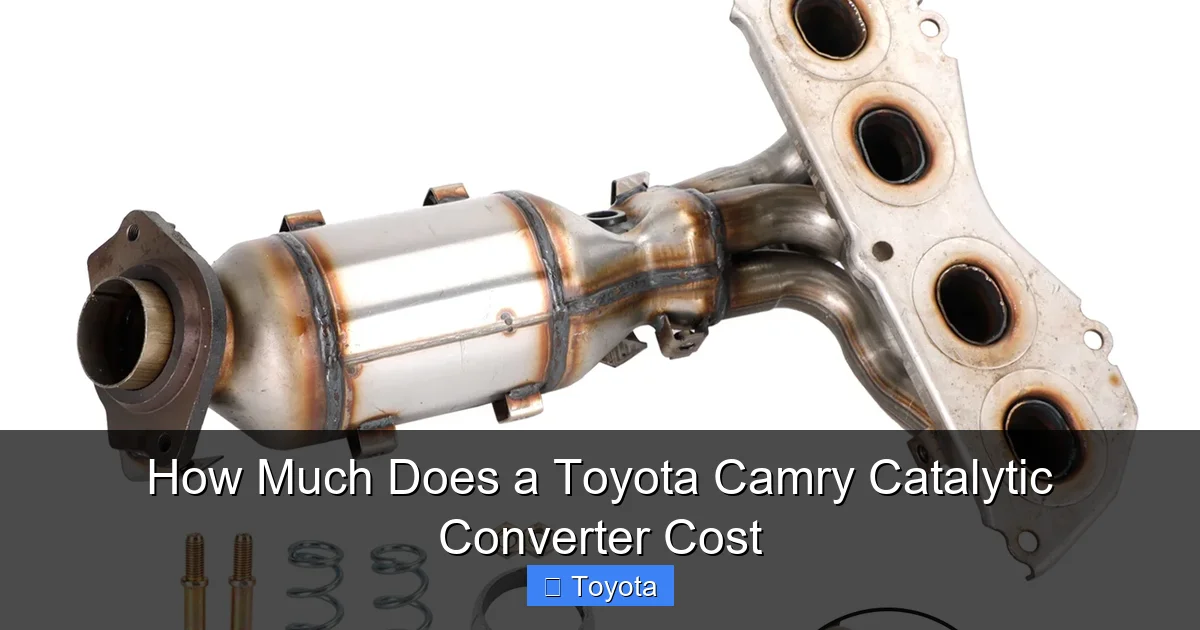
- Aftermarket “Direct Fit”: This is where you find value. Companies like MagnaFlow, Flowmaster, Walker, and Bosal manufacture converters that are designed to bolt directly into your Camry’s exhaust system without modification. They use the correct precious metal loading to pass EPA tests for your vehicle. Prices are typically 30-50% lower than OEM. A direct-fit for a 2018-2021 Camry 2.5L might be $900-$1,500. For a 2007-2011 Camry, you might find them for $600-$1,100.
- Aftermarket “Universal Fit”: These are cheaper ($400-$800) but require a professional welder to install, as they come in sections that must be cut and welded to fit your specific exhaust layout. The labor cost often cancels out the parts savings, and there’s a higher risk of poor fitment or failure. Not generally recommended for daily drivers.
- Used / Salvage / “Rebuilt”: You might find a used converter from a junkyard for $200-$500. We strongly caution against this. Its catalyst may be near the end of its life, it may not be certified for your exact vehicle (leading to a failed emissions test), and in many states, it’s illegal to install a non-certified used converter. The savings are rarely worth the risk and potential for a repeat repair.
2. The Labor: It’s Not a Simple Bolt-On
Replacing a catalytic converter is rarely a 30-minute job. On most Camrys, it’s a 2-4 hour procedure for a skilled mechanic. Why so long?
- Access is difficult: The converters are located in the exhaust system, often near the engine manifold or under the car, surrounded by other components like the front pipe, oxygen sensors, heat shields, and sometimes even the subframe.
- Bolts are seized: The bolts holding the converter to the exhaust manifold and pipe are exposed to extreme heat and weather for years. They are frequently rusted solid. Breaking them off can turn a simple replacement into a major repair requiring manifold or pipe replacement, adding hundreds in parts and many more hours of labor.
- Sensor care: The upstream (before the converter) and downstream (after the converter) oxygen sensors must be carefully removed and reinstalled. They are fragile and expensive.
- Hybrid models add complexity: As mentioned, there are often two converters. The one for the hybrid battery system (sometimes called the “battery cooler” or “NOx” converter) can be in an even tighter spot, increasing labor time and cost.
Shop labor rates vary wildly by region and shop type (dealer vs. independent). A reasonable average is $120-$180 per hour. So, a 3-hour job adds $360-$540 in labor alone. If the bolts break and require additional parts, that’s another $200-$800+.
3. Your Specific Camry: Model Year and Engine Type
This is the foundational factor that determines everything else.
- Gasoline Engine (Most Common): The standard 2.5L 4-cylinder (found in 2012-2024 models) and the older 3.5L V6 (2007-2011) have a single main catalytic converter. The 2.5L is generally less expensive to fix than the older 3.5L due to more available aftermarket support.
- Hybrid (Camry Hybrid): This is the most expensive scenario. The Hybrid uses a complex emissions system. It has the standard engine-mounted converter AND a second converter dedicated to treating the exhaust from the hybrid battery’s thermal management system. You often need to replace both at the same time, as they share sensors and plumbing. The hybrid-specific converter is less common and more expensive. Total parts cost for a Hybrid can easily hit $2,500-$4,000+.
- Model Year Generations:
- 2007-2011 (XV40): Older, but still on the road. Parts are available, but OEM is pricier for a 15-year-old car. Aftermarket is the smart play. Be prepared for rusty bolts.
- 2012-2017 (XV50): A very common generation. Excellent aftermarket support. Costs are moderate. The 2012-2014 models had some known issues with premature converter failure in certain regions, so there’s a lot of repair experience out there.
- 2018-2024 (XV70): The current generation. Stricter emissions standards mean more advanced (and expensive) converter designs. OEM prices are high. Good aftermarket “direct fit” options exist but are pricier than for older models. The 2020+ models with the “XSE” or “TRD” trims might have slightly different exhaust setups.
Real-World Cost Breakdowns for Popular Camry Years
Enough theory. Let’s look at estimated total costs (parts + labor) for some of the most common Toyota Camry configurations on the road today. These are national averages; your local shop may be higher or lower.
Visual guide about How Much Does a Toyota Camry Catalytic Converter Cost
Image source: i5.walmartimages.com
- 2010 Toyota Camry 2.5L (Gas): Aftermarket direct-fit converter + labor (3 hrs). Est. Total: $1,000 – $1,600. If bolts break and require a new front pipe: add $300-$600.
- 2015 Toyota Camry SE 2.5L (Gas): High-quality aftermarket converter + labor. Est. Total: $1,200 – $1,800.
- 2019 Toyota Camry XLE 2.5L (Gas): Premium aftermarket (MagnaFlow) or mid-level OEM + labor. Est. Total: $1,500 – $2,500.
- 2021 Toyota Camry Hybrid LE: This is the big one. Two converters required. Aftermarket for both + extended labor (4-5 hrs). Est. Total: $2,800 – $4,200. If going OEM, add $1,000-$2,000 immediately.
- 2009 Toyota Camry 3.5L V6: Single converter, but older. Aftermarket + labor, with a high risk of bolt issues. Est. Total: $1,300 – $2,100.
Pro Tip: Always get at least three written estimates. Ask the shop to break down the estimate into “Parts – OEM/Aftermarket Brand” and “Labor – Estimated Hours.” This transparency helps you compare apples to apples. Also, ask if the estimate includes new gaskets, hardware, and oxygen sensor replacement if needed—these are often necessary for a proper job.
Once you know the approximate cost, you need to decide on the path. You have three main avenues:
Visual guide about How Much Does a Toyota Camry Catalytic Converter Cost
Image source: autopricingnearme.com
1. The Dealership: Peace of Mind at a Premium
Going to the Toyota dealer guarantees OEM parts, factory-trained technicians, and a warranty that often covers parts and labor for 12 months/unlimited miles. For a newer car still under its original power train warranty (typically 5 years/60,000 miles for emissions components), this is your only free option. For an out-of-warranty car, it’s the most expensive route, but you get the highest confidence in the repair’s quality and longevity. It’s the “set it and forget it” solution.
2. A Reputable Independent Shop: The Sweet Spot
This is where most people find the best value. A good independent mechanic (or a specialized exhaust shop) has decades of experience with Camrys. They know the common pitfalls (like those seized bolts) and can often offer a high-quality aftermarket converter that meets or exceeds OEM specs at a much better price. They will also typically offer a solid warranty on their work (e.g., 12 months/12,000 miles). How to choose: Look for shops with excellent reviews specifically mentioning “catalytic converter” or “exhaust” work on Toyotas. Ask if they use “direct fit” parts and if they will replace the oxygen sensors if they look old.
3. The DIY Route: For the Bold and Skilled
If you have advanced mechanical skills, a well-equipped garage, and a willingness to wrestle with rusted bolts, you can save the $300-$600 in labor. You’ll need to buy the converter, new gaskets, possibly new bolts/nuts, and anti-seize compound. Factor in the cost of special tools (deep sockets, breaker bars, possibly a torch). Warning: This is one of the more challenging DIY jobs. A mistake can lead to exhaust leaks, check engine lights, or a converter that doesn’t seal properly. If you’re not 100% confident, this job is worth paying a professional for. Also, remember that in many areas, a vehicle must pass a visual inspection for a catalytic converter during its annual safety check—a DIY job with an aftermarket part must be properly installed and certified.
Protecting Your Investment: Maintenance and Theft Prevention
A catalytic converter replacement is a significant expense. The best way to manage that cost is to avoid needing one for as long as possible.
Driving Habits & Engine Health
The #1 cause of catalytic converter failure is a poorly running engine. Misfires from bad spark plugs, ignition coils, or fuel injectors send unburned gasoline straight into the exhaust. This gasoline burns inside the super-hot converter, melting the ceramic substrate and causing a meltdown/clog. Address check engine lights for misfires immediately. Use high-quality fuel and don’t ignore oil consumption issues—excessive oil burning can coat the catalyst with ash, poisoning it over time. Regular oil changes with the correct oil viscosity are crucial. Speaking of maintenance, if you’re doing your own work, it’s helpful to know how much oil a 2011 Toyota Camry takes to ensure you’re not over or under-filling, which can contribute to engine issues.
The Rising Threat of Catalytic Converter Theft
Due to the value of the precious metals inside, catalytic converters are a prime target for thieves, who can saw one off in under 2 minutes. Older Camrys (2007-2011) are particularly vulnerable because their converters have higher concentrations of precious metals and are easier to access. The cost to replace a stolen converter is on you, as comprehensive insurance deductibles often exceed the repair cost for an older vehicle.
Prevention is key and relatively inexpensive:
- Install an anti-theft plate or cage: A steel plate welded or bolted over the converter makes theft much harder and time-consuming. Many exhaust shops install these for $150-$300.
- Etch your VIN onto the converter: This deters thieves and helps police identify stolen parts. Some shops offer this service.
- Park in well-lit, secure areas. If you have a garage, use it.
- Consider a car alarm with a vibration/shock sensor.
While we’re on the topic of protecting your vehicle’s appearance and value, some owners consider cosmetic upgrades like paint protection. If you’re curious about the cost to safeguard your Camry’s exterior, you can read about how much it costs to wrap a Toyota Camry as an alternative to traditional paint.
Final Thoughts: Is It Worth the Investment?
Here’s the bottom line: your Toyota Camry’s catalytic converter is not an optional part. It is legally required for your car to operate on public roads. A failed converter will cause your car to fail emissions testing, run poorly, and potentially damage other components like the oxygen sensors. So, replacement is not a question of “if,” but “when” and “at what cost.”
For a gas-engine Camry, budgeting $1,200-$2,500 for a quality repair is realistic. For a Hybrid, start at $2,800 and go up. The most cost-effective strategy is to use a reputable independent shop with a good aftermarket brand. Avoid the junkyard special. And by maintaining your engine in perfect health and taking simple theft prevention steps, you can maximize the life of your new converter and protect your wallet from this major unexpected expense.
When you get that estimate, you’ll now be armed with the knowledge to understand it, question it, and make the best decision for your specific Toyota Camry. It’s a big job, but with the right parts and the right mechanic, your Camry will be back to running clean and strong for years to come.
Frequently Asked Questions
How much does it cost to replace a catalytic converter on a Toyota Camry?
The total cost typically ranges from $1,200 to over $3,500. The main variables are your Camry’s model year, whether it’s a standard gas or Hybrid model (Hybrids are much more expensive), if you choose OEM or aftermarket parts, and your local labor rates. Expect the parts to make up 60-70% of the total cost.
What are the symptoms of a failing catalytic converter?
Common signs include a persistent check engine light (often with codes P0420 or P0430), a noticeable drop in fuel economy, a rotten egg smell from the exhaust, poor acceleration or engine performance, and a rattling noise from under the car, especially when starting cold. A failed emissions test is the ultimate confirmation.
Can I drive my Camry with a bad catalytic converter?
You can drive it for a short period, but it’s not advisable. A severely clogged converter can create excessive backpressure, causing the engine to overheat, stall, or suffer serious damage. It will also continuously throw a check engine light and fail emissions. Get it diagnosed and replaced as soon as possible to avoid more costly engine damage.
Why are catalytic converters so expensive?
The high cost is driven by the precious metals inside—platinum, palladium, and rhodium—which act as the catalyst. These metals are valuable commodities. The amount used is precisely engineered to meet strict federal emissions standards for your specific vehicle. Stricter standards for newer models require more complex and expensive converter designs.
How long does a Toyota Camry catalytic converter last?
Most are designed to last the life of the vehicle, often 100,000 miles or more. However, they can fail prematurely due to engine problems (misfires, oil burning, fuel contamination), physical damage from road debris, or extreme environmental conditions. Regular engine maintenance is the best way to ensure a long converter life.
Will an aftermarket catalytic converter pass emissions in my state?
Yes, if you purchase a “direct fit” converter from a reputable brand (like MagnaFlow, Walker, or Bosal) that is specifically certified and listed for your exact year, make, model, and engine. It must meet EPA standards. Universal converters require professional welding and may not pass visual inspections in some states. Always verify the part’s CARB or EPA compliance number before purchasing if you live in a strict emissions state like California.