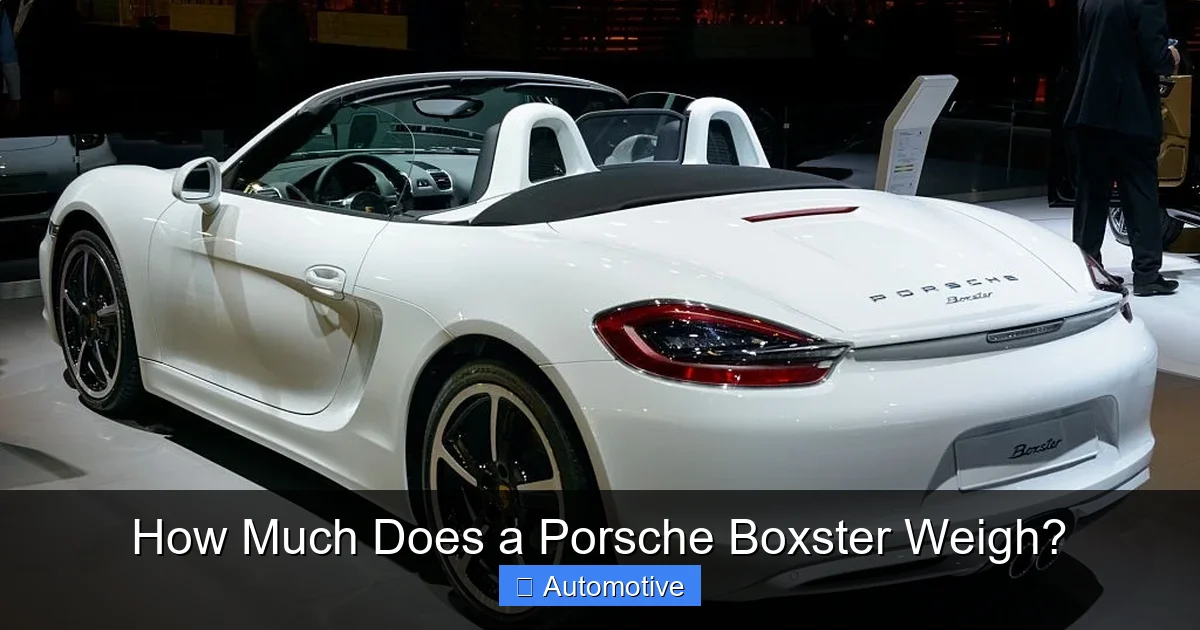
How Much Does a Porsche Boxster Weigh?

Contents
- 1 Key Takeaways
- 2 📑 Table of Contents
- 3 How Much Does a Porsche Boxster Weigh?
- 4 Understanding Curb Weight and Why It Matters
- 5 Porsche Boxster Weight by Generation
- 6 Factors That Influence the Boxster’s Weight
- 7 How Weight Affects Performance and Driving Experience
- 8 Comparing the Boxster to Competitors
- 9 Tips for Reducing Your Boxster’s Weight
- 10 Conclusion
- 11 Frequently Asked Questions


The Porsche Boxster’s weight varies by model year, engine, and trim, ranging from about 2,800 to 3,200 pounds. This mid-engine roadster balances agility and power, with lighter models offering sharper handling and improved fuel efficiency.
[FEATURED_IMAGE_PLACEOLDER]
Key Takeaways
- Weight Range: The Porsche Boxster typically weighs between 2,800 and 3,200 pounds, depending on the generation and configuration.
- Mid-Engine Layout: The engine placement contributes to balanced weight distribution, enhancing handling and cornering stability.
- Generational Differences: Earlier models (like the 986) are lighter, while newer versions (718) may be slightly heavier due to added tech and safety features.
- Performance Impact: Lower weight improves acceleration, braking, and fuel economy—key reasons the Boxster remains a driver’s favorite.
- Lightweight Options: Porsche offers performance packages and carbon fiber components to reduce weight in high-end trims.
- Real-World Relevance: Knowing the weight helps with towing, transport, and understanding how the car behaves on the road.
- Comparison to Competitors: The Boxster is lighter than many rivals like the BMW Z4 or Mercedes-AMG SL, giving it an edge in agility.
📑 Table of Contents
- How Much Does a Porsche Boxster Weigh?
- Understanding Curb Weight and Why It Matters
- Porsche Boxster Weight by Generation
- Factors That Influence the Boxster’s Weight
- How Weight Affects Performance and Driving Experience
- Comparing the Boxster to Competitors
- Tips for Reducing Your Boxster’s Weight
- Conclusion
How Much Does a Porsche Boxster Weigh?
If you’re considering buying a Porsche Boxster—or you’re just curious about what makes this iconic roadster tick—you’ve probably wondered: *How much does a Porsche Boxster weigh?* It’s a simple question, but the answer isn’t one-size-fits-all. The weight of a Porsche Boxster depends on several factors, including the model year, engine type, transmission, optional features, and trim level.
From the original 986 generation in the late ’90s to the modern 718 series, Porsche has refined the Boxster’s design for better performance, comfort, and safety. With each update, engineers have balanced the need for lightweight agility with the demands of modern technology and safety standards. As a result, the curb weight—the total weight of the car with a full tank of gas, all fluids, and a standard driver—has shifted over time.
But why does weight matter so much for a sports car like the Boxster? In short, it affects everything: how fast it accelerates, how well it corners, how efficiently it uses fuel, and even how it feels on the road. A lighter car responds quicker to steering inputs, brakes more effectively, and generally feels more alive. That’s why Porsche has always prioritized weight management in the Boxster, even as they’ve added more features over the years.
In this guide, we’ll break down the weight of the Porsche Boxster across all major generations, explain what influences those numbers, and show you how weight impacts real-world driving. Whether you’re comparing models, planning to transport your Boxster, or just love the details behind high-performance machines, this article will give you the full picture.
Understanding Curb Weight and Why It Matters
Visual guide about How Much Does a Porsche Boxster Weigh?
Image source: costhack.com
Before diving into specific numbers, it’s important to understand what “curb weight” means. Curb weight is the total weight of a vehicle when it’s ready to drive—fully fueled, with all standard fluids (oil, coolant, brake fluid), and including a standard driver (usually assumed to be 150–160 pounds). It does *not* include passengers, cargo, or optional equipment unless specified.
For sports cars like the Porsche Boxster, curb weight is a critical performance metric. Every extra pound affects acceleration, braking distance, fuel efficiency, and handling. That’s why automakers go to great lengths to reduce weight—using aluminum body panels, lightweight seats, and compact components—while still meeting safety and comfort standards.
The Boxster’s mid-engine layout plays a big role in its weight distribution. Unlike front-engine cars, where the engine sits over the front axle, the Boxster’s engine is mounted behind the driver but ahead of the rear axle. This creates a near-perfect 40:60 or 45:55 front-to-rear weight balance, which improves traction, reduces understeer, and makes the car feel incredibly balanced through corners.
But weight isn’t just about performance—it’s also practical. If you’re planning to tow your Boxster on a trailer, ship it overseas, or store it in a tight garage, knowing its exact weight helps you choose the right equipment and avoid surprises. Even insurance and registration fees can be influenced by vehicle weight in some regions.
So while the number on the scale might seem like a minor detail, it’s actually a window into the car’s engineering philosophy. Porsche has always aimed to keep the Boxster as light as possible without sacrificing durability or refinement. That balance is what makes it such a beloved sports car.
Porsche Boxster Weight by Generation
Visual guide about How Much Does a Porsche Boxster Weigh?
Image source: costhack.com
Now let’s get into the numbers. The weight of a Porsche Boxster has evolved over the years, reflecting changes in technology, safety regulations, and design priorities. Below is a breakdown by generation, with average curb weights for key models.
First Generation: Porsche Boxster (986, 1996–2004)
The original Boxster, known internally as the 986, launched in 1996 as a more affordable entry into the Porsche lineup. It was designed to be lightweight and fun, with a focus on driving purity.
– **Boxster (Base, 2.5L flat-six):** ~2,870 lbs (1,302 kg)
– **Boxster S (3.2L flat-six):** ~2,930 lbs (1,329 kg)
These early models were praised for their agility and responsiveness, thanks in part to their relatively low weight. The base model, in particular, was a favorite among driving enthusiasts who appreciated its simplicity and balance. Even the S model, with its larger engine, stayed under 3,000 pounds—a testament to Porsche’s focus on efficiency.
Second Generation: Porsche Boxster (987, 2005–2012)
The 987 generation brought updated styling, improved interiors, and more powerful engines. Despite these upgrades, Porsche managed to keep weight in check.
– **Boxster (2.7L flat-six):** ~2,910 lbs (1,320 kg)
– **Boxster S (3.4L flat-six):** ~2,970 lbs (1,347 kg)
– **Boxster Spyder (2009–2012):** ~2,811 lbs (1,275 kg)
The Spyder stands out as the lightest Boxster ever made. Porsche removed the power soft top, used lighter seats, and eliminated some interior trim to shave off nearly 100 pounds compared to the standard S model. It was a no-compromise driver’s car, and its weight—just over 2,800 pounds—helped it deliver razor-sharp handling.
Third Generation: Porsche Boxster (981, 2012–2016)
With the 981, Porsche introduced a completely redesigned chassis, wider track, and more advanced electronics. The car grew slightly in size, and weight increased as a result.
– **Boxster (2.7L flat-six):** ~3,020 lbs (1,370 kg)
– **Boxster S (3.4L flat-six):** ~3,080 lbs (1,397 kg)
– **Boxster GTS (3.4L flat-six):** ~3,110 lbs (1,411 kg)
While heavier than its predecessor, the 981 still felt nimble thanks to improved suspension and steering. The added weight came from stronger safety structures, better sound insulation, and more standard features—trade-offs that enhanced comfort and refinement.
Fourth Generation: Porsche 718 Boxster (2016–Present)
The current generation, rebranded as the 718, switched from naturally aspirated flat-six engines to turbocharged flat-four engines. This change sparked debate among purists, but it also allowed Porsche to reduce engine weight and improve efficiency.
– **718 Boxster (2.0L turbo flat-four):** ~3,090 lbs (1,402 kg)
– **718 Boxster S (2.5L turbo flat-four):** ~3,150 lbs (1,429 kg)
– **718 Boxster GTS (2.5L turbo flat-four):** ~3,170 lbs (1,438 kg)
– **718 Boxster Spyder (2020–Present):** ~3,190 lbs (1,447 kg)
Interestingly, the new Spyder is heavier than the 987 version, despite efforts to reduce weight. This is due to modern safety systems, stronger body structures, and additional tech features. Still, the 718 remains one of the lightest cars in its class.
Factors That Influence the Boxster’s Weight
Visual guide about How Much Does a Porsche Boxster Weigh?
Image source: costhack.com
So why do some Boxsters weigh more than others? Several key factors come into play:
Engine and Drivetrain
The type of engine has a major impact on weight. For example, the switch from a 3.4L flat-six to a 2.5L turbo flat-four in the 718 reduced engine mass, but the addition of turbochargers, intercoolers, and emissions equipment added weight elsewhere. Similarly, all-wheel-drive versions (like the Boxster 4S) are heavier than rear-wheel-drive models due to extra drivetrain components.
Transmission
The choice between a manual and automatic transmission also affects weight. Porsche’s PDK dual-clutch automatic is actually lighter and more efficient than a traditional manual in some cases, but it includes more electronics and hydraulic systems, which can offset the savings.
Optional Features and Trim Levels
Higher trim levels and performance packages often add weight. For example:
– **Sport Chrono Package:** Adds a lap timer, dynamic engine mounts, and sometimes a rear spoiler—minor weight gain.
– **PASM (Porsche Active Suspension Management):** Includes adaptive dampers and additional sensors.
– **Carbon Fiber Seats:** Reduce weight but are expensive.
– **Premium Audio Systems:** Heavy speakers and amplifiers add pounds.
– **Heated and Ventilated Seats:** Electric motors and wiring increase weight.
Even something as simple as a power-operated soft top versus a manual one can make a difference. The automatic top includes motors, sensors, and reinforced frames.
Body Materials and Construction
Porsche uses a mix of steel, aluminum, and composite materials in the Boxster’s body. Aluminum is used for hoods, doors, and suspension components to reduce weight, while high-strength steel ensures crash protection. The Spyder models often use lighter materials and remove non-essential parts to achieve lower weights.
Safety and Emissions Equipment
Modern cars are required to meet strict safety and emissions standards. This means more airbags, stronger crumple zones, advanced driver-assistance systems (like lane departure warning), and complex exhaust after-treatment systems—all of which add weight. While these features improve safety and reduce environmental impact, they do come at the cost of added mass.
How Weight Affects Performance and Driving Experience
Now that we know how much the Boxster weighs, let’s talk about what that means on the road.
Acceleration and Power-to-Weight Ratio
A lighter car accelerates faster, all else being equal. The power-to-weight ratio—measured in horsepower per pound—is a key indicator of performance. For example:
– A 718 Boxster with 300 hp and 3,090 lbs has a ratio of about 0.097 hp/lb.
– A 718 Boxster S with 350 hp and 3,150 lbs has a ratio of about 0.111 hp/lb.
Even small reductions in weight can improve this ratio. That’s why the Spyder, despite having similar power to the GTS, feels quicker and more responsive.
Handling and Cornering
The Boxster’s mid-engine layout and low center of gravity make it exceptionally stable in corners. Lower weight enhances this by reducing inertia—the tendency of the car to resist changes in direction. When you turn the wheel, a lighter car responds more instantly, making it feel more connected to the road.
This is especially noticeable on winding mountain roads or race tracks. Drivers often say the Boxster “dances” through corners, and that agility is directly tied to its weight management.
Braking Performance
Heavier cars require more force to stop, which means longer braking distances and increased wear on brake components. The Boxster’s relatively low weight allows it to stop quickly and confidently, even with standard brakes. Performance models come with larger brake discs and multi-piston calipers, but the base weight still gives them an advantage.
Fuel Efficiency
Weight also impacts fuel economy. A lighter car needs less energy to move, which translates to better mileage. The 718 Boxster, with its turbocharged engines and reduced weight, achieves impressive fuel efficiency for a sports car—around 25–30 mpg combined, depending on driving style.
Ride Comfort and Refinement
While lower weight improves performance, it can sometimes reduce ride comfort if not managed properly. Porsche strikes a balance by using advanced suspension systems and sound insulation. Even though newer models are heavier, they often feel more refined than older, lighter versions.
Comparing the Boxster to Competitors
How does the Boxster stack up against similar roadsters? Let’s look at a few key rivals:
– **BMW Z4 (G29):** Weighs around 3,200–3,400 lbs. Slightly heavier due to front-engine layout and luxury features.
– **Mercedes-AMG SL (R232):** Weighs over 3,600 lbs. Much heavier, with a focus on luxury and power over agility.
– **Audi TT Roadster:** Around 3,100–3,300 lbs. Similar weight, but front-wheel-drive bias affects handling.
– **Alfa Romeo 4C Spider:** Weighs just 2,465 lbs—much lighter, but less practical and less refined.
The Boxster’s weight advantage, combined with its mid-engine layout, gives it superior balance and driving dynamics. It’s not the lightest, but it’s one of the best-balanced sports cars on the market.
Tips for Reducing Your Boxster’s Weight
If you’re a performance enthusiast looking to shave pounds off your Boxster, here are some practical tips:
– **Choose a manual transmission:** Often lighter than PDK and gives more driver engagement.
– **Opt for base models:** Avoid high-trim versions with extra features.
– **Remove unnecessary items:** Take out floor mats, spare tire (if you have a repair kit), and rear seats (if not needed).
– **Upgrade to lightweight wheels:** Aftermarket forged wheels can save 5–10 lbs per corner.
– **Install carbon fiber parts:** Hoods, spoilers, and interior trim can reduce weight significantly.
– **Use a lightweight battery:** Lithium-ion batteries are much lighter than traditional lead-acid ones.
Keep in mind that some modifications may affect warranty coverage or resale value, so proceed with caution.
Conclusion
So, how much does a Porsche Boxster weigh? The answer depends on the model, but most fall between 2,800 and 3,200 pounds. This range reflects Porsche’s ongoing effort to balance performance, safety, and comfort.
From the lightweight 986 to the tech-rich 718, the Boxster has always prioritized driving enjoyment. Its mid-engine layout, careful material selection, and engineering precision keep it agile and responsive, even as it gains features over time.
Whether you’re drawn to the raw simplicity of the Spyder or the modern refinement of the 718 GTS, the Boxster’s weight plays a crucial role in what makes it special. It’s not just about speed—it’s about how the car feels, how it responds, and how it connects you to the road.
If you’re in the market for a sports car that delivers pure driving joy without sacrificing everyday usability, the Boxster remains one of the best choices. And now, you know exactly what it weighs—and why that matters.
Frequently Asked Questions
What is the lightest Porsche Boxster ever made?
The lightest Boxster is the 987-generation Boxster Spyder, weighing just 2,811 pounds. Porsche removed the power top, used lighter seats, and eliminated excess trim to achieve this low weight.
Does the 718 Boxster weigh more than the 981?
Yes, the 718 Boxster is slightly heavier due to updated safety systems, stronger body structures, and additional technology. However, the switch to turbocharged flat-four engines helped offset some of the weight gain.
How does weight affect the Boxster’s fuel economy?
Lighter cars use less energy to move, which improves fuel efficiency. The Boxster’s relatively low weight contributes to its impressive 25–30 mpg combined fuel economy, especially in the 718 models.
Can I reduce my Boxster’s weight for track use?
Yes, you can reduce weight by removing non-essential items, upgrading to lightweight wheels, and installing carbon fiber parts. However, some modifications may void your warranty or affect resale value.
Why is the Boxster Spyder heavier now than in earlier generations?
The modern 718 Spyder is heavier due to advanced safety features, stronger chassis components, and modern electronics. While it’s not as light as the 987 Spyder, it’s still one of the lightest performance variants.
How does the Boxster’s weight compare to the Cayman?
The Boxster and Cayman share the same platform and engine options, so their weights are nearly identical—usually within 20–30 pounds of each other, depending on configuration.