How Much Cargo Space Does a Toyota Sienna Have with the Third Row Down?

Contents
- 1 Key Takeaways
- 2 📑 Table of Contents
- 3 The Official Numbers: Cubic Feet and Linear Dimensions
- 4 Generation-to-Generation Consistency (Mostly)
- 5 How It Compares: Sienna vs. The Competition
- 6 Real-World Scenarios: What Actually Fits?
- 7 Maximizing Your Cargo Space: Pro Tips
- 8 Conclusion: The Verdict on Sienna Cargo Space
- 9 Frequently Asked Questions



Folding down the third row in a Toyota Sienna transforms it from a spacious family hauler into a massive cargo van. You gain a flat load floor with approximately 101.0 cubic feet of volume behind the second row. This space is measured from the back of the second-row seats to the rear hatch, offering a long, unobstructed area perfect for large items, DIY projects, or vacation gear. The exact usable volume can vary slightly by model year and whether the second row is also adjusted.
So, you’re eyeing a Toyota Sienna. Maybe you have a growing family, a side hustle, or just a penchant for big-box store runs. Whatever the reason, you know minivans are the ultimate utility vehicles. But the burning question on your mind is a very practical one: just how much stuff can you actually fit in this thing when you need to? Specifically, what happens when you fold down that third row? Let’s pop the hatch and dig into the numbers, the real-world usability, and why the Sienna’s cargo space is a major selling point.
First, a quick mindset shift. When we talk about “cargo space” in a minivan, we’re usually talking about two distinct configurations: “third row down” (7-passenger mode, cargo behind row 3) and “both rows down” (5-passenger or 2-passenger mode, maximum cargo). This article focuses squarely on the former—the most common reconfiguration for a family that occasionally needs to haul more than groceries. It’s the sweet spot between passenger capacity and utility. To understand this space, we need to look at cubic footage, linear dimensions, and how that space actually feels when you’re trying to stuff a 48-inch TV box back there.
Key Takeaways
- Maximum Cargo Volume: With both the second and third rows folded flat, the Sienna offers up to 101.0 cubic feet of total cargo space, competitive with leading minivans.
- Third Row Down Only: Folding just the third row provides a significant 48.0 cubic feet behind the second row, creating a deep well for groceries or luggage while keeping 7-passenger capability.
- Flat Load Floor: The Sienna’s third-row seats fold completely flush into the floor, creating a single, level surface for easy loading and securing items.
- Length is Key: The cargo length from the second-row seatbacks to the tailgate is about 70-72 inches, allowing you to fit items like full-length ladders or furniture.
- Model Year Variations: Dimensions are consistent across recent generations (2021+), but always verify specific measurements for your exact model year and trim.
- Payload Capacity Matters: Cargo volume is different from weight capacity. The Sienna’s Gross Vehicle Weight Rating (GVWR) dictates how much weight you can safely carry in that space.
- Versatility is the Point: The Sienna’s power-folding third row makes reconfiguring from passenger to cargo mode quick and effortless, a core feature for active families.
📑 Table of Contents
The Official Numbers: Cubic Feet and Linear Dimensions
Toyota provides official SAE-standard cargo volume measurements. For the current fourth-generation Sienna (2021-present), these are the key figures:
- Behind 3rd Row (All Seats Up): ~33.5 cubic feet. This is your “run to the airport” or “weekly groceries” space. It’s deep but narrow.
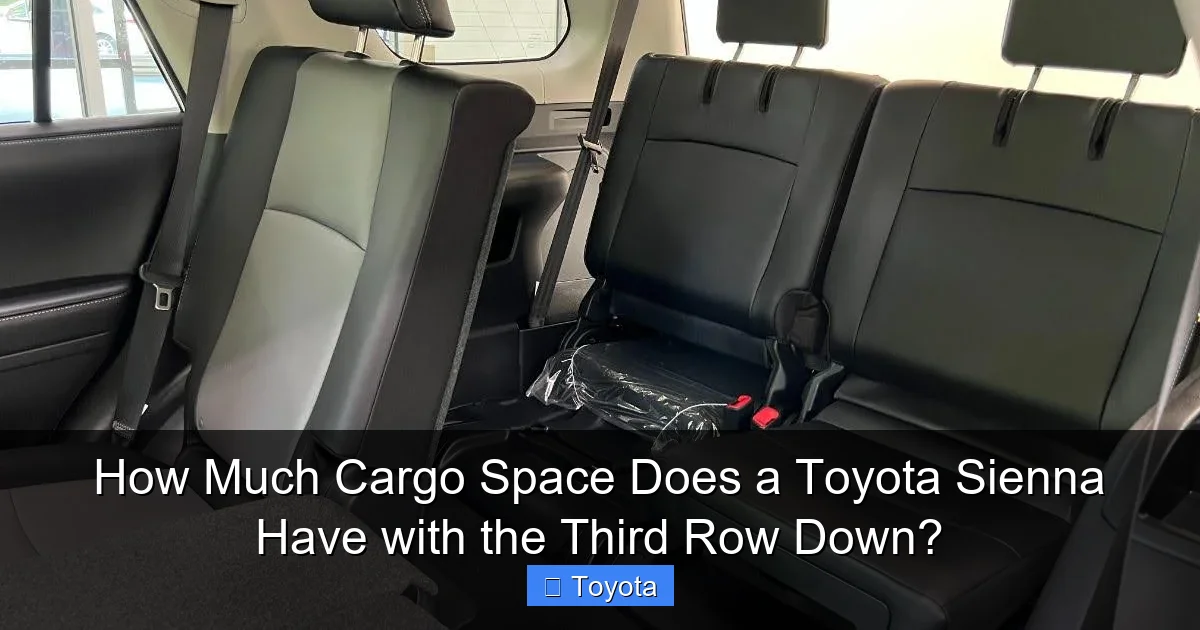
- Behind 2nd Row (3rd Row Folded): ~48.0 cubic feet. This is the number you’re here for. This is the volume you get when you fold the third row flat into the floor. It transforms the rear of the cabin into a deep, well-like space. For context, that’s more than the total cargo capacity of many compact SUVs with their rear seats up.
- Maximum (2nd & 3rd Rows Folded): ~101.0 cubic feet. This is the “move-out day” or “home improvement project” space, rivaling some full-size vans.
But cubic feet is an abstract number. What does 48 cubic feet actually look like? Think of it this way: a standard household refrigerator is about 20-25 cubic feet. So, your Sienna with the third row down can comfortably hold the equivalent of two large refrigerators in volume, with room to spare around the edges.
Tracing the Tape Measure: Critical Lengths
Volume is great, but often, it’s the length of an item that determines if it fits. Here are the crucial linear measurements for a current-gen Sienna with the third row folded:
- Length (2nd row seatback to tailgate): Approximately 70 to 72 inches. This is the continuous, flat floor length from the back of the second-row seats to the inside of the rear hatch. This is long enough for most full-size sofas (disassembled), mattresses (twin or full, diagonally), ladders, and unwrapped plywood sheets (4×8 might be tight on width).
- Width (floor at narrowest point): About 48 inches between the wheel wells. This is a critical constraint. You cannot fit a standard 4×8 sheet of plywood flat on the floor because it’s 48 inches wide. You’d need to angle it or put it on top of the folded seats (which raises the load height). The width between the wheel wells is a common bottleneck in almost all minivans and SUVs.
- Height (floor to ceiling): Roughly 50 inches from the folded floor to the ceiling liner. This gives you good vertical space for stacking boxes or tall items.
Practical Example: You want to transport a 65-inch TV in its box (typically ~60″W x 40″H x 20″D). With the third row down, the 72-inch length is perfect. The 48-inch width is tight for the 40-inch height, but you can angle the box or place it on its end. The 20-inch depth leaves plenty of room in front for other cargo. This configuration makes such a trip trivial.
Generation-to-Generation Consistency (Mostly)
If you’re shopping used, you’ll be glad to know the core cargo dimensions with the third row down have been remarkably consistent for the last two major redesigns.

Visual guide about How Much Cargo Space Does a Toyota Sienna Have with the Third Row Down?
Image source: autoblog.com
Fourth Generation (2021-Present): The Hybrid Standard
The all-hybrid Sienna introduced in 2021 changed the powertrain but not the fundamental packaging. The under-floor storage for the third-row seats remains, and the folded position creates that same flat floor. The ~48.0 cubic foot figure is the standard. The only minor variance might be if you have a second-row captain’s chair with Ottoman (on higher trims)—these chairs may have a slightly different track position, but the overall length from seatback to tailgate remains the same.
Third Generation (2011-2020): The Gasoline Benchmark
The previous generation, especially the 2015-2020 refresh, is also a benchmark. Toyota listed its cargo volume behind the second row (with third row down) at 48.0 cubic feet as well. The linear dimensions are nearly identical. So, whether you’re looking at a 2018 Sienna or a 2023 Sienna, the usable space in this configuration is essentially the same. This consistency is a testament to Toyota’s efficient, long-standing minivan architecture.
How It Compares: Sienna vs. The Competition
Numbers are one thing, but how does the Sienna stack up against its main rivals? Let’s look at the “third-row down” cargo volume for the 2023-2024 model years:

Visual guide about How Much Cargo Space Does a Toyota Sienna Have with the Third Row Down?
Image source: importyourcar.ng
- Toyota Sienna: 48.0 cu ft
- Honda Odyssey: 38.2 cu ft (a notable gap; Odyssey’s third row doesn’t fold as flat, creating a higher load floor)
- Chrysler Pacifica: 32.3 cu ft (Pacifica’s third row is also a “stow-n-go” but its measured volume here is lower; however, its floor is arguably flatter)
- Kia Carnival: 40.2 cu ft
On paper, the Sienna leads this specific category. But what does that mean for you? It means when you fold the Sienna’s third row, you get a deeper well. The Pacifica and Odyssey’s third rows fold into “wells” as well, but the Sienna’s well is slightly deeper, giving you more vertical space before items hit the second-row seatbacks. The Kia Carnival is a very close competitor. For a detailed look at how other three-row SUVs handle cargo, you might compare it to models like the Nissan Pathfinder, which offers different folding dynamics. You can read more about that here.
The Sienna’s advantage here is partly due to its hybrid battery packaging. The battery is located under the front seats, freeing up traditional under-floor space that in gas vans might be used for an exhaust system or fuel tank. This allows for a truly flat floor from the front of the second row all the way back.
Real-World Scenarios: What Actually Fits?
Cubic feet are theoretical. Let’s get practical. Here’s what you can confidently haul in your Sienna with only the third row folded down:

Visual guide about How Much Cargo Space Does a Toyota Sienna Have with the Third Row Down?
Image source: dadand.com
The Family Vacation Load
This is the Sienna’s bread and butter. Two adults, three kids in the second row (captain’s chairs or bench), and all the luggage for a week. You’re looking at:
- 2-3 large suitcases (28-30″ tall)
- 1-2 carry-on roller bags
- A beach bag or two
- Snack cooler
- Stroller or wagon
All of this will fit comfortably in the 48 cu ft space with room to spare. The deep well keeps items from sliding forward into the passenger compartment.
The DIY / Home Improvement Haul
This is where the length shines. With the third row down:
- Lumber: 8-foot 2x4s will fit lengthwise (72″ interior length). You’ll need to angle them slightly or put the tailgate up and have them protrude.
- Drywall: A full 4×8 sheet of 1/2″ drywall (122″ long) will not fit flat. You’d need to angle it or carry it on the roof. However, a 4×4 sheet or cut pieces are no problem.
- Plywood: Same as drywall. A full 4×8 sheet is too long and too wide for the wheel well constraint. Cut it in half (4×4) and it’s trivial.
- Plants/Soil: Multiple large bags of potting soil (40lb/2 cu ft) fit easily. Potted shrubs and small trees can be stood upright.
The “I Bought Too Much at Costco” Run
This is a weekly test for many. A bulk pack of toilet paper (96 rolls), a case of water (40 bottles), a 20lb bag of rice, and a family pack of chicken breasts? The Sienna’s 48 cu ft well eats this for breakfast. The low load floor means you don’t have to heave heavy items up high. The wide tailgate and large hatch opening make loading and unloading a breeze.
Furniture and Large Boxes
A standard loveseat (disassembled if possible) or a small apartment-sized sofa will often fit with the third row down. A full/queen mattress (60″x80″) can fit diagonally with the tailgate closed, or lengthwise with the tailgate slightly ajar (and safely secured, of course). Large TV boxes (up to 75″), dressers (small, double), and large toys (playhouses, trampolines in boxes) are all within the realm of possibility.
Maximizing Your Cargo Space: Pro Tips
Having the space is one thing. Using it efficiently is another. Here’s how to get the most out of your Sienna’s third-row-down configuration:
1. Use the Under-Floor Storage
When the third row is up, you have a large, deep bin under the floor. When you fold the third row, this bin becomes part of the cargo floor—it’s not extra space, it’s just flat. However, if you’re carrying items that are small or you want to keep the floor clear, you can use this bin area as a secure, hidden compartment. Store tools, emergency supplies, or dirty sports equipment down there and cover it with the flat floor panel.
2. Mind the Wheel Wells
As mentioned, the 48-inch width between the wheel wells is your primary width constraint. When planning to haul wide items (like a dresser), measure the item’s width. If it’s over 48 inches, you’ll need to angle it. Always load the widest item first and angle it from the tailgate inward. Use the space over the wheel wells (the “shelf” area) for narrower items like bags or boxes.
3. The Second Row is Your Friend (or Foe)
The position of the second-row seats dramatically affects your cargo length. If you have captain’s chairs, slide them all the way forward. If you have a bench, slide it forward. This maximizes the 70+ inches of length from the seatback to the tailgate. However, ensure the seats are securely latched and that you don’t compromise passenger legroom if someone is still sitting there.
4. Invest in Good Cargo Management
A clean, flat floor is a blessing. Use it! Get a sturdy cargo net with hooks that attach to the tie-down points in the floor and sidewalls. This prevents boxes from sliding forward during sudden stops. Consider a collapsible cargo crate or two to contain loose items like sports gear or tools, making unloading at your destination easier. For more tips on keeping your vehicle organized for various tasks, general cargo management strategies are widely available.
5. Know Your Payload
This is a safety and legal issue. Your Sienna’s cargo volume is 48 cu ft, but how much weight can you put in it? Check your driver’s door jamb sticker for the GVWR (Gross Vehicle Weight Rating) and the GAWR (Gross Axle Weight Rating). Subtract the vehicle’s curb weight (found in your manual or online, approx. 4,500-4,800 lbs for a Sienna) from the GVWR to find your maximum payload (including passengers and cargo). A fully loaded Sienna with 7 people and all their gear can easily approach or exceed its payload limit. Distribute weight evenly and don’t overload.
Conclusion: The Verdict on Sienna Cargo Space
So, how much cargo space does a Toyota Sienna have with the third row down? The definitive answer is approximately 48.0 cubic feet of volume, with a usable floor length of about 70-72 inches and a width of 48 inches between the wheel wells. This isn’t just a spec sheet number; it’s a transformative amount of space that makes the Sienna a true Swiss Army Knife on wheels. It’s the space that lets you say “yes” to the big garage sale find, the spontaneous camping trip, or the helping hand for a friend moving a couch.
The Sienna’s design philosophy—a hybrid powertrain freeing up interior packaging—pays dividends here. The flat, unobstructed floor from the second row to the tailgate is arguably its best cargo feature. It’s more usable than the deeper but less flat wells in some competitors. For the family that needs to be both a people-mover and a cargo-hauler without compromise, the Sienna’s third-row-down space is a primary reason it remains a category leader. It’s not the absolute largest in any single linear dimension, but the combination of depth, flatness, and thoughtful design makes it exceptionally practical for real life.
Before you buy or load up, your final step is simple: take a test drive with your typical cargo. Bring the stroller, the cooler, the golf clubs, or the dog crate. Fold that third row and see how it feels. The numbers say it’s huge. Your own experience will confirm it.
Frequently Asked Questions
Is the cargo floor completely flat with the third row down?
Yes, a major strength of the Sienna is that its third-row seats power-fold completely flush into the floor, creating a single, level load surface from the back of the second row to the tailgate. There is no step or lip.
How does the Sienna’s third-row-down cargo space compare to the Honda Odyssey?
The Sienna has a significant advantage, offering about 48.0 cubic feet versus the Odyssey’s 38.2 cubic feet. The Sienna’s well is deeper, providing more vertical space before items contact the second-row seats. The Odyssey’s third row also folds into a well but creates a higher load floor.
Can I fit a 4×8 sheet of plywood with the third row down?
No, not flat on the floor. The sheet is 48 inches wide and 96 inches long. While the Sienna’s width between wheel wells is about 48 inches (too tight with no margin), the main issue is the 96-inch length compared to the ~72-inch interior length. You would need to angle it significantly or carry it on the roof rack.
Does the second-row seat position affect the cargo length?
Absolutely. To maximize the length from the second-row seatbacks to the tailgate, you must slide the second-row seats all the way forward. This can give you an extra few inches of length, which can be the difference between fitting and not fitting a long item.
What is the payload capacity when the third row is down?
The payload capacity (total weight of passengers and cargo) is determined by the vehicle’s GVWR, not by the seat configuration. A typical Sienna has a GVWR around 5,900 – 6,100 lbs. Subtract the vehicle’s curb weight (~4,700 lbs) to find your available payload, which is usually between 1,200 and 1,400 lbs. This must cover all passengers and your cargo.
Are there any differences in cargo space between the LE, XLE, and Limited trims?
No. The fundamental cargo dimensions with the third row down are identical across all Sienna trims. The differences are in second-row seat style (bench vs. captain’s chairs with ottomans) and interior amenities, not in the overall envelope of the cargo area. The floor length and volume remain the same.