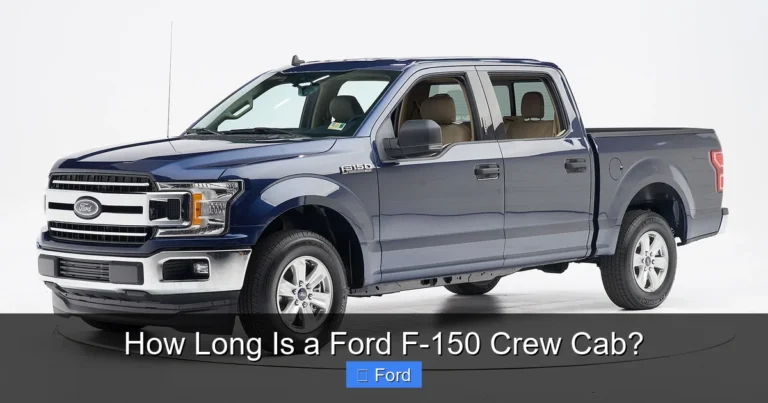
How Much Can a Ford F150 2.7 Ecoboost Tow

Contents
- 1 Key Takeaways
- 2 📑 Table of Contents
- 3 Unlocking the Towing Potential of Your Ford F150 2.7 EcoBoost
- 4 Decoding the Max Tow Ratings: It’s All in the Details
- 5 The Real-World Equation: Payload is the Silent Killer
- 6 How the 2.7L EcoBoost Stacks Up Against Its F150 Siblings
- 7 Pro Tips for Safe and Effective Towing with Your 2.7L EcoBoost
- 8 Debunking Myths: Is the 2.7L “Just a Car Engine”?
- 9 Frequently Asked Questions

Car Mud Flaps (Universal)

Tire Pressure Monitoring System (TPMS)

LED Indicator Light

Car Cleaning Brush Set
The Ford F150 with the 2.7L EcoBoost engine can tow up to 9,000 pounds when properly configured. This impressive number is achieved with the Max Trailer Tow Package, a specific axle ratio, and in the right cab/bed setup. However, your actual safe towing capacity depends heavily on payload, tongue weight, and your truck’s overall setup. It’s a powerful, efficient turbocharged V6 that rivals many V8s for most towing needs.
Key Takeaways
- Max Tow Rating: The absolute maximum for a 2.7L EcoBoost F150 is 9,000 lbs, but this is only for specific configurations (usually Regular Cab, 8′ bed, 4×2) with the Max Trailer Tow Package and 3.55 or 3.73 axle.
- Payload is the Limiting Factor: Your truck’s payload rating (how much weight it can carry *in* the cabin and bed) is often the real constraint. Exceeding payload can be dangerous and is a common mistake.
- The 10-Speed Transmission is Key: The Ford 10-speed automatic is essential for managing the 2.7L’s power, providing smooth shifts and engine braking when towing heavy loads.
- Configuration Matters Hugely: A Regular Cab has a higher tow rating than a SuperCrew because it’s lighter. Adding a larger cab, 4×4, and a shorter bed reduces your max tow capacity.
- It’s a Torque Monster: The 2.7L produces its peak torque (400 lb-ft) at a low 2,750 RPM, giving it strong, responsive pulling power from a stop and on hills, similar to a larger V8.
- Efficiency is a Major Advantage: Compared to the 5.0L V8, the 2.7L EcoBoost offers significantly better fuel economy, both while towing and unloaded, making it a cost-effective choice for frequent tower.
- Proper Setup is Non-Negotiable: You must use the correct hitch class (Class IV for max tow), ensure your trailer brakes are functional, and weigh your fully loaded trailer to stay within all limits.
📑 Table of Contents
- Unlocking the Towing Potential of Your Ford F150 2.7 EcoBoost
- Decoding the Max Tow Ratings: It’s All in the Details
- The Real-World Equation: Payload is the Silent Killer
- How the 2.7L EcoBoost Stacks Up Against Its F150 Siblings
- Pro Tips for Safe and Effective Towing with Your 2.7L EcoBoost
- Debunking Myths: Is the 2.7L “Just a Car Engine”?
Unlocking the Towing Potential of Your Ford F150 2.7 EcoBoost
So, you’re looking at a Ford F150 with the 2.7L EcoBoost engine, and the big question on your mind is: “How much can this thing actually tow?” Maybe you’ve got a boat, a camper, or a hefty work trailer in your future. You’ve heard the rumors—some say it’s a tiny turbo motor not up to the task, others swear by its surprising grunt. Let’s cut through the noise. This isn’t just about quoting a maximum number from a brochure. It’s about understanding what that number means, what affects it, and how to safely and confidently put your truck to work. The 2.7L EcoBoost has rewritten the rules for half-ton trucks, offering a blend of power and efficiency that has made it one of the most popular engine choices in the F150 lineup. By the end of this deep dive, you’ll know exactly what your specific truck can handle and how to maximize it.
The Turbocharged Revolution in a Half-Ton Truck
Before we dive into numbers, let’s talk philosophy. Ford introduced the 2.7L EcoBoost for the F150 in the 2015 model year as a direct response to the need for better fuel economy without sacrificing capability. It’s a twin-turbocharged, direct-injected V6. The magic of turbocharging is that it uses exhaust gases to spin a compressor, forcing more air into the engine. More air means you can burn more fuel, which creates more power. The key benefit? This power is on demand. The 2.7L produces a massive 400 lb-ft of torque, and it arrives at just 2,750 RPM. That’s a very low, broad plateau of torque. What does that mean for you? It means strong, immediate pulling power from a dead stop. It means the truck doesn’t have to downshift aggressively to maintain speed on a grade. It feels responsive and confident, almost like a much larger engine. This low-end grunt is precisely what you want when you’re hooking up a heavy trailer and pulling out onto the highway.
Now, onto the number you’ve been waiting for. The maximum conventional towing capacity for a Ford F150 equipped with the 2.7L EcoBoost engine is 9,000 pounds. This is a factory rating. But—and this is a big but—this is the absolute ceiling under perfect, controlled conditions. It’s the number you get when you check every box on the options sheet and choose the lightest possible cab and bed configuration. For most buyers shopping for a crew cab with a usable bed, that 9,000-lb max will be slightly lower. A typical SuperCrew (4-door) with a 5.5′ or 6.5′ bed will see a max tow rating in the range of 8,000 to 8,700 lbs, depending on the exact axle ratio and whether you have 4×2 or 4×4. The 4×4 system adds weight, which reduces the overall capacity you can pull. It’s crucial to look at the yellow and white tire label on your driver’s door jamb or your owner’s manual for your specific truck’s exact ratings. Those documents are the final authority for your vehicle’s capabilities.
Decoding the Max Tow Ratings: It’s All in the Details
You might see two different F150s, both with 2.7L EcoBoost badges, and they have different tow ratings printed on their door stickers. Why? Because Ford’s ratings are a precise calculation of the entire vehicle’s capability, not just the engine’s strength. Several key factors create this final number.

Visual guide about How Much Can a Ford F150 2.7 Ecoboost Tow
Image source: i.ytimg.com
Configuration: Cab, Bed, and Drivetrain
The single biggest variable after the engine itself is the truck’s own weight. A Regular Cab with an 8-foot bed is the lightest configuration. This leaves more of the truck’s Gross Combined Weight Rating (GCWR)—the total weight of the truck, passengers, cargo, and trailer—available for the trailer. As you add a second row of seats (SuperCab) or a full rear cab (SuperCrew), and as you opt for a shorter, heavier bed, the truck’s curb weight goes up. That eats into the GCWR, directly lowering your maximum trailer weight. Similarly, 4×4 adds significant unsprung weight (transfer case, front axle, etc.), which also reduces the available tow rating compared to a 4×2 model. If maximum tow is your sole priority and you don’t need a massive back seat, the Regular Cab 8′ bed 4×2 is the king for the 2.7L.
The Non-Negotiable Max Trailer Tow Package
To even *approach* that 9,000-lb figure, your F150 must be equipped with the optional Max Trailer Tow Package. This isn’t just a fancy hitch. It’s a comprehensive suite of upgrades that includes:
- A heavy-duty hitch receiver (typically a Class IV, 2.5″ receiver).
- An integrated trailer brake controller, so you can control your trailer’s brakes from the dash.
- Upgraded cooling systems, often a larger radiator and sometimes an additional transmission oil cooler. Towing generates immense heat, and you need all the cooling you can get.
- Specific axle gearing, usually a 3.55 or 3.73 ratio. A numerically higher gear ratio (like 3.73) gives the engine more mechanical advantage, making it easier to get a heavy load moving and maintain speed on hills, but it can reduce fuel economy at cruising speeds. A 3.55 is a great all-around compromise.
If your truck doesn’t have this package, its factory tow rating will be significantly lower, often in the 5,000–7,000 lb range, depending on the configuration. Always verify you have this package if you’re shopping for a used truck and plan to tow.
The Real-World Equation: Payload is the Silent Killer
Here’s where most people, especially first-time towers, get into trouble. They look at the tow rating and think, “My truck can pull 8,500 lbs, so I can buy an 8,500 lb camper.” Wrong. You must also consider payload capacity. Payload is everything the truck carries *itself*: you, your passengers, your tools, the fuel, the hitch, and the tongue weight of the trailer (the downward force on the hitch, typically 10-15% of the trailer’s weight). Your truck’s payload rating is also printed on the door jamb sticker.

Visual guide about How Much Can a Ford F150 2.7 Ecoboost Tow
Image source: i.ytimg.com
Let’s do a real-world example. Your F150 SuperCrew has a payload rating of 1,800 lbs. You load up the family (4 people, 600 lbs), a full tank of gas (150 lbs), your gear in the bed (200 lbs), and install a heavy hitch (75 lbs). You’ve already used 1,025 lbs of your 1,800-lb payload. That leaves you with only 775 lbs of remaining payload capacity for the trailer’s tongue weight. If your trailer weighs 7,500 lbs, its tongue weight should be 750-1,125 lbs (10-15%). You’re already at or over your payload limit before you even hook up the trailer. In this scenario, your *actual* safe tow weight is much lower than the max rating. Your payload is the limiting factor. This is why weighing your fully loaded truck and trailer at a public scale is the single best thing you can do to tow safely. It removes all guesswork.
Tongue Weight and Hitch Selection: Getting it Right
Tongue weight (TW) is critical. Too little (under 10%) and the trailer can sway dangerously. Too much (over 15%) and you overload your truck’s rear axle, causing poor steering, brake wear, and potential suspension failure. For a 7,000 lb trailer, you need 700-1,050 lbs of TW. Your truck’s payload must cover this weight. You also need the correct hitch. For max tow with the 2.7L, you need a Class IV or V hitch. A weight-distributing hitch is highly recommended for trailers over 5,000 lbs. It uses spring bars to distribute the trailer’s weight more evenly across all axles of the truck and trailer, improving stability, steering, and leveling. It’s not always legally required for your truck’s weight, but it’s a best practice for safety and vehicle health. For those towing larger campers, a fifth-wheel or gooseneck hitch (which mounts in the truck bed) can actually increase your payload capacity because it places the tongue weight more directly over the rear axle, but that’s a different setup entirely and not applicable to all trailers.
How the 2.7L EcoBoost Stacks Up Against Its F150 Siblings
The F150 buyer has a fantastic problem: too many good engine choices. So how does the 2.7L hold up? Let’s compare it to the other main players: the 3.5L EcoBoost V6 and the 5.0L V8.

Visual guide about How Much Can a Ford F150 2.7 Ecoboost Tow
Image source: towengine.com
2.7L vs. 3.5L EcoBoost: The Power Twins
The 3.5L EcoBoost is the top-tier turbo V6. It makes 400 hp and 500 lb-ft of torque (in its highest output version). Its max tow rating is 14,000 lbs when properly configured. That’s a massive 5,000-lb advantage over the 2.7L. The 3.5L is for the person who regularly tows the largest conventional trailers—large multi-axle boats, massive luxury fifth-wheels, or heavy equipment. The 2.7L, with its 400 lb-ft of torque, is more than capable for the vast majority of half-ton truck owners. That 9,000-lb rating covers most large travel trailers, big boats, and car haulers. The 2.7L’s advantage is cost (often a $1,500-$2,000 upcharge over the base V6, but less than the 3.5L) and, in many real-world driving scenarios, better fuel economy due to its smaller displacement and less effort required to move the truck itself. If your trailer is under 8,000 lbs, the 2.7L is arguably the smarter, more efficient choice.
2.7L vs. 5.0L V8: The Old Guard vs. The New Tech
The 5.0L V8 is the traditionalist’s choice. It makes 400 hp and 410 lb-ft of torque. Its max tow rating is very close to the 2.7L’s, typically around 8,900-9,000 lbs in similar configurations. So on paper, they’re nearly identical in capability. The decision comes down to driving character and efficiency. The V8 offers a smooth, linear power delivery and that iconic V8 rumble. The 2.7L EcoBoost delivers its torque much earlier and more forcefully. You’ll feel the turbo spool and be pushed back in your seat. In real-world fuel economy, the 2.7L consistently wins, especially during light-load driving and even while towing, because it’s not working as hard to move its own mass. If you tow frequently and care about fuel costs, the EcoBoost has a clear edge. If you prefer the sound and feel of a naturally aspirated V8 and tow primarily on flat terrain, the 5.0L is a fantastic, proven engine.
For those looking at even heavier duties, comparing the F150’s capabilities to a true heavy-duty truck like the GMC Sierra 2500 is a common next step. Those HD trucks with diesel engines can tow 15,000+ lbs, but they are a different class of vehicle—heavier, less refined on-road, and more expensive to operate. The F150 2.7L sits perfectly in the sweet spot for the owner who needs serious half-ton capability without stepping up to a three-quarter ton.
Pro Tips for Safe and Effective Towing with Your 2.7L EcoBoost
Knowing the numbers is step one. Using them correctly is step two. Here’s how to get the most out of your truck safely.
Essential Towing Packages and Gear
As mentioned, the Max Trailer Tow Package is your starting point. But don’t stop there. Consider these additions:
- Upgraded Mirrors: Extended or telescoping tow mirrors are a necessity for seeing past your trailer. They’re often an option from the factory or an easy aftermarket addition.
- Transmission Cooler: If your truck didn’t come with an auxiliary transmission cooler from the factory (some Max Tow packages include a larger one), adding an aftermarket cooler is one of the best investments you can make. It keeps transmission fluid temperatures down, ensuring shift quality and long-term reliability under heavy load.
- Quality Wiring Harness: Use a high-quality, vehicle-specific trailer wiring harness (like from Tekonsha or Hopkins) for a reliable, plug-and-play connection for your trailer’s lights and brakes. Avoid cheap, universal “splice-in” kits.
- Weight-Distributing Hitch: As discussed, this is a game-changer for stability with trailers over 5,000 lbs. It’s worth every penny.
Driving Techniques: It’s Not Just About the Gas Pedal
The 2.7L has the power, but towing changes the physics. Allow more time and distance for everything.
- Acceleration and Merging: Plan way ahead. Use the truck’s low-end torque to your advantage, but know it will take longer to get up to speed. Use the “ Tow/Haul” mode in your transmission if equipped. This holds gears longer and provides more engine braking.
- Passing: Allow for massive gaps. Your truck will be slower to accelerate and your passing distance will be quadrupled. Be patient and signal early.
- Braking: Start braking sooner and more gradually. Your stopping distance is dramatically increased. Your trailer brakes should do most of the work, but your truck’s brakes are still in the equation. Ensure your brake controller is properly adjusted so the trailer brakes engage smoothly and progressively.
- Downhill: This is where engine braking shines. In Tow/Haul mode or by manually selecting a lower gear (using the paddle shifters or “L” gear), let the engine slow you down. Do not ride your truck’s brakes continuously on a long descent; they will overheat and fade. Use the transmission to control your speed.
Maintenance is More Critical Than Ever
Towing is severe service for any vehicle. Your 2.7L EcoBoost is robust, but it needs extra care.
- Oil Changes: Do them more frequently. If the manual says 7,500 miles for normal driving, consider 5,000 miles or 6 months when towing regularly. Use the specified oil (usually a full synthetic 5W-30).
- Check Fluids: Regularly check engine oil, coolant, and especially transmission fluid levels and condition. Towing heats the transmission. If the fluid smells burnt or looks dark, change it. Consider a more frequent transmission fluid service interval (e.g., every 50,000 miles) if towing heavily.
- Inspect the Cooling System: Ensure your radiator is clean and free of debris. Check all hoses and belts for wear. A overheating engine or transmission is your biggest risk when towing.
- Tires: Ensure your truck’s tires are properly inflated to the max pressure listed on the door jamb (not the tire sidewall) when loaded. Under-inflated tires generate excessive heat and are a blowout risk. Inspect your trailer’s tires as well.
Debunking Myths: Is the 2.7L “Just a Car Engine”?
You’ll hear it. “That’s a Taurus engine!” or “It’s not a real truck motor.” Let’s put this to bed. Yes, the base architecture of the 2.7L shares some design DNA with Ford’s car and SUV engines. But the F150 version is extensively modified. It has a unique block, cylinder heads, turbochargers, and tuning specifically for truck duty. It’s built to withstand the stresses of towing, with robust internals and a strong bottom end. Ford’s own durability testing for truck applications is brutal. The 2.7L in an F150 is not the same as the one in a Flex or Explorer. Furthermore, real-world reliability data from owners and mechanics shows the 2.7L EcoBoost to be a very durable engine when maintained properly. The two main concerns historically have been carbon buildup on the intake valves (common to all direct-injected engines, solved by periodic walnut blasting) and, in early models (2015-2017), occasional coolant leaks from the water pump. These are known, serviceable items. The engine’s widespread use across Ford’s lineup means a vast network of technicians is familiar with it. It has proven itself over a decade in millions of trucks.
Real-World Success: What Are People Actually Towing?
Forums and owner groups are full of 2.7L owners successfully towing. Common loads include:
- Travel Trailers & Campers: 6,000 – 8,500 lb. This is the 2.7L’s bread and butter. It handles them with ease, often with power to spare.
- Boats: 20-24 foot center consoles or ski boats, often weighing 5,000-7,500 lbs.
- Car Haulers: Single or dual-axle car trailers with a vehicle or two.
- Utility Trailers: Loaded with equipment, landscaping material, or ATVs.
The common theme? They are staying within the truck’s *actual* payload and GCWR limits. The most successful owners are those who weigh their setup, use a proper weight-distributing hitch, and don’t try to max out the brochure number with an overweight, poorly loaded trailer. The 2.7L is more than capable for the vast majority of recreational and light-commercial towing needs.
Frequently Asked Questions
What is the absolute maximum tow capacity for a Ford F150 with the 2.7L EcoBoost?
The maximum conventional towing capacity is 9,000 pounds. This is only achievable in specific configurations, primarily the Regular Cab with an 8-foot bed, 4×2 drivetrain, and the Max Trailer Tow Package with a 3.55 or 3.73 axle ratio.
Does adding accessories like a bed liner or running boards reduce my truck’s tow rating?
Not directly. The factory tow rating is calculated with a baseline vehicle weight. Adding heavy accessories (like a steel bed liner) increases your truck’s curb weight, which reduces your available Gross Combined Weight Rating (GCWR). This means your *actual* safe towing capacity is lower than the max rating. Always account for all added weight.
Which F150 configuration is best for towing with the 2.7L EcoBoost?
For maximum tow capacity, the Regular Cab 8′ bed 4×2 is the lightest and thus has the highest rating. For most buyers needing a crew cab, a SuperCrew with a 5.5′ or 6.5′ bed and the Max Trailer Tow Package is the best balance of utility and capability, offering up to ~8,700 lbs.
How does the 2.7L EcoBoost compare to the 3.5L EcoBoost for towing?
The 3.5L EcoBoost has a significantly higher max tow rating (up to 14,000 lbs) and more peak torque (500 lb-ft). It’s designed for the largest trailers. The 2.7L’s 400 lb-ft is ample for most half-ton applications (up to ~9,000 lbs) and often delivers better real-world fuel economy for lighter loads, making it a more efficient choice for many.
Can I tow a fifth-wheel or gooseneck trailer with the 2.7L EcoBoost F150?
No. The F150, including the 2.7L model, is not designed or rated for fifth-wheel or gooseneck hitches. These require a specialized bed mount and structural reinforcement found only in heavy-duty trucks like the F250/F350. Attempting to tow a fifth-wheel with an F150 is unsafe and will void warranties.
Is the 2.7L EcoBoost reliable for heavy towing?
Yes, when properly maintained. It is a robust engine designed for truck duty. Key maintenance includes regular oil changes with full synthetic oil, monitoring transmission fluid temperature/condition, and addressing carbon buildup on intake valves (a common issue on all direct-injected engines) as needed, typically around 60,000-80,000 miles. Its widespread use has proven its durability over the last decade.