How Many Quarts of Oil Does a Gmc 1500 Take

Contents
- 1 Key Takeaways
- 2 📑 Table of Contents
- 3 The Golden Rule: Your Owner’s Manual is Law
- 4 Common GMC 1500 Engines and Their Typical Oil Capacities
- 5 How to Find the EXACT Capacity for Your Specific Truck
- 6 The Critical “With Filter” vs. “Without Filter” Distinction
- 7 What Happens If You Get It Wrong? (The “Why This Matters” Section)
- 8 Oil Type and Capacity: Two Sides of the Same Coin
- 9 Special Considerations: Mods, High-Mileage, and Extreme Use
- 10 Frequently Asked Questions


The exact amount of oil a GMC 1500 requires is not a single number—it depends entirely on your truck’s specific engine size (like the 5.3L or 6.2L V8) and model year. Always consult your owner’s manual for the precise specification, which typically ranges from 6 to 8 quarts with a filter change. Using the correct oil capacity is critical for engine protection and performance.
So, you’re getting ready to change the oil in your trusty GMC Sierra 1500 or your powerful GMC Canyon? You’ve got the new filter, the right wrench, and a fresh jug of oil. But then it hits you: how many quarts of oil does a GMC 1500 take? It seems like a simple question, but the answer is a classic “it depends.” Getting this number wrong is one of the most common—and potentially damaging—mistakes a DIYer can make. Let’s clear up the confusion once and for all. This guide will walk you through exactly how to find the correct oil capacity for your specific truck, why it varies, and the crucial steps to ensure you put in the perfect amount every single time. Think of it as your definitive owner’s manual for oil capacity.
Key Takeaways
- Engine Dictates Capacity: The primary factor is your GMC 1500’s engine displacement (e.g., 5.3L EcoTec3 V8 vs. 6.2L V8). Each has a different oil sump size and requirement.
- Model Year Matters: Even for the same engine size, oil capacity can change slightly between model years due to design tweaks. A 2020 and a 2023 with the same 5.3L may have a small difference.
- Filter Change is Key: The standard specification is always for an oil change with a new oil filter. Forgetting this leads to underfilling.
- Check the Manual First: Your vehicle’s owner’s manual is the single, most authoritative source for the correct oil capacity and viscosity grade.
- Don’t Guess, Verify: While this guide provides ranges, the only way to be 100% certain for your personal truck is to look up the exact specification for its VIN or manual.
- Overfilling is Dangerous: Adding more oil than specified can cause aeration, foaming, increased pressure, and seal leaks, potentially leading to catastrophic engine failure.
- Capacity vs. Dipstick: The “full” mark on the dipstick is your final check. After adding the specified quarts, always start the engine, let it run, re-check, and top off if necessary to reach the “full” line.
📑 Table of Contents
- The Golden Rule: Your Owner’s Manual is Law
- Common GMC 1500 Engines and Their Typical Oil Capacities
- How to Find the EXACT Capacity for Your Specific Truck
- The Critical “With Filter” vs. “Without Filter” Distinction
- What Happens If You Get It Wrong? (The “Why This Matters” Section)
- Oil Type and Capacity: Two Sides of the Same Coin
- Special Considerations: Mods, High-Mileage, and Extreme Use
The Golden Rule: Your Owner’s Manual is Law
Before we dive into numbers and engine types, let’s establish the non-negotiable rule. The absolute, final authority on how many quarts of oil your GMC 1500 needs is your vehicle’s owner’s manual. It’s the document General Motors wrote specifically for your exact truck, with its specific engine, model year, and configuration. Inside, you’ll find a section titled something like ” Capacities and Specifications” or “Fluid and Lubricants.” There, listed plainly, will be the engine oil capacity with filter and the recommended oil viscosity (like 0W-20 or 5W-30). If you have the physical book, crack it open. If you don’t, most manufacturers, including GMC, offer free digital PDFs on their owner’s portal websites. A quick search for “[Your Year] GMC Sierra 1500 owner’s manual PDF” will usually get you there. This is step one, and it’s the most important. For those who love cross-referencing, you can also find this information on the official GM website’s owner resources section or through reputable automotive databases.
Why You Can’t Use a “One-Size-Fits-All” Number
It’s tempting to ask a friend with a similar truck or search for a generic answer online. But here’s why that’s risky business. The GMC 1500 (and its sibling, the Chevrolet Silverado 1500) has been offered with a variety of engines over the years. Each engine family has a different oil pan design, different internal clearances, and thus, a different oil capacity. Furthermore, General Motors frequently updates engines mid-generation. The 5.3L V8 EcoTec3 engine introduced in 2014 is not identical to the 5.3L V8 in a 2023 model. These updates can include changes to the oil pan, the oil pump, or even the oil filter design, all of which can shift the required capacity by a fraction of a quart. Using the wrong capacity, even by half a quart, can have consequences. Too little oil spells disaster for lubrication. Too much oil creates froth and pressure. You need the precise number for your powertrain.
Common GMC 1500 Engines and Their Typical Oil Capacities
Now, let’s get to the numbers you’re here for. Below are the most common engines found in the last decade of GMC 1500s (Sierra) and 1500-series trucks. Remember: these are general ranges and examples. Your manual is the final judge. We’ll focus on capacities for an oil change with a new filter installed, as that’s the standard procedure.
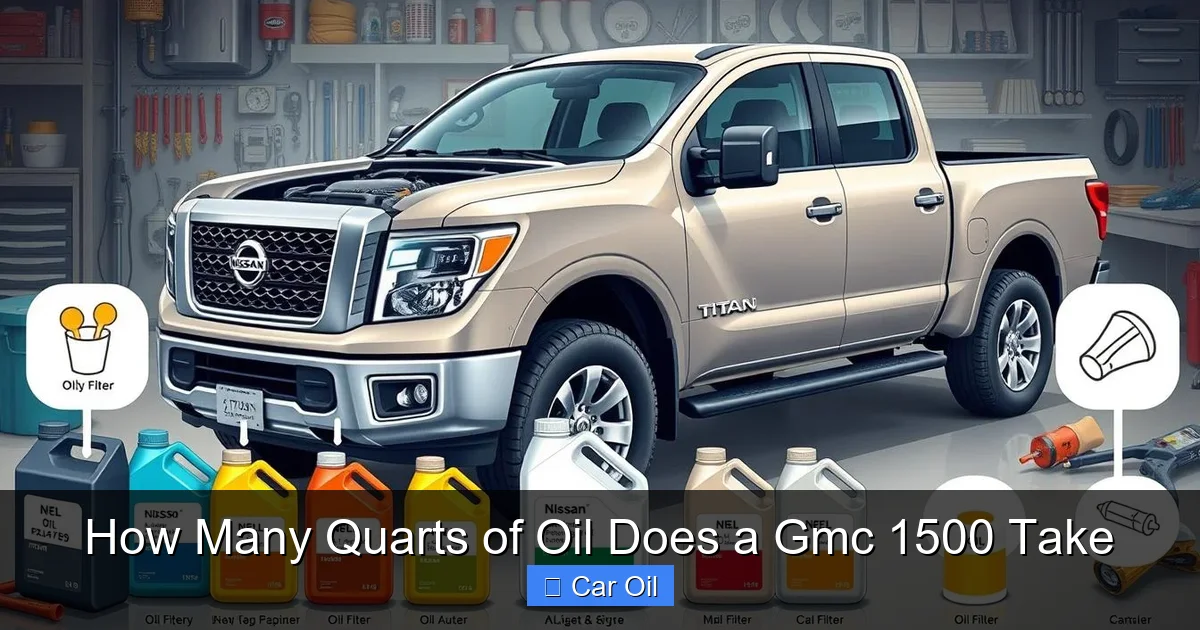
Visual guide about How Many Quarts of Oil Does a Gmc 1500 Take
Image source: vehiclefreak.com
The Workhorse: 5.3L EcoTec3 V8
This is arguably the most popular engine in the full-size GMC lineup for many years. It’s a balance of power and efficiency. For the vast majority of model years from 2014 to the present, the 5.3L V8 takes 6.0 quarts (5.7 liters) of oil with a filter change. However, there are notable exceptions and variations. Some earlier models (like 2014-2015) or specific configurations might call for 6.5 quarts. The 2020-2023 models with the updated 5.3L L84 engine often still use the 6.0-quart specification, but it’s vital to confirm. If you have a truck with the 5.3L and you’re unsure, start by assuming 6.0 quarts, but have your manual ready to verify.
The High-Performance: 6.2L V8 EcoTec3
This is the bigger, more powerful brother, often found in the Denali, AT4, and top-tier SLT trims. It’s a beast of an engine, and it needs more oil to keep all those larger components lubricated and cooled. The standard oil capacity for the 6.2L V8 with filter is typically 8.0 quarts (7.6 liters). This has been a consistent figure for many model years. It’s a significant jump from the 5.3L, so don’t make the mistake of using the smaller engine’s capacity. If you own a 6.2L-powered GMC 1500, you’re almost certainly looking at an 8-quart requirement.
The Efficient Turbo: 2.7L L4 Turbo (Newer Models)
For the 2022 and newer model years, GMC introduced a revolutionary (for the full-size segment) turbocharged 2.7-liter four-cylinder engine as the base powerplant in many Sierra 1500 trims. This engine is designed for efficiency and torque, but its oil system is different from the V8s. The oil capacity for the 2.7L Turbo with filter is 6.2 quarts (5.9 liters). It’s crucial not to confuse this with the V8 capacities. This engine also has specific oil requirements (often 0W-20), so you must check the manual for both the capacity and the viscosity.
Other Engines: The 4.3L V6 and 5.3L with AFM/DoD
While less common in recent 1500s, the 4.3L V6 EcoTec3 was a base engine option for years. It typically requires 5.5 quarts (5.2 liters) with a filter. Also, some 5.3L engines from earlier generations (pre-2014) or those with specific Active Fuel Management (AFM) or Displacement on Demand (DoD) systems might have slightly different capacities. This is why pinning down your exact engine code (found on a sticker under the hood or in the manual) is so helpful. You can search for “[Your Engine Code] oil capacity” for a precise answer.
How to Find the EXACT Capacity for Your Specific Truck
You’ve got a ballpark figure now. But how do you get the exact, bulletproof number? Here is your step-by-step verification process.
Visual guide about How Many Quarts of Oil Does a Gmc 1500 Take
Image source: psychoautos.com
Step 1: The Owner’s Manual (Again)
We cannot stress this enough. Open that book. Go to the lubrication section. It will list “Engine Oil Capacity” with and without filter. That’s your number. Write it down. This is your primary source.
Step 2: The Oil Cap or Dipstick Area
Sometimes, especially on newer vehicles, the manufacturer will print the oil capacity directly on the oil filler cap itself or on a sticker near the dipstick. It might say “API SN” and “6.0qt” or similar. This is a fantastic, quick-reference confirmation. Give your oil cap a good look.
Step 3: Online Lookup by VIN
This is the most accurate method if you don’t have the manual. Your Vehicle Identification Number (VIN) is a 17-digit code that tells the entire story of your truck. You can enter your VIN into the GM Owner’s portal, or use reputable third-party sites like our detailed guide for the 6.2L GMC, which breaks down capacities by year and engine. The VIN will decode your exact engine, transmission, and assembly plant, giving you the precise specification.
Step 4: Trusted Mechanic or Dealership
When in doubt, a quick call to your local GMC dealer’s service department or a trusted mechanic will get you the answer in seconds. They have access to all the official specifications. It’s a five-minute phone call that saves you from a $5,000 engine rebuild.
The Critical “With Filter” vs. “Without Filter” Distinction
This is a pitfall that catches many people. Specifications in manuals and online are almost always given for an oil change with a new oil filter. Why? Because when you drain the oil, you typically drain the oil pan, but the old oil filter still holds a significant amount of oil—usually between 0.5 to 1 quart. If you put in the “with filter” capacity but don’t change the filter, you will be overfilling the engine by that filter’s residual volume. Conversely, if you see a spec for “without filter,” you would need to add the filter’s volume on top of that. Always, always, always assume the capacity you are looking for is for a new filter. When you change your filter, you are replacing that old, oil-filled cartridge, and the new one needs to be filled, which is accounted for in the “with filter” total.
Visual guide about How Many Quarts of Oil Does a Gmc 1500 Take
Image source: enduringautomotive.com
What Happens If You Get It Wrong? (The “Why This Matters” Section)
It’s not just about hitting a number on a jug. Getting the oil level wrong has real, severe consequences for your engine’s health.
The Dangers of Underfilling
If you put in less oil than required, the oil pump will suck air along with oil. This creates aeration and foam. Foamy oil cannot lubricate properly. It loses its ability to form a protective film on bearings, camshafts, and piston walls. The result is extreme friction, rapid wear, overheating, and eventually, catastrophic engine seizure. The dipstick’s “low” mark is not a target; it’s a minimum threshold you should never operate below. Always fill to the “full” mark.
The Hidden Dangers of Overfilling
This is a more insidious problem. Too much oil means the crankshaft, which is spinning at thousands of RPM, will dip into the oil sump and whip it into a frothy foam. This foam, just like underfilling, cannot lubricate. It also causes aeration in the oil, reducing its cooling capacity and potentially leading to oil starvation in critical areas. Furthermore, the excess volume increases crankcase pressure. This pressure has to go somewhere, and it often forces oil past seals and gaskets, causing leaks from the rear main seal, valve covers, or even the dipstick tube. In modern engines with sensitive variable valve timing systems, aerated oil can disrupt hydraulic pressure and cause timing errors, leading to poor performance and warning lights.
The Perfect Procedure: Fill, Run, Re-check
So you know the capacity is, say, 6.0 quarts. You pour in 6.0 quarts, right? Not so fast. The correct procedure is:
- Pour in approximately 90% of the specified capacity (e.g., 5.4 quarts for a 6.0-quart spec).
- Install the new oil filter (pre-filled with a little oil, of course).
- Start the engine and let it run for about 30 seconds. This allows oil to circulate and fill the new filter and all oil passages.
- Turn off the engine, wait a minute for oil to drain back to the pan, and then check the dipstick.
- Add the remaining oil in small increments (a half-quart at a time), re-checking each time, until the dipstick reads exactly at the “full” mark. Do not force it to the top of the “full” range if it’s not there.
This method accounts for minor variations in oil drainage, filter fill, and engine design. The dipstick reading is the ultimate truth, not the theoretical jug count.
Oil Type and Capacity: Two Sides of the Same Coin
We’ve focused on volume, but you cannot separate capacity from the oil’s specification. GMC, like all modern manufacturers, requires a specific viscosity and performance standard. For most newer GMC 1500s with the 5.3L and 6.2L engines, the requirement is SAE 0W-20 that meets the GM dexos1™ Gen 3 specification. The 2.7L Turbo also uses 0W-20 dexos1 Gen 3. Older models might call for 5W-30. Using the wrong viscosity can affect cold-start flow, fuel economy, and wear protection. Always use the exact oil type specified in your manual. Using a different oil does not change the capacity, but it changes whether that capacity is doing its job correctly. For a deep dive into what those numbers mean, you can read our general guide on how many quarts of oil a car takes, which explains the principles that apply to every vehicle.
Special Considerations: Mods, High-Mileage, and Extreme Use
What if your truck is not stock? If you’ve added a larger oil pan (common in off-road or towing rigs), an aftermarket oil cooler, or other modifications, your capacity has changed. You must consult the instructions for that specific part. Similarly, some mechanics recommend using a “high-mileage” oil in engines with over 100,000 miles. While the viscosity might be the same (e.g., 5W-30 High-Mileage), the capacity remains unchanged. For extreme use—like constant high-speed towing in very hot climates—some owners might opt for a slightly different viscosity (like 5W-30 instead of 0W-20), but only after consulting with a trusted mechanic and understanding any potential warranty implications. Never alter your oil type or capacity based on internet forum advice alone for a daily-driven truck.
Frequently Asked Questions
Can I use 5W-30 instead of 0W-20 in my GMC 1500?
For newer models (typically 2019+), GM specifically calls for 0W-20 dexos1 Gen 3 oil to meet fuel economy and emissions standards. Using 5W-30 could void your warranty and may not provide the same low-temperature flow. Always use the viscosity specified in your manual. For older pre-2019 trucks, 5W-30 was often standard, so check your manual.
What’s the best way to check my oil level to ensure it’s perfect?
Follow this ritual: After an oil change, drive the truck normally for 5-10 minutes, then park on level ground. Turn off the engine and wait at least 5-10 minutes for oil to drain back. Pull the dipstick, wipe it clean, reinsert it fully, pull it out again, and read the level. The oil should be clean and sit between the “min” and “max” marks, ideally at or near the “max/full” mark. Check it cold the next morning as a final confirmation.
I added the specified quarts, but my dipstick shows below the full mark. Is that okay?
No, that’s not okay. The dipstick is the final arbiter of truth. If the level is below the “full” mark after following the fill-run-check procedure, you must add more oil in small amounts until it reaches the mark. The “quarts” specification is an average estimate. Your specific engine’s oil galleries, the exact drain-down time, and the brand of filter can all affect the final level. The dipstick reading is what matters for your engine’s safety.
Is it ever okay to slightly overfill the engine, say by 0.25 quarts?
It’s generally not recommended. While a tiny overfill might not cause immediate harm, it increases the risk of aeration and foaming, especially under hard driving or high RPM conditions. The safe margin is small. It’s far better to be a hair underfilled (but above the “min” mark) than overfilled. If you overfill, the correct action is to drain the excess oil into a clean container, re-measure, and re-install the drain plug. Do not just run it.
My GMC 1500 has a 5.3L engine, but the manual says 6.5 quarts. Why is it different from what I’ve read online?
This highlights the importance of your specific model year and engine variant. The 5.3L engine has evolved. Earlier models (like 2014-2015) or certain pickup box/configurations might have a different oil pan design requiring 6.5 quarts. Later models refined it to 6.0 quarts. Your manual is for your exact truck. Trust it over a general internet article. If you have a VIN, you can decode it to see the exact engine code (like L83, L84, L8B) and find specs for that precise variant.
When changing my oil, should I also change the oil filter every time?
Absolutely, yes. An oil change is not complete without a new oil filter. The filter traps contaminants, metal shavings, and sludge. Reusing an old filter reintroduces all that debris into your fresh, clean oil, defeating the entire purpose of the service. Always use a high-quality filter that meets or exceeds GM specifications (look for dexos1™ approval on the filter box). And remember, the oil capacity listed in your manual is for a change with a new filter.