How Many Quarts of Oil Does a 4 Cylinder Toyota Corolla Take

Contents
- 1 Key Takeaways
- 2 📑 Table of Contents
- 3 Understanding Your Corolla’s Heart: The 4-Cylinder Engine Family
- 4 The Exact Numbers: Oil Capacities by Model Year
- 5 The Critical Role of Oil Type and Viscosity: It’s Not Just About Quantity
- 6 How to Check Your Oil Level: The Gold Standard Procedure
- 7 The Dangers of Getting It Wrong: Overfilling vs. Underfilling
- 8 Your Step-by-Step Guide to a Perfect DIY Oil Change
- 9 Conclusion: Knowledge is the Best Mechanic
- 10 Frequently Asked Questions


The amount of oil a 4-cylinder Toyota Corolla requires isn’t a one-size-fits-all answer; it varies slightly by engine generation and model year. Most commonly, models from 2014-2018 with the 1.8L engine take 4.4 quarts with a filter change, while newer 2019+ models with the 2.0L Dynamic Force engine require 4.2 quarts. Always confirm using your owner’s manual, as using the correct oil type (typically 0W-20) and capacity is critical for engine health and longevity.
You pop the hood of your trusty Toyota Corolla, ready to top off the oil. You grab the familiar jug of 0W-20, but then a simple, crucial question stops you in your tracks: “Just how many quarts does this thing actually hold?” It’s a deceptively simple question that opens a Pandora’s box of model years, engine codes, and factory specifications. One wrong guess can mean the difference between a smoothly purring engine and a costly, smoky disaster. As your friendly neighborhood automotive guide, I’m here to give you the definitive, no-nonsense answer for your 4-cylinder Toyota Corolla. We’ll break down the exact quarts for every major generation, explain why the number changes, and arm you with the professional-grade knowledge to handle your oil with absolute confidence.
First, let’s get the most common answer out of the way. If you own a Corolla from the 2014 through 2018 model years, equipped with the ubiquitous 1.8-liter 2ZR-FE engine, your answer is 4.4 quarts (4.2 liters) when changing the oil and filter. For the current generation, starting in 2019 for the North American market, which switched to the more efficient 2.0-liter M20A-FKS Dynamic Force engine, the capacity is 4.2 quarts (4.0 liters) with a filter change. But what about the hundreds of thousands of Corollas on the road from 2009-2013, or the legendary models from the 2000s? The numbers shift slightly. This isn’t Toyota being arbitrary; it’s engineering. Different engine designs have different sump sizes, different filter locations, and different clearances. Getting this number right is the first and most fundamental step in proper engine maintenance. A quick search for “how many quarts of oil does a 4 cylinder Toyota Corolla take” will give you a starting point, but you must narrow it down to your specific machine. For the most precise information, you can always cross-reference with our detailed guide How Many Quarts Of Oil Does A Toyota Corolla Take, which lists capacities by exact year and trim.
Key Takeaways
- Capacity Varies by Engine Generation: The most common 1.8L 4-cylinder (2014-2018) holds 4.4 quarts. The newer 2.0L (2019+) holds 4.2 quarts. Older 1ZZ-FE engines (pre-2009) may differ.
- Oil Type is Non-Negotiable: Toyota specifies 0W-20 synthetic oil for all modern Corolla 4-cylinders. Using the wrong viscosity can cause damage and void warranties.
- The Dipstick is Your Best Friend: Never rely solely on capacity numbers. The final, authoritative check is the oil level on the dipstick after starting and running the engine.
- Overfilling is Dangerous: Too much oil causes aeration, foaming, and increased pressure, leading to seal leaks, catalyst damage, and potential engine failure.
- Always Change the Filter: The “with filter” capacity is the correct number. The old filter holds about 0.25-0.5 quarts, so omitting it leads to underfilling.
- Model Year is Key: A 2010 Corolla and a 2022 Corolla have different engines and therefore different oil capacities. Your VIN or owner’s manual is the ultimate source.
- Climate Can Influence Choice: While 0W-20 is standard for all temperatures, in extreme sustained cold, some owners may consult a dealer about alternatives, but 0W-20 remains the official recommendation.
📑 Table of Contents
- Understanding Your Corolla’s Heart: The 4-Cylinder Engine Family
- The Exact Numbers: Oil Capacities by Model Year
- The Critical Role of Oil Type and Viscosity: It’s Not Just About Quantity
- How to Check Your Oil Level: The Gold Standard Procedure
- The Dangers of Getting It Wrong: Overfilling vs. Underfilling
- Your Step-by-Step Guide to a Perfect DIY Oil Change
- Conclusion: Knowledge is the Best Mechanic
Understanding Your Corolla’s Heart: The 4-Cylinder Engine Family
To understand the oil capacity, you must first understand which engine is under the hood. Toyota has used several excellent 4-cylinder engines in the Corolla over the last two decades. Identifying yours is simple: check the badge on the engine cover (it often says “1.8L” or “2.0L”), or look up your VIN online. The two primary players for our discussion are the workhorse 1.8L and the newer 2.0L.
The Legendary 1ZZ-FE and 2ZR-FE (Pre-2009 & 2009-2018)
The 1ZZ-FE engine powered Corollas from the late 1990s through the 2008 model year. It’s a cast-iron block, aluminum-head design known for its durability. Its oil capacity with filter is typically 4.2 quarts. In 2009, Toyota introduced the second-generation 1.8L, the 2ZR-FE, with dual VVT-i (variable valve timing on both intake and exhaust cams). This all-aluminum engine is a bit more efficient but holds a very similar, though not identical, amount of oil at 4.4 quarts for the vast majority of its applications in the Corolla. This 0.2-quart difference might seem trivial, but in the precise world of engine lubrication, it matters. The sump design and oil pump pickup location were optimized differently. If you’re changing the oil in a 2015 Corolla LE, you want 4.4 quarts, not the 4.2 from its older sibling. This is a perfect example of why year and model specificity is everything when asking “how many quarts of oil does a 4 cylinder Toyota Corolla take?”
The Modern M20A-FKS Dynamic Force Engine (2019-Present)
The current Corolla (E210 series) marks a significant evolution. Under the hood, you’ll find the 2.0-liter M20A-FKS engine, part of Toyota’s “Dynamic Force” family. This engine features a higher compression ratio (13.0:1), improved combustion, and is designed to run on regular 87-octane fuel while being more fuel-efficient. Its oil capacity is 4.2 quarts (4.0 liters) with a filter. The reduction from 4.4 to 4.2 quarts is a direct result of the redesigned, more efficient sump and internal components. It holds slightly less oil but is engineered to maintain perfect lubrication with that specific volume. Using 4.4 quarts in this engine would lead to overfilling, a serious issue we’ll discuss later. For owners of these newer models, it’s vital to use the correct capacity. You can find the exact specification for your VIN in your owner’s manual or on the official Toyota resources.
The Exact Numbers: Oil Capacities by Model Year
Let’s get concrete. Below is a breakdown of the most common 4-cylinder Corolla configurations. Remember, these are for a standard oil and filter change. “With Filter” is the only number you should ever use when refilling.
Visual guide about How Many Quarts of Oil Does a 4 Cylinder Toyota Corolla Take
Image source: oilcapacityguide.com
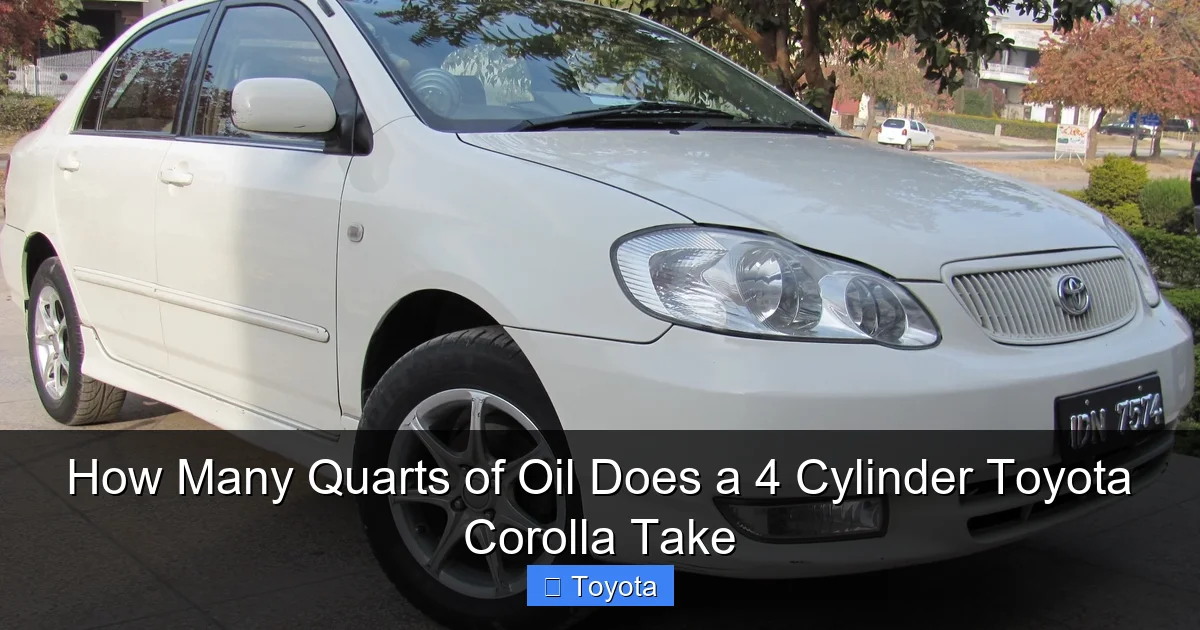
- 2009-2013 Corolla (1ZZ-FE or 2ZR-FE 1.8L): The transition year 2009 could have either engine, but 2010-2013 almost universally used the 2ZR-FE. Capacity: 4.4 quarts (4.2L) with filter.
- 2014-2018 Corolla (2ZR-FE 1.8L): This is the longest-running and most numerous modern generation. Capacity: 4.4 quarts (4.2L) with filter.
- 2019-Present Corolla (M20A-FKS 2.0L): The current model. Capacity: 4.2 quarts (4.0L) with filter.
- Pre-2009 Corolla (1ZZ-FE 1.8L): Models from the early 2000s to 2008. Capacity: 4.2 quarts (4.0L) with filter.
There are also rare exceptions, like the 2003-2004 Corolla with the 1ZZ-FE engine which some sources list as 4.1 quarts. This is why your owner’s manual is the final authority. For a deep dive into historical capacities and some of the more obscure trims, our companion article How Much Oil Does A Toyota Corolla Take explores those variations in detail.
The Critical Role of Oil Type and Viscosity: It’s Not Just About Quantity
Knowing the quarts is only half the battle. What you put *in* those quarts is equally, if not more, important. Toyota’s engineers designed these engines to operate with a specific oil viscosity. For all modern 4-cylinder Corollas (from roughly 2011 onward), the mandatory specification is SAE 0W-20. The “0W” means it flows like a single-weight oil at cold startup temperatures (the “W” stands for winter), providing immediate lubrication to critical parts. The “20” indicates its viscosity at operating temperature (100°C/212°F). This thin film reduces internal friction, improves fuel economy, and helps the engine meet emissions standards.
Visual guide about How Many Quarts of Oil Does a 4 Cylinder Toyota Corolla Take
Image source: koala.sh
Why 0W-20 is the Standard
Older engines, like the 1ZZ-FE in early 2000s Corollas, often used 5W-30. The move to 0W-20 is a direct result of tighter engine tolerances. Modern engines have smaller clearances between moving parts. A thicker oil like 5W-30 at operating temperature might not flow quickly enough through these tiny gaps, leading to increased wear. Conversely, using a 0W-20 in an older engine designed for 5W-30 is usually fine and can even improve cold-start protection, but you should always follow your manual. For the 2ZR-FE and M20A-FKS engines, using anything other than 0W-20 is a bad idea. It can cause increased fuel consumption, poor performance, and potentially damage the VVT-i (Variable Valve Timing with intelligence) system, which relies on precise oil flow and pressure. If your manual calls for 0W-20, that’s what you must use. This is a universal rule across the Toyota lineup; for instance, the Toyota Camry also requires 0W-20 for its 4-cylinder engines in recent years.
Synthetic is the Only Game in Town
You’ll notice that 0W-20 is almost exclusively sold as a full synthetic oil. This is not a marketing ploy. The advanced additive packages and base oils in synthetic are required to maintain the necessary stability and protection at both extreme cold and high operating temperatures. Conventional oil simply cannot meet the performance demands of these modern engines. Toyota’s genuine motor oil (available at dealers) or any API-certified 0W-20 synthetic from a reputable brand (like Mobil 1, Pennzoil, Castrol) is acceptable. The “Resource Conserving” or “ILSAC GF-6” certification on the bottle is the key standard to look for.
How to Check Your Oil Level: The Gold Standard Procedure
Here is the single most important piece of advice in this entire article: the dipstick does not lie. Capacity numbers are a guideline for a *full* refill after a complete drain. The true, final arbiter of whether your engine has the correct amount of oil is the dipstick reading. Here is the professional, foolproof method to check your oil.
Visual guide about How Many Quarts of Oil Does a 4 Cylinder Toyota Corolla Take
Image source: koala.sh
Step 1: Conditions Matter
Park your Corolla on a level, solid surface. The ground must be flat; an incline will give a false reading. The engine should be off for at least 5-10 minutes if it’s been running. This allows oil to drain fully from the upper galleries back into the sump for an accurate measurement. Some manuals for newer models with cartridge filters might suggest a “hot check” after a short drive and a 2-minute wait, but for the vast majority of Corollas, the cold-check method is standard and safest. When in doubt, consult your owner’s manual for the exact procedure.
Step 2: The Pull, Wipe, Reinsert, Read Ritual
Pull the dipstick out completely. It will be coated in oil. Wipe it clean with a lint-free cloth or paper towel. This is the critical step people skip. Now, push the dipstick all the way back into its tube until it seats fully. Don’t just let it drop; guide it in. Then, pull it out again and read the oil level. Look at the tip. There will be two marks, often with a crosshatch or “min/max” region between them. The oil should be clean and leave a film on the dipstick. The ideal spot is right in the middle of the crosshatch area, or between the two lines. If it’s below the “Add” or “Low” line, you need to add oil. If it’s above the “Full” line, you have too much. Never add oil to bring it to the very top line; the middle is perfect. Add oil in small increments (a half-quart at a max), rechecking each time, to avoid overfilling. This method works for every car, from a Toyota Corolla to a Honda Civic. It’s universal.
The Dangers of Getting It Wrong: Overfilling vs. Underfilling
We’ve established the “what” and the “how to check.” Now, let’s talk about the “why” with terrifying clarity. Putting in the wrong amount of oil is one of the quickest ways to destroy a perfectly good engine.
The Silent Killer: Overfilling
When you add too much oil, the crankshaft, which is spinning at thousands of RPMs, starts to whip through the oil in the sump. This action aerates the oil, turning it into a frothy, bubbly mess. Aerated oil cannot be pumped properly. It loses its lubricating film strength and, worse, can be forced into the combustion chamber through the piston ring seals. This is called “oil blow-by.” Symptoms include blue-tinged smoke from the exhaust, fouled spark plugs, and a plugged catalytic converter. The catalytic converter is an expensive emissions component that is destroyed by burning oil. Furthermore, the increased pressure in the crankcase can rupture seals and gaskets, leading to major leaks. Adding just one extra quart to a Corolla that takes 4.4 can be enough to cause these problems, especially at high RPMs. If you suspect you’ve overfilled, the only safe remedy is to drain some oil out immediately.
The Slow Grind: Underfilling
Running an engine low on oil is a slower, but equally certain, path to destruction. Oil creates a separating film between metal surfaces—the bearings, cam lobes, piston skirts, and cylinder walls. Without sufficient oil, these parts make metal-to-metal contact. The first sign is usually a faint ticking or tapping noise from the valvetrain (lifters/tappets). This is the sound of metal wearing away. If you continue to run it low, the wear accelerates dramatically. Bearings can spin, pistons can seize, and the entire engine can grenade itself. Low oil also causes extreme heat buildup, as oil carries away heat from combustion. Even being a quart low on a 4.4-quart system is a serious red flag that requires immediate topping off. The dipstick check is your only defense against this slow-motion catastrophe.
Your Step-by-Step Guide to a Perfect DIY Oil Change
Armed with the knowledge of your exact capacity (e.g., 4.4 quarts for a 2016 Corolla), the correct 0W-20 synthetic oil, and a new OEM or high-quality aftermarket oil filter, you’re ready. Here’s a streamlined guide.
Tools and Supplies Checklist
- Correct amount of 0W-20 synthetic oil (4.2 or 4.4 quarts, plus a little extra for the filter).
- New oil filter (Toyota Part # 90915-YZZF1 or equivalent).
- Socket wrench (14mm or 17mm for the drain plug, check yours).
- Oil filter wrench (if needed, for cartridge-style filters).
- Drain pan (at least 6-quart capacity).
- Funnel.
- Gloves and safety glasses.
- Ratchet and extension for the filter housing (if applicable).
The Process: Drain, Replace, Refill
1. Warm the Oil: Run the engine for 5-10 minutes. Warm oil flows out faster and carries more sludge with it. Park on your level surface and engage the parking brake.
2. Drain the Oil: Crawl under and locate the oil drain plug on the oil pan. Place your drain pan underneath. Use your socket to loosen (but not remove) the plug. Once loose, finish unscrewing it by hand and pull it out quickly. Let it drain completely (10-15 minutes). Be prepared for hot oil.
3. Change the Filter: This is where design varies. Many modern Corollas (2014+) use a cartridge-style filter inside a housing on the engine block, accessed from the top. You’ll need a special socket or cap wrench to remove the housing cap. Have a rag ready—oil will spill from the cap. Remove the old cartridge, clean the housing and cap seal surfaces, install the new filter cartridge, and reinstall the cap to the specified torque (usually hand-tight plus 3/4 turn, check manual). Older models may have a traditional spin-on canister filter underneath; use the wrench.
4. Reinstall Drain Plug: Once oil has dripped, clean the drain plug and its washer (replace the washer if it’s a crush type). Screw the plug back in by hand, then torque it with your socket. Do not overtighten.
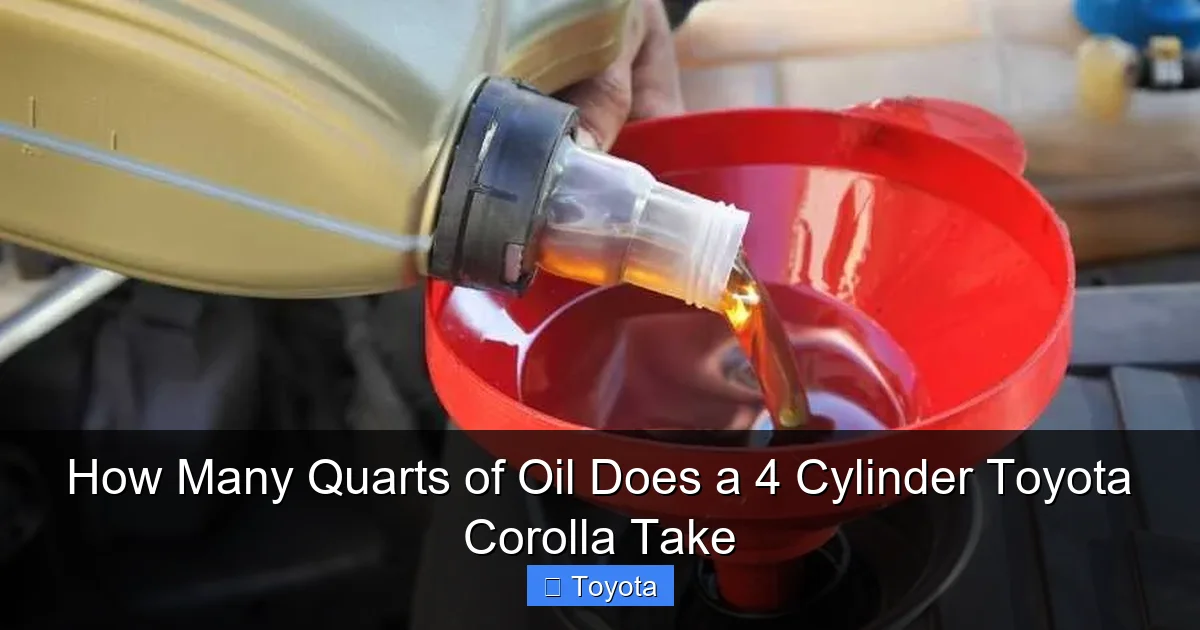
5. Refill with Oil: Open the hood. Remove the oil filler cap (usually yellow or black, labeled “Oil”). Place your funnel. Pour in about 4 quarts of fresh 0W-20. Wait a minute for it to settle.
6. Check the Level: Follow the dipstick procedure from the previous section meticulously. You will likely need to add the final 0.2 to 0.4 quarts to reach the middle mark. Do not skip this step.
7. Final Check: Start the engine and let it idle for 30 seconds. Check for leaks around the drain plug and filter housing. Turn the engine off and wait another 5 minutes. Re-check the dipstick. It should still be in the safe zone. Add a tiny bit more if needed.
8. Dispose of Old Oil: Pour the used oil from your drain pan into a sealed container (old oil jugs are perfect). Take it to any auto parts store or mechanic—they recycle it for free. Never dump it.
This process, when done correctly, takes about 45 minutes for a first-timer and under 30 for a seasoned pro. It saves you money and gives you a direct connection to your car’s health. For a broader look at what different vehicles require, our article How Many Quarts Of Oil Does A Car Take Explained Simply And Accurately breaks down the principles that apply to every make and model.
Conclusion: Knowledge is the Best Mechanic
So, how many quarts of oil does a 4-cylinder Toyota Corolla take? The precise answer is a range: 4.2 quarts for the 2.0L (2019+), and 4.4 quarts for the 1.8L (2009-2018), with older 1.8L engines taking 4.2 quarts. But the real takeaway isn’t just memorizing a number. It’s understanding that this number is a starting point for a critical maintenance ritual. The true answer is always found on the dipstick, after you’ve used the correct 0W-20 synthetic oil and a new filter. By combining the factory capacity spec with the hands-on verification of the dipstick, you eliminate guesswork and protect one of your most valuable assets. A properly lubricated Corolla engine will easily surpass 300,000 miles. It starts with this simple, informed act of adding the right amount of the right fluid. Don’t just change your oil—understand it. That’s the difference between a car owner and a car enthusiast, and it will save you time, money, and stress for the life of your vehicle.
Frequently Asked Questions
What happens if I accidentally overfill my Corolla’s oil?
Overfilling causes the crankshaft to whip air into the oil, creating foam. This aerated oil cannot lubricate properly, leading to increased wear, seal leaks, and potentially oil being forced into the combustion chamber, which will smoke and destroy your catalytic converter. If you overfill, drain the excess immediately.
Can I use 5W-30 oil instead of 0W-20 in my Corolla?
For all modern 4-cylinder Corollas (roughly 2011 and newer), Toyota specifies 0W-20. Using 5W-30 is not recommended and can harm fuel economy and the VVT-i system. For older models (pre-2009) that originally used 5W-30, using 0W-20 is generally safe and offers better cold-start protection, but 5W-30 remains the stated recommendation.
How often should I change the oil in my 4-cylinder Corolla?
Under normal driving conditions, Toyota recommends an oil change every 7,500-10,000 miles or 12 months when using 0W-20 synthetic oil. If your driving is mostly severe (short trips, extreme heat/cold, heavy traffic), shorten this interval to 5,000-7,500 miles. Always follow the alert in your vehicle’s maintenance reminder system if equipped.
My Corolla takes 4.4 quarts, but after a change, the dipstick shows full with only 4.1 quarts. Is that okay?
Yes, this is common and expected. The “4.4 quarts with filter” number is a maximum guideline for a *full refill from empty*. The dipstick’s “Full” mark is the absolute truth. If your dipstick reads full at 4.1 quarts, that’s perfect. Never add oil just to hit the capacity number. The dipstick reading is all that matters.
Do I need to use a Toyota oil filter?
While genuine Toyota filters are engineered to their specs, any high-quality filter that meets or exceeds API and OEM specifications is acceptable. Look for brands like WIX, Mobil 1, Fram, or Denso. The key is ensuring the filter has the correct anti-drain back valve and is designed for your specific engine’s oil flow requirements.
How should I dispose of my used Corolla oil and filter?
Never pour oil down drains or on the ground. Pour the used oil from your drain pan into a clean, sealed container (like an old oil jug). Take it to any auto parts store (like AutoZone, O’Reilly, Advance), most quick-lube centers, or your local hazardous waste facility—they all recycle used motor oil for free. The used oil filter can also be taken to these same locations for recycling, as long as it is drained of oil (punch a hole in the dome and let it drip into your drain pan).