How Many Quarts of Oil Does a 2011 Toyota Camry Take

Contents
- 1 Key Takeaways
- 2 📑 Table of Contents
- 3 Understanding Oil Capacity: It’s Not a One-Size-Fits-All Answer
- 4 More Than Just a Number: The Critical Role of Oil Type
- 5 Step-by-Step: How to Check and Change Your Oil Correctly
- 6 Common Mistakes and How to Avoid Them
- 7 The Long-Term Impact: Why Correct Oil Matters Beyond the Fill
- 8 Maintenance Schedule and Pro Tips for Your 2011 Camry
- 9 Conclusion: Knowledge is Power (And a Healthy Engine)
- 10 Frequently Asked Questions
Car Emergency Roadside Kit
Reflective Safety Triangle

Tire Pressure Monitoring System (TPMS)

Microfiber Car Cleaning Cloth
The 2011 Toyota Camry’s oil capacity depends on its engine. The 2.5L 4-cylinder needs 4.2 quarts, while the 3.5L V6 requires 6.0 quarts with a filter change. Always use Toyota-approved 0W-20 synthetic oil and confirm via your owner’s manual or dipstick for accuracy.
Key Takeaways
- Engine Dictates Capacity: Your 2011 Camry’s oil capacity is either 4.2 quarts (2.5L 4-cylinder) or 6.0 quarts (3.5L V6) when replacing the filter.
- Oil Type is Critical: Toyota specifies 0W-20 full synthetic oil for both engines for optimal performance and fuel economy.
- Always Verify: The dipstick is your final guide. After filling, check it to ensure the level is between the MIN and MAX marks, not over.
- Change the Filter: The capacity figures assume a new oil filter is installed. Reusing the old filter will reduce the amount of new oil you can add.
- Manual is Final Authority: Your vehicle’s owner’s manual provides the definitive specification for your specific VIN and configuration.
- Overfilling is Harmful: Too much oil causes aeration, increased pressure, and can lead to seal leaks or catastrophic engine damage.
- Professional Help Available: If unsure, a quick service at a dealership or trusted mechanic ensures the correct oil and level every time.
📑 Table of Contents
- Understanding Oil Capacity: It’s Not a One-Size-Fits-All Answer
- More Than Just a Number: The Critical Role of Oil Type
- Step-by-Step: How to Check and Change Your Oil Correctly
- Common Mistakes and How to Avoid Them
- The Long-Term Impact: Why Correct Oil Matters Beyond the Fill
- Maintenance Schedule and Pro Tips for Your 2011 Camry
- Conclusion: Knowledge is Power (And a Healthy Engine)
Understanding Oil Capacity: It’s Not a One-Size-Fits-All Answer
So, you’re staring at the oil cap under your 2011 Toyota Camry’s hood, wrench in hand, and the big question hits: “How many quarts of oil does a 2011 Toyota Camry take?” It seems like a simple question, but the honest answer is: it depends. While we can give you the definitive factory numbers, understanding *why* there are two answers is the key to being a confident car owner. This isn’t just trivia; it’s crucial information that protects your engine, saves you money, and prevents a messy, expensive mistake.
The 2011 Camry was offered with two distinct engine families, each with its own displacement, design, and, consequently, its own oil capacity. The most common and popular engine is the reliable 2.5-liter 4-cylinder (often called the 2AR-FE). The performance-oriented option is the powerful 3.5-liter V6 (the 2GR-FE). These engines are mechanically different, meaning their internal oil passages, sump sizes, and required oil volumes are not the same. Pouring the wrong amount—even if it’s just a quart off—can have real consequences. Let’s break down exactly what your specific Camry needs.
The Two Engine Families and Their Capacities
To find your engine, open the hood and look for the engine cover or the block itself. It will be clearly labeled “2.5” or “3.5”. You can also check your vehicle identification number (VIN) or, most reliably, your owner’s manual. Here are the factory-specified capacities for a standard drain and refill with a new oil filter:
- 2.5L 4-Cylinder (2AR-FE): 4.2 quarts (4.0 liters) of oil. This is the figure for a complete drain and refill. It’s a precise number, not a round 4 or 5.
- 3.5L V6 (2GR-FE): 6.0 quarts (5.7 liters) of oil. This V6 requires significantly more oil to lubricate its additional cylinders and components.
It’s vital to note these capacities are for a new filter. If you are only adding oil to top off a low level, you must add it gradually and constantly check the dipstick. Never assume you can pour the full capacity in without first checking the current level. For more details on Camry specifications across different years, you can explore resources that explain how many quarts of oil does a Toyota Camry take in general.
More Than Just a Number: The Critical Role of Oil Type
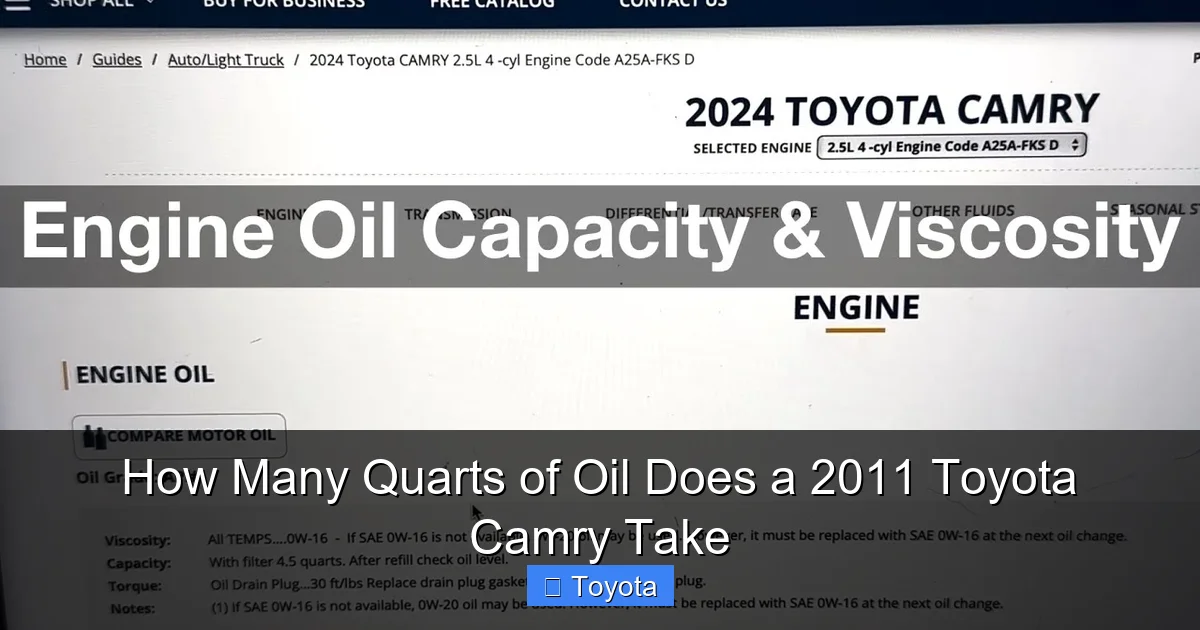
Knowing the quantity is only half the battle. Using the correct oil type is equally, if not more, important. For the 2011 Camry, Toyota’s specification is non-negotiable: 0W-20 full synthetic oil. This specification is written on the oil cap itself in many cases. The “0W” refers to its winter viscosity (how easily it flows in cold starts), and the “20” is its hot viscosity. This lightweight synthetic is designed to:

Visual guide about How Many Quarts of Oil Does a 2011 Toyota Camry Take
Image source: koala.sh
- Improve fuel economy by reducing internal engine friction.
- Provide superior protection during cold starts, which is when most engine wear occurs.
- Maintain stable viscosity across a wide temperature range.
- Meet the specific demands of Toyota’s modern engine designs, including components like variable valve timing systems.
Using an older conventional 5W-30 or a different viscosity can void your warranty, reduce performance, and potentially cause long-term damage. Always look for the API “Starburst” certification symbol and the ILSAC GF-5 certification, which indicate the oil meets the requirements for this engine. If you own a different Toyota model, the oil type can vary, so it’s always best to verify. For instance, the oil for a 2008 Camry has similar but not identical requirements, highlighting the need for model-specific knowledge.
Why 0W-20? A Deep Dive into Modern Lubrication
The move to 0W-20 wasn’t just an arbitrary change. Engineers designed the 2AR-FE and 2GR-FE engines with tighter tolerances and advanced systems like VVT-i (Variable Valve Timing with intelligence). These systems rely on precise oil pressure and flow. A thicker oil, like 5W-30, might be too viscous when cold, delaying its flow to critical components. It can also create more drag when hot, hurting fuel economy. The 0W-20 flows almost like water when cold, guaranteeing immediate lubrication upon startup. As the engine reaches operating temperature, it thickens to a perfect 20-weight, maintaining a protective film between all moving metal parts. This balance is why Toyota is so specific. Using the correct oil is a foundational part of what your car needs to run smoothly for hundreds of thousands of miles.
Step-by-Step: How to Check and Change Your Oil Correctly
Now that you know the “what,” let’s talk about the “how.” Whether you’re a DIY enthusiast or just want to understand what the shop is doing, the process is universal. The golden rule: never guess the oil level. Always use the dipstick. Here’s a reliable method for a perfect fill.

Visual guide about How Many Quarts of Oil Does a 2011 Toyota Camry Take
Image source: psychoautos.com
The Proper Fill Procedure: Patience is a Virtue
1. Drain Completely: Warm the engine slightly (2-3 minutes) to thin the oil for easier draining. Remove the drain plug, let it fully drip, and replace the crush washer on the plug. Remove the old oil filter with an oil filter wrench. Let that drain too.
2. Install New Filter: Pre-lubricate the rubber seal on the new filter with a dab of fresh oil. Screw it on by hand until snug, then give it a 3/4 turn more. Do not overtighten.
3. Initial Fill: Pour in approximately 80% of the total capacity. For the 2.5L, that’s about 3.5 quarts. For the V6, about 4.8 quarts. This prevents the common mistake of overfilling.
4. Check the Dipstick: Wait 2-3 minutes for the oil to settle in the pan. Pull the dipstick, wipe it clean, reinsert it fully, and pull it out again. Read the level.
5. Top Off Gradually: If the oil is below the MIN mark, add oil in 0.25-quart (1/4 quart) increments. Re-check after each addition. Your goal is to have the oil level solidly in the cross-hatched “safe zone” between MIN and MAX, ideally closer to the MAX but never above it.
6. Final Check: After starting the engine and letting it run for 30 seconds (do not rev it), turn it off and wait another minute. Check the dipstick one final time. The level may drop slightly as oil fills the new filter and passages. Top off if necessary to the MAX mark.
This method is foolproof. Rushing and pouring in the full 4.2 or 6.0 quarts without checking is the #1 cause of overfilling. Remember, it’s easier to add oil than to remove it.
Common Mistakes and How to Avoid Them
Even with the right number in your head, simple errors can turn a routine oil change into a problem. Let’s spotlight the pitfalls.

Visual guide about How Many Quarts of Oil Does a 2011 Toyota Camry Take
Image source: oilcapacityguide.com
Mistake 1: Guessing Based on “How Much It Took Last Time”
This is a big one. If you drained the oil and the old oil container held 4.0 quarts, you might think you need 4.0 quarts back. But you must account for oil left in the engine! The oil filter alone holds about 0.5 quarts. The old oil clinging to engine passages and the crankshaft also isn’t fully drained. That’s why the factory capacity is higher than what you typically drain out. Always follow the manual capacity for a refill, not what you drained.
Mistake 2: Using the Wrong Oil Filter
Not all oil filters are created equal. A low-quality filter may have a different anti-drain back valve or media that restricts flow. More importantly, some filters have a different internal capacity. A filter that holds 0.6 quarts instead of 0.5 quarts means less space for new oil in your sump. Always use the filter specified for your exact engine. A reputable brand like Toyota OEM (Original Equipment Manufacturer), Wix XP, Mobil 1 M1, or Fram Ultra is a safe bet.
Mistake 3: Ignoring the Dipstick After a “Professional” Change
Even at a quick-lube shop, errors happen. A technician might misidentify your engine and put in 6 quarts instead of 4.2, or simply overfill. It is your responsibility to check the oil level after any service. Do it with the car on level ground, after the engine has been off for a few minutes. This simple 30-second check can save you from thousands in engine repairs. If the level is high, have them remove the excess immediately.
For broader context on oil capacities across all makes and models, understanding the general principles of how many quarts of oil does a car take can help you troubleshoot any vehicle.
The Long-Term Impact: Why Correct Oil Matters Beyond the Fill
Getting this right isn’t just about avoiding a dipstick error today. It’s about the long-term health and value of your vehicle. The 2011 Camry is known for longevity, but that reputation is earned through proper maintenance.
Engine Protection and Fuel Economy
The correct 0W-20 synthetic oil creates a microscopic film that prevents metal-on-metal contact in bearings, piston rings, and camshafts. It also keeps the engine clean by suspending combustion byproducts and preventing sludge. A well-lubricated engine runs cooler, quieter, and more efficiently. Using the wrong oil or level increases friction, which directly hurts your miles per gallon. Over time, this adds up to significant extra fuel costs.
Warranty and Resale Value
If your Camry is still under its original powertrain warranty (unlikely for a 2011, but possible if it was a Certified Pre-Owned purchase), using the specified oil is a requirement. An audit of service records could reveal a discrepancy. Furthermore, a complete service history showing the correct oil and capacity at every change is a huge selling point. It proves to a future buyer that the engine has been meticulously cared for, potentially increasing your resale value.
Maintenance Schedule and Pro Tips for Your 2011 Camry
Toyota’s official maintenance schedule for the 2011 Camry under “normal” driving conditions calls for an oil and filter change every 10,000 miles or 12 months. However, many owners, especially those with short trips, heavy traffic, or extremely hot/cold climates, opt for a more conservative 5,000-7,500 mile interval to be safe. Here are some pro tips:
- Use a High-Quality Filter: Don’t skimp. The filter is the only thing catching metal shavings and contaminants. A good filter is worth the few extra dollars.
- Keep a Log: Record the date, mileage, oil type, filter brand, and who performed the service. A simple notebook or app works.
- Check Oil Monthly: Even with modern engines that burn very little oil, a monthly check with the dipstick is the best early-warning system for leaks or consumption issues.
- Mind the Environment: Take your used oil and filter to a designated recycling center. Never dump it. Many auto parts stores accept used oil for free.
- Consider Professional Help: If you’re not comfortable performing the change, a reputable independent shop or dealership is a good investment. Just always verify the oil level afterward.
For specific queries about oil types for other models, such as what kind of oil does a 2002 Toyota Camry take, the principles are similar but the viscosity specification may differ for older engines.
Conclusion: Knowledge is Power (And a Healthy Engine)
So, how many quarts of oil does a 2011 Toyota Camry take? You now have the precise answer: 4.2 quarts for the 2.5L 4-cylinder, and 6.0 quarts for the 3.5L V6, with a new filter. But more importantly, you understand the context—the why behind the number. You know to use 0W-20 synthetic oil, to check the dipstick religiously, and to never overfill. This knowledge transforms you from a passive car owner into an active guardian of your vehicle. It prevents costly mistakes, ensures peak performance, and contributes to the legendary reliability of the Camry platform. Bookmark this page, save your owner’s manual, and approach your next oil change with confidence. Your engine will thank you with years of smooth, dependable service.
Frequently Asked Questions
What happens if I accidentally overfill the oil in my 2011 Camry?
Overfilling is serious. Excess oil gets churned by the crankshaft, creating foam and aeration. This frothy oil can’t properly lubricate, leading to increased wear, seal leaks, and in extreme cases, engine failure from lack of oil pressure or hydraulic lock. If you overfill, drain the excess immediately.
Can I use a conventional 5W-30 oil instead of 0W-20?
It is not recommended. The 2011 Camry’s engine is designed specifically for 0W-20 synthetic. Using 5W-30 can reduce fuel economy, potentially cause VVT-i system issues, and may not provide the same level of cold-start protection. Always use the specified 0W-20.
How do I know if my 2011 Camry has the 2.5L or 3.5L engine?
Check the engine cover—it will say “2.5” or “V6 3.5”. You can also look at your driver’s side door jamb sticker for the engine code: “2AR-FE” is the 2.5L, “2GR-FE” is the 3.5L. Your owner’s manual also states it clearly.
Do I need to change the oil filter every time I change the oil?
Yes, absolutely. The oil filter is designed for single use. It contains the old oil and contaminants from the previous drain period. Reusing it would immediately contaminate your fresh oil and new filter, defeating the entire purpose of the service.
Is synthetic oil really necessary for my 2011 Camry?
Yes. The specification calls for full synthetic 0W-20. Synthetic oil has a more stable molecular structure, superior detergency, and better performance in extreme temperatures. It is essential for meeting the engine’s design requirements for longevity and efficiency.
My oil level is low between changes. Is that normal for a Camry?
Modern Toyota engines, including the 2011 Camry, are designed to use very little oil between changes—typically less than a quart every 1,000 miles. If you are adding more than a quart between scheduled changes, it could indicate a problem like worn piston rings, valve seals, or a leak. Have it inspected by a mechanic.