How Many Miles per Gallon Does a Chrysler Pacifica Get

Contents
- 1 Key Takeaways
- 2 📑 Table of Contents
- 3 Understanding Chrysler Pacifica Fuel Efficiency: More Than Just a Number
- 4 EPA Ratings Decoded: Gas vs. Hybrid Pacifica
- 5 Real-World MPG: Why Your Results Will Vary
- 6 Hybrid vs. Gas: The Deep Dive on Pacifica Efficiency
- 7 Maximizing Your Pacifica’s MPG: Practical Tips
- 8 The Big Picture: Total Cost of Ownership and Value
- 9 Conclusion: The Right Pacifica for Your Miles
- 10 Frequently Asked Questions
Car Wash Mitt

Car Cup Holder Expander

Car Door Edge Guard
Wiper Blade Refills
The Chrysler Pacifica offers impressive fuel efficiency for a minivan, with the hybrid model achieving up to 82 MPGe combined. Gas-only models deliver competitive EPA ratings around 22 city/28 highway MPG. Real-world mileage varies with driving habits, cargo load, and maintenance—especially proper oil changes—but both powertrain options provide excellent value for families prioritizing space and running costs.
Key Takeaways
- Hybrid Dominance: The Pacifica Hybrid is the efficiency champion, rated for up to 82 MPGe (electric + gas) and 30 MPG on gas alone after the electric range is depleted.
- Gas Model Competitiveness: The standard 3.6L V6 gas model delivers a respectable 22 MPG city and 28 MPG highway, which is strong for its class.
- Real-World vs. EPA: Actual mileage often differs from EPA estimates; aggressive driving, heavy loads, and climate control use can reduce MPG by 15-25%.
- Maintenance is Key: Using the correct oil viscosity and adhering to change intervals is critical for optimal fuel economy and engine health in any Pacifica.
- Total Cost Matters: When comparing vehicles, consider the Pacifica Hybrid’s potential fuel savings against its higher upfront cost, similar to evaluating leasing a Chrysler Pacifica.
- Class-Leading Value: The Pacifica Hybrid’s combination of 30 miles of all-electric range and high hybrid MPG makes it uniquely efficient among minivans, comparable to the fuel savings seen in efficient crossovers like the Nissan Rogue.
📑 Table of Contents
- Understanding Chrysler Pacifica Fuel Efficiency: More Than Just a Number
- EPA Ratings Decoded: Gas vs. Hybrid Pacifica
- Real-World MPG: Why Your Results Will Vary
- Hybrid vs. Gas: The Deep Dive on Pacifica Efficiency
- Maximizing Your Pacifica’s MPG: Practical Tips
- The Big Picture: Total Cost of Ownership and Value
- Conclusion: The Right Pacifica for Your Miles
Understanding Chrysler Pacifica Fuel Efficiency: More Than Just a Number
So, you’re in the market for a minivan. You need the space, the sliding doors, the movie theater for the kids. But your brain keeps whispering one nagging question: “How many miles per gallon does a Chrysler Pacifica get?” It’s a fair and crucial question. In a world of rising fuel prices and environmental awareness, even the most practical family hauler needs to make sense at the pump. The good news is that the Pacifica, especially in its hybrid guise, is a standout performer. But the full story is a bit more nuanced than a single EPA sticker number. Let’s pop the hood, look under the minivan, and dig into everything that influences the Pacifica’s miles per gallon.
First, a key distinction: the Chrysler Pacifica comes in two fundamentally different powertrains. There’s the traditional, and very capable, 3.6-liter V6 gasoline engine. Then there’s the innovative Pacifica Hybrid, a plug-in hybrid electric vehicle (PHEV) that fundamentally changes the MPG conversation. Your “miles per gallon” answer depends entirely on which one you’re looking at and, just as importantly, how you drive it. We’ll break down both, explore how real-world driving compares to those optimistic EPA window stickers, and give you actionable tips to squeeze every last drop of efficiency from your Pacifica, whether it plugs in or not.
EPA Ratings Decoded: Gas vs. Hybrid Pacifica
The Environmental Protection Agency (EPA) puts every new vehicle through standardized tests to assign its official fuel economy rating. For the Pacifica, these numbers tell two very different stories. Understanding these baseline figures is your starting point for setting realistic expectations.
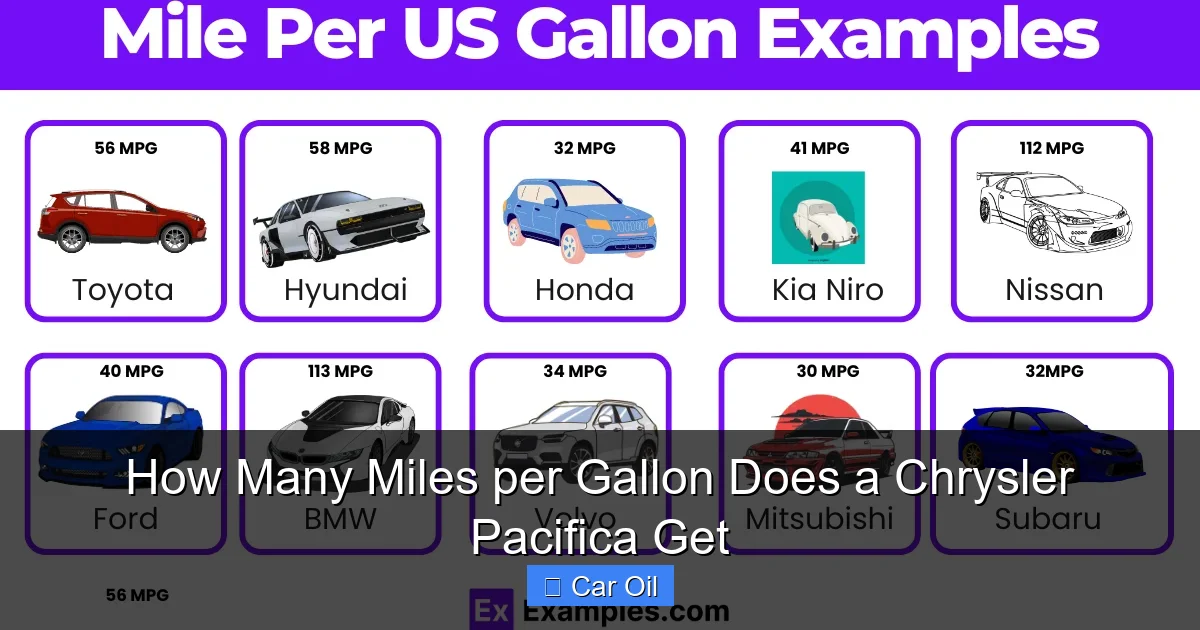
Visual guide about How Many Miles per Gallon Does a Chrysler Pacifica Get
Image source: images.examples.com
The Gas-Powered Pacifica: A Solid Performer
For the 2023-2024 models equipped with the standard 3.6L V6 engine and front-wheel drive, the EPA ratings are 22 MPG in the city and 28 MPG on the highway, with a combined estimate of 24 MPG. All-wheel drive (AWD) models see a slight penalty, dropping to an estimated 20 city / 27 highway / 23 combined. These are genuinely good numbers for a full-size, 3-row minivan weighing over 4,400 pounds. They compete directly with rivals like the Honda Odyssey (19/28/22 FWD) and Toyota Sienna (the standard hybrid-only Sienna gets 36/36/36, a benchmark we’ll discuss). For the gas Pacifica, you’re essentially looking at a range of 20 to 28 MPG depending on your drivetrain and driving cycle.
The Pacifica Hybrid: A Class-Defying Marvel
This is where the Pacifica truly shines and completely redefines what a minivan can be. The Pacifica Hybrid is a plug-in hybrid with a 16-kWh lithium-ion battery. The EPA rates it for an all-electric range of 30 miles. Here’s where it gets interesting:
- When charged and using only electric power: It uses 0 gallons of gas. Its efficiency is measured in MPGe (Miles Per Gallon equivalent), with a rating of 82 MPGe combined.
- Once the electric range is depleted: It operates as a standard hybrid. The EPA then rates it at 30 MPG combined (26 city / 30 highway).
This dual nature is key. If your daily commute is under 30 miles and you plug in nightly, you could theoretically drive for weeks without visiting a gas station. For longer trips, it seamlessly switches to hybrid mode and still delivers 30 MPG—a figure that beats the gas Pacifica and is competitive with many non-hybrid SUVs. This flexibility is a massive advantage over a pure electric vehicle for family road trips.
Real-World MPG: Why Your Results Will Vary
Let’s be brutally honest: the EPA numbers are achieved in a lab with a gentle driver on a treadmill. Your life is not that lab. Your actual “miles per gallon” in a Chrysler Pacifica will be a living, breathing number influenced by dozens of factors. Accepting this is the first step to managing your expectations and, more importantly, improving your results.
Visual guide about How Many Miles per Gallon Does a Chrysler Pacifica Get
Image source: vehiclebright.com
The Driving Style Tax
This is the single biggest variable. The EPA tests are conducted with smooth acceleration and gentle cruising. If you have a lead foot—quick starts from stoplights, hard braking, speeding on the highway—you are hemorrhaging fuel. Aggressive driving can lower your MPG by 15% to 30% in city driving. The Pacifica Hybrid is particularly sensitive here; launching in electric mode is silent and instant, making it incredibly easy to “floor it” without the engine roar warning you. Resist the temptation! Smooth, anticipatory driving is the #1 way to hit or even exceed EPA estimates.
Cargo and Passenger Weight
A minivan is designed to carry people and stuff. But more weight means more work for the engine. A fully loaded Pacifica with seven passengers and a roof full of luggage for a vacation will see a noticeable dip in MPG, especially on highways with elevation changes. The hybrid’s battery and electric motor add weight, but its electric torque helps offset this in low-speed situations. The rule of thumb: every 100 pounds of extra cargo can reduce MPG by about 1-2%. Plan your packing efficiently.
Climate Control: The Silent MPG Killer
Running the air conditioning in summer or the heater in winter places a significant load on the engine (or the hybrid’s battery). In the gas Pacifica, the A/C compressor is belt-driven, directly sapping engine power. In the hybrid, the climate system runs off the high-voltage battery when in EV mode, reducing gas engine use but draining your electric range faster. In winter, the gas engine must run more frequently to generate heat. Expect a 5-15% drop in MPG during extreme temperature months. Using seat heaters (if equipped) instead of the cabin heater for a quick warm-up can help save a little energy.
Tire Pressure and Type
This is the easiest, cheapest fix. Under-inflated tires increase rolling resistance. The Pacifica’s door jamb sticker recommends a specific PSI (often around 33-35 PSI for normal load). Check your tires monthly and inflate to that number. You can gain 0.3-0.5 MPG just from this. Additionally, the type of tires matters. All-season tires are standard. If you opt for aftermarket wheels or aggressive all-terrain tires, you will sacrifice significant fuel economy for traction. Stick to the factory-recommended size and type for best results.
Hybrid vs. Gas: The Deep Dive on Pacifica Efficiency
Choosing between the gas and hybrid Pacifica isn’t just about the sticker price. It’s a calculation of your driving patterns and how you value fuel savings versus upfront cost. Let’s compare them head-to-head beyond the EPA numbers.
Visual guide about How Many Miles per Gallon Does a Chrysler Pacifica Get
Image source: autozonic.com
How the Pacifica Hybrid System Works
Understanding the system helps you drive it efficiently. The Pacifica Hybrid uses a 2.0L Atkinson-cycle 4-cylinder engine paired with two electric motors (one for propulsion, one as a generator) and a 16-kWh battery. It’s a “split-mode” hybrid similar to the Toyota Prius. At low speeds and light loads, it can run on electric power alone. At higher speeds or hard acceleration, the engine and motors work together. During braking and coasting, the engine shuts off, and the motors act as generators to recapture energy (regenerative braking) and store it in the battery. This constant, intelligent blending of power sources is why it gets such high MPG.
The 30-Mile Electric Sweet Spot
The 30-mile electric range is the magic number. The U.S. Department of Transportation reports the average one-way commute is about 27 miles. If your commute fits within this range and you can charge at home or work, the Pacifica Hybrid effectively becomes an electric minivan for daily duties. Your “MPG” is infinite during those trips. Even if your commute is 40 miles, you get 30 miles of electric, then 10 miles on hybrid power, drastically cutting your gas purchases. For families with predictable, shorter daily drives, the hybrid’s value proposition is enormous. For those frequently taking 500-mile road trips without charging, the benefit diminishes, though the 30 MPG hybrid mode is still efficient.
Ownership Cost Considerations
The hybrid carries a price premium of several thousand dollars over the gas model. The break-even point depends entirely on gas prices and your annual mileage. A conservative estimate: driving 15,000 miles per year with gas at $3.50/gallon, the hybrid could save you $500-$800 annually in fuel costs compared to the gas model (which gets ~24 MPG). At that rate, it would take many years to recoup the upfront cost solely through gas savings. However, you must also factor in potential tax incentives for the plug-in hybrid (which vary by state and have phased out for some buyers), higher resale value for the hybrid, and the intrinsic value of reduced emissions and fuel independence. It’s a long-term value play, not a short-term one. You might also consider how the Pacifica Hybrid’s efficiency stacks up against other efficient vehicles, such as the Toyota Venza, which is a hybrid-only crossover.
Maximizing Your Pacifica’s MPG: Practical Tips
Regardless of whether you own a gas or hybrid Pacifica, your driving habits and maintenance routine directly control your fuel bill. Here is your actionable checklist to become a mileage master.
Drive with a Purpose (and Patience)
This cannot be overstated. Accelerate slowly and smoothly. Imagine there’s a raw egg between your foot and the pedal. Brake early and gently. Use cruise control on flat highways. In the hybrid, learn to drive in “EV Mode” (if your model has a button for it) to maximize electric-only operation in low-speed situations like parking lots. The Pacifica’s hybrid system is designed to reward gentle driving with longer EV stretches. Aggression turns off the electric motor and wakes up the gas engine instantly.
Plan Trips and Reduce Idling
Combine errands. A cold engine uses more fuel. Multiple short trips with a cold start can use twice the fuel of a single longer trip covering the same distance. If you’re stuck in traffic or waiting for a child, consider turning the engine off if you’ll be stopped for more than 60 seconds (the hybrid does this automatically). For gas models, this is a simple fuel-saver. For hybrids, it’s already a standard feature.
Maintenance That Directly Impacts Fuel Economy
This is where the “Car Oil” category comes into sharp focus. A well-maintained engine runs efficiently. Here’s the critical maintenance checklist:
- Oil Changes: Use the exact oil viscosity specified in your owner’s manual (typically 0W-20 for recent models). Thicker oil increases internal friction, forcing the engine to work harder and burn more fuel. Stick to the recommended change interval—usually every 7,500-10,000 miles for modern engines. Dirty oil loses its lubricating properties, harming efficiency. This is non-negotiable. If you’re unsure about the specifics, resources on how much oil a car needs can illustrate the general principle of proper oil levels and types being universal for engine health and efficiency.
- Air Filter: A clogged air filter starves the engine of air, forcing it to use more gas. Check and replace it as recommended, often every 15,000-30,000 miles. It’s an easy, cheap fix.
- Spark Plugs: Worn plugs cause misfires, wasting fuel. Replace them on schedule (often 100,000 miles on modern iridium plugs).
- Tire Pressure: Re-check monthly, as mentioned.
- Wheel Alignment: Misalignment causes tires to drag, increasing resistance and tire wear alongside fuel consumption.
The Big Picture: Total Cost of Ownership and Value
Asking “how many MPG does it get?” is really asking “how much will this cost me to run?” The Pacifica, in both forms, answers this question favorably when you look at the whole picture.
Fuel Costs in Context
Let’s do some math. Assume 15,000 annual miles, 60% city/40% highway.
- Gas Pacifica (24 MPG combined): 15,000 / 24 = 625 gallons. At $3.50/gal = $2,187.50/year.
- Pacifica Hybrid (assuming 50% of miles on electric @ 30mpge equivalent, 50% on gas @ 30mpg): 7,500 electric miles (cost: electricity, ~$0.04/mile = $300) + 7,500 gas miles (7,500/30=250 gal * $3.50 = $875) = ~$1,175/year.
The hybrid saves over $1,000 annually in this scenario. That’s real money. Over five years, that’s a $5,000+ saving that begins to chip away at the hybrid’s purchase premium. If you can charge at home on a cheaper off-peak rate, the savings are even greater.
Resale Value and Incentives
Historically, hybrids hold their value slightly better than their gas counterparts due to ongoing fuel savings and buyer perception. Check current residual values on sites like Kelley Blue Book. Furthermore, while the federal tax credit for the Pacifica Hybrid has phased out for Stellantis (the manufacturer), some state and local incentives may still exist (like rebates or HOV lane access). These can further sweeten the hybrid deal. When you think about total cost, also consider the practical advantage of the hybrid’s electric torque for merging, which is a subtle but nice performance perk.
Conclusion: The Right Pacifica for Your Miles
So, how many miles per gallon does a Chrysler Pacifica get? The definitive answer is: it depends. The gas V6 model is a solid, competitive 22-28 MPG performer, making it efficient for its massive size and capability. The Pacifica Hybrid is in a league of its own, offering a 30-mile electric commute and 30 MPG thereafter, effectively giving you the best of both worlds. Your real-world results will always be a conversation between your driving style, your climate, your cargo, and your commitment to maintenance—especially that oil change.
If your lifestyle fits the hybrid’s electric sweet spot—short, predictable trips with overnight charging—the Pacifica Hybrid is arguably the most fuel-efficient family vehicle on the market, period. You’ll laugh at the gas pump. If your life is long, unplannable road trips with no charging access, the gas model still provides respectable, class-competitive MPG without the complexity of plugging in. Take a hard look at your average week. The miles you actually drive, and how you drive them, will tell you which Pacifica, and which MPG number, is truly yours. For a broader look at efficient vehicles, comparing it to models like the Subaru Crosstrek can provide perspective on what’s available in different vehicle classes.
Frequently Asked Questions
Does the Chrysler Pacifica Hybrid really get 82 MPG?
The 82 MPGe rating applies only to the first 30 miles when the battery is fully charged and you drive using electricity alone. Once that electric range is used, it operates as a 30 MPG hybrid. So, your average MPG depends on how many of your miles are within the 30-mile electric window.
How does towing affect Pacifica MPG?
Towing a trailer significantly reduces fuel economy in any vehicle. For a Pacifica, expect an MPG drop of 20-30% or more when towing near its maximum capacity (3,600 lbs for hybrid, 3,600 lbs for gas). The added aerodynamic drag and weight force the engine to work much harder.
What type of oil is best for Pacifica fuel economy?
Always use the oil viscosity specified in your owner’s manual—typically 0W-20 synthetic oil for recent models. This specific “thin” oil reduces internal engine friction, which is critical for maximizing fuel efficiency. Using a heavier oil (like 5W-30) can harm both MPG and engine protection over time.
Can I use regular gasoline in a Pacifica Hybrid?
Yes. Both the gas and hybrid Pacifica models are designed to run on regular unleaded 87-octane gasoline. Using premium is not required and will not improve fuel economy, though it may slightly improve performance in very high-altitude or extreme-temperature conditions.
Is the Pacifica Hybrid worth the extra cost for fuel savings alone?
It depends on your driving pattern. If you can consistently drive within the 30-mile electric range and charge at home, the fuel savings are substantial and can eventually offset the premium. If you rarely plug in, you won’t realize those savings, and the hybrid’s price premium may not be recouped through fuel alone over ownership.
How much does it cost to charge the Pacifica Hybrid?
Charging costs depend on your electricity rate. On average, a full charge from empty (using ~16 kWh) costs between $2 and $4 at typical U.S. residential rates ($0.13/kWh). This provides about 30 miles of range, making the cost per mile for electric driving extremely low compared to gasoline.