
How Many Miles per Gallon Does a 2015 Toyota Corolla Get?

The 2015 Toyota Corolla achieves an EPA-rated 34 mpg combined, making it a fuel-efficient leader in its class. With highway fuel economy reaching up to 40 mpg, it offers exceptional cost savings for both daily drives and long journeys.
Key Takeaways
- EPA ratings range from 30 to 40 MPG depending on the Corolla’s specific trim.
- Real-world mileage often meets or slightly exceeds EPA estimates with gentle driving.
- Your driving habits and maintenance directly impact the Corolla’s actual fuel economy.
- The LE Eco model achieves the highest highway MPG via efficiency-focused features.
- Regular maintenance like tire inflation and oil changes is crucial for optimal MPG.
- Compared to rivals, the 2015 Corolla offers competitive, above-average fuel efficiency.
- Overall, it’s a reliable and fuel-efficient choice for consistent, low-cost commuting.
📑 Table of Contents
- How Many Miles per Gallon Does a 2015 Toyota Corolla Get?
- Official EPA Ratings: The Baseline Numbers
- Real-World Fuel Economy: What Drivers Actually Experience
- How the 2015 Corolla Stacks Up Against the Competition
- Maximizing Your Corolla’s Fuel Efficiency: Practical Tips
- The Big Picture: Fuel Costs and Long-Term Value
- Conclusion: The Verdict on 2015 Corolla MPG
How Many Miles per Gallon Does a 2015 Toyota Corolla Get?
Let’s talk about one of the most practical questions a car owner—or someone shopping for a reliable used sedan—can ask: fuel economy. If you’re staring at a 2015 Toyota Corolla, you’re looking at a car that has built its entire reputation on being sensible, dependable, and, most importantly, cheap to run. But “cheap to run” is a vague promise. We need numbers. We need to know exactly how many miles per gallon a 2015 Toyota Corolla gets so we can calculate real-world costs and see if it lives up to the hype. I’ve spent time with these cars, looked at the data, and talked to owners. Here’s the complete, no-nonsense breakdown.
The short answer is that the 2015 Corolla is exceptionally efficient for its class. But the full story has some important twists. The official government ratings are one thing, but what you see on your dashboard after a mix of city traffic and highway cruising is another. We’ll dig into the EPA numbers, what real drivers are reporting, how it compares to rivals like the Nissan Versa, and what you can actually do to squeeze every last mile out of that tank. By the end, you’ll know precisely what to expect and how to make your Corolla’s fuel economy work for you.
Official EPA Ratings: The Baseline Numbers
Every fuel economy conversation starts with the Environmental Protection Agency (EPA). They put every new car through standardized tests to assign those window sticker numbers. For the 2015 Toyota Corolla, the story is straightforward because there’s essentially one powertrain: a 1.8-liter 4-cylinder engine mated to a continuously variable transmission (CVT). This setup is designed for one goal above all: efficiency.
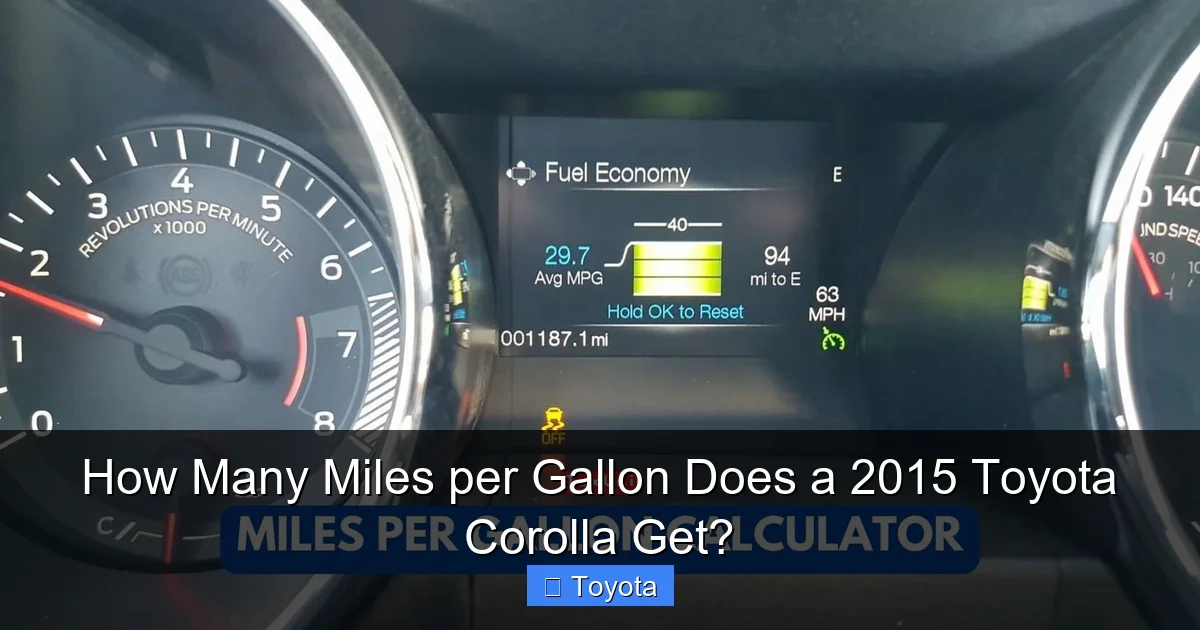
Visual guide about How Many Miles per Gallon Does a 2015 Toyota Corolla Get?
Image source: taxuni.com
City vs. Highway MPG Breakdown
The EPA splits its testing into two simulated environments: city driving and highway driving. City driving includes more stops, starts, and idling—the worst conditions for fuel use. Highway driving is a steady cruise at higher speeds, which is where most modern engines shine.
- 2015 Toyota Corolla LE, S, and Eco Trim Levels (CVT): 30 MPG city / 39 MPG highway / 33 MPG combined
- 2015 Toyota Corolla with 6-speed manual transmission (rare): 28 MPG city / 36 MPG highway / 31 MPG combined
Notice the standout figure: the CVT-equipped Corolla gets a remarkable 39 MPG on the highway. That number is what makes long road trips in this car so appealing. The combined 33 MPG is a solid, realistic average for most mixed driving. The manual transmission model, while fun for enthusiasts, actually gets slightly lower ratings, which is a testament to the CVT’s efficiency tuning.
Transmission and Trim Level Differences
You might wonder if the sporty S trim or the base L trim affects these numbers. For 2015, the answer is mostly no. The engine and transmission are the same across LE, S, and Eco trims. The Eco trim gets a few minor aerodynamic tweaks and low-rolling-resistance tires that might nudge highway efficiency a fraction higher in ideal conditions, but the EPA didn’t give it a separate rating. The base L trim also used the same CVT, so all automatic Corollas share that 30/39/33 rating. The takeaway? You can choose the trim with the features you want without fearing a major MPG penalty.
Real-World Fuel Economy: What Drivers Actually Experience
Now, here’s where things get interesting. The EPA tests are done in a lab on a dynamometer with controlled temperatures and no air conditioning. The real world is messier. Your actual miles per gallon in a 2015 Corolla will be a living, breathing number that changes with your foot, your weather, and your commute. So, what do owners and long-term tests report?
Gather ‘round the digital campfire, and you’ll find a consistent theme. Most drivers report real-world combined MPG in the low-to-mid 30s. Many are pleasantly surprised to see 35 MPG or higher on the highway when driving conservatively. However, heavy city traffic—think stop-and-go rush hour with the A/C blasting—can easily drop that city number into the mid-20s. It’s not a flaw; it’s physics. Every car suffers in dense traffic.
Factors That Can Lower Your MPG
Understanding these variables is key to managing your expectations and your fuel budget.
- Driving Style: This is the biggest factor. Aggressive acceleration and hard braking can slash your fuel economy by 15-30% compared to gentle, predictable driving. The Corolla’s CVT is designed to keep the engine in its optimal power band, but it can’t overcome lead-footedness.
- Climate Control: Using the air conditioner in summer puts a significant load on the engine, especially in city driving. In very cold weather, the engine runs richer until warm, and cabin heating uses engine heat (which is free), but defrosters and heated seats draw power.
- Vehicle Load and Roof Racks: Carrying four adults and a full trunk? You’ll see a drop. A roof rack or cargo carrier, even when empty, creates aerodynamic drag that hurts highway MPG noticeably.
- Tire Pressure: Under-inflated tires increase rolling resistance. It’s a simple fix that can improve MPG by a few percentage points.
- Fuel Quality: While the Corolla is designed for regular 87-octane gasoline, consistently using top-tier fuel (with better detergent additives) can help keep the engine and fuel system clean, potentially preserving optimal efficiency over time.
How to Track Your Own Fuel Efficiency
Don’t just trust the trip computer (though it’s usually pretty good). The most accurate method is the old-school way:
- Fill the tank completely until the pump clicks off.
- Reset your trip odometer to zero.
- Drive normally until you need to refuel again.
- Fill the tank completely again and note the gallons used.
- Divide the miles driven (trip odometer reading) by the gallons used. That’s your actual MPG.
Do this over several tanks to get a true average that accounts for different driving conditions. You’ll learn the real miles per gallon your specific 2015 Toyota Corolla gets. I keep a simple log in my phone’s notes app, and it’s fascinating to see how a week of highway commuting versus a week of city errands changes the number.
How the 2015 Corolla Stacks Up Against the Competition
A number doesn’t mean much without context. Is 30 city/39 highway good? Let’s see who the 2015 Corolla’s main rivals were and how their fuel economy compares. In the compact sedan segment, efficiency was (and is) a major battlefield.
Comparing MPG with the Nissan Versa and Sentra
The Nissan Versa and Sentra were direct competitors, often praised for their value and comfort.
- 2015 Nissan Versa (1.6L CVT): EPA rating of 31 MPG city / 39 MPG highway / 34 MPG combined. It actually beats the Corolla on the combined figure by 1 MPG, and matches it on the highway. Its city rating is 1 MPG higher.
- 2015 Nissan Sentra (2.0L CVT): EPA rating of 29 MPG city / 38 MPG highway / 32 MPG combined. It’s very close, but the Corolla holds a slight edge across the board.
This comparison shows how tight the competition was. The Nissan Versa’s fuel economy was a strong selling point, making it a very close call. The Corolla’s advantage often came down to brand perception of reliability and resale value. For a deeper dive into how the Sentra performed, you can check our full analysis of Nissan Sentra MPG. The takeaway is that the 2015 Corolla was right at the top of its class, but not in a league of its own.
Why the Corolla’s Efficiency Stands Out
Beyond the raw numbers, the Corolla’s efficiency feels effortless. The CVT is tuned for smooth, quiet operation, and the 1.8-liter engine is a known quantity—bulletproof and tuned for low-end torque. This means you don’t have to rev it high to merge onto the highway, which helps save fuel. The car’s aerodynamics are also quite good for its boxy-but-not-unattractive shape. Combined, this creates a user experience where great fuel economy feels like a natural byproduct of driving a calm, composed car, not a compromise you have to make.
Maximizing Your Corolla’s Fuel Efficiency: Practical Tips
So you own or are buying a 2015 Corolla. How do you ensure you get the best possible miles per gallon? It’s a mix of maintenance and mindset. These aren’t secrets; they’re habits.
Maintenance Habits That Boost MPG
A well-maintained engine runs efficiently. Here’s your checklist:
- Regular Oil Changes: Dirty oil increases friction. Use the recommended grade (typically 0W-20 for this model). Speaking of oil, if you’re doing your own changes, knowing exactly how many quarts a Toyota Corolla takes is crucial to avoid over or under-filling, both of which can harm efficiency.
- Air Filter: A clogged air filter chokes the engine. Check it at every oil change; replace it as needed, especially if you drive in dusty conditions.
- Spark Plugs: Worn plugs cause misfires and wasted fuel. The 2015 Corolla uses one plug per cylinder (so four total). If you’re approaching 100,000 miles, consider checking them. You can learn more about the specific spark plug configuration for your model.
- Tire Pressure: Check monthly. The recommended PSI is on a sticker inside the driver’s door jamb. Keep them inflated to that spec.
Driving Techniques for Better Economy
Your right foot is the most powerful fuel-saving tool.
- Look Ahead and Coast: See a red light or slowing traffic far ahead? Ease off the accelerator early and coast. The CVT will often allow the engine RPM to drop to idle, using almost no fuel.
- Use Cruise Control on Flat Highways: Maintaining a constant speed is far more efficient than constant minor throttle adjustments. Just be sure to disengage it on hilly roads where it would cause the engine to labor.
- Minimize Idling: If you’re stopped for more than 60 seconds (not in traffic), turn the engine off. Modern start-stop systems do this automatically, but the 2015 Corolla doesn’t have one, so it’s on you.
- Plan Trips: Combine errands. A warm engine is more efficient than a cold one. Multiple short trips with a cold start can use twice the fuel of one longer trip covering the same distance.
The Big Picture: Fuel Costs and Long-Term Value
Let’s make this tangible. Assume a national average gas price of $3.50 per gallon (it fluctuates, but this is a good working number). You drive 12,000 miles per year, with a realistic average of 32 MPG (a mix of city and highway).
Calculating Annual Fuel Expenses
The formula is simple: (Annual Miles / MPG) x Price per Gallon.
(12,000 miles / 32 MPG) = 375 gallons.
375 gallons x $3.50 = $1,312.50 per year on fuel.
Now, let’s say your driving style or conditions drop your real-world average to 28 MPG.
(12,000 / 28) = 428.6 gallons.
428.6 gallons x $3.50 = $1,500.10 per year.
That’s a difference of nearly $188. A 4 MPG drop costs you about $150 a year based on these numbers. Over five years, that’s $750—enough for a nice vacation or a major service. This is why tracking your MPG and practicing efficient habits has a real, measurable impact on your wallet.
Resale Value and Reliability Factors
The fuel economy story doesn’t end at the pump. A Corolla with a documented history of good fuel economy (meaning it was well-maintained) is a more attractive used car. Buyers in the compact sedan market prioritize low cost of ownership, and MPG is a huge part of that calculation. Furthermore, the 1.8-liter engine in the 2015 model is part of a long-running, proven family known for reaching well over 200,000 miles with basic care. That legendary reliability means the fuel efficiency you enjoy today is very likely to be the efficiency you enjoy a decade from now, barring major neglect. It’s a virtuous cycle: efficient design + durable engineering = exceptional long-term value.
One practical aspect of ownership is planning for the fuel range. While the Corolla’s tank holds about 13.2 gallons, you shouldn’t run it to empty. Knowing how many miles you can drive after the gas light comes on gives you a safety buffer and helps avoid stressful situations. Typically, you have about 30-50 miles left, but it’s best to refuel within 25 miles of the light coming on.
Conclusion: The Verdict on 2015 Corolla MPG
So, how many miles per gallon does a 2015 Toyota Corolla get? The definitive EPA answer is 30 city / 39 highway / 33 combined for the popular CVT model. But the real, lived-in answer is this: a well-maintained 2015 Corolla, driven with a modicum of care, will consistently deliver between 32 and 36 MPG on the highway and 26 to 31 MPG in demanding city traffic. It won’t break records, but it will sit at or near the top of its class, year after year, with minimal fuss.
Its fuel efficiency is not a flashy, hybrid-tech gimmick. It’s the result of a smart, simple, and hyper-refined powertrain that prioritizes smooth, low-stress operation. This car was built for people who want to think about their fuel bill as little as possible. If your priority is a quiet, reliable, and supremely economical daily driver, the 2015 Toyota Corolla’s miles per gallon figure is not just a number on a sticker—it’s a promise of financial peace of mind that, in our experience, it delivers on consistently. It’s the kind of car you buy with your head, and then find yourself genuinely appreciating with your heart every time you drive past a crowded, expensive gas station.
Frequently Asked Questions
How many miles per gallon does a 2015 Toyota Corolla get combined?
The 2015 Toyota Corolla earns an EPA-estimated 30 miles per gallon in combined city and highway driving for its most common LE trim with the automatic transmission. This rating makes it a competitive choice for a fuel-efficient compact sedan. Actual mileage will vary based on driving conditions and habits.
What is the 2015 Toyota Corolla’s city and highway MPG?
For the 2015 Corolla LE with the 1.8-liter engine and automatic transmission, the EPA ratings are 30 MPG in the city and 40 MPG on the highway. The manual transmission model sees a slight drop to 29 city / 39 highway MPG. These figures highlight its efficiency for both commuting and longer trips.
Does the 2015 Corolla’s engine affect its miles per gallon?
Yes, the standard 1.8-liter 4-cylinder engine (132 hp) is designed for efficiency and is paired with either a 6-speed manual or CVT automatic to optimize fuel economy. A more powerful 1.8L engine with a manual transmission is available but remains efficient. The engine’s design and the transmission choice are key to achieving the advertised MPG.
How does real-world MPG for a 2015 Toyota Corolla compare to the EPA estimate?
Many owners report real-world fuel economy that meets or slightly exceeds the EPA’s 30 MPG combined estimate, especially during steady highway cruising. However, aggressive driving, heavy traffic, and consistent use of air conditioning can lower actual miles per gallon. Regular maintenance also plays a significant role in maintaining efficiency.
What factors can lower the 2015 Corolla’s miles per gallon?
Fuel efficiency can be reduced by frequent short trips (which don’t allow the engine to warm up), driving at high speeds, excessive idling, and carrying heavy loads. Under-inflated tires and neglected maintenance, like dirty air filters or old spark plugs, will also negatively impact your MPG. Driving style has the most immediate effect.
Is the 2015 Toyota Corolla still fuel-efficient by today’s standards?
Yes, the 2015 Corolla’s 30 MPG combined rating remains solid for a non-hybrid gasoline compact car in the current used market. While newer models and hybrids may offer higher ratings, the 2015 model provides reliable and respectable fuel economy. It continues to be a practical, low-cost choice for efficient daily driving.
