How Many Miles Does a Full Tank of Gas Last in a Toyota Corolla?

Contents
- 1 Key Takeaways
- 2 📑 Table of Contents
- 3 Understanding Your Corolla’s Fuel Tank Capacity
- 4 Decoding MPG Ratings: EPA Estimates vs. Real-World Driving
- 5 Real-World Range: Calculating Your Miles per Tank
- 6 The Gas Light: Your Final Warning and Reserve Fuel
- 7 Maximizing Your Miles Per Tank: Practical Tips and Strategies
- 8 Conclusion: Know Your Number, Drive Smart
- 9 Frequently Asked Questions

Diesel Fuel Additive
Reflective Safety Triangle
Car Inverter
Foam Cannon
A full tank of gas in a Toyota Corolla typically lasts between 350 to 450 miles, depending on model year, driving conditions, and fuel efficiency. The Corolla’s fuel tank capacity ranges from 13.2 to 14.5 gallons, combined with an EPA-estimated 30-40 MPG, creates this range. Real-world mileage can vary significantly based on city vs. highway driving, weather, and vehicle maintenance, making it essential to understand your specific driving habits and model specifications for accurate estimates.
Have you ever found yourself staring at your Toyota Corolla’s fuel gauge, wondering exactly how far you can go before needing to stop for gas? You’re not alone. This simple question plagues every driver, especially those who rely on their Corolla for daily commutes, road trips, or running errands. The Toyota Corolla has long been celebrated as one of the most fuel-efficient and reliable compact sedans on the market. But “fuel-efficient” is a broad term. What does it translate to in actual miles you can drive on a single tank? The answer isn’t a single number—it’s a range influenced by your specific car, how you drive, and where you drive. In this comprehensive guide, we’ll break down exactly how many miles a full tank of gas lasts in a Toyota Corolla, covering everything from tank size and EPA ratings to real-world examples and pro tips to stretch every drop of fuel. Whether you drive a 2010 model or a 2024 hybrid, this article will give you the clear, actionable answers you need.
Key Takeaways
- Tank Capacity: Modern Toyota Corollas (2014+) have a 13.2-gallon tank, while older models may hold 13.2 to 14.5 gallons, directly impacting maximum range.
- EPA MPG vs. Reality: While EPA ratings provide a baseline (30-40 MPG combined), real-world mileage often differs by 10-20% due to driving style, terrain, and climate.
- Driving Conditions Matter: Highway driving at steady speeds maximizes range (up to 40 MPG), while stop-and-go city traffic can reduce efficiency to 25-30 MPG.
- Gas Light Reserve: The low-fuel warning typically illuminates with 1-2 gallons remaining, offering roughly 30-50 miles of additional driving before empty.
- Maintenance is Key: Regular oil changes, proper tire inflation, and clean air filters can improve fuel economy by 5-15%, extending your miles per tank.
- Model Year Variations: Newer Corollas with hybrid options or advanced engine tech (like the 2.0L Dynamic Force engine) achieve higher MPG, increasing total range per fill-up.
- Fuel Quality Impacts: Using the recommended 87-octane regular unleaded ensures optimal performance; lower-quality fuels may reduce efficiency and increase emissions.
📑 Table of Contents
- Understanding Your Corolla’s Fuel Tank Capacity
- Decoding MPG Ratings: EPA Estimates vs. Real-World Driving
- Real-World Range: Calculating Your Miles per Tank
- The Gas Light: Your Final Warning and Reserve Fuel
- Maximizing Your Miles Per Tank: Practical Tips and Strategies
- Conclusion: Know Your Number, Drive Smart
Understanding Your Corolla’s Fuel Tank Capacity
Before we can calculate range, we need to know the starting point: how much gas your Corolla can hold. The fuel tank capacity is the single most direct factor determining your maximum possible distance. Think of it as the size of your gas “bucket.” A bigger bucket means more raw material to create miles. Toyota has slightly adjusted tank sizes across Corolla generations and model types, so it’s crucial to identify your specific vehicle.
Tank Sizes Across Model Years and Trims
For the vast majority of modern Toyota Corollas (model years 2014 to present), the fuel tank capacity is 13.2 gallons. This applies to the standard gasoline-powered L, LE, XLE, and XSE trims. If you own a Corolla Hybrid, its tank is slightly smaller at 11.4 gallons due to packaging constraints from the hybrid battery system. Older models, particularly from the mid-2000s to early 2010s (like the 2009-2013 generations), often featured a 13.2-gallon tank as well. Some very early models (pre-2000) or specific market variants might have a 14.5-gallon tank, but this is less common today. To find your exact capacity, the easiest methods are: 1) Check your owner’s manual under “Fuel” or “Specifications.” 2) Look for a sticker inside the fuel filler door that often lists capacity. 3) Use your VIN to query Toyota’s official resources or a trusted dealership.
Why does this matter? Let’s do a simple hypothetical. If your car gets a consistent 35 MPG, a 13.2-gallon tank gives you a theoretical maximum of 462 miles (13.2 x 35). Drop to 30 MPG in heavy city traffic, and that same tank yields only 396 miles. That 66-mile difference is entirely due to efficiency changes, but the tank size sets the absolute ceiling. It’s also worth noting that you should never intentionally run your tank completely dry. Doing so risks damaging the fuel pump, which relies on gasoline for cooling and lubrication. Most manufacturers design a “reserve” volume beyond what the gauge indicates, but consistently driving to empty is a costly habit.
Comparing Tank Sizes Within the Toyota Family
It’s helpful to put the Corolla’s tank in context. If you’re considering other Toyota models, you’ll find significant variation. For instance, the larger Toyota Camry midsize sedan typically has a 15.8-gallon tank, while the compact Toyota RAV4 SUV holds about 14.5 gallons. The full-size Toyota Highlander has a massive 17.2-gallon tank. This means a Camry or RAV4 with similar MPG ratings to a Corolla can often achieve a longer absolute range between fill-ups simply because they carry more fuel. You can see how tank size and efficiency interact to create the final number. If you’re curious about other models’ capacities, resources like our article on how many gallons a Toyota Highlander holds provide detailed breakdowns for comparison.
Decoding MPG Ratings: EPA Estimates vs. Real-World Driving
Now for the other half of the equation: fuel efficiency, measured in miles per gallon (MPG). This tells you how far you can travel on each gallon of gas. The Environmental Protection Agency (EPA) provides official MPG ratings for every vehicle, but these are laboratory estimates under controlled conditions. Your actual results will almost always vary. Understanding this gap is key to setting realistic expectations for your Corolla’s range.
Visual guide about How Many Miles Does a Full Tank of Gas Last in a Toyota Corolla?
Image source: vehiclefreak.com
What the EPA Ratings Actually Mean
For a standard gasoline Toyota Corolla (non-hybrid), recent EPA ratings typically look like this: City: 30-31 MPG, Highway: 38-40 MPG, Combined: 34-35 MPG. For example, a 2024 Corolla LE is rated at 32 city / 41 highway / 35 combined MPG. The hybrid model soars to an estimated 53 city / 52 highway / 52 combined MPG. These numbers are derived from standardized tests simulating specific drive cycles. The “combined” figure is a weighted average representing a mix of city and highway driving. It’s the most useful single number for rough estimates, but it’s still an average, not a guarantee.
Here’s the critical part: the EPA tests are optimized for consistency, not real-world chaos. They use gentle acceleration, specific temperatures, and no traffic. Your daily drive likely involves rapid starts, air conditioning, hills, and varying speeds—all of which reduce MPG. A common rule of thumb is that real-world combined MPG for a non-hybrid Corolla often lands 2-4 MPG below the EPA combined estimate. So, instead of 35 MPG, you might realistically see 31-33 MPG over many fill-ups. For hybrids, the gap is often smaller, sometimes even exceeding the EPA number in gentle, warm-weather highway driving.
Factors That Drastically Change Your Real MPG
Numerous variables will push your actual miles per tank up or down. Let’s break them down:
- Driving Style: Aggressive acceleration and hard braking can reduce fuel economy by 15-30% in city driving. Smooth, gradual inputs are the single biggest factor you control.
- Trip Length and Type: Short trips (under 5 miles) where the engine never fully warms up are the least efficient. Long, steady highway cruises at 55-65 mph are where the Corolla truly shines, often exceeding 40 MPG.
- Climate and Terrain: Cold weather thickens oil, increases engine friction, and forces the car to run richer for longer, reducing MPG by 10-20%. Using the heater also draws engine power. Extreme heat means heavy air conditioning use, which can cost 1-3 MPG. Hilly or mountainous terrain requires more engine work, lowering efficiency versus flat roads.
- Vehicle Load and Accessories: Carrying extra weight (roof racks, heavy cargo, full passengers) increases energy required to move the car. A loaded roof rack creates significant aerodynamic drag. Even under-inflated tires can reduce MPG by 0.3% for every 1 PSI drop.
- Fuel Quality: While the Corolla is designed for regular 87-octane unleaded, the quality and ethanol content can vary. Top-tier detergents help keep engines clean, which maintains efficiency over time. Consistently poor-quality fuel can lead to deposits that hurt MPG. You can learn more about the correct fuel for your Corolla in our guide on what gas a Toyota Corolla takes.
- Vehicle Age and Maintenance: A well-maintained Corolla with fresh spark plugs, a clean air filter, and proper fluid levels will perform closer to its original specs. Worn spark plugs, clogged filters, or old oxygen sensors can significantly degrade fuel economy. This is where regular maintenance pays direct dividends at the pump.
Real-World Range: Calculating Your Miles per Tank
Armed with your tank size (let’s assume 13.2 gallons for this example) and a realistic MPG estimate, you can calculate a practical range. But remember, this is a range with a floor and a ceiling, not a fixed number.

Visual guide about How Many Miles Does a Full Tank of Gas Last in a Toyota Corolla?
Image source: vehiclefreak.com
Best-Case Scenario: The Highway Cruise
Imagine a long, flat highway trip with minimal traffic, gentle speeds around 60-65 mph, and a warm engine. In this ideal state, a non-hybrid Corolla can sometimes achieve 42-45 MPG, exceeding its EPA highway rating. With a 13.2-gallon tank, that’s a potential 555 to 594 miles on a single tank. This is the absolute maximum you might see under perfect, sustained conditions. However, it’s not sustainable for everyday driving and often requires a very specific set of circumstances (like a downhill stretch). Don’t plan your trips expecting this number.
Typical Mixed-Use Scenario: The Daily Driver
For most people, driving is a mix of short city trips and occasional highway segments. Let’s use a realistic combined MPG of 32 MPG for a well-maintained, late-model Corolla in moderate climates. The calculation is straightforward: 13.2 gallons x 32 MPG = 422.4 miles. This is a solid, realistic estimate for a “typical” full tank. You might see this consistently if your commute is 20-30 minutes each way with some highway miles. For an older Corolla (e.g., 2010-2013) with slightly lower efficiency, a realistic combined MPG might be 28-30, yielding 370-396 miles per tank.
Worst-Case Scenario: Heavy City and Adverse Conditions
Now consider stop-and-go traffic in a major city during winter, with the heater blasting and multiple short trips. Your MPG could drop to 25 MPG or even lower. The math: 13.2 gallons x 25 MPG = 330 miles. This represents the lower end of what you should expect. If you consistently find your range dipping this low, it’s a strong signal to check your maintenance (tires, air filter, oil) or reconsider your driving habits. The hybrid model excels here; even in city traffic, its electric motor assists at low speeds, potentially keeping MPG in the 45-50 range, still yielding 594-660 miles from its smaller 11.4-gallon tank.
It’s helpful to look at these numbers as a spectrum:
- Non-Hybrid (13.2 gal tank): ~330 miles (poor conditions) to ~450 miles (good mixed driving) to ~590 miles (ideal highway).
- Hybrid (11.4 gal tank): ~450 miles (poor conditions) to ~590 miles (good mixed driving) to ~660+ miles (ideal highway/electric assist).
Notice how the hybrid’s superior efficiency often gives it a comparable or even greater range despite a smaller tank.
The Gas Light: Your Final Warning and Reserve Fuel
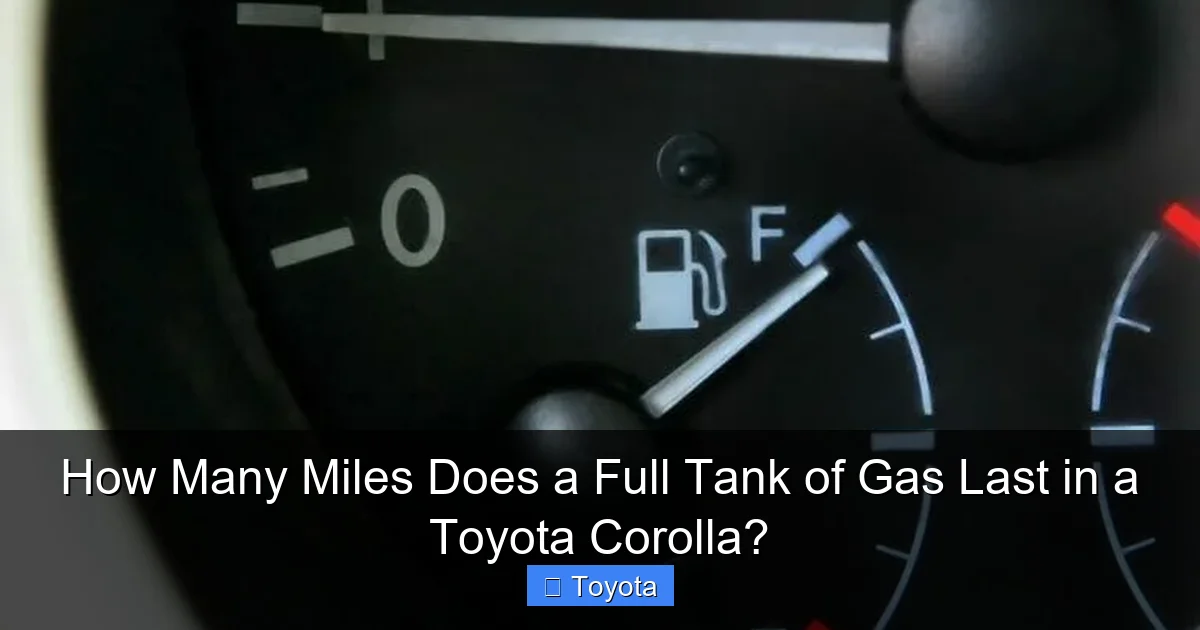
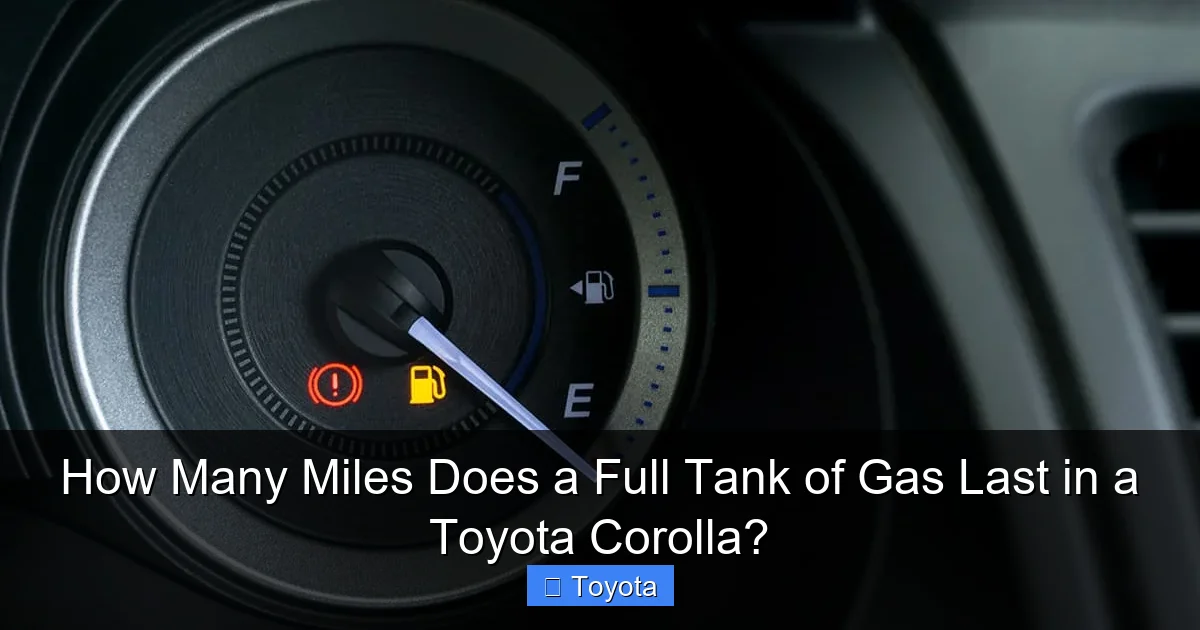
That moment when the low-fuel warning light flickers on—usually a yellow or amber gas pump icon—is your car’s way of saying, “It’s time to start thinking about gas, like, now.” But how much farther can you actually go? This is a critical piece of the “miles per tank” puzzle because it defines your usable range, not just your theoretical maximum.
Visual guide about How Many Miles Does a Full Tank of Gas Last in a Toyota Corolla?
Image source: upgradedvehicle.com
How the Gas Light System Works
The fuel gauge and warning light are controlled by a fuel level sensor in the tank. This sensor is a float attached to a resistor. As the fuel level drops, the float sinks, changing the resistance and signaling the dashboard. The “reserve” or “unused” fuel is the amount left in the tank after the gauge reads empty or the light comes on. Manufacturers intentionally set the light to come on before you’re completely out to give you a safety margin. This margin is not standardized; it varies by make, model, and even year.
Typical Corolla Reserve: How Many Miles After the Light?
For most Toyota Corollans, the low-fuel light illuminates when there are approximately 1.0 to 2.0 gallons remaining in the tank. At a realistic 32 MPG, that’s a reserve of roughly 30 to 65 miles. At a more conservative 25 MPG in bad conditions, that reserve shrinks to 25-40 miles. This means your practical, safe range from a full tank is actually your calculated total minus this reserve, because you shouldn’t regularly test the limit. If you calculate 420 miles total, plan your fill-up around the 350-380 mile mark to be safe.
It is absolutely not recommended to routinely drive until you run out of gas. Doing so can cause the fuel pump to overheat and fail (it’s cooled by submersion in fuel), draw sediment from the tank bottom into the fuel system, and leave you stranded. The gas light is a warning, not an invitation. If you’re curious about the exact safe distance for your specific Corolla model year, we have a dedicated article that dives deep into the data and owner experiences: How Many Miles Can You Drive After The Gas Light Comes On In A Toyota Corolla. This is a must-read for anyone wanting to understand their car’s final buffer.
Variations Between Models and Years
While the 1-2 gallon reserve is common, there are nuances. Some older Corollas might have a slightly larger reserve. Hybrid models sometimes have different sensor calibrations due to the different tank shape. The most reliable way to know is to perform a safe, controlled test: fill up, reset your trip odometer, drive normally until the light comes on, then immediately fill up and note how many gallons it took to fill. Subtract that from 13.2 (or your tank size) to find your personal reserve. Do this near a gas station, not on a remote highway. You’ll get your car’s exact number.
Maximizing Your Miles Per Tank: Practical Tips and Strategies
Now that we understand the numbers, let’s focus on how to push that range to its upper limit. Improving your real-world MPG by even 1-2 MPG can add 10-25 miles to your total range. These are actionable, proven strategies.
Driving Habits That Save Fuel
Your right foot is the most powerful fuel-saving tool. Drive smoothly. Accelerate gently, as if you have an egg under your foot. Anticipate traffic flow to avoid unnecessary braking. Use cruise control on flat highways to maintain a constant speed. Observe the speed limit; aerodynamic drag increases exponentially above 50-55 mph. For every 5 MPH over 60, you can lose about 1 MPG. If you have a multi-display showing instantaneous MPG, use it as a game to maximize efficiency. You’ll often see MPG peak in the 40-50 range on long downhill coasts.
Vehicle Maintenance for Peak Efficiency
A neglected car is a thirsty car. Here are the maintenance non-negotiables:
- Proper Tire Inflation: Check pressure monthly with a good gauge. Under-inflated tires increase rolling resistance. Inflate to the PSI listed on your driver’s door jamb sticker, not the max on the tire sidewall.
- Regular Oil Changes: Use the correct oil viscosity (often 0W-16 or 0W-20 in modern Corollas). Old, thickened oil increases engine friction. Stick to the schedule in your manual. Wondering about oil capacity? Your Corolla’s engine size determines this; a typical 2.0L takes about 4.2 quarts. For precise details on your model, consult our resource on how much oil a Toyota Corolla takes.
- Air Filter: A clogged air filter chokes the engine, forcing it to work harder and use more fuel. Check it every 12,000-15,000 miles; replace if dirty.
- Spark Plugs: Worn plugs misfire, wasting fuel. Replace them at the recommended interval (often 60,000-120,000 miles on modern iridium plugs). You can find the exact count and location for your Corolla in our guide on how many spark plugs are in a Toyota Corolla.
- Wheel Alignment: Misaligned wheels cause drag, reducing MPG. Get it checked annually or if you notice uneven tire wear.
Smart Trip Planning and Reducing Load
Combine errands into one trip. A warm engine is more efficient than multiple cold starts. Remove unnecessary weight from the car—every 100 lbs reduces MPG by about 1%. Take off roof racks or cargo boxes when not in use. Plan routes to avoid heavy traffic and excessive idling. While idling, a Corolla uses about 0.2-0.5 gallons of gas per hour. If you’re stopped for more than 60 seconds, it’s often more efficient to turn the engine off (modern starters are designed for this).
Conclusion: Know Your Number, Drive Smart
So, how many miles does a full tank of gas last in a Toyota Corolla? The definitive answer is: it depends. For the standard, non-hybrid model with a 13.2-gallon tank, you can realistically expect a range of 350 to 450 miles under normal mixed driving conditions. The hybrid model, with its exceptional 50+ MPG, can often match or exceed this range from a smaller 11.4-gallon tank, making it the champion for long distances between fill-ups. Your personal number will land somewhere in that spectrum based on your model year, driving environment, and vehicle health. The key takeaway is to understand the factors you control—smooth driving, proper maintenance, and mindful trip planning—and use them to maximize your efficiency. Remember, the gas light is your safety net, not your target. Fill up when you have about 1-2 gallons left to protect your fuel system and avoid stress. By treating your Corolla well and driving intelligently, you’ll consistently get the most miles possible from every single tank, living up to its reputation as one of the most economical and dependable cars on the road.
Frequently Asked Questions
Does the model year significantly affect my Corolla’s miles per tank?
Yes, newer model years generally have more efficient engines and transmissions. For example, the 2020+ Corolla with the 2.0L Dynamic Force engine and CVT achieves higher MPG than a 2010 model with the 1.8L and conventional automatic, increasing range. Hybrid models from any year offer substantially better range.
How does using the air conditioning or heater impact my fuel range?
Using the air conditioning can reduce fuel economy by 1-3 MPG in hot weather, as the compressor places a load on the engine. The heater uses minimal extra fuel in modern cars, as it primarily taps waste heat from the engine. However, defrosters engage the AC compressor to dehumidify air, slightly increasing load.
Is it better to fill up when the tank is half empty or only when the gas light comes on?
For long-term fuel system health, it’s best to refuel when your tank reaches about 1/4 full. This helps keep sediment (which settles at the bottom) out of your fuel pump and filter. It also ensures you have a sufficient reserve for unexpected detours or traffic delays.
Can the type of gasoline I use change my Corolla’s range?
Your Corolla is designed for regular 87-octane unleaded. Using premium (91+ octane) will not improve fuel economy or range unless your specific model manual recommends it (most do not). However, consistently using high-quality, top-tier detergents can help maintain engine cleanliness and efficiency over the long term.
How does tire pressure affect my miles per tank?
Under-inflated tires increase rolling resistance, forcing the engine to work harder. For every 1 PSI below the recommended pressure, you can lose about 0.3% in fuel economy. On a Corolla, this could mean losing 1-2 miles per tank. Check pressures monthly with the vehicle cold, using the PSI on the driver’s door jamb sticker.
If my Corolla has lower range than before, what should I check first?
Start with the simplest, most common issues: 1) Check tire pressure. 2) Replace the engine air filter if it’s dirty. 3) Ensure you’re up to date on oil changes with the correct oil. 4) Check for any illuminated check engine lights, as a faulty oxygen sensor can drastically reduce MPG. A professional diagnostic scan is a wise next step if basics are fine.