
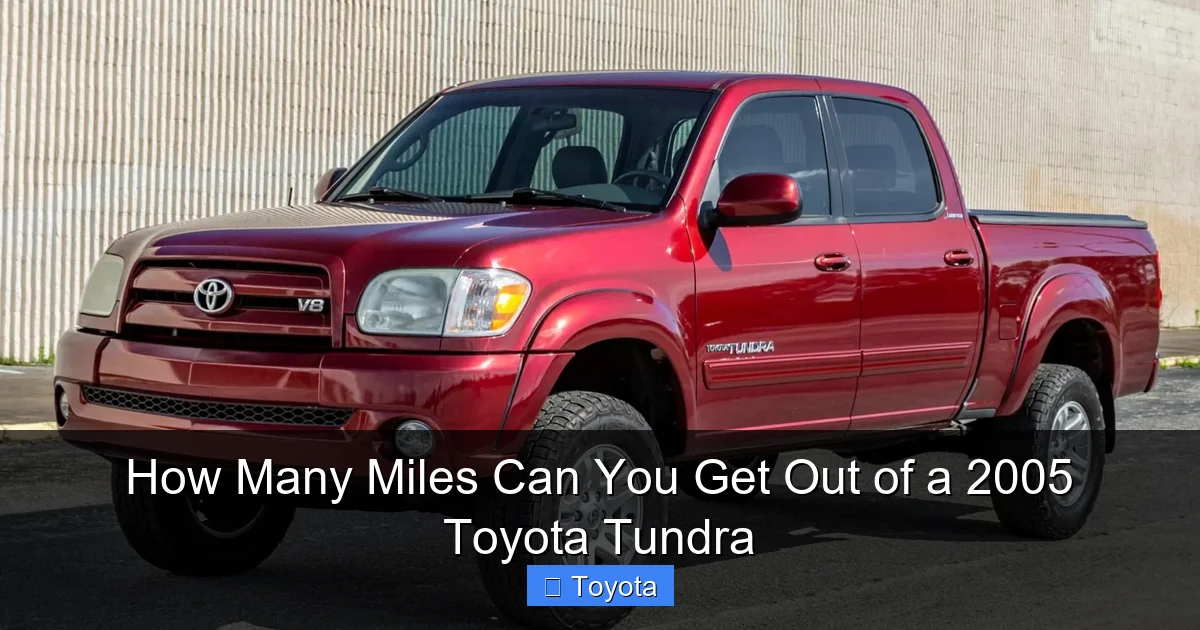
How Many Miles Can You Get Out of a 2005 Toyota Tundra

The 2005 Toyota Tundra is renowned for its robust 4.7L V8 engine and solid build quality, often surpassing 300,000 miles with meticulous care. Its reliability hinges heavily on consistent maintenance, especially regarding the transmission, timing chain, and rust prevention. While fuel economy is modest, the truck’s potential for extreme longevity makes it a viable used purchase if its service history is clear and critical wear items have been addressed.
Key Takeaways
- The 4.7L V8 (2UZ-FE) is the heart of its longevity: This proven engine, when oil-changed regularly, is known to easily surpass 300,000 miles before major rebuilds are needed.
- Transmission is the primary weak link: The 5-speed automatic (A750F) is robust but can fail around 200,000-250,000 miles without proactive fluid and filter changes, especially if used for towing.
- Rust is a critical, model-specific enemy: The 2005 Tundra is prone to severe frame and body panel corrosion, particularly in snowy/salty regions, which can compromise structural integrity long before the engine quits.
- Maintenance history is non-negotiable: A complete, consistent service record is the single best predictor of a high-mileage Tundra’s remaining health and value.
- Expect and budget for major services: At 150k-200k miles, plan for timing chain guides, water pump, spark plugs, and transmission service. At 250k+, consider engine and transmission rebuilds as eventualities.
- Real-world examples show extreme potential: Many owners report 400,000+ mile examples with original engines, but these are theexception, not the rule, and required legendary ownership diligence.
- Its value is in the “proven” platform: Buying a high-mileage 2005 Tundra is a bet on its simple, overbuilt mechanical design, but a pre-purchase inspection by a Toyota specialist is absolutely essential.
📑 Table of Contents
- How Many Miles Can You Get Out of a 2005 Toyota Tundra?
- The Mighty 4.7L V8 (2UZ-FE): An Engine Built to Last
- Transmission Tango: The A750F’s Reputation
- The Rust Scourge: A Tundra’s True Arch-Nemesis
- The Critical Role of Maintenance History
- Real-World Mileage Examples: Separating Myth from Reality
- Maximizing Your Tundra’s Lifespan: The Action Plan
How Many Miles Can You Get Out of a 2005 Toyota Tundra?
So, you’re eyeing a used 2005 Toyota Tundra, or maybe you already own one and are wondering just how far you can push this full-size hauler. It’s a fantastic question. The 2005 model year represents the final year of the first-generation Tundra (2000-2006), a truck built during an era when Toyota was fiercely competing with the American giants by prioritizing bulletproof reliability over featherlight efficiency. The short answer? With a huge caveat of “it depends entirely on how it’s been treated,” a 2005 Toyota Tundra can realistically be expected to reach 250,000 to 300,000 miles as a reliable daily driver. Many well-maintained examples have been documented crossing the 400,000-mile threshold, but these are the automotive equivalent of marathon champions—rare, celebrated, and the product of extraordinary care.
This article isn’t about wishful thinking. It’s a deep dive into the mechanical soul of the 2005 Tundra. We’ll break down the strengths and vulnerabilities of its key components—the vaunted 4.7-liter V8, the sturdy yet finicky transmission, and the Achilles’ heel of rust. We’ll translate owner forum wisdom into practical maintenance milestones and give you the unvarnished truth about what it costs to keep one of these trucks running into the stratosphere of mileage. If you want to understand the true lifespan of this truck, you need to look past the “Toyota reliability” badge and into the nuts and bolts.
The Mighty 4.7L V8 (2UZ-FE): An Engine Built to Last
Let’s start with the star of the show: the 4.7-liter V8, internally coded the 2UZ-FE. This is not a high-revving, peaky race engine. It’s a low-stress, torque-rich workhorse designed from the ground up for trucks. Its iron block, aluminum heads, and timing chain design are inherently durable. The secret to its longevity is simple: it operates under minimal stress when driven normally and, most importantly, it receives clean oil at the correct intervals.

Visual guide about How Many Miles Can You Get Out of a 2005 Toyota Tundra
Image source: images.customwheeloffset.com
Proven Design, Known Weak Points
The 2UZ-FE’s reputation is stellar, but it’s not invincible. The primary wear item is the timing chain and guide system. Unlike a timing belt, the chain is “lifetime” in theory, but the plastic guides that keep it tensioned can wear out and break around 150,000 to 200,000 miles. A failure here is catastrophic—it’s an interference engine, meaning bent valves and damaged pistons are the likely result. This is not a “if” but a “when” for many high-mileage examples. The fix involves a significant dealership-level repair, often costing $2,000-$3,000. Therefore, if you’re looking at a 2005 Tundra with 180,000 miles and no record of this service, you must budget for it immediately.
Other common, but less severe, issues include:
- Oil Consumption: Some 2UZ-FE engines, particularly earlier versions, are known to burn oil. Regularly checking the dipstick (every 1,000 miles) is mandatory. Burning a quart every 1,000-1,500 miles is not uncommon and may require replacing the valve stem seals as a repair.
- VVT-i System: The Variable Valve Timing with intelligence system uses oil pressure. Low oil levels or poor oil quality can cause VVT-i codes and performance loss. This reinforces the need for premium oil and strict change intervals.
- Exhaust Manifold Cracks: The cast iron manifolds can crack due to thermal cycling. You’ll hear a ticking noise. Replacement is the only fix.
For perspective on Toyota’s engineering consistency, the same 4.7L V8 powered the contemporaneous Toyota Sequoia and even the luxury Toyota Land Cruiser. Its durability record is cross-validated across multiple platforms. If you’re researching other Toyota models for their longevity, you’ll find similar patterns of engine resilience, as discussed in articles about how many miles a Toyota Avalon can last.
Transmission Tango: The A750F’s Reputation
If the engine is the heart, the transmission is the circulatory system. The 2005 Tundra came standard with the A750F 5-speed automatic. Paired with the 4.7L V8, it’s a heavy-duty unit shared with the 4Runner and Sequoia. In stock, non-towing applications, it’s very robust. However, it has a well-documented vulnerability: neglect.
Visual guide about How Many Miles Can You Get Out of a 2005 Toyota Tundra
Image source: bringatrailer.com
Fluid is King
The single most important thing you can do for this transmission is to change the fluid and filter every 60,000 miles, without exception. The factory “lifetime” fluid claim is a legal loophole, not a mechanical recommendation. Old, burned fluid loses its frictional properties, leading to slipping, harsh shifts, and eventual failure. A proper drain-and-fill (which only replaces about 1/3 of the fluid) is better than nothing, but a full pan drop and filter change is the gold standard. Using Toyota WS fluid is specified for a reason.
Towing is the transmission’s kryptonite. While rated to tow up to 7,100 lbs, regularly maxing out this capacity, especially in hot conditions or mountainous terrain, will heat the fluid and accelerate wear. A large aftermarket transmission cooler is almost a requirement for serious tower duty. Look for a history of heavy towing; it will significantly shorten the transmission’s lifespan.
Common failure symptoms include:
- Delayed engagement into Drive/Reverse
- Harsh, jarring shifts between 2nd and 3rd gear
- Slipping or flaring RPMs under load
- Check engine light with solenoid or pressure switch codes
A rebuilt A750F from a reputable shop runs $3,000-$4,000 installed. A used one from a salvage yard is a gamble. Prevention through meticulous fluid service is infinitely cheaper.
The Rust Scourge: A Tundra’s True Arch-Nemesis
Here is where we separate the optimistic from the realistic. The first-generation Tundra, particularly the 2005 model, has a notorious reputation for rust. This is not a surface rust issue. We’re talking about severe, frame-compromising corrosion that can cause a vehicle to fail safety inspections and be deemed unrepairable. The problem is multi-faceted:

Visual guide about How Many Miles Can You Get Out of a 2005 Toyota Tundra
Image source: images.customwheeloffset.com
- Frame Design: The boxed frame has numerous cavities and welds that trap moisture and road salt.
- Inadequate Factory Coating: Early 2000s Toyota frames were not as thoroughly e-coated or galvanized as later models.
- Aftermarket Accessories: Poorly installed or sealed aftermarket running boards, step bars, and tow hooks create traps for salt and debris against the frame.
Inspecting for Rust: A Must-Do
You must physically inspect the vehicle. Get underneath on a sunny day and use a flashlight and a pick/ice scraper. Focus on:
- Frame Rails: Especially the sections behind the front wheels and in front of the rear wheels. Poke at any bubbles or flaking paint. If the metal is papery or you can poke a hole through it, walk away.
- Bed Corners: The seams where the bed meets the frame and the cab are classic rust spots.
- Rockers and Cab Corners: Check for bubbling paint along the bottom of the doors and behind the rear wheels.
A Tundra with a solid, original frame in 2024 is a unicorn in many states. Rust repair is expensive, often requiring cutting out sections and welding in new metal. For a 20-year-old truck, the cost can easily exceed the truck’s value. This is the number one reason high-mileage Tundras get scrapped, not because the engine died. When evaluating a potential purchase, your rust inspection should be more thorough than your engine check.
The Critical Role of Maintenance History
I can’t say this enough: a 2005 Tundra with 150,000 miles and a complete, dealer-stamped or meticulously documented service history is a far better bet than a 100,000-mile example with a blank service record. The “how” matters more than the “how many.”
What to Look For in the Paperwork
You need to see evidence of:
- Regular Oil Changes: Every 5,000 miles, not 10,000. Look for consistent intervals.
- Transmission Service: At least one fluid and filter change in the last 60,000 miles, and ideally multiple.
- Timing Chain Service: This is the big one. Has it been done? If not, it’s a ticking time bomb (literally, you’ll hear rattling on cold start). The service includes chain, guides, tensioner, water pump, and often seals.
- Cooling System: Radiator, thermostat, water pump (if not done with timing chain), and hoses should be replaced every 80,000-100,000 miles. Overheating kills everything.
- Differential and Transfer Case Fluid: Should be changed every 60,000-80,000 miles, especially if used in 4WD.
- Brakes, Tires, and Suspension: Are these wear items documented as being replaced as needed? This shows an owner who addressed problems proactively.
A stack of receipts from a trusted independent Toyota shop is worth its weight in gold. Generic “lube, oil, filter” stickers from quick-lube places are not sufficient proof of comprehensive care. You need to know what was actually done.
Real-World Mileage Examples: Separating Myth from Reality
You’ll find stories online of 2005 Tundras with 500,000 miles. Take them with a grain of salt, but don’t dismiss them entirely. They are real, but they are statistical outliers born from a perfect storm of factors:
- Climate: Often from dry, rust-free states (Arizona, Nevada, parts of California).
- Use: Primarily highway miles, minimal stop-and-go, no towing.
- Owner: A mechanically-inclined enthusiast who did every single service themselves, on time, with the best parts.
- Luck: No major manufacturing defects from the factory.
The more common, believable high-mileage story is the 2005 Tundra at 250,000-300,000 miles that has had:
- The timing chain service done once at ~180k.
- Two or three transmission services.
- One or two radiator replacements.
- All suspension bushings, ball joints, and tie-rod ends replaced.
- Constant attention to oil consumption and small leaks.
This truck is not “original” in the sense of untouched. It’s a survivor that has had its wear parts replaced. Its value is in its functional, reliable state, not its originality. When you hear about a high-mileage Tundra, grill the seller on what has been replaced, not just the odometer reading. For comparison, the Toyota Avalon, a car built on similar principles of over-engineering, shows similar patterns of extreme longevity when cared for, as noted in articles exploring how many miles a Toyota Avalon can last.
Maximizing Your Tundra’s Lifespan: The Action Plan
Whether you’re buying used or committed to keeping your current Tundra, here is your blueprint for maximizing miles.
Immediate & Non-Negotiable Actions
- Full Pre-Purchase Inspection (PPI): Do not skip this. Pay a Toyota specialist (not a general mechanic) for a 2-hour inspection. They will check for rust, scan for codes, test compression, and inspect the transmission pan for metal shavings. This $200-$300 is the best money you will ever spend on this truck.
- If timing chains are original, budget for the service. It is the single most important mechanical service this engine needs. Do not delay.
- Change all fluids. Engine oil, transmission fluid (full drop), differential fluid, transfer case fluid, coolant. Flush the brake system if the fluid is dark.
- Address rust proactively. If you find minor surface rust, grind it back, treat with a rust converter, and repaint with undercoating. For frame rust, consult a frame specialist. Drilling drain holes in trapped areas (a controversial but common fix) can help.
Long-Term Ownership Strategy
- Adhere to a strict oil change interval. 5,000 miles max. Use a high-quality full synthetic oil (Toyota’s recommended 0W-20 or a high-quality 5W-30) and a premium filter (Toyota OEM, Wix XP, or Mobil 1).
- Warm up, then drive gently. Let it idle for 30 seconds to a minute on cold starts to get oil circulating, then drive gently until the coolant temp gauge moves off the cold mark. This protects the engine and transmission during the most wear-prone period.
- Listen and feel. Get to know your truck’s normal sounds. A new rattle, a new vibration, a new shift point is an early warning sign. Address small problems before they become big ones.
- Use quality parts. When replacing wear items, don’t cheap out. A $50 set of control arm bushings is a false economy if you’re doing the labor yourself. OEM or top-tier aftermarket (Moog, Timken, etc.) is worth it.
- Consider a secondary vehicle. If you plan to keep this truck to 400,000 miles, understand that at some point, the cost of major repairs (engine/transmission rebuild) will approach or exceed the truck’s value. Have a plan for this eventuality. Sometimes, it’s smarter to put that $5,000 toward a newer, lower-mileage used truck than into a 25-year-old one.
Ultimately, getting the most miles out of a 2005 Tundra is a marathon, not a sprint. It requires patience, a budget for scheduled and unscheduled maintenance, and a willingness to be the truck’s primary caretaker. It’s not for the mechanically timid or the budget-conscious who want a trouble-free appliance. But for the hands-on owner who values simple, repairable design, the reward is a loyal, capable companion that can, with extraordinary diligence, defy the odds.
Frequently Asked Questions
What is the biggest mileage-related weak spot on a 2005 Toyota Tundra?
The transmission (A750F 5-speed auto) is the most common high-mileage failure point, primarily if fluid changes were neglected. The timing chain guides on the 4.7L V8 engine are the second most critical, with failure often occurring between 150,000-200,000 miles.
Is 300,000 miles a realistic goal for a 2005 Tundra?
Yes, 300,000 miles is a realistic and achievable goal for a 2005 Tundra, but only with impeccable maintenance history, especially regarding transmission fluid and timing chain service. Rust must also be non-existent or fully repaired to maintain structural integrity.
How much does a timing chain job cost on a 4.7L V8?
A complete timing chain replacement, which includes the chain, guides, tensioner, water pump, and various seals, typically costs between $2,000 and $3,500 at a reputable independent shop or dealership. This is a major but essential service for high-mileage prevention.
Will my 2005 Tundra be rusty?
Very likely, yes. The first-generation Tundra is infamous for frame and body rust. A thorough, hands-on inspection underneath is mandatory. Many trucks from salt-belt states have already been retired due to structural corrosion, regardless of engine condition.
What is a good maintenance milestone schedule for a high-mileage Tundra?
Oil/filter every 5,000 miles; transmission fluid/filter every 60,000 miles; differential/transfer case fluid every 60,000-80,000 miles; coolant every 60,000 miles; spark plugs every 120,000 miles; and a full inspection of belts, hoses, and suspension bushings every 30,000 miles.
Should I buy a 2005 Tundra with over 200,000 miles?
Only if it has a comprehensive, verifiable service history, a clean title, and has passed a rigorous pre-purchase inspection by a Toyota specialist with no significant rust or pending major repairs. The price must also reflect the high-risk nature and impending need for services like the timing chain.
