How Many Miles Can a Toyota Prius Go on a Full Tank?

Contents
- 1 Key Takeaways
- 2 📑 Table of Contents
- 3 Understanding the Toyota Prius Fuel System
- 4 Real-World Range: What the Numbers Actually Mean
- 5 Maximizing Your Prius Range: Practical Tips
- 6 The Gas Light: Your Final Warning and Reserve Fuel
- 7 Comparing Generations: Does a Newer Prius Go Farther?
- 8 Prius vs. Other Hybrids: How Does It Stack Up?
- 9 Conclusion: It’s About the System, Not Just the Tank
- 10 Frequently Asked Questions


A Toyota Prius can typically travel between 500 to 650 miles on a full tank of gas, depending on the model year, driving conditions, and individual driving habits. This impressive range is a combination of its small but efficient gasoline engine and its powerful electric motor system. Understanding your specific Prius’s EPA ratings and how you drive is key to achieving or even exceeding these estimates.
Key Takeaways
- Tank Size & Efficiency Combo: The Prius uses a relatively small gas tank (typically 11-12 gallons) but achieves exceptional miles per gallon (MPG), often 50+ MPG combined, to create its long range.
- Real-World vs. EPA Estimates: While EPA ratings provide a baseline (e.g., 57 MPG combined for recent models), actual mileage and range vary significantly with driving style, terrain, weather, and cargo load.
- The “Gas Light” Reserve: When the low fuel warning light illuminates, most Prius models still have approximately 1-1.5 gallons of fuel remaining, offering a crucial safety buffer of 40-80+ miles.
- Model Year Matters: Newer generations (like the 2023+ Prius) have more powerful but still efficient engines, while older generations (Gen 2, 3) are famous for hyper-efficiency but may have slightly different real-world range characteristics.
- Driving Habits are Everything: Gentle acceleration, maintaining steady speeds, using regenerative braking effectively, and maximizing electric-only (EV) mode in city driving are the most impactful ways to extend your range per tank.
- It’s a Hybrid, Not an EV: The Prius’s range is based on its gasoline tank. The battery stores energy for efficiency but does not directly add “miles” in the same way a plug-in EV’s larger battery does; it simply allows the gas engine to work less.
- Comparison Context: This 500-650 mile range often surpasses many conventional gasoline-only sedans and SUVs with much larger tanks, making it exceptionally convenient for long trips without frequent refueling.
📑 Table of Contents
- Understanding the Toyota Prius Fuel System
- Real-World Range: What the Numbers Actually Mean
- Maximizing Your Prius Range: Practical Tips
- The Gas Light: Your Final Warning and Reserve Fuel
- Comparing Generations: Does a Newer Prius Go Farther?
- Prius vs. Other Hybrids: How Does It Stack Up?
- Conclusion: It’s About the System, Not Just the Tank
Understanding the Toyota Prius Fuel System
To truly grasp how far a Toyota Prius can go, we need to peel back the hood—both literally and figuratively. The magic isn’t just in one component but in the symphony of engineering under the skin. At its heart, the Prius is a hybrid electric vehicle (HEV). This means it seamlessly blends power from two sources: a gasoline engine and an electric motor. This system, known as Hybrid Synergy Drive, is designed for one primary goal: maximum efficiency.
The Two-Power Source Dance
When you start your Prius, it will often silently glide away from the curb on electric power alone, using stored energy from its nickel-metal hydride (NiMH) or lithium-ion (Li-ion) battery. This is perfect for stop-and-go traffic and low-speed maneuvers, using zero gasoline. As you accelerate or demand more power, the gasoline engine—a highly efficient Atkinson-cycle engine—kicks in. But here’s the clever part: the engine doesn’t just power the wheels; it also acts as a generator to recharge the battery. When you brake or coast, regenerative braking captures kinetic energy that would be lost as heat and converts it back into electricity to top up the battery. This constant, intelligent dance between the two power sources is why the Prius sips fuel so slowly.
The Gas Tank: Smaller But Mighty
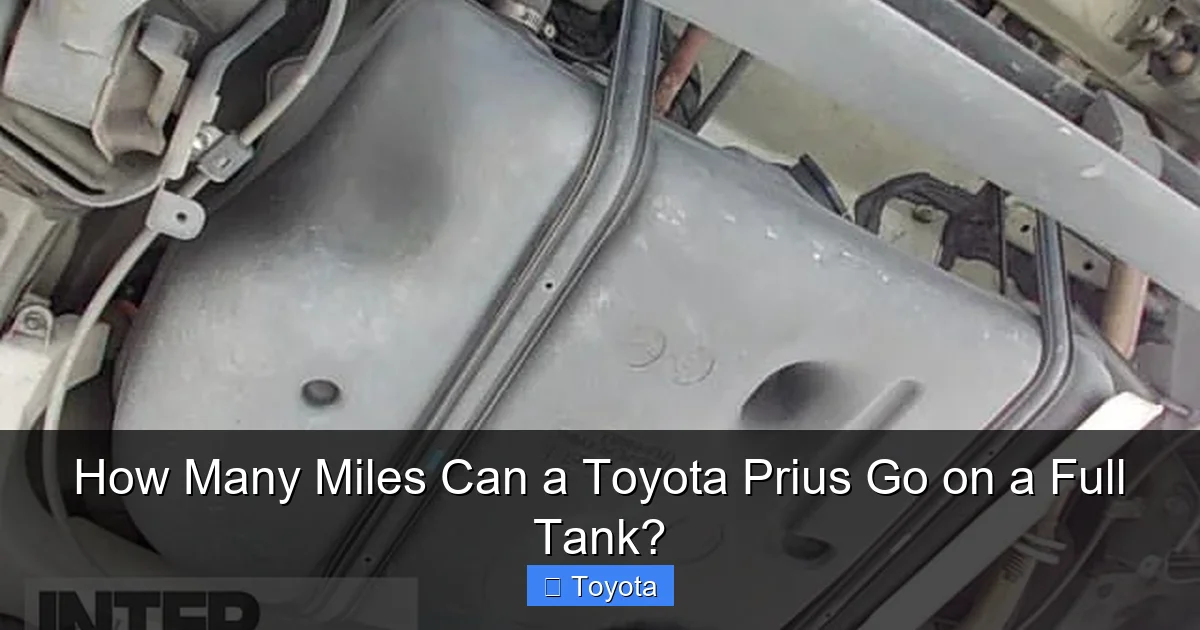
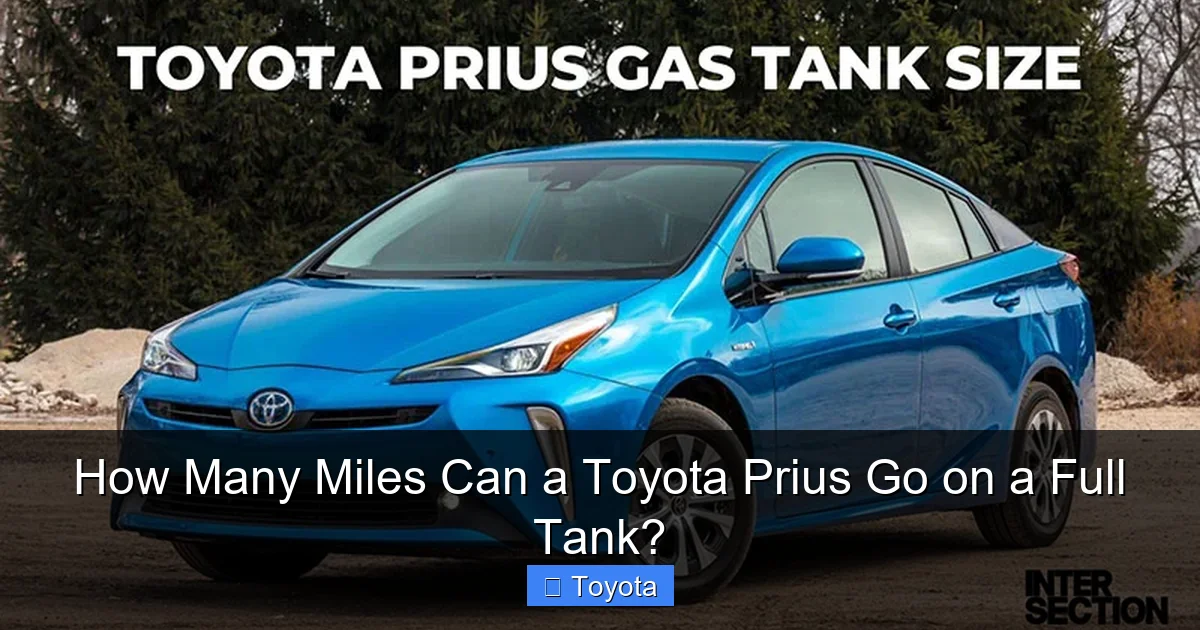
Look at a Prius, and you might expect a massive gas tank to achieve its legendary range. Surprisingly, the fuel tank is quite compact. For most recent model years (e.g., 2016-2022), the tank capacity is 11.4 gallons. The newest 2023+ redesign holds a slightly larger 12.4 gallons. Compare this to a midsize sedan like a Toyota Camry, which has a ~15.8-gallon tank, or an SUV like a RAV4 with a ~14.5-gallon tank. The Prius’s secret weapon is that it doesn’t need a big tank because it doesn’t burn fuel quickly. It’s not about how much fuel you carry; it’s about how far each gallon takes you.
Real-World Range: What the Numbers Actually Mean
Now for the million-dollar question: with that 11-12 gallon tank, how many miles can you expect? We must look at the official EPA ratings first, then layer in the real-world variables.
Visual guide about How Many Miles Can a Toyota Prius Go on a Full Tank?
Image source: intersectionmagazine.net
EPA Estimates: The Official Baseline
The Environmental Protection Agency (EPA) puts every vehicle through standardized laboratory and road tests to assign its MPG (miles per gallon) ratings. For the 2022 Toyota Prius (a common reference point), the ratings are:
- City: 58 MPG
- Highway: 53 MPG
- Combined: 56 MPG
Using the 11.4-gallon tank, the simple math for the combined rating is: 11.4 gallons x 56 MPG = 638.4 miles. That’s the theoretical maximum range. For the 2023+ model with a 12.4-gallon tank and an EPA combined rating of 52-57 MPG (depending on trim), the math yields roughly 645 to 707 miles. So, on paper, a full tank should get you well over 600 miles in ideal conditions.
The Reality Check: Factors That Change Everything
That EPA number is a fantastic benchmark, but it’s a controlled lab average. Your actual “miles per full tank” will be a living, breathing number influenced by dozens of factors. Here are the most significant ones that will make your range swing from the high 500s to the low 400s, or even push it past 700 miles in a perfect storm of efficiency.
- Driving Environment (City vs. Highway): This is the biggest factor. The Prius is a city superstar. Its electric motor is perfect for low speeds and frequent stops, allowing it to drive on battery power for significant stretches in urban areas. You can easily see 60+ MPG in gentle city driving. On the open highway, the gasoline engine runs almost constantly at steady, efficient speeds, but you lose the regenerative benefits of stop-and-go traffic. Highway MPG typically drops to the high 40s or low 50s. A long road trip will yield a lower overall MPG than a week of city commuting.
- Season & Climate: Cold weather is the efficiency killer. The engine runs longer to warm up and maintain cabin heat. The battery’s performance drops in the cold, reducing its ability to hold a charge and power the car alone. Using the heater (especially the high-voltage cabin heater) draws significant power from the engine or battery. You can expect a 10-20% drop in MPG in winter. Extreme heat also hurts efficiency as the air conditioning compressor places a constant load on the engine.
- Driving Style: Are you a “hypermiler” or a lead-foot? Aggressive acceleration and hard braking are the antithesis of hybrid efficiency. Every time you slam the gas, you force the engine to work hard and burn fuel rapidly. Smooth, gradual acceleration and anticipating traffic flow to maximize coasting and regenerative braking (the “B” mode on the shifter) can add several MPG. Speeding is a major factor; aerodynamic drag increases exponentially with speed. Driving 75 mph vs. 65 mph can drastically reduce your range.
- Vehicle Load & Maintenance: A fully loaded Prius with five adults and a roof rack is a heavier, less aerodynamic machine. Extra weight means more energy needed to move. Under-inflated tires create more rolling resistance. Neglected engine oil, a dirty air filter, or old spark plugs all make the engine work harder and burn more fuel. Regular maintenance is non-negotiable for peak range.
- Terrain: Driving in hilly or mountainous areas requires more energy for climbing. While regenerative braking helps on descents, the net effect of constant elevation change is lower overall efficiency compared to flat, straight roads.
So, what’s a realistic real-world range? For the average driver in mixed conditions, a safe, achievable expectation is 500 to 600 miles per full tank. A skilled driver in perfect summer conditions on mostly city roads might squeeze out 650+ miles. A driver in a cold winter with a loaded car on a highway road trip might see 450-500 miles. Your personal range is a unique fingerprint of your car, your environment, and your right foot.
Maximizing Your Prius Range: Practical Tips
Want to get every last drop out of your fill-up? Adopt a hybrid-minded driving philosophy. It’s not about driving slowly; it’s about driving smart.
Visual guide about How Many Miles Can a Toyota Prius Go on a Full Tank?
Image source: intersectionmagazine.net
Master the EV Mode and Regenerative Braking
Most Prius models have an EV Mode button. When conditions are right (battery has charge, speed is low, gentle acceleration), this allows you to drive on electric power alone, usually up to 25 mph or so. Use this in parking lots, neighborhood streets, and heavy traffic. It’s the closest you’ll get to “free” miles. The “B” mode on the shifter increases regenerative braking strength. Use it on long downhill stretches to recapture more energy and reduce brake wear. In normal “D” mode, practice gentle, early braking to let the regen system do most of the work before the friction brakes engage.
Plan Your Routes and Speed
Use your navigation system to choose routes with fewer stops and more steady speeds, even if they are slightly longer. Congested highways with constant stop-and-go are worse than a clear suburban route. Most importantly, use cruise control on the highway. Maintaining a constant, moderate speed (65-70 mph is the sweet spot for most hybrids) is far more efficient than the constant speed fluctuations of manual driving.
Maintenance for Miles
Follow your Toyota’s maintenance schedule religiously. Use the recommended 0W-16 oil (or newer specification) for the lowest viscosity and friction. Keep tires inflated to the door jamb placard pressure (often 35 PSI or higher for the Prius), not the lower number on the tire sidewall. A tire pressure monitoring system (TPMS) light is a direct hit to your range. Ensure your engine air filter is clean. These simple steps keep your powertrain operating at its designed efficiency.
The Gas Light: Your Final Warning and Reserve Fuel
That little amber fuel pump icon that illuminates on your dashboard isn’t a “you’re out of gas” light; it’s a “please refuel soon” light. It’s your car’s polite way of saying you have a reserve. So, how many miles can you drive after the gas light comes on in a Prius?
This is where specific knowledge about your model helps. Based on owner forums, technical data, and testing, most Toyota Prius models (from Gen 3 onward) have a reserve fuel capacity of approximately 1.0 to 1.5 gallons after the light comes on. The light typically triggers when about 1-2 gallons have been used from the tank’s total capacity. Given the Prius’s excellent MPG, this reserve is substantial.
Calculating the reserve range: If you’re getting 50 MPG in your current driving conditions and have 1.2 gallons left, you have a buffer of about 60 miles. In hyper-efficient city driving at 60 MPG, that could be 72 miles. On a cold highway at 45 MPG, it could be 54 miles. You should never routinely test this limit. It’s a safety margin, not an extension of your normal range. Running the tank completely dry can damage the fuel pump, which is cooled by the gasoline itself. If you’re curious about other models, we have a detailed guide on how many miles you can drive when the gas light comes on in a Toyota Camry, which shares similar engineering principles.
Comparing Generations: Does a Newer Prius Go Farther?
The Prius has evolved through five major generations. Does a newer one mean more miles per tank? It’s a nuanced answer.

Visual guide about How Many Miles Can a Toyota Prius Go on a Full Tank?
Image source: autozonic.com
Gen 2 (2004-2009) & Gen 3 (2010-2015): The Efficiency Kings
These models, especially the Gen 2, are legendary in hyper-miling circles. Their Atkinson-cycle engines and simpler hybrid systems were optimized purely for fuel economy. EPA ratings for the Gen 3 Prius were up to 51 MPG city / 48 highway / 50 combined. With their 11.9-gallon tank, the potential range was similar to today’s models. However, they are less powerful and may have slightly different real-world characteristics based on age and wear.
Gen 4 (2016-2022): The Refined Standard
This generation became the ubiquitous image of the Prius. It offered a great balance of improved power (still modest), refined ride, and stellar efficiency. The 11.4-gallon tank and ~56 MPG combined rating made it a consistent 600+ mile performer. This is the generation most people think of when they ask this question.
Gen 5 (2023-Present): More Power, Similar Efficiency
The latest Prius is a dramatic redesign, looking more like a sport wagon and offering significantly more horsepower (up to 194 hp in the AWD-e model). The efficiency is still top-tier, with EPA ratings of 57 MPG combined for the FWD model. The larger 12.4-gallon tank means the potential maximum range is the highest ever for a Prius, theoretically touching 700 miles. However, the extra power can tempt drivers to use it, potentially negating some of that gain if driven spiritedly. The core hybrid system remains brilliantly efficient.
Prius vs. Other Hybrids: How Does It Stack Up?
The Prius is the original mass-market hybrid, but it now has many competitors. How does its range compare to others like the Honda Insight, Hyundai Ioniq Hybrid, or even its own sibling, the Corolla Hybrid?
Toyota’s Own Lineup
The Toyota Corolla Hybrid shares much of the Prius’s powertrain technology. With a smaller 13.2-gallon tank but very similar efficiency (around 50 MPG combined), its range is comparable, often in the 550-650 mile zone. The larger Toyota RAV4 Hybrid has a bigger 14.5-gallon tank but lower efficiency (~40 MPG combined). Its range is similar to the Prius, around 550 miles, but it offers more space and AWD capability. For context on other Toyota models, you might wonder how big is the gas tank on a Toyota Camry; it’s larger, but the Camry’s lower MPG results in a similar overall range.
Competitor Comparison
The Hyundai Ioniq Hybrid is a direct competitor with a slightly larger 11.9-gallon tank and an EPA rating of 59 MPG combined. Its real-world range is nearly identical to the Prius. The Honda Insight also competes closely with a ~12-gallon tank and ~52 MPG combined. The key takeaway is that modern hybrids from reputable manufacturers have converged on a similar efficiency plateau, meaning a full tank of gas in any of them will likely deliver 500-700 miles of travel. The Prius’s advantage remains its proven, decades-refined reliability and vast real-world data on long-term durability. If you’re considering long-term value, you might also be interested in how much is a 2013 Toyota Prius worth to see how well these cars hold their value.
Conclusion: It’s About the System, Not Just the Tank
So, how many miles can a Toyota Prius go on a full tank? The definitive answer is: it depends, but you can confidently plan on 500-650 miles. The upper end of that spectrum is achievable with mindful driving in favorable conditions. The lower end is what you might see in a harsh winter on a long highway trip with a full load.
This incredible range is not a trick; it’s the result of a holistic design philosophy. Toyota didn’t just cram a big gas tank into the Prius. Instead, they engineered a car that uses every drop of fuel with extreme prejudice. The small tank is a physical manifestation of that efficiency. It means fewer stops at the gas station, more money in your pocket, and a smaller carbon footprint over the life of the vehicle.
Your mission, should you choose to accept it, is to become a partner in this efficiency. Understand your car’s systems, drive with anticipation, keep it well-maintained, and you will not only meet the EPA estimates but likely surpass them. The number on your odometer when the gas light comes on is a personal report card on your driving habits. Aim for that number to be as high as possible, and you’ll extract every last mile from that full tank, proving once again why the Toyota Prius remains the benchmark for practical, long-range hybrid motoring.
Frequently Asked Questions
What is the actual reserve range when the Prius gas light comes on?
Most Prius models have a reserve of about 1.0 to 1.5 gallons after the warning light illuminates. Given its high MPG, this typically translates to a safe driving buffer of 40 to 80+ miles, depending on your current real-world fuel economy. You should refuel as soon as is safely possible after the light comes on.
Can driving faster on the highway really reduce my Prius’s range per tank?
Absolutely. Aerodynamic drag increases with the square of your speed. Driving at 75 mph instead of 65 mph can reduce your MPG by 5-10% or more. This directly shrinks your total range on a full tank. Using cruise control at a moderate, steady speed is the most efficient way to cover highway miles.
Does using the heater or air conditioning significantly impact my Prius’s range?
Yes, especially the heater in cold weather. The gasoline engine must run longer to generate heat for the cabin, which uses fuel even if you’re not accelerating. Air conditioning places a constant load on the engine. Expect a 10-20% drop in MPG and thus your total range when using climate control extensively in extreme temperatures.
Is the range different between the front-wheel drive and AWD-e Prius models?
The AWD-e model has a slightly lower EPA combined rating (around 52 MPG vs. 57 MPG for FWD) due to the added weight and mechanical complexity of the rear electric motor. This small efficiency difference means the AWD-e’s total range on a full tank will be marginally less, perhaps 20-50 miles less in ideal conditions, but still excellent.
How does the Prius’s range compare to a plug-in hybrid like the Prius Prime?
They are fundamentally different. The standard Prius (HEV) generates its own electricity and its range is solely based on the gasoline tank (~500-650 miles). The Prius Prime (PHEV) has a larger battery that allows it to drive 40+ miles on electricity alone without using any gas. Once its electric range is depleted, it operates like a standard Prius. Its *total* range (gas + electric) is much higher, but its *gas-only* range is similar to the regular Prius.
If my Prius is older, will its range on a full tank be less than when it was new?
Potentially, yes. As a hybrid’s high-voltage battery ages, its ability to hold a charge and deliver power may diminish slightly. This can cause the engine to run more frequently to compensate, reducing overall MPG. However, Toyota’s hybrid batteries are famously robust, and many owners report minimal MPG loss even after 150,000+ miles. Regular maintenance and gentle driving can help preserve the original efficiency and range for the long haul.