
How Many Miles Can a Toyota 4runner Go on a Full Tank?

The Toyota 4Runner’s range on a full tank typically falls between 350 to 450 miles, but this number is highly dependent on your specific model year, engine, driving habits, and conditions. A 2023 Limited with a 23-gallon tank and 20 MPG combined can theoretically go about 460 miles, while an older, heavier off-road model might only manage 320 miles. Understanding your vehicle’s exact tank size and real-world MPG is crucial for avoiding an unexpected run out of gas on your adventures.
So, you’re behind the wheel of your trusty Toyota 4Runner, ready to hit the open road or tackle a rugged trail. That feeling of freedom is incredible. But then a thought creeps in: “Just how far can I actually go before I need to find a gas station?” It’s a critical question for any adventure vehicle owner. The answer isn’t a single number. It’s a calculation, a guess, and a bit of a moving target all rolled into one. This guide will break down everything you need to know about the Toyota 4Runner’s fuel range, from the specs on paper to the gritty reality of the trail.
Key Takeaways
- Tank Capacity Varies: The 4Runner’s fuel tank size has changed over the years, ranging from about 17.1 to 23.2 gallons, which is the primary factor in maximum range.
- MPG is the Big Variable: Combined fuel economy for modern 4Runners ranges from roughly 16 to 20 MPG. Your actual mileage can be 10-20% lower in demanding conditions.
- The Gas Light is a Warning, Not a Guarantee: When the low fuel light illuminates, you typically have 30-50 miles left, but you should treat it as a “last chance” to refuel, not a precise measurement.
- Heavy Loads & Terrain Drain Range: Carrying extra cargo, roof gear, towing, or driving in mountains, sand, or mud can drastically reduce your miles per gallon and overall range.
- Driving Style Matters: Aggressive acceleration, high speeds, and constant 4WD use will consume fuel much faster than gentle, steady cruising on the highway.
- Maintenance is Key: A well-maintained 4Runner with fresh fluids, proper tire pressure, and a clean air filter will achieve its best possible MPG and range.
- Use a Trip Meter: The most accurate way to know your true range is to reset your trip odometer at fill-up and calculate your actual MPG over several tanks, not relying solely on the EPA estimate.
📑 Table of Contents
Understanding the Formula: Tank Size x MPG
At its most basic, the question “how many miles can a Toyota 4Runner go on a full tank?” is a simple math problem: Fuel Tank Capacity (in gallons) multiplied by your Real-World Miles Per Gallon (MPG). That product gives you your approximate maximum range. However, both of those numbers are variables, not constants. Let’s dissect each one.
The Shifting Capacity of the 4Runner Fuel Tank
The size of the gas tank in a 4Runner hasn’t been static. Toyota has adjusted it across generations and even within model years based on trim and drivetrain. Knowing your specific tank size is the first step. Here’s a general breakdown for recent generations:
- Fifth Generation (2010-Present): This is the current body style. For most of its run, 4WD models had a 23.2-gallon tank. However, for the 2020 model year and later, Toyota slightly reduced the tank capacity to 23.0 gallons for 4WD models. The 2WD variants (available in earlier years) typically had a smaller tank, around 17.1 to 19.5 gallons.
- Fourth Generation (2003-2009): These models generally featured a 21.1-gallon tank for 4WD versions. The 2WD models were smaller, usually around 17.1 gallons.
- Third Generation (1996-2002): Tank sizes were similar, typically in the 20-21 gallon range for 4×4 models.
How to Find Your Exact Tank Size: The easiest way is to check your owner’s manual. You can also look for a sticker inside the fuel filler door, which often states the tank capacity. Online owner’s forums for your specific model year are an excellent resource for confirmation.
EPA MPG Estimates vs. Your Actual MPG
The Environmental Protection Agency (EPA) provides fuel economy estimates. These are great for comparing models but often differ from real-world results. For the current (fifth-gen) 4Runner, EPA estimates look like this:
- V6 Engine (All recent models): City: ~16 MPG, Highway: ~20 MPG, Combined: ~17-18 MPG.
- V6 Engine (2020+ with slight efficiency tweaks): City: ~16 MPG, Highway: ~19 MPG, Combined: ~17 MPG.
These numbers give you a baseline. But your real MPG is what you get when you drive. To calculate it, the old-school method is best: Reset your trip odometer at each full fill-up, drive until you need to fill again, then divide the miles driven by the gallons pumped. Do this over 3-5 tanks to get a reliable average for your driving style and conditions. Your real MPG will likely be 10-20% lower than the highway estimate if you do a lot of city driving, off-roading, or carry heavy loads. For instance, if you’re getting 15 MPG combined in a 23-gallon 4Runner, your range is 345 miles. If you’re getting 18 MPG, it jumps to 414 miles. That’s a huge difference!
Real-World Range Factors: It’s Not Just Math
Now we get to the heart of the matter. The simple formula gives you a theoretical maximum. Reality is messier. Here are the biggest factors that will make your actual range on a full tank swing wildly from that calculated number.

Visual guide about How Many Miles Can a Toyota 4runner Go on a Full Tank?
Image source: vehiclerides.com
Driving Conditions: City vs. Highway vs. Trail
This is the single biggest influence on MPG. Stop-and-go city traffic with frequent acceleration is a fuel hog. The 4Runner’s V6 works overtime, and MPG can plummet to 12-14 in heavy urban environments. Steady highway cruising at 65-70 mph is where the 4Runner shines, potentially achieving 20+ MPG on a flat, calm day. But the moment you hit the trail, all bets are off. Low-range 4WD, creeping over rocks, churning through sand or mud, and using power accessories like winches or high-RPM driving can easily cut your MPG in half compared to highway driving. A day of serious off-roading might only net you 8-10 MPG, draining that 23-gallon tank in well under 200 miles.
Vehicle Load and Aerodynamics
A 4Runner is a heavy vehicle (around 4,500-5,000 lbs). Adding weight makes it work harder. If you’re packing the family, a rooftop tent, a bike rack, and all your gear for a week-long trip, you’re adding significant mass and wind resistance. That roof rack and tent? They create terrible aerodynamic drag, especially at highway speeds, which can reduce MPG by 2-4 MPG or more. Every 100 lbs of extra cargo can reduce fuel efficiency by about 1-2%. Towing a trailer is the ultimate range killer, potentially slashing your MPG by 30-50%.
Tire Pressure and Type
This is a huge, often overlooked factor. Under-inflated tires create more rolling resistance, forcing the engine to work harder. Check your tire pressure regularly, especially before a long trip, and inflate them to the manufacturer’s recommended PSI (found on a sticker inside the driver’s door jamb). The type of tires matters too. Large, aggressive all-terrain or mud-terrain tires have deeper tread blocks and are heavier, increasing rolling resistance. A set of highway all-season tires will almost always provide better fuel economy. If maximum range is your goal for a specific journey, consider swapping to a more efficient tire if you have a set.
Climate and Accessory Use
Extreme temperatures play a role. In winter, the engine runs richer until it warms up, and using the heater blower and defroster adds electrical load. In summer, the A/C compressor is a significant power drain, especially in a large vehicle like a 4Runner. Driving with the windows down at high speeds also creates aerodynamic drag. Using the 4Runner’s powerful heater and A/C can reduce MPG by 1-3 MPG depending on settings and outside temperature.
The Gas Light: Your Last Line of Defense
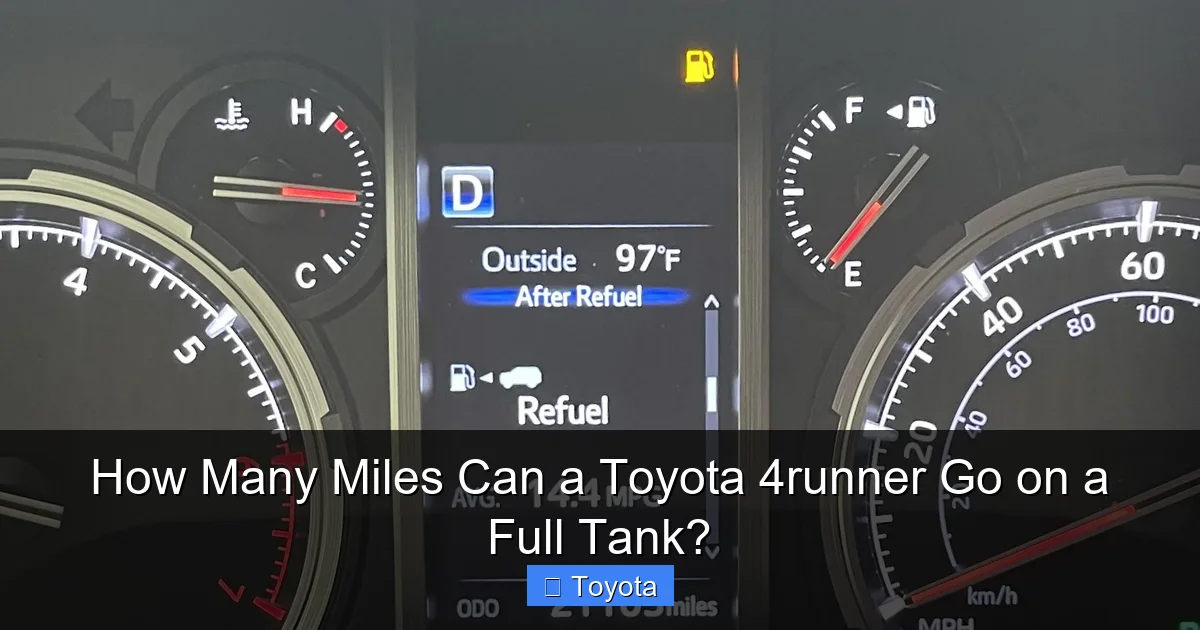
Ah, the moment every driver dreads. The low fuel warning light flickers on, and the chime sounds. In a 4Runner, this is your final signal that it’s time to start planning a refuel. But how far can you *really* go after it comes on?
Visual guide about How Many Miles Can a Toyota 4runner Go on a Full Tank?
Image source: diycarexpert.com
How Much Reserve is Left?
When that light illuminates, your 4Runner is not running on fumes. There is still a significant reserve of fuel in the tank. This reserve is intentionally designed to be enough to get you to a safe, convenient gas station. For most 4Runners, you can expect to have between 30 and 50 miles of range remaining when the light first comes on. Some owners have reported seeing 60+ miles in ideal conditions, while others in mountainous terrain might see it dip closer to 30. The exact amount varies by model year and tank geometry.
Should You Push Your Luck?
Short answer: No. While 30-50 miles sounds like a comfortable buffer, it’s a dangerous game. Here’s why:
- You risk running dry: Pushing beyond the reserve can cause the fuel pump to overheat (it’s lubricated and cooled by gasoline) and lead to sediment from the tank bottom being sucked into the fuel system, causing expensive damage.
- You’re stressed: Driving while anxious about running out of gas is unsafe. You might make poor decisions, like speeding to a station or ignoring traffic.
- Gas stations aren’t always where you think: A station 40 miles away might be closed, out of order, or—in remote areas—might not exist. Traffic, detours, and getting lost eat up your reserve quickly.
The smart strategy is to treat the gas light as a “last chance” alert. As soon as it comes on, start looking for a station at the next convenient exit or town. Don’t wait until you’re down to 10 miles on the trip computer. This is especially critical when off-roading in remote areas. Many experienced 4Runner owners follow the “1/4 Tank Rule” for adventure trips: when you hit 3/4 full, start thinking about your next fuel stop. In the wilderness, a full tank is your best friend. You can also learn more about general empty-range safety by reading our article on how far can a car go on empty, which explains the risks of running your fuel system dry.
Maximizing Your 4Runner’s Range: Practical Tips
Armed with knowledge about your tank and MPG, what can you do to eke out every last mile? Here are actionable strategies for the pragmatic 4Runner owner.
Visual guide about How Many Miles Can a Toyota 4runner Go on a Full Tank?
Image source: cyclistshub.com
Drive Like a Grandma (Seriously)
Aggressive driving is the fastest way to burn fuel. Practice smooth, anticipatory driving. Accelerate slowly from a stop. Coast to red lights instead of braking at the last second. Use cruise control on the highway to maintain a steady, efficient speed (around 65 mph is often the sweet spot for many vehicles). Avoid jackrabbit starts and speeding. Your fuel gauge—and your wallet—will thank you.
Plan Your Refuels Strategically
Don’t wait for the gas light on a long highway drive. Use a mapping app to note gas stations along your route, especially in rural areas where they are sparse. A good rule for road trips is to refuel when you still have at least 1/3 of a tank. This gives you a buffer for unexpected detours or closed stations. For off-road excursions, start with a full tank and know the location of the last reliable gas station before you enter the backcountry. Carrying a certified, safe fuel container with a few gallons of extra gas is a smart backup for extreme remote trips.
Lighten the Load and Reduce Drag
Before a long trip, take a critical look at what’s on and in your 4Runner. Remove unnecessary items from the cabin and cargo area. Every 100 lbs matters. If you have a roof rack or cargo box that you don’t need for the trip, take it off. That huge, boxy rooftop tent is an aerodynamic nightmare on the highway. If you can, remove it for efficient highway driving and only install it when you reach your off-grid destination. Keep your tires properly inflated to the maximum PSI listed on the door jamb sticker for best rolling efficiency.
Stay on Top of Maintenance
A well-tuned engine runs efficiently. Stick to your recommended service schedule. This includes:
- Oil Changes: Fresh, clean oil reduces internal engine friction.
- Air Filter: A clogged air filter starves the engine of air, making it work harder and burn more fuel.
- Spark Plugs: Worn plugs cause inefficient combustion.
- Fuel System: Using quality fuel and occasionally adding a fuel system cleaner can help keep injectors clean.
- Alignment: A misaligned vehicle creates drag and uneven tire wear, hurting MPG.
You can also find general maintenance advice, like how many miles for an oil change on a new car, which applies to your 4Runner’s longevity and efficiency.
Model Year and Trim Level Considerations
Not all 4Runners are created equal in the efficiency department. The engine has been largely the same 4.0L V6 (until the recent 4.0L was replaced by a 4.7L in some markets, but the 4.0L remained in the US until 2023), but gearing, weight, and tire choices differ.
The Impact of Off-Road Packages
Trims like the TRD Off-Road, TRD Pro, and Trailhunter are built for capability, not efficiency. They often come with:
- Heavier, more aggressive all-terrain tires (like the Falken Wildpeak or Goodyear Wrangler).
- Heavier steel bumpers and skid plates.
- Sometimes different final drive gear ratios optimized for crawling, not cruising.
- In the case of the Trailhunter (2023+), a factory-installed suspension lift and larger tires.
All of these add unsprung weight, rotational mass, and rolling resistance. You should expect the MPG—and thus the range—of an Off-Road/Pro/Trailhunter model to be 1-3 MPG lower than a similarly driven SR5 or Limited on the highway, and potentially much lower off-pavement.
Hybrid? Not in the 4Runner (Yet)
While Toyota has hybridized many of its models (like the RAV4 Hybrid and the Sienna minivan), the 4Runner remains a pure gasoline-only SUV as of the 2024 model year. There is no hybrid 4Runner available in North America. This means its efficiency is capped by the limits of its conventional V6 engine and drivetrain. If maximum range and efficiency are your top priorities, you might look at a hybrid SUV, but you sacrifice the 4Runner’s legendary body-on-frame, rugged capability. For a comparison of Toyota’s hybrid efficiency in a different vehicle, you could look at how many miles per gallon does a Toyota Venza get.
Conclusion: Know Your Number
So, how many miles can a Toyota 4Runner go on a full tank? The honest answer is: it depends on you. A 2023 Limited on the highway might confidently cruise 450 miles on a 23-gallon tank. A 2015 TRD Pro loaded with gear and driving a rocky canyon road might see that tank exhausted in 250 miles. The key takeaway is that you must determine your own vehicle’s real-world range. Don’t trust the window sticker alone. Spend a few tanks calculating your actual MPG in your typical driving. Then, multiply that by your fuel tank capacity (find it in your manual). That is your personal, reliable number. Respect the gas light, plan your refuels, keep your 4Runner maintained, and you’ll enjoy countless miles of adventure with one less worry. The 4Runner is built to go the distance; it’s up to you to manage the journey.
Frequently Asked Questions
What is the average miles per gallon for a Toyota 4Runner?
For the current fifth-generation model (2010-present) with the 4.0L V6 engine, the EPA combined rating is 17 MPG. Real-world averages for most drivers typically range from 15 to 18 MPG, heavily influenced by driving style, terrain, and vehicle load.
How many miles can I drive after the gas light comes on in my 4Runner?
When the low fuel light illuminates, you generally have between 30 and 50 miles of range remaining. This is a reserve to reach a gas station safely. You should not regularly push beyond this limit, as it risks damaging the fuel pump and leaves you vulnerable to running out of gas.
Does the Toyota 4Runner have a fuel range display?
Yes, most 4Runners are equipped with a trip computer that displays an estimated “Distance to Empty” or “Range” figure. This is a helpful guideline but is based on your recent driving MPG and can change rapidly. It should be used as a conservative estimate, not a precise measurement.
How often should I fill my 4Runner’s tank for optimal performance?
For daily driving, there’s no need to constantly fill to the top. However, for planning purposes and to avoid sediment from the tank bottom being drawn in, it’s good practice to refill when you reach about 1/4 tank. For long trips or remote off-roading, always start with a full tank.
Will using premium gasoline increase my 4Runner’s range?
No. The Toyota 4Runner is designed to run on regular unleaded gasoline (87 octane). Using a higher octane premium fuel will not improve fuel economy or power and is not recommended by the manufacturer. It only increases your cost per mile.
My 4Runner’s range seems much lower than it used to be. What could be wrong?
>A significant drop in MPG and range is usually due to a maintenance issue. Start by checking your tire pressure, then have the vehicle inspected for a clogged air filter, failing oxygen sensors, dirty fuel injectors, or incorrect engine timing. A diagnostic scan can often pinpoint the cause. Regular maintenance is crucial for preserving your 4Runner’s efficiency.