
How Long Is a Ford F-150?

The length of a Ford F-150 varies dramatically based on cab configuration and bed length, ranging from roughly 210 inches for a Regular Cab with a 6.5-foot bed to over 260 inches for a SuperCrew with an 8-foot bed. The specific configuration you choose directly impacts your cargo capacity, towing potential, and everyday maneuverability, making it the most critical dimension for potential buyers to understand.
Key Takeaways
- Configuration is everything: The F-150’s total length is determined by the combination of cab style (Regular, SuperCab, SuperCrew) and bed length (5.5′, 6.5′, 8′), not a single number.
- Bed length dictates cab options: The longest 8-foot bed is only available with the Regular Cab, while the shortest 5.5-foot bed is exclusive to the SuperCrew cab, creating distinct configuration families.
- Wheelbase is the key variable: The distance between the axles (wheelbase) changes with each configuration and is the primary factor in determining overall length, ride quality, and stability.
- Model year matters: Dimensions have shifted slightly over the years, especially with the 2015 redesign and 2021 refresh, so always check the specs for your specific model year.
- Length affects real-world use: A longer truck offers more bed space but is harder to park, maneuver in tight spaces, and may not fit in standard garages or tight job sites.
- Don’t forget the accessories: Adding a tonneau cover, bed liner, or aftermarket bumper can add a few inches to the overall length, which is crucial for garage fitment.
- Compare before you buy: Always measure your parking space and consider your typical cargo needs against the exact dimensions of your chosen F-150 configuration.
📑 Table of Contents
- Why Asking “How Long Is a Ford F-150?” Is the Wrong Question
- The Core Equation: Cab + Bed = Total Length
- Breaking Down the Numbers: Lengths by Cab and Bed
- How Length Impacts Your Real Life: Beyond the Spec Sheet
- Model Year Variations: Has the F-150 Grown?
- Choosing Your Perfect Length: A Buyer’s Decision Tree
- The Bottom Line: It’s All About Your Needs
Why Asking “How Long Is a Ford F-150?” Is the Wrong Question
If you’re shopping for a full-size pickup truck, one of the first questions you might ask is, “How long is a Ford F-150?” It seems simple enough. But here’s the crucial secret: there is no single answer. Asking the length of an F-150 is like asking the length of a “car.” The answer depends entirely on the specific model you build or buy. The Ford F-150 isn’t one truck; it’s a family of trucks with different combinations of cabs and beds, each with its own unique footprint.
This variability is a good thing! It means you can tailor the truck to your exact needs. But it also means you need to understand the system. This guide will dismantle the mystery. We’ll walk through every cab style, every bed length, and show you exactly how they combine to create the final number you see on the spec sheet. We’ll cover recent model years, explain what the numbers mean for your daily life, and give you the practical tools to measure and choose the perfect F-150 for your garage and your workload.
The Core Equation: Cab + Bed = Total Length
The length of any Ford F-150 is a direct result of two primary choices you make when configuring the truck:
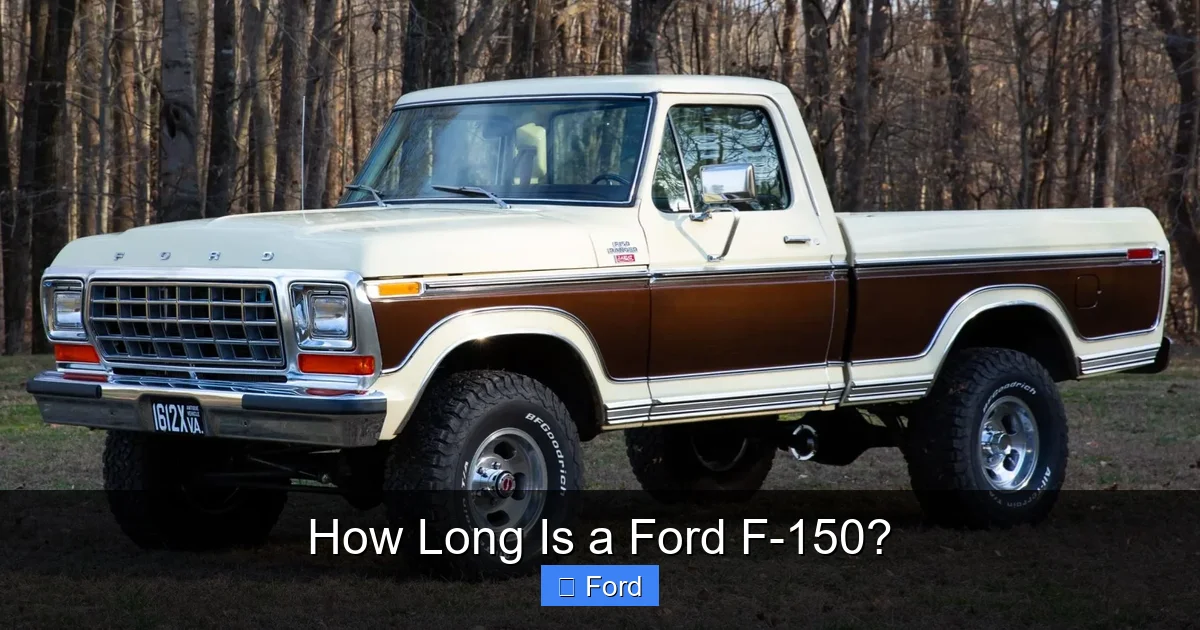
Visual guide about How Long Is a Ford F-150?
Image source: bringatrailer.com
- The Cab (Passenger Compartment): This is the part you sit in. Ford offers three main styles for the F-150: Regular Cab, SuperCab (extended cab), and SuperCrew (crew cab).
- The Bed (Cargo Box): This is the open cargo area in the back. For the F-150, you’ll typically choose from three lengths: 5.5-foot, 6.5-foot, and 8-foot.
These two choices are not completely independent. Ford pairs certain bed lengths with certain cab styles based on production and platform design. You cannot get an 8-foot bed with a SuperCrew cab, and you cannot get a 5.5-foot bed with a Regular Cab. This creates three main “configuration families.” Understanding these families is the key to unlocking the length puzzle.
The Three Configuration Families
Think of it like building blocks. Ford has three basic block combinations:
- Family 1: Regular Cab + 6.5′ or 8′ Bed This is the classic work truck. The smallest cab, paired with the two longest beds.
- Family 2: SuperCab + 5.5′ or 6.5′ Bed The middle-ground option. An extended cab with small rear jump seats, paired with the shorter or mid-length bed.
- Family 3: SuperCrew + 5.5′ or 6.5′ Bed The popular family and luxury choice. A full-size rear door and spacious back seat, paired with the shorter beds.
Within each family, the wheelbase (the distance between the front and rear axles) is the same. The bed length is what changes the total vehicle length. For example, a SuperCrew with a 6.5-foot bed is longer than a SuperCrew with a 5.5-foot bed because the cargo box itself is longer.
Breaking Down the Numbers: Lengths by Cab and Bed
Now, let’s get specific. We’ll focus on the most common and current generation (2015-Present) F-150s. Dimensions can vary slightly by model year (e.g., the 2021 refresh tweaked some lengths by an inch or two) and by drive type (4×2 vs. 4×4 adds a tiny bit of length to the front overhang). The following are approximate overall lengths for 4×2 models. Always verify exact specs for the precise year and trim you’re considering.
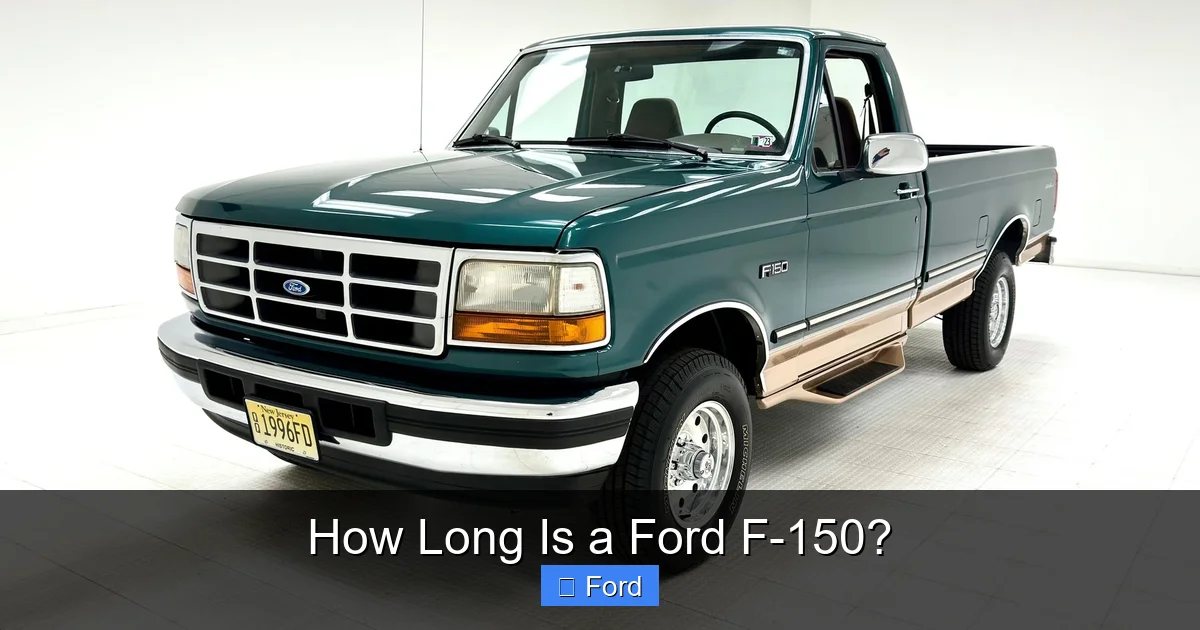
Visual guide about How Long Is a Ford F-150?
Image source: cdn.dealeraccelerate.com
Regular Cab Configurations
The Regular Cab is the shortest cab option, with no rear seats or very small jump seats behind the main row. Its strength is maximizing bed length in a shorter overall vehicle.
- Regular Cab + 6.5-Foot Bed: Overall length is approximately 210 to 213 inches (depending on year). Wheelbase is 126 inches. This is the shortest overall F-150 you can buy new today.
- Regular Cab + 8-Foot Bed: Overall length is approximately 231 to 234 inches. Wheelbase is a long 141.5 inches. This is the longest overall F-150 configuration, a true long-bed workhorse.
Real-World Example: The difference between these two Regular Cabs is about 21 inches, or nearly two feet, all coming from the extended bed behind the cab.
SuperCab Configurations
The SuperCab (often called an “extended cab”) features small rear-hinged doors and a small rear seating area with no full rear doors. It’s a good compromise for occasional passengers.
- SuperCab + 5.5-Foot Bed: Overall length is approximately 221 to 224 inches. Wheelbase is 144.6 inches. This is a very popular, maneuverable setup.
- SuperCab + 6.5-Foot Bed: Overall length is approximately 231 to 234 inches. Wheelbase is the long 163.7 inches. This gives you the mid-length bed with the extended cab space.
Key Insight: Notice that a SuperCab with a 6.5-foot bed is roughly the same overall length as a Regular Cab with an 8-foot bed. They share the same long wheelbase, but one has a huge bed and a tiny cab, while the other has a decent bed and a useful small cab.
SuperCrew Configurations
The SuperCrew is the full-size, four-door crew cab. It has four full-size doors and a spacious rear seat, making it the best choice for families and crews.
- SuperCrew + 5.5-Foot Bed: Overall length is approximately 231 to 234 inches. Wheelbase is 145.8 inches. This is the shortest wheelbase SuperCrew and a very common configuration.
- SuperCrew + 6.5-Foot Bed: Overall length is approximately 241 to 244 inches. Wheelbase is 164.1 inches. This is the longest SuperCrew, offering the best bed space in the crew cab lineup.
Important Note: The SuperCrew with a 6.5-foot bed is one of the longest F-150s overall. It rivals the length of the long-bed Regular Cab but gives you a massive, family-friendly interior.
How Length Impacts Your Real Life: Beyond the Spec Sheet
Knowing the inches is one thing. Understanding what those inches mean for your daily routine is what truly matters. The length of your F-150 will affect several practical considerations.
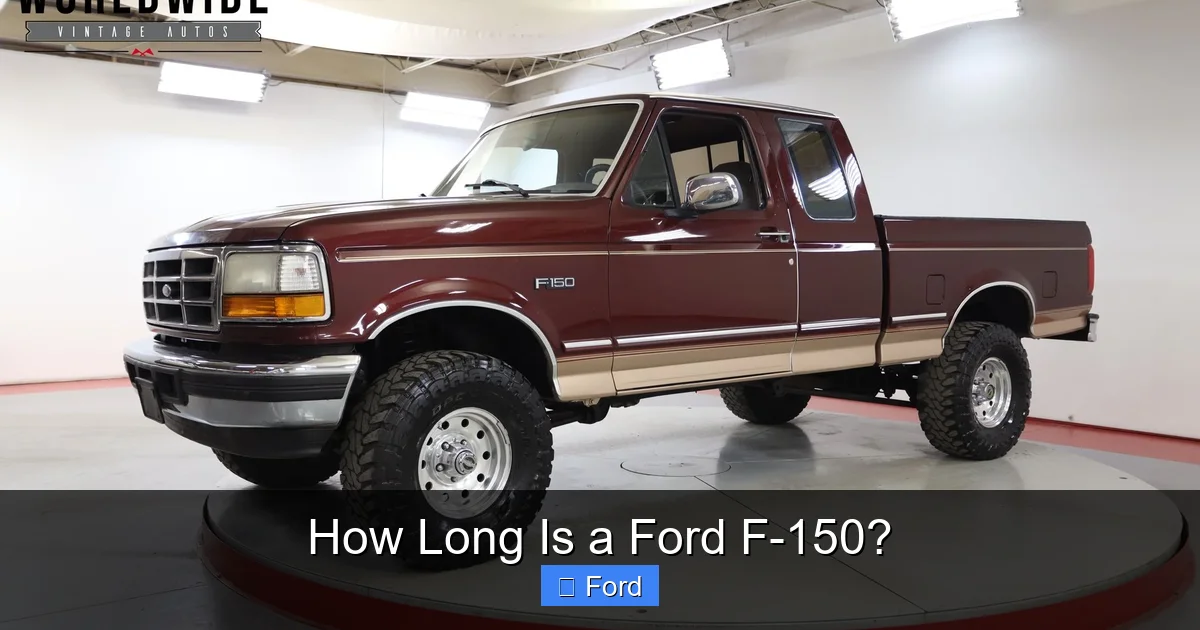
Visual guide about How Long Is a Ford F-150?
Image source: cdn.dealeraccelerate.com
Parking and Garage Fitment
This is the #1 concern for many buyers. A truck that’s 240+ inches long (20 feet!) will not fit in a standard single-car garage, which is typically 20-22 feet deep but requires clearance for opening doors. You must measure your specific parking space from the wall or bumper stop and leave at least 12-18 inches of clearance in front and behind for maneuvering. Remember to account for any protruding accessories like a bed rack or a large spare tire carrier mounted in the front or rear bumper. If you have a short driveway or park on the street, a shorter configuration like a SuperCab 5.5′ or Regular Cab 6.5′ will be far less stressful.
Maneuverability and Tight Spaces
A longer wheelbase generally means a larger turning circle. The long-wheelbase models (Regular Cab 8′, SuperCab 6.5′, SuperCrew 6.5′) will require more room to make a U-turn or navigate narrow city streets and tight parking lots. The shorter-wheelbase models (SuperCab 5.5′, SuperCrew 5.5′, Regular Cab 6.5′) are noticeably more agile and easier to handle in confined areas. If your driving is mostly urban or suburban with frequent tight turns, the shorter configurations are worth serious consideration. You can also check the manufacturer’s turning diameter spec, which is usually listed.
Cargo and Towing Capacity
Here’s the trade-off. A longer bed (8′ vs. 5.5′) gives you dramatically more room for cargo—think full-size lumber, motorcycles, or large recreational vehicles. However, the longer wheelbase of the long-bed truck often provides a slightly higher maximum tow rating because the hitch is farther from the rear axle, improving stability. But the difference in max tow ratings between a 5.5′ and 6.5′ bed SuperCrew is often minimal (sometimes just a few hundred pounds) compared to the huge gain in bed utility. For most, bed length should be chosen based on what you plan to *carry*, not what you plan to *tow*. For heavy towing, the engine, axle ratio, and frame are more critical factors than bed length alone.
Resale Value and Popularity
Market trends affect length choices. In recent years, the SuperCrew with a 5.5-foot or 6.5-foot bed has been the best-selling configuration. This means there’s a larger inventory of used trucks with these dimensions, which can help with resale value and selection. The Regular Cab, especially with the 8-foot bed, is a niche, fleet-oriented vehicle and may be harder to find on the used market and hold value differently. Consider your long-term plans.
Model Year Variations: Has the F-150 Grown?
Yes, slightly. The F-150 has gone through significant redesigns, and with each, dimensions can shift. Here’s a brief overview:
- 2009-2014 (12th Generation): These trucks are generally a few inches shorter overall than the current generation. A SuperCrew with a 6.5-foot bed was about 239 inches long. The cabs were also boxier.
- 2015-2020 (13th Generation): The major aluminum-body redesign. Lengths increased slightly for most configurations, with the SuperCrew 5.5′ coming in around 231 inches. Wheelbases were set as noted above.
- 2021-Present (14th Generation Refresh): The recent refresh made minor tweaks. Some lengths increased by 0.5 to 1 inch due to new front/rear styling. For example, a 2023 SuperCrew 5.5′ might be listed at 231.7 inches vs. 231.1 for a 2020. The differences are negligible for practical purposes but exist on the spec sheet.
Pro Tip: When comparing used trucks, always look up the exact “Overall Length” specification for that specific year, make, and cab/bed combo on a trusted source like Ford’s official archive or a reputable automotive database. Don’t assume a 2018 and a 2023 with the same cab and bed are identical in length.
Choosing Your Perfect Length: A Buyer’s Decision Tree
So, how do you decide? Follow this simple thought process:
- What is my primary cargo? If it’s long, bulky items (lumber, all-terrain vehicles, large equipment), the 8-foot bed is king, forcing you into a Regular Cab. If it’s pallets, furniture, or medium cargo, the 6.5-foot bed is the versatile sweet spot for most. If you rarely carry big cargo and prioritize back seat space, the 5.5-foot bed is fine.
- Who sits in my truck? Family of four or frequent rear passengers? SuperCrew is non-negotiable. Solo driver or occasional adult passengers? A SuperCab or even Regular Cab could work and will get you a longer bed for the same overall length.
- Where will I park? Measure your garage, driveway, and typical parking spots. If you have a short space or tight urban environment, prioritize the shortest overall length configurations (Regular Cab 6.5′, SuperCab 5.5′, SuperCrew 5.5′). If you have a long driveway or park outside, you have more flexibility.
- What is my budget? Shorter beds and larger cabs (SuperCrew) often command a slight premium over long-bed Regular Cabs. Consider the value of the interior space you’re getting.
Final Recommendation: For the vast majority of buyers who want a balance of passenger space and cargo utility, the SuperCrew with a 6.5-foot bed or the SuperCab with a 5.5-foot bed are the most popular and versatile choices. They offer a great blend of length, capability, and manageability.
The Bottom Line: It’s All About Your Needs
The Ford F-150’s length is not a static number; it’s a customizable feature. By understanding the relationship between cab style and bed length, you can predict the overall footprint of any truck you’re looking at. A 210-inch Regular Cab is a nimble workhorse. A 244-inch SuperCrew long-bed is a spacious, heavy-duty hauler. The “right” length is the one that fits your life—your cargo, your passengers, and your parking spot. Use the dimensions we’ve outlined as a starting point, but always, always take a tape measure to the exact truck you’re considering, both for the vehicle itself and for the spaces it needs to fit into. That physical measurement, combined with this knowledge, will ensure your F-150 purchase is a perfect fit.
Frequently Asked Questions
What is the shortest overall length for a new Ford F-150?
The shortest configuration is the Regular Cab with a 6.5-foot bed, measuring approximately 210-213 inches (around 17.5 feet) for recent model years. This setup prioritizes a compact footprint while still offering a useful bed length.
Can I get an 8-foot bed with a SuperCrew (four-door) cab?
No. Ford does not offer the 8-foot bed with the SuperCrew cab. The longest bed available for the SuperCrew is the 6.5-foot box. The 8-foot bed is exclusive to the Regular Cab configuration.
How much longer is a long-bed F-150 compared to a short-bed?
The difference between a 5.5-foot bed and an 8-foot bed in the same cab style (where available) is about 20 to 21 inches. This is almost entirely due to the extended length of the cargo box itself. However, you cannot directly compare a 5.5′ SuperCrew to an 8′ Regular Cab because they have different cabs and wheelbases.
Does a longer F-150 tow more?
Not necessarily. Maximum towing capacity is determined primarily by the engine, transmission, axle ratio, and frame. While a longer wheelbase can improve towing stability, the difference in max tow ratings between, say, a SuperCrew 5.5′ and a SuperCrew 6.5′ is usually minimal. Always check the specific tow rating for the exact configuration, not just the length.
My garage is 20 feet deep. Will a Ford F-150 fit?
It depends entirely on the configuration. A 20-foot (240-inch) garage is very tight. Many F-150 configurations (like a SuperCrew 6.5′ at ~241-244 inches) will not fit with any room to spare. You would likely only fit the shorter models like a SuperCrew 5.5′ (~231-234 inches) or a SuperCab 5.5′ (~221-224 inches) and even then, you must measure carefully from the inside wall to ensure you can open the garage door and have room to get in/out.
Has the F-150 gotten longer over the years?
Comparing the current generation (2015+) to the previous one (2009-2014), overall lengths are very similar, with the newer trucks perhaps a fraction of an inch longer in some configurations. The most significant change was the 2015 redesign’s shift to an aluminum body, which didn’t drastically alter external dimensions. The 2021 refresh made minor tweaks of an inch or less. The core configuration lengths (cab+bed combos) have been stable for about a decade.
