How Long Does a 2007 Toyota Camry Timing Chain Last?

Contents
- 1 Key Takeaways
- 2 📑 Table of Contents
- 3 Introduction: The Heartbeat of Your 2.4L or 3.5L V6
- 4 Timing Chain vs. Timing Belt: Why the 2007 Camry Got It Right
- 5 The Realistic Lifespan: What “Lifetime” Actually Means
- 6 Warning Signs: Listening to Your Camry’s Cry for Help
- 7 Maximizing Your Timing Chain’s Lifespan: Proactive Maintenance
- 8 The Replacement Process: What to Expect If It Fails
- 9 Conclusion: Peace of Mind Through Diligence
- 10 Frequently Asked Questions


The 2007 Toyota Camry’s timing chain is designed to last the life of the engine, often exceeding 200,000 miles with proper maintenance. However, neglect, low oil levels, or poor quality oil can cause premature wear and failure. Unlike timing belts, it’s not a scheduled replacement item, but vigilant oil changes and listening for unusual noises are crucial for prevention.
Key Takeaways
- Designed for “Lifetime”: Toyota engineered the 2007 Camry’s timing chain to last the engine’s life under normal conditions, typically 200,000+ miles.
- Oil is Everything: Clean, adequate oil at the correct pressure is the #1 factor for timing chain longevity. Skipping oil changes is the fastest path to failure.
- Listen for Symptoms: Ticking or rattling noises from the front of the engine, especially on cold starts, are the primary early warning sign of a failing chain or tensioner.
- Not a Scheduled Item: Unlike a timing belt, there is no factory-recommended mileage interval to replace the chain preemptively on a 2007 Camry.
- Failure is Catastrophic: If the chain skips or breaks on this interference engine, it will cause severe, often terminal, internal engine damage (bent valves, wrecked pistons).
- Tensioner & Guides Wear Too: The plastic guide rails and hydraulic tensioner can wear out or fail before the chain itself, causing excessive slack and noise.
- Costly Repair: Replacing a timing chain on a 2007 Camry is a major, labor-intensive job costing $1,500 – $3,000+ at a shop, as it requires disassembling much of the front of the engine.
📑 Table of Contents
- Introduction: The Heartbeat of Your 2.4L or 3.5L V6
- Timing Chain vs. Timing Belt: Why the 2007 Camry Got It Right
- The Realistic Lifespan: What “Lifetime” Actually Means
- Warning Signs: Listening to Your Camry’s Cry for Help
- Maximizing Your Timing Chain’s Lifespan: Proactive Maintenance
- The Replacement Process: What to Expect If It Fails
- Conclusion: Peace of Mind Through Diligence
Introduction: The Heartbeat of Your 2.4L or 3.5L V6
Under the hood of your trusted 2007 Toyota Camry lies a marvel of engineering: the timing chain. It’s the silent, relentless conductor ensuring your engine’s valves open and close in perfect sync with the pistons. For a car known for its bulletproof reliability, understanding this critical component is key to keeping your Camry running for decades. The big question on every owner’s mind is simple: how long does a 2007 Toyota Camry timing chain last? The official answer from Toyota is “the life of the engine.” But in the real world, what does that mean? Is it truly a “fit and forget” part, or a potential time bomb? This guide will cut through the noise, give you a realistic expectation, arm you with the warning signs, and provide the non-negotiable maintenance steps to help your timing chain—and your entire engine—reach that legendary 300,000-mile milestone.
We’ll dive into the key differences between a timing chain and a belt, why your 2007 Camry’s chain is generally robust, and the single biggest threat to its longevity. Whether you have the efficient 2.4L 4-cylinder (code: 2AZ-FE) or the smooth 3.5L V6 (code: 2GR-FE), the principles are the same. Let’s get into the nuts and bolts of it.
Timing Chain vs. Timing Belt: Why the 2007 Camry Got It Right
First, a quick lesson in terminology, because confusion here is common. A timing belt is made of rubber with reinforced fibers. It’s quieter but has a finite lifespan (typically 60,000-100,000 miles) and must be replaced periodically. A broken belt on an interference engine—like both engines in the 2007 Camry—means the pistons and valves collide, destroying the engine.
Visual guide about How Long Does a 2007 Toyota Camry Timing Chain Last?
Image source: i.ytimg.com
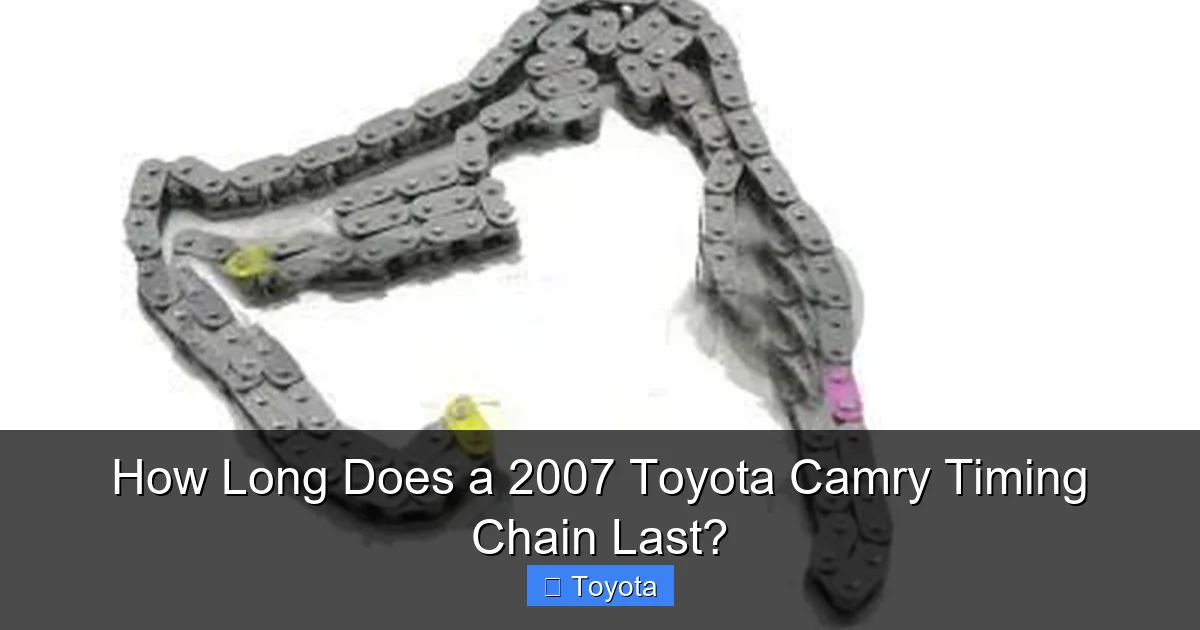
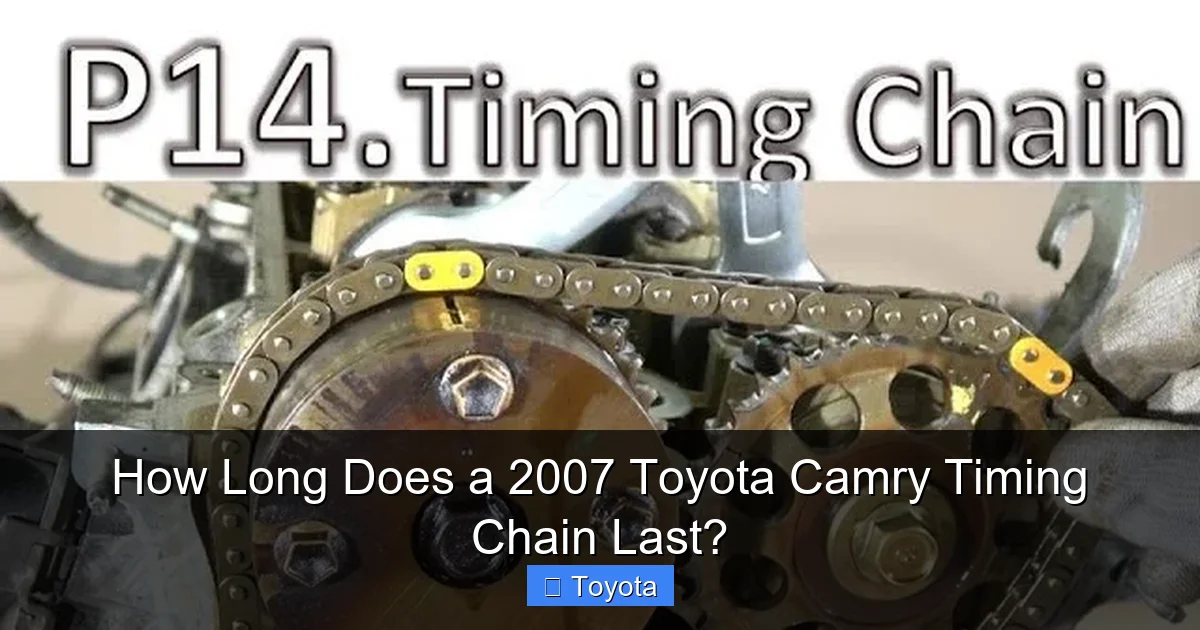
A timing chain, by contrast, is a metal link chain, similar to a bicycle chain but far more robust. It runs inside the engine, lubricated by engine oil. The 2007 Camry uses this chain. The perceived advantage is “lifetime” durability. But “lifetime” in an engineering context means the designed service life of the vehicle under ideal conditions. In your driveway, that translates to: it should last as long as you maintain the engine properly. The chain itself is incredibly strong. The weak points are often the components that guide and tension it: the plastic guide rails and the hydraulic tensioner. These parts can degrade over hundreds of thousands of miles.
The Interference Engine Reality
It’s crucial to understand that both the 2AZ-FE and 2GR-FE engines in your 2007 Camry are interference engines. This means there is not enough clearance between the pistons and the valves if the timing is off. If the chain fails or jumps a tooth, the piston will smash into the open valve. The result is bent valves, damaged pistons, and a cylinder head that needs to be rebuilt or replaced—a repair that often exceeds the car’s value. This is why timing chain health is not a “maybe” issue; it’s a fundamental to your Camry’s survival.
The Realistic Lifespan: What “Lifetime” Actually Means
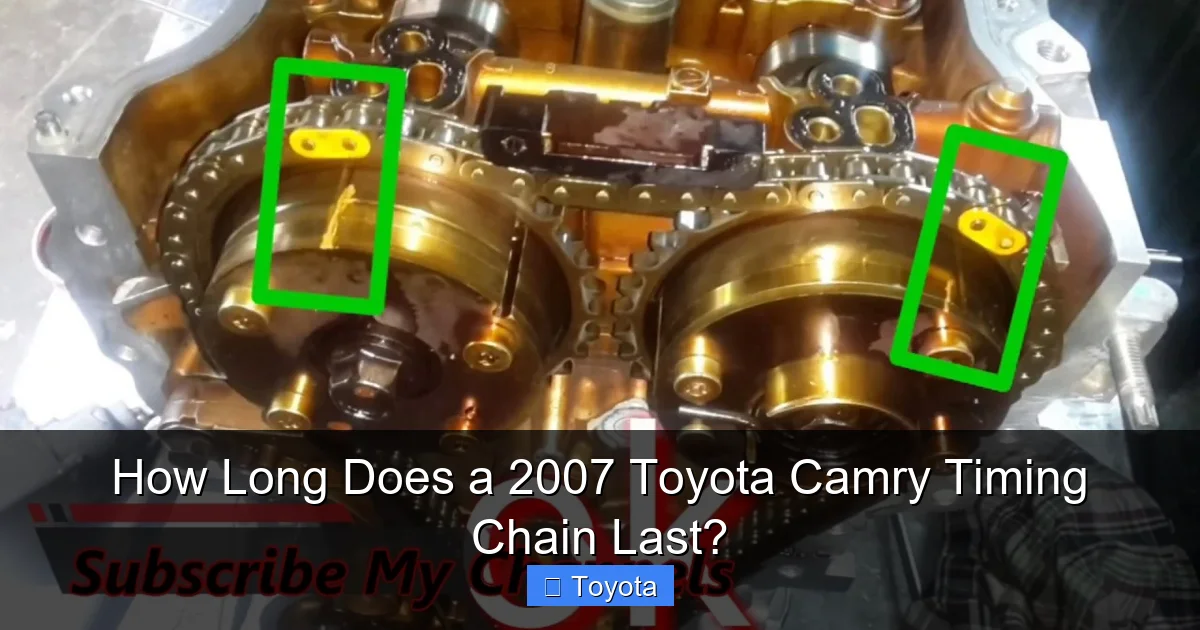
So, let’s put a number on it. While there’s no set mileage, the collective experience of mechanics and high-mileage Camry owners points to a clear pattern. A well-maintained 2007 Camry timing chain and its associated components (tensioner, guides) can easily last 200,000 to 300,000 miles, and often more. There are documented cases of original timing chains still working perfectly at 400,000+ miles. This is a testament to Toyota’s design and the quality of materials used.
Visual guide about How Long Does a 2007 Toyota Camry Timing Chain Last?
Image source: i.ytimg.com
However, this is the best-case scenario. The realistic expectation for an average, well-cared-for vehicle is 150,000-250,000 miles. The variables that determine where your Camry falls on that spectrum are almost entirely within your control as the owner. The primary determinant is, without question, engine oil maintenance.
The Engine Oil Connection: Your #1 Defense
Think of your engine oil as the lifeblood for the timing chain. It provides lubrication, reduces friction, and carries away tiny metal particles. The chain tensioner itself is hydraulic, meaning it uses oil pressure to maintain correct tension. Low oil level, dirty oil, or the wrong oil viscosity directly attacks the timing chain system.
- Low Oil Level: This is the fastest way to cause damage. Without enough oil, the chain and tensioner can run dry, causing rapid wear and potential tensioner failure.
- Extended Oil Change Intervals: Modern synthetic oils are amazing, but they still break down. When oil degrades, it loses its lubricity and becomes acidic. This abrasive, acidic sludge accelerates wear on the chain links and, more critically, on the plastic guide rails, which can become brittle and crack.
- Wrong Oil Viscosity: Using oil that is too thin (e.g., 0W-20 instead of recommended 5W-30 for high-mileage climates) may not maintain a sufficient protective film under high stress and heat. The tensioner relies on proper oil pressure, which is viscosity-dependent.
For your 2007 Camry, Toyota’s original recommendation was likely 5W-30. For high-mileage engines, a high-quality 5W-30 or even a 10W-30 synthetic is often recommended by mechanics to maintain better film strength. Sticking to a strict oil change schedule—every 5,000 to 7,500 miles with a quality filter—is the single most important thing you can do for your timing chain. If you’re unsure about your maintenance history, checking the oil level monthly and noting its color and smell is a good habit. Dark, gritty, or burnt-smelling oil is a red flag.
Warning Signs: Listening to Your Camry’s Cry for Help
Your 2007 Camry will give you warnings before a catastrophic failure. These symptoms usually start subtly and worsen over time. Catching them early can save you from a $3,000+ engine rebuild.
Visual guide about How Long Does a 2007 Toyota Camry Timing Chain Last?
Image source: i.ytimg.com
The Classic “Cold Start Rattle”
The most common and tell-tale sign is a distinct rattling or ticking noise from the front, top of the engine that lasts for 1-3 seconds after a cold start (first start of the day or after the engine has sat for hours). This noise is almost always the timing chain slapping against the tensioner or guides because oil pressure hasn’t built up yet to fully tension the chain. As the engine warms and oil circulates, the noise should disappear completely. If it goes away after a few seconds, it’s a strong indicator of a worn tensioner or stretched chain. If the noise persists after warm-up, the problem is severe.
Persistent Ticking or Rattling
Any ongoing metallic ticking, slapping, or rattling noise from the timing cover area (the front metal cover behind the serpentine belt) that is present at all RPMs and doesn’t go away is a major red flag. This means the chain has excessive slack, likely from a failed tensioner or severely stretched links. You might also hear this noise change with engine speed (RPM).
Poor Performance & Check Engine Light
A timing chain that has stretched significantly can cause the engine’s computer (ECU) to detect misalignment between the crankshaft and camshaft position sensors. This triggers a P0016, P0017, P0018, or P0019 code (Crankshaft Position – Camshaft Position Correlation). Symptoms can include rough idle, hesitation, reduced power, and poor fuel economy. A flashing Check Engine Light accompanied by severe misfires is an emergency—stop driving immediately.
Visual Inspection: The Mechanic’s Perspective
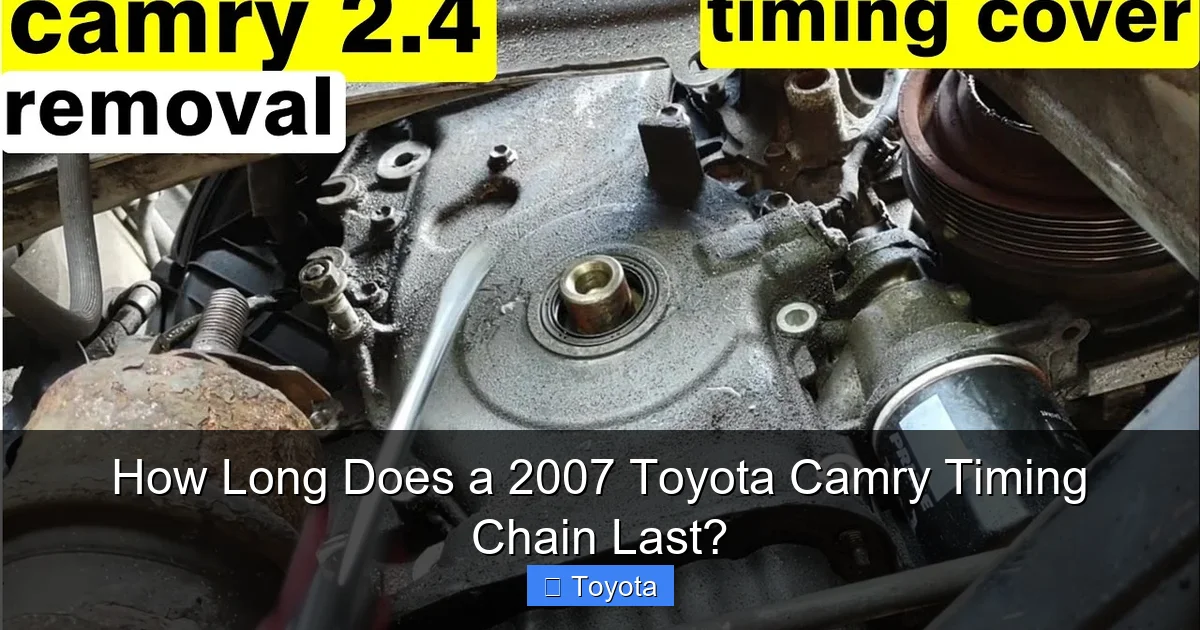
A definitive diagnosis often requires a mechanic to remove the timing cover (a 5-8 hour job). They look for:
- Chain Stretch: Measuring the chain against specifications.
- Guide Rail Condition: Checking for cracks, excessive wear, or missing chunks of plastic.
- Tensioner Failure: The tensioner piston may be fully extended (failed) or the oil hole may be clogged.
- Metal Debris: Finding shiny metal shavings in the oil pan during a drain is a catastrophic sign of imminent failure.
If you hear the cold start rattle, get it diagnosed. Don’t wait for the noise to get louder.
Maximizing Your Timing Chain’s Lifespan: Proactive Maintenance
You are the guardian of your Camry’s timing chain. Here is your actionable checklist to maximize its life, which also benefits your entire engine.
1. Oil Changes: Non-Negotiable
This cannot be stressed enough. Use a high-quality oil that meets Toyota’s specifications (look for API SP and ILSAC GF-6). A full synthetic oil is highly recommended for its superior high-temperature stability and lubricity. Change the oil and filter every 5,000-7,500 miles, or at least once a year. If you do mostly short trips, change it more frequently. Use a high-quality oil filter (OEM Toyota, WIX, Mobil 1, K&N). A cheap filter can allow larger particles to circulate, accelerating wear. Proper oil maintenance also protects other critical components; for instance, knowing how long a Toyota alternator lasts is also tied to the health of the serpentine belt system, which relies on proper tension and condition.
2. Never Ignore Oil Level or Leaks
Check your oil level at least once a month with the engine cold and on level ground. If it’s low, find and fix the leak immediately. Common leak points on high-mileage 2AZ-FE engines include the valve cover gaskets and the oil pump cover. A slowly burning engine due to worn piston rings (common on these engines) will also lower oil level over time. Letting it run low even once can be the beginning of the end for your timing chain.
3. Warm Up Gently, Cool Down
While modern engines don’t need a long warm-up, avoiding heavy acceleration until the oil is fully warm (after the first minute or two of driving) is wise. This allows oil to reach full pressure and temperature, providing optimal lubrication to the chain and tensioner. Similarly, after hard driving (like highway merging or mountain driving), let the engine idle for 30-60 seconds before shutting off. This allows the turbo (if equipped, not on base Camry) and the timing chain area to cool down gradually, preventing oil coking in the tensioner.
4. Address Other Related Maintenance
The timing chain system doesn’t exist in a vacuum. A failing serpentine belt or tensioner can cause belt flutter and vibration that may, over extreme time, affect the timing cover and its components. While not a direct cause, keeping the entire front-end accessory drive system in good shape is part of holistic engine care. Understanding how long a Toyota serpentine belt lasts helps you plan for this related maintenance.
The Replacement Process: What to Expect If It Fails
If diagnosis confirms a worn timing chain, tensioner, or guides, replacement is not a simple DIY job for the vast majority of people. It is a major engine repair.
Labor-Intensive Procedure
The timing cover must be removed. On the 2.4L, this often involves removing the power steering pump, alternator, and other front-mounted accessories. On the V6, it’s a significant job. The mechanic must then lock the engine in time using special tools, remove the old chain, tensioner, and guides, and install new ones. The entire front of the engine is exposed. This is why labor costs are so high—it can easily take 8-12 hours for an experienced technician.
Parts Cost vs. Engine Replacement
A quality timing chain kit (chain, tensioner, guides) for a 2007 Camry typically costs $300-$600 from OEM or premium aftermarket brands (like Aisin, Cloyes). The massive cost is all labor. A dealer or reputable independent shop will charge $1,500 – $3,000+ for the full job, depending on your location and shop rates. This is why prevention through oil changes is so valuable. For a car that might be worth $4,000-$6,000, this repair is a tough financial decision. It’s often more economical to replace the engine with a used or remanufactured unit, but that’s a different can of worms.
The “While You’re In There” Opportunity
Since the front of the engine is wide open, a smart mechanic (and a wise owner) will consider replacing other wear items at the same time to save on future labor. These include:
- The water pump (driven by the timing chain on the 2.4L).
- The front crank seal and cam seals (which are accessible).
- The serpentine belt and tensioner.
- Spark plugs (on the 2.4L, they are under the valve cover, which is removed anyway).
Spending an extra $200-$400 on these parts while the labor is already being done is a very smart hedge against future breakdowns. It also ties into other maintenance queries, like how much oil a 2011 Toyota Camry takes—knowing your specific engine’s capacity is part of being an informed owner, even for a 2007 model.
Conclusion: Peace of Mind Through Diligence
So, how long does a 2007 Toyota Camry timing chain last? The truthful answer is: as long as you treat it right. Toyota built it to be a lifetime part, but that lifetime is heavily dependent on your maintenance habits, primarily your unwavering commitment to clean, adequate engine oil. For the thousands of Camry owners cruising past 250,000 miles with their original timing chains chugging along silently, the secret isn’t magic—it’s consistent, quality oil changes and never ignoring a low oil level.
Your 2007 Camry is a fantastic, reliable car that can serve you for many more years. The timing chain is its most critical internal component. By listening for the cold-start rattle, checking your oil religiously, and adhering to a strict synthetic oil change interval, you are doing everything in your power to ensure that the answer to “how long does it last?” for your specific car is a resounding “as long as I own it.” If you hear noises, don’t procrastinate. Get a professional diagnosis. The cost of a timely repair is a fraction of the cost of a ruined engine. Treat your Camry’s heart with respect, and it will reward you with countless miles of trouble-free driving.
Frequently Asked Questions
Can I visually inspect the timing chain myself on a 2007 Camry?
No. The timing chain is hidden inside the engine behind the timing cover. A proper inspection requires a mechanic to remove this cover, which is a major job. Your best “visual” check is to monitor your oil level and condition monthly and listen for any unusual noises.
Is the 2007 Camry 2.4L engine more prone to timing chain issues than the V6?
There is no widespread evidence that one engine is significantly more prone than the other. Both the 2AZ-FE (4-cylinder) and 2GR-FE (V6) are known for robust timing chains when maintained. However, the 2.4L has a separate issue with oil consumption (burning oil) on some models, which can lead to low oil levels and indirectly threaten the chain if not monitored.
What happens if my timing chain breaks while driving?
Catastrophic engine failure. Since it’s an interference engine, the pistons will collide with the valves. This will bend or break valves, damage pistons and cylinder heads, and likely send debris through the engine. The repair will be a full engine rebuild or replacement, which is often not economically feasible for a 2007 model.
Should I replace the timing chain preventively at 150,000 miles?
There is no factory-recommended preventative replacement interval. If your car has a perfect maintenance history, no noises, and good oil consumption, you can likely leave it. However, if you are buying a used 2007 Camry with unknown history, a pre-purchase inspection that includes a timing chain assessment (listening test, possibly a scope) is highly advisable. Some owners opt for replacement at 200k+ miles as a major service item for long-term peace of mind.
Does using synthetic oil extend the timing chain’s life?
Yes, absolutely. High-quality full synthetic oil has better lubricity, resists breakdown longer, and maintains its protective properties better under extreme heat and shear stress than conventional oil. This directly benefits the timing chain, tensioner, and guides. It is the best choice for any high-mileage engine.
My 2007 Camry has 180,000 miles and runs perfectly. Should I be worried?
Not if you have a consistent record of oil changes and no symptoms. A quiet engine with no warning lights and normal oil consumption is your best indicator. Continue your diligent maintenance. If you want ultimate peace of mind, you could budget for a timing chain replacement as a planned major service, but it’s not an emergency if all is well. Just stay vigilant for that cold-start rattle.