
How Long Do Toyota Tpms Sensors Last?

Toyota TPMS sensors usually last between 5 and 10 years, depending on driving conditions, climate, and battery life. While they’re built to be durable, factors like extreme temperatures, road salt, and battery degradation can shorten their lifespan. Regular maintenance and timely replacements help ensure your tire pressure monitoring system works reliably.
If you’ve ever driven a Toyota—whether it’s a reliable Camry, a rugged Tacoma, or a family-friendly RAV4—you’ve probably noticed that little tire pressure warning light on your dashboard. That’s your Tire Pressure Monitoring System (TPMS) doing its job. But have you ever wondered how long those tiny sensors inside your wheels actually last?
TPMS sensors are small but mighty. They constantly monitor the air pressure in each tire and send real-time data to your vehicle’s computer. When pressure drops below a safe level—usually 25% under the recommended PSI—the system triggers a warning light to alert you. This isn’t just about convenience; it’s a critical safety feature that helps prevent blowouts, improves fuel efficiency, and extends tire life.
But like any electronic component, TPMS sensors don’t last forever. Over time, their internal batteries wear out, seals degrade, and exposure to harsh conditions takes its toll. So, how long do Toyota TPMS sensors last? The short answer is 5 to 10 years. But the real story is a bit more nuanced. In this guide, we’ll break down everything you need to know about the lifespan of Toyota TPMS sensors—what affects it, how to spot trouble early, and what you can do to get the most out of them.
Whether you’re a longtime Toyota owner or just considering one, understanding your TPMS system is key to safe, efficient driving. Let’s dive in.
Key Takeaways
- Typical Lifespan: Most Toyota TPMS sensors last 5 to 10 years before needing replacement.
- Battery Life is Key: The internal lithium battery powers the sensor and cannot be replaced—once it dies, the whole unit must be swapped.
- Climate Matters: Extreme heat or cold can accelerate battery drain and sensor wear.
- Warning Signs: A flashing TPMS light, inaccurate readings, or no signal from one tire often indicates a failing sensor.
- Replacement Cost: Expect to pay $50–$150 per sensor, plus labor if done at a dealership or shop.
- Preventive Care: Regular tire rotations and avoiding potholes can help extend sensor life.
- Reset After Service: Always reset the TPMS after tire changes or rotations to maintain accuracy.
📑 Table of Contents
- What Are Toyota TPMS Sensors and How Do They Work?
- How Long Do Toyota TPMS Sensors Last? The Real Answer
- Signs Your Toyota TPMS Sensor Is Failing
- Factors That Can Shorten TPMS Sensor Lifespan
- How to Extend the Life of Your Toyota TPMS Sensors
- Replacing Toyota TPMS Sensors: What You Need to Know
- Conclusion
What Are Toyota TPMS Sensors and How Do They Work?
Before we talk about how long they last, let’s make sure we’re on the same page about what TPMS sensors actually are and how they function in your Toyota.
TPMS stands for Tire Pressure Monitoring System. It’s a federally mandated safety feature in all vehicles sold in the U.S. since 2008. Toyota, like other automakers, installs TPMS sensors in each wheel to monitor tire pressure continuously.
There are two main types of TPMS: direct and indirect. Toyota uses the **direct TPMS** system, which means each wheel has its own physical sensor mounted inside the tire, usually attached to the valve stem or wheel rim. These sensors measure the actual air pressure (and sometimes temperature) inside the tire and transmit that data wirelessly to your vehicle’s onboard computer.
Here’s how it works in simple terms:
– Each sensor has a small battery-powered transmitter.
– It sends pressure readings to a central receiver in the car.
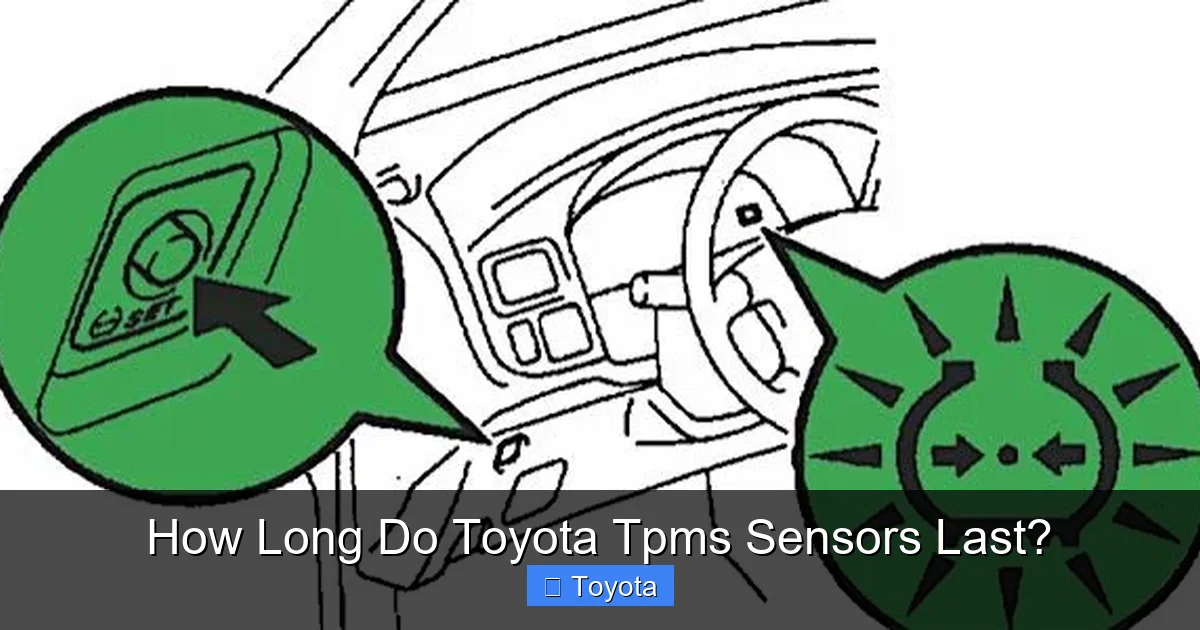
– If pressure drops too low, the system triggers a warning light on your dashboard—usually a yellow icon that looks like a tire cross-section with an exclamation point.
Some newer Toyota models also display real-time pressure readings for each tire right on the instrument cluster or infotainment screen. That’s thanks to the direct TPMS system’s precision.
The sensors are built to be durable. They’re sealed units designed to withstand the harsh environment inside a spinning wheel—exposure to moisture, dirt, road salt, and temperature swings. But they’re not invincible. Over time, the battery inside each sensor will eventually die, and that’s usually what ends their usable life.
Direct vs. Indirect TPMS: Why Toyota Uses Direct Sensors
You might wonder why Toyota doesn’t use the indirect TPMS system, which relies on wheel speed sensors (like those used in ABS) to detect underinflated tires. The reason is accuracy.
Indirect TPMS can’t tell you the exact pressure in each tire. It only notices when one tire is rotating faster than the others—a sign it might be underinflated. But it can’t confirm the pressure, and it often gives false alerts after tire rotations or changes in driving conditions.
Direct TPMS, on the other hand, gives precise, real-time readings. That’s why Toyota—and most modern automakers—opt for direct sensors. They’re more reliable, offer better driver feedback, and meet stricter safety standards.
Where Are the Sensors Located?
In most Toyota vehicles, the TPMS sensors are mounted inside the wheel, attached to the valve stem. When you remove the tire for service, you’ll see a small, cylindrical or disc-shaped unit screwed onto the stem. It’s usually made of plastic or metal and sealed to prevent moisture from getting in.
Some older or performance-oriented Toyotas may use banded sensors, which are secured to the wheel with a metal band instead of the valve stem. But valve-mounted sensors are far more common.
It’s important to note that these sensors are not part of the tire itself—they’re separate components. That means when you replace your tires, the sensors usually stay with the wheels (unless you’re switching to a new set of rims).
How Long Do Toyota TPMS Sensors Last? The Real Answer

Visual guide about How Long Do Toyota Tpms Sensors Last?
Image source: themegavehicle.com
Now for the big question: How long do Toyota TPMS sensors last?
The general consensus among mechanics, Toyota service centers, and automotive experts is that **most TPMS sensors last between 5 and 10 years**. That’s a pretty wide range, and there’s a good reason for that—lifespan depends on several factors.
Let’s break it down.
Battery Life: The Main Limiting Factor
The biggest reason TPMS sensors fail is the battery. Each sensor contains a small lithium battery that powers the transmitter. These batteries are not rechargeable and cannot be replaced. Once the battery dies, the sensor stops sending signals, and your TPMS light will likely come on.
Most manufacturers design these batteries to last around 7 to 10 years. However, real-world performance varies. Some sensors may start failing as early as 5 years, especially if they’re exposed to extreme conditions.
For example, if you live in a hot climate like Arizona or Texas, the heat can accelerate battery degradation. Similarly, if you drive in cold regions like Minnesota or Colorado, the cold can reduce battery efficiency over time.
Driving Habits and Mileage
How you drive also plays a role. If you put a lot of miles on your Toyota—say, 15,000 to 20,000 miles per year—your sensors may wear out faster simply because they’re transmitting data more frequently.
Frequent short trips can also be tough on sensors. Unlike long highway drives, short trips don’t allow the sensors to fully “wake up” and transmit data efficiently. Over time, this can lead to inconsistent performance.
On the flip side, if you drive conservatively, avoid potholes, and keep your tires properly inflated, your sensors are more likely to last closer to the 10-year mark.
Environmental Factors
Your local environment has a big impact on sensor longevity. Here are a few key factors:
– **Extreme Temperatures:** Heat and cold stress the battery and internal electronics. In hot climates, the battery drains faster. In cold climates, the sensor may struggle to transmit signals.
– **Road Salt and Moisture:** If you live in an area that uses road salt in winter, the salt can corrode the sensor housing or valve stem, leading to leaks or electrical issues.
– **Dirt and Debris:** Off-road driving or driving on gravel roads can expose sensors to more dirt and vibration, which may shorten their life.
Quality of Installation and Maintenance
How the sensors were originally installed—and how well they’ve been maintained—also matters. If a sensor was damaged during tire mounting or if the valve stem wasn’t properly sealed, it could fail prematurely.
Regular tire rotations and inspections can help catch issues early. For example, if a sensor is loose or showing signs of corrosion, a mechanic can address it before it fails completely.
Real-World Examples
Let’s look at a few real-world scenarios:
– **Case 1:** A 2014 Toyota Camry with 90,000 miles. The owner lives in Florida (hot, humid climate). The TPMS light came on after 6 years. Diagnosis: Battery failure in the front passenger sensor. Replaced for $120 at a local shop.
– **Case 2:** A 2016 Toyota Tacoma with 60,000 miles. Owner drives mostly on highways in Colorado (cold winters, moderate summers). After 8 years, all four sensors are still working fine.
– **Case 3:** A 2012 Toyota Highlander with 110,000 miles. Owner lives in Michigan (cold, salty roads). After 7 years, two sensors failed due to corrosion. Replaced during a tire change.
These examples show that while 5–10 years is a good rule of thumb, your experience may vary.
Signs Your Toyota TPMS Sensor Is Failing

Visual guide about How Long Do Toyota Tpms Sensors Last?
Image source: themegavehicle.com
Knowing when a TPMS sensor is on its last legs can save you from a sudden warning light or unsafe driving conditions. Here are the most common signs that your sensor might be failing:
The TPMS Light Stays On or Flashes
This is the most obvious sign. If the TPMS warning light comes on and stays on, it usually means one or more tires are underinflated. But if the light flashes for about a minute when you start the car and then stays on, that’s a strong indicator of a sensor malfunction.
A flashing light often means the vehicle’s computer isn’t receiving a signal from one or more sensors—likely because the battery is dead or the sensor is damaged.
Inaccurate or Missing Readings
On Toyota models with a digital TPMS display, you might notice that one tire shows “—” or “LO” instead of a pressure reading. Or the reading might be way off—like showing 10 PSI when the tire is actually at 32 PSI.
This usually means the sensor isn’t transmitting data correctly. It could be a low battery, interference, or physical damage.
Intermittent Warnings
Sometimes the TPMS light comes on randomly—especially after driving over bumps or potholes. This could mean the sensor is loose, the battery is weak, or there’s a temporary signal loss.
If the light goes off after a few minutes, it might not be a serious issue. But if it keeps coming back, it’s time to get it checked.
Slow Response After Inflating Tires
After you add air to a tire, the TPMS system should update within a few minutes of driving. If the light stays on long after you’ve inflated the tire, the sensor might not be responding properly.
This is especially common in cold weather, when sensors take longer to “wake up.” But if it happens consistently, it’s a red flag.
Physical Damage or Corrosion
If you’re getting new tires or having your wheels serviced, ask the technician to inspect the sensors. Look for:
– Cracks in the sensor housing
– Corrosion around the valve stem
– Loose or wobbly sensors
– Moisture inside the sensor (a sign of seal failure)
Even small cracks can let in moisture, which can short-circuit the electronics.
Age of the Vehicle
If your Toyota is 7 years or older, it’s a good idea to start monitoring the TPMS system more closely. Sensors from that era are nearing the end of their expected lifespan, especially if the car has high mileage.
Factors That Can Shorten TPMS Sensor Lifespan
Visual guide about How Long Do Toyota Tpms Sensors Last?
Image source: s19526.pcdn.co
While TPMS sensors are designed to last, certain conditions can wear them out faster. Here’s what to watch out for:
Extreme Weather Conditions
Heat is one of the biggest enemies of lithium batteries. In hot climates, the battery inside the sensor can degrade faster. Studies show that batteries in high-temperature environments can lose capacity up to 20% faster than those in moderate climates.
Cold weather isn’t much better. While lithium batteries can function in freezing temps, their performance drops. In very cold conditions, the sensor may not transmit data as frequently or reliably.
If you live in an area with extreme temperatures, consider having your sensors inspected more often—especially as they approach the 5-year mark.
Road Salt and Corrosion
In northern states, road salt is used to melt ice and snow. While it keeps roads safe, it’s harsh on vehicle components—including TPMS sensors.
Salt can corrode the metal parts of the sensor, especially the valve stem and mounting hardware. Over time, this corrosion can cause leaks or electrical failures.
To reduce risk, rinse your wheels regularly in the winter, especially after driving on salted roads. Some owners also apply a protective coating to the valve stems.
Potholes and Rough Roads
Hitting potholes, curbs, or rough terrain can physically damage TPMS sensors. The impact can crack the housing, loosen the sensor, or damage the internal electronics.
If you frequently drive on poor roads, inspect your sensors during tire rotations. Look for signs of impact or stress.
Improper Tire Service
When tires are removed and reinstalled, the TPMS sensors can be damaged if the technician isn’t careful. For example:
– Using the wrong tools to remove the valve core
– Over-tightening the sensor
– Damaging the sensor during tire mounting
Always choose a reputable shop with experience in TPMS service. Many modern tire shops have TPMS-specific tools and training.
Low-Quality Aftermarket Sensors
If you’ve had a sensor replaced in the past, make sure it was a high-quality unit. Some aftermarket sensors are cheaper but use lower-grade batteries or materials. They may fail in just 2–3 years.
Stick with OEM (Original Equipment Manufacturer) sensors or reputable brands like Schrader, Denso, or Huf. These are more likely to match Toyota’s original specs and last longer.
How to Extend the Life of Your Toyota TPMS Sensors
While you can’t stop the battery from eventually dying, there are steps you can take to maximize the lifespan of your TPMS sensors.
Maintain Proper Tire Pressure
One of the best things you can do is keep your tires properly inflated. Underinflated tires put extra stress on the sensors and can cause them to overheat or fail prematurely.
Check your tire pressure at least once a month—and always before long trips. Use a reliable gauge and follow the PSI recommendation in your owner’s manual or on the driver’s door jamb sticker.
Rotate Your Tires Regularly
Most Toyota models recommend tire rotations every 5,000 to 7,500 miles. Rotating your tires helps ensure even wear and gives technicians a chance to inspect the sensors.
During a rotation, the technician can check for:
– Sensor tightness
– Valve stem condition
– Signs of corrosion or damage
They can also relearn the sensor positions if needed (more on that below).
Avoid Potholes and Rough Roads
It’s easier said than done, but try to avoid potholes, curbs, and uneven pavement when possible. These impacts can damage sensors over time.
If you live in an area with poor roads, consider upgrading to stronger wheels or tires with reinforced sidewalls.
Keep Wheels Clean
Wash your wheels regularly, especially in winter. Use a mild soap and avoid harsh chemicals that can degrade rubber or plastic components.
Rinse thoroughly to remove salt, dirt, and grime. Pay special attention to the valve stem area.
Use a TPMS Reset Tool (If Needed)
After tire rotations, replacements, or sensor replacements, your Toyota’s TPMS system may need to be reset. This process, called “relearning,” tells the car which sensor is in which position.
Some Toyotas can reset automatically after driving a short distance. Others require a TPMS reset tool or a visit to the dealership.
If your TPMS light comes on after a tire service, don’t ignore it—get it reset to avoid false warnings.
Consider Sensor Upgrades (For Older Vehicles)
If your Toyota is nearing 10 years old, you might consider proactively replacing the sensors—even if they’re still working. This can prevent unexpected failures and ensure your TPMS system remains reliable.
Some owners also upgrade to sensors with longer-life batteries or better signal strength. Just make sure they’re compatible with your Toyota model.
Replacing Toyota TPMS Sensors: What You Need to Know
When a TPMS sensor fails, it needs to be replaced—not repaired. Here’s what to expect:
Cost of Replacement
The cost varies depending on whether you go to a dealership, independent shop, or do it yourself.
– **Sensor Cost:** $50–$150 per sensor (OEM sensors are more expensive but more reliable)
– **Labor Cost:** $20–$50 per wheel (if done at a shop)
– **TPMS Relearn:** Often included, but some shops charge $20–$50 extra
So, replacing one sensor might cost $70–$200. Replacing all four could run $300–$800.
DIY vs. Professional Installation
Replacing a TPMS sensor isn’t impossible, but it’s not for everyone. You’ll need:
– A TPMS tool to program the new sensor
– A tire machine to remove the tire
– Knowledge of your vehicle’s relearn procedure
Most people are better off letting a professional handle it. They have the tools and experience to do it quickly and correctly.
Relearn Procedure
After replacing a sensor, the vehicle must “learn” the new sensor’s ID. This is done through a relearn procedure, which varies by Toyota model.
Some models use a magnet or tool to trigger the relearn mode. Others require a scan tool. Check your owner’s manual or consult a technician.
Can You Replace Just One Sensor?
Yes—you don’t need to replace all four sensors at once. However, if one has failed, the others may not be far behind, especially if the car is 7+ years old.
Some owners choose to replace all four at the same time to avoid future headaches. It’s more expensive upfront but can save money in the long run.
Conclusion
So, how long do Toyota TPMS sensors last? The answer is 5 to 10 years—but that’s just the starting point. Your driving habits, climate, and maintenance routine all play a role in how long they’ll actually last.
These small sensors are essential for safety, fuel efficiency, and tire longevity. By understanding how they work, recognizing the signs of failure, and taking steps to care for them, you can get the most out of your Toyota’s TPMS system.
Don’t wait for the warning light to come on. Be proactive. Check your tire pressure regularly, inspect your sensors during service, and replace them when needed. Your safety—and your peace of mind—are worth it.
Frequently Asked Questions
How often should I check my Toyota’s tire pressure?
You should check your tire pressure at least once a month and before long trips. Use a reliable gauge and follow the PSI recommendation on your door jamb sticker.
Can I drive with a faulty TPMS sensor?
Yes, but it’s not recommended. A faulty sensor means you won’t get accurate pressure warnings, which could lead to underinflated tires and safety risks.
Do I need to replace all four TPMS sensors at once?
No, you can replace just the failed sensor. However, if your Toyota is over 7 years old, consider replacing all four to avoid future issues.
Will a dead TPMS sensor affect my car’s performance?
Not directly. The car will still run fine, but you won’t receive low-pressure alerts, which could compromise safety and fuel efficiency.
Can I replace a TPMS sensor myself?
It’s possible with the right tools and knowledge, but most people are better off having a professional do it to ensure proper installation and relearn.
Do TPMS sensors work with aftermarket wheels?
Yes, but you may need to transfer the sensors or install new ones compatible with the new wheels. Some aftermarket wheels require specific valve stems or mounting methods.
