
How Fast Can an F1 Car Go?

F1 cars are among the fastest racing machines on Earth, reaching top speeds over 370 km/h (230 mph) on long straights. Their blistering acceleration, advanced aerodynamics, and hybrid power units make them engineering marvels built for speed, precision, and performance.
Key Takeaways
- Top speed exceeds 370 km/h (230 mph): F1 cars can hit incredible speeds on high-speed circuits like Monza or Baku, depending on setup and conditions.
- 0-100 km/h in under 2.5 seconds: Thanks to powerful hybrid engines and lightweight construction, F1 cars accelerate faster than most supercars.
- Aerodynamics play a crucial role: Downforce and drag balance determine how fast a car can go while maintaining grip through corners.
- Track layout affects maximum speed: Straights allow higher top speeds, while twisty tracks limit overall velocity despite high cornering speeds.
- Hybrid power units deliver over 1000 horsepower: The combination of a turbocharged V6 engine and electric motor provides immense power efficiently.
- Brake performance is just as vital: F1 cars can decelerate from 200 km/h to 0 in under 3 seconds, showcasing their extreme capabilities.
- Driver skill and strategy influence speed: Even the fastest car needs a skilled driver and optimal race strategy to achieve peak performance.
📑 Table of Contents
- How Fast Can an F1 Car Go?
- The Science Behind F1 Speed
- Top Speed: How Fast Is “Fast” in F1?
- Acceleration: From 0 to Hero in Seconds
- Braking: Slowing Down at the Speed of Light
- The Role of the Driver in Achieving Maximum Speed
- Real-World Examples: Speed in Action
- Future of F1 Speed: What’s Next?
- Conclusion: The Need for Speed
How Fast Can an F1 Car Go?
When you watch Formula 1 on TV, it’s easy to be mesmerized by the blur of color, the roar of engines, and the way these machines seem to defy physics as they scream down straights and carve through corners. But just how fast can an F1 car go? The answer isn’t just a single number—it’s a combination of top speed, acceleration, braking, and cornering ability, all working together to create one of the most advanced racing platforms ever built.
At its core, an F1 car is designed for one thing: speed. But not just straight-line speed. It’s about maximizing velocity across every phase of a lap—accelerating out of corners, maintaining high speeds on straights, and braking later than anyone else into tight turns. The result is a vehicle that can reach speeds over 370 km/h (230 mph) on the right track, all while weighing less than a compact car and producing more than 1,000 horsepower.
What makes this possible is a blend of cutting-edge engineering, aerodynamics, and hybrid technology. From the turbocharged V6 engine to the energy recovery systems, every component is optimized for performance. And while the numbers are impressive, they only tell part of the story. The real magic lies in how these cars handle, respond, and adapt to the demands of different circuits and racing conditions.
The Science Behind F1 Speed
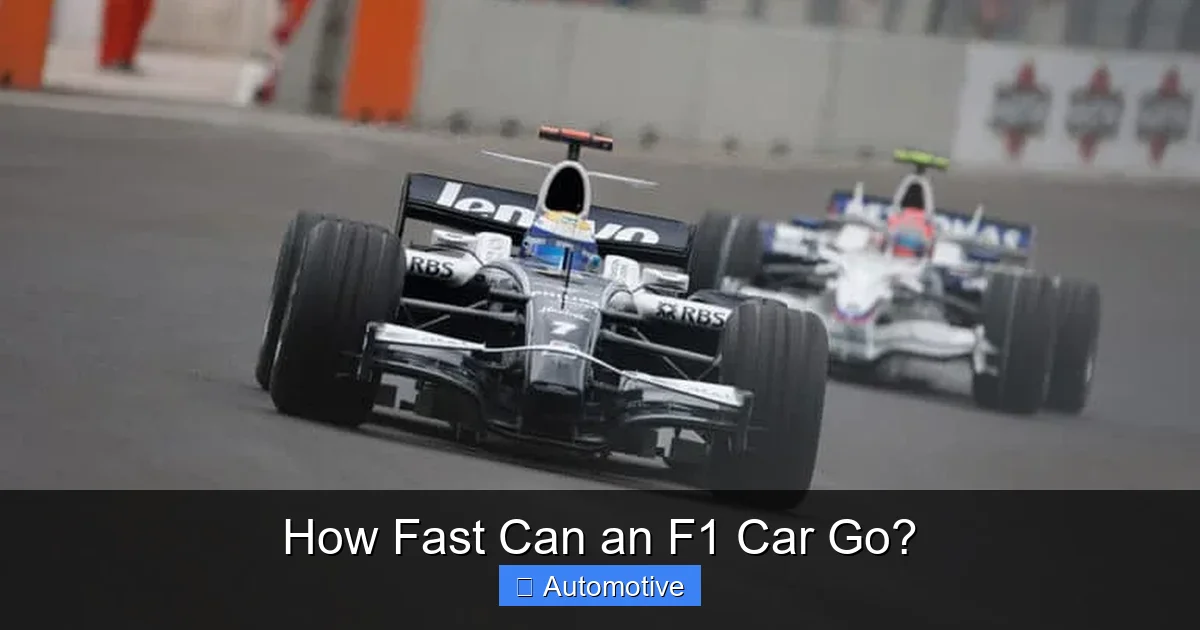
Visual guide about How Fast Can an F1 Car Go?
Image source: drivinggeeks.com
To understand how fast an F1 car can go, we need to look under the hood—literally and figuratively. These aren’t your average sports cars. They’re highly specialized machines built with precision and purpose. Every gram, every watt, and every millisecond counts.
At the heart of every F1 car is the power unit, a hybrid system that combines a 1.6-liter turbocharged V6 internal combustion engine (ICE) with two electric motors. This setup, introduced in 2014, was a game-changer. It not only increased efficiency but also boosted power output significantly. The ICE alone produces around 850 horsepower, while the electric components—the MGU-K (Motor Generator Unit – Kinetic) and MGU-H (Motor Generator Unit – Heat)—add another 160+ horsepower, bringing the total to over 1,000 hp.
But power is only part of the equation. How that power is delivered, managed, and used is what separates F1 cars from everything else on the road. The hybrid system recovers energy during braking (MGU-K) and from exhaust gases (MGU-H), storing it in a battery. This energy can then be deployed strategically—usually during acceleration—to give drivers an extra boost when they need it most.
Aerodynamics: The Invisible Force
One of the most critical factors in F1 speed is aerodynamics. Unlike road cars, which prioritize comfort and fuel efficiency, F1 cars are shaped to manipulate airflow for maximum performance. The goal is to generate downforce—a downward force that pushes the car into the track, increasing grip and allowing higher cornering speeds.
Downforce is created by the front and rear wings, bargeboards, diffusers, and even the shape of the car’s body. The more downforce, the faster a car can take corners. However, there’s a trade-off: more downforce means more drag, which slows the car down on straights. That’s why teams adjust the aerodynamic setup depending on the circuit. On a track with long straights like Monza in Italy, teams reduce downforce to minimize drag and maximize top speed. On tighter circuits like Monaco, they maximize downforce to improve cornering, even if it means sacrificing straight-line speed.
This balance is what makes F1 so complex. A car that’s fast on one track might struggle on another, simply because the aerodynamic setup isn’t optimized. It’s a constant game of adjustments, simulations, and real-time feedback.
Weight and Materials: Light as a Feather, Strong as Steel
Another key factor in F1 speed is weight. The minimum weight of an F1 car, including the driver, is 798 kg (1,759 lbs) as of the 2022 regulations. That might not sound light, but consider what’s packed into that weight: a powerful engine, a complex hybrid system, advanced suspension, and safety features like the halo device.
To keep weight down, F1 teams use advanced materials like carbon fiber composites. The monocoque—the core structure of the car—is made entirely of carbon fiber, which is incredibly strong yet lightweight. Every component, from the gearbox to the brake ducts, is designed with weight savings in mind.
Less weight means better acceleration, faster braking, and improved handling. It also allows the car to change direction more quickly, which is crucial on twisty tracks. When you’re accelerating from 0 to 100 km/h in under 2.5 seconds, every kilogram matters.
Top Speed: How Fast Is “Fast” in F1?
Visual guide about How Fast Can an F1 Car Go?
Image source: img.freepik.com
So, what’s the actual top speed of an F1 car? The answer varies depending on the track, the car setup, and even the weather. But in ideal conditions, F1 cars can reach speeds exceeding 370 km/h (230 mph).
The record for the highest speed in an F1 race was set by Valtteri Bottas during the 2016 Mexican Grand Prix, where he hit 372.5 km/h (231.4 mph) on the long straight at the Autódromo Hermanos Rodríguez. That’s faster than most commercial airplanes at takeoff!
But top speed isn’t just about engine power. It’s also about gearing, aerodynamics, and track layout. On circuits with long straights—like Monza, Baku, or Spa-Francorchamps—cars can reach their maximum velocity. In contrast, tracks with short straights and tight corners, such as Monaco or Singapore, see much lower top speeds, often below 250 km/h (155 mph).
Factors That Influence Top Speed
Several factors determine how fast an F1 car can go on a given lap:
– **Track Layout:** Long straights allow cars to build up speed, while frequent corners limit acceleration.
– **Aerodynamic Setup:** Low-downforce configurations reduce drag and increase top speed.
– **Engine Mode:** Teams can adjust engine power settings during a race, sometimes using “party modes” for qualifying to extract maximum performance.
– **Fuel Load:** Heavier fuel loads at the start of a race can slightly reduce top speed.
– **Tire Condition:** Worn tires have less grip, which can affect acceleration and cornering, indirectly influencing overall speed.
– **Weather:** Cooler air is denser, which can improve engine performance and aerodynamics, potentially increasing speed.
It’s also worth noting that top speed isn’t the only measure of performance. A car that hits 370 km/h but can’t corner well won’t win races. That’s why teams focus on lap time—the total time it takes to complete one circuit—as the ultimate benchmark.
Acceleration: From 0 to Hero in Seconds
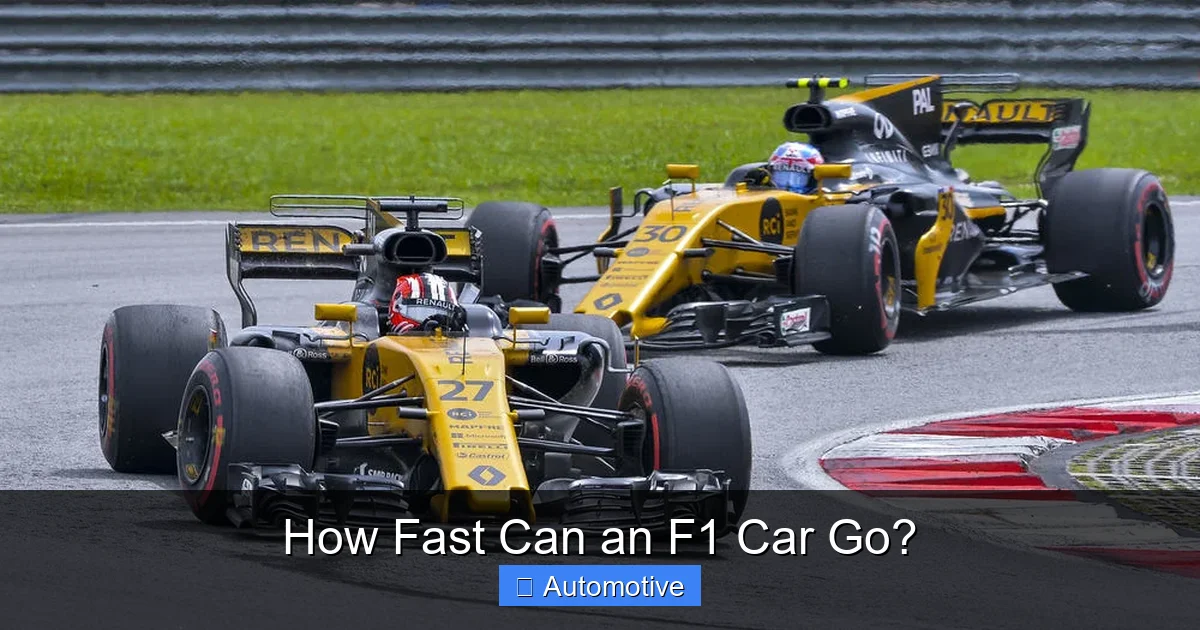
Visual guide about How Fast Can an F1 Car Go?
Image source: onestopracing.com
While top speed grabs headlines, acceleration is where F1 cars truly shine. These machines can go from 0 to 100 km/h (0 to 62 mph) in just 2.4 to 2.6 seconds. That’s faster than a Bugatti Chiron, a Lamborghini Aventador, or even a Tesla Model S Plaid.
To put that in perspective, most high-performance road cars take between 3 and 5 seconds to reach 100 km/h. F1 cars do it in less than half that time. And it’s not just the initial burst—they can accelerate from 100 to 200 km/h in under 4 seconds, thanks to their immense power-to-weight ratio.
What Makes F1 Acceleration So Impressive?
Several factors contribute to this incredible acceleration:
– **Power Output:** With over 1,000 horsepower and instant torque from the electric motor, F1 cars have more than enough power to launch quickly.
– **Lightweight Design:** At under 800 kg, the car doesn’t have much mass to move, making acceleration more efficient.
– **Traction Control and Tire Technology:** Modern F1 tires are designed to provide maximum grip, allowing drivers to put power down without spinning the wheels.
– **Gearing:** The gearbox is optimized for quick shifts and rapid acceleration, with up to eight forward gears to keep the engine in its power band.
Drivers also play a crucial role. Launching an F1 car off a standing start requires precise throttle control, clutch management, and timing. A poor start can lose a driver several positions, while a perfect launch can gain them the lead.
Braking: Slowing Down at the Speed of Light
Speed isn’t just about going fast—it’s also about stopping fast. F1 cars can decelerate from 200 km/h (124 mph) to a complete stop in less than 3 seconds, covering just 65 meters (213 feet). That’s shorter than the length of a basketball court!
This incredible braking performance is due to advanced carbon-carbon brake discs, which can withstand temperatures over 1,000°C (1,832°F). These brakes are incredibly effective but require careful management to avoid overheating or failure.
How F1 Braking Compares to Road Cars
Most high-performance road cars can brake from 100 km/h to 0 in about 30–35 meters. F1 cars do it in half that distance—and from even higher speeds. This allows drivers to brake later into corners, gaining a crucial advantage over their rivals.
But braking isn’t just about the hardware. It’s also about technique. F1 drivers use trail braking—gradually releasing the brake while turning—to maintain control and maximize corner entry speed. This requires immense skill and precision, as even a small mistake can lead to a spin or crash.
The Role of the Driver in Achieving Maximum Speed
While the car is a technological marvel, the driver is the key to unlocking its full potential. An F1 car can only go as fast as the person behind the wheel allows. Drivers must balance aggression with control, pushing the limits without crossing them.
Skill, Experience, and Instinct
F1 drivers are among the best in the world, with years of experience in lower racing categories. They possess exceptional reflexes, spatial awareness, and mental focus. During a race, they’re constantly making split-second decisions—when to brake, when to accelerate, how to position the car for the next corner.
They also work closely with their engineers to fine-tune the car’s setup. Feedback on tire wear, brake balance, and aerodynamic feel helps teams optimize performance throughout the weekend.
Physical Demands of High Speed
Driving an F1 car at high speeds is physically demanding. Drivers experience G-forces of up to 5G during braking and cornering—equivalent to having five times their body weight pressing down on them. This puts immense strain on the neck, arms, and core.
To cope, drivers undergo rigorous fitness training, focusing on strength, endurance, and flexibility. A typical F1 driver burns over 5,000 calories during a race, more than most people consume in a day.
Real-World Examples: Speed in Action
To truly appreciate how fast F1 cars are, let’s look at some real-world examples from recent seasons.
– **Monza, Italy (2023):** Known as the “Temple of Speed,” Monza features long straights and minimal downforce setups. In qualifying, cars regularly exceed 350 km/h (217 mph), with top speeds approaching 360 km/h (224 mph).
– **Baku City Circuit, Azerbaijan (2022):** The 2.2-kilometer straight in Baku allows cars to reach over 360 km/h (224 mph). In 2022, Sergio Pérez hit 362 km/h (225 mph) during the race.
– **Spa-Francorchamps, Belgium (2021):** The long Kemmel Straight sees cars hitting 340+ km/h (211+ mph), especially with DRS (Drag Reduction System) activated.
These examples show how track design directly impacts speed. But they also highlight the importance of strategy. Teams must decide whether to prioritize straight-line speed or cornering performance, knowing that one mistake can cost them the race.
Future of F1 Speed: What’s Next?
As technology evolves, so does F1. The sport is constantly pushing the boundaries of what’s possible, with new regulations and innovations shaping the future of speed.
Hybrid Evolution and Sustainability
The current hybrid power units are already highly efficient, but F1 is moving toward even greater sustainability. By 2026, the sport plans to introduce 100% sustainable fuels and more powerful electric components, potentially increasing efficiency and performance.
Aerodynamic Innovations
New aerodynamic regulations aim to improve racing by reducing the turbulence (“dirty air”) that makes it hard for cars to follow each other. This could lead to closer racing and more overtaking, even if top speeds remain similar.
Active Suspension and AI
While active suspension is currently banned, future technologies like AI-driven setup optimization and real-time adaptive aerodynamics could further enhance speed and handling.
Conclusion: The Need for Speed
So, how fast can an F1 car go? The answer is both simple and complex. On the right track, with the right setup, and in the hands of a skilled driver, an F1 car can exceed 370 km/h (230 mph). It can accelerate from 0 to 100 km/h in under 2.5 seconds and stop from 200 km/h in less than 3 seconds.
But speed in F1 isn’t just about numbers. It’s about the perfect harmony of power, aerodynamics, weight, and driver skill. It’s about pushing the limits of engineering and human performance. And it’s about the thrill of watching these incredible machines dance at the edge of physics.
Whether you’re a die-hard fan or a casual viewer, there’s no denying the awe-inspiring speed of an F1 car. It’s not just fast—it’s a masterpiece of speed.
Frequently Asked Questions
What is the top speed of an F1 car?
The top speed of an F1 car can exceed 370 km/h (230 mph) on long straights, depending on the track and setup. The record is 372.5 km/h, set by Valtteri Bottas in 2016.
How fast do F1 cars accelerate?
F1 cars can accelerate from 0 to 100 km/h in just 2.4 to 2.6 seconds, making them faster than most supercars. They can reach 200 km/h in under 6 seconds.
Why do F1 cars have different top speeds on different tracks?
Top speed depends on track layout, aerodynamic setup, and gearing. Tracks with long straights allow higher speeds, while twisty circuits require more downforce and lower top speeds.
What makes F1 cars so fast?
F1 cars are fast due to their hybrid power units (over 1,000 hp), lightweight carbon fiber construction, advanced aerodynamics, and high-performance tires.
Can F1 cars go faster than fighter jets?
No, fighter jets can exceed 2,000 km/h (1,200 mph), far faster than F1 cars. However, F1 cars accelerate and brake much more quickly over short distances.
Do F1 drivers feel the speed?
Yes, drivers experience extreme G-forces—up to 5G during braking and cornering—which makes the physical and mental demands of driving an F1 car incredibly intense.
