How Does Toyota Pre-collision System Work?

Contents



The Toyota Pre-Collision System (PCS) is a cutting-edge safety feature designed to detect potential front-end collisions and help drivers avoid or mitigate them. Using a combination of cameras and radar, it warns drivers and can automatically apply the brakes if needed.
Key Takeaways
- Uses radar and camera technology: The system combines a forward-facing camera and millimeter-wave radar to monitor the road ahead for vehicles, pedestrians, and cyclists.
- Provides audio and visual warnings: When a collision risk is detected, the driver receives immediate alerts through dashboard lights and audible signals.
- Can automatically apply brakes: If the driver doesn’t respond in time, the system can engage the brakes to reduce speed or stop the vehicle.
- Works at various speeds: PCS functions in a wide range of driving conditions, from city traffic to highway speeds.
- Enhances pedestrian safety: Advanced versions can detect pedestrians and cyclists, especially during daylight hours.
- Part of Toyota Safety Sense: PCS is a core component of Toyota Safety Sense (TSS), a suite of active safety technologies.
- Not a replacement for driver attention: While highly effective, the system is designed to assist, not replace, safe driving habits.
📑 Table of Contents
How Does Toyota Pre-Collision System Work?
Driving can be unpredictable. One moment, the road is clear. The next, a car slams on its brakes, a pedestrian steps off the curb, or a cyclist swerves into your lane. These split-second moments are where advanced safety technology can make all the difference. That’s where the Toyota Pre-Collision System (PCS) comes in—a smart, proactive feature designed to help prevent accidents before they happen.
Imagine you’re driving down a busy city street, focused on the traffic ahead. Suddenly, the car in front slows down unexpectedly. Your reflexes are good, but not instant. The Toyota Pre-Collision System acts like a second set of eyes, constantly scanning the road. It detects the slowing vehicle, calculates the risk, and gives you a warning. If you don’t react in time, it can even hit the brakes for you. This isn’t science fiction—it’s real technology built into many Toyota models today.
The system is part of Toyota Safety Sense (TSS), a comprehensive suite of driver-assist features that includes lane departure alerts, adaptive cruise control, and automatic high beams. But the Pre-Collision System is often the star of the show because it directly addresses one of the most common types of accidents: front-end collisions. Whether you’re stuck in stop-and-go traffic or cruising on the highway, PCS is always on guard, ready to help you avoid a crash.
Understanding the Technology Behind the System
Visual guide about How Does Toyota Pre-collision System Work?
Image source: pictures.dealer.com
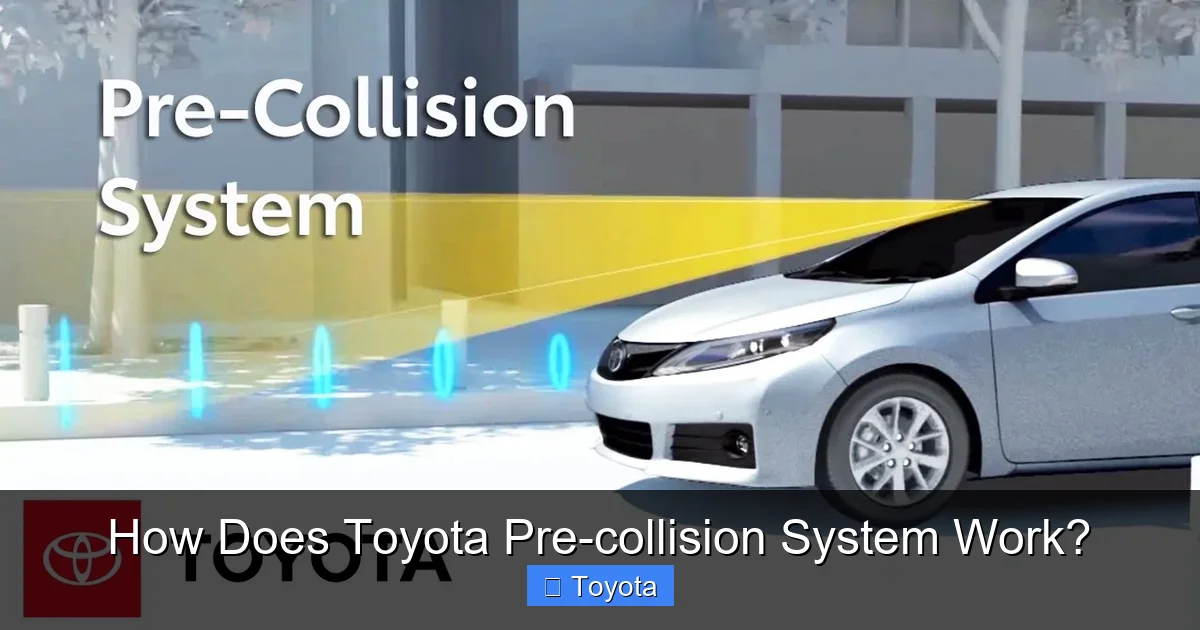
At the heart of the Toyota Pre-Collision System is a blend of advanced sensors and intelligent software. The system relies primarily on two key components: a forward-facing camera and a millimeter-wave radar sensor. These work together to create a detailed picture of what’s happening in front of your vehicle.
The camera, usually mounted near the rearview mirror, captures visual data much like a human eye. It can identify lane markings, traffic signs, and—most importantly—other vehicles, pedestrians, and cyclists. It’s especially good at recognizing shapes and patterns, which helps it distinguish between a car, a person, or a stationary object.
Meanwhile, the radar sensor uses radio waves to measure distance, speed, and direction of objects ahead. Unlike the camera, radar works well in poor visibility conditions like fog, rain, or darkness. It can “see” through obstacles and detect how fast another vehicle is moving relative to yours. This dual-sensor approach ensures the system remains effective in a wide range of driving environments.
Once the camera and radar collect data, it’s sent to an onboard computer that analyzes the information in real time. The system calculates the likelihood of a collision based on factors like closing speed, distance, and trajectory. If the risk reaches a certain threshold, the system springs into action.
How Sensors Detect Potential Collisions
Let’s break it down with a practical example. Suppose you’re driving at 40 mph on a suburban road. The car ahead is moving at the same speed, about 100 feet in front of you. The radar sensor detects the distance and speed difference—everything looks normal. But then, that car suddenly brakes hard.
Within milliseconds, the radar picks up the change in speed and distance. The camera confirms the presence of the vehicle and its position in your lane. The system’s algorithm quickly determines that a collision is likely unless action is taken. This entire process happens faster than a human can react.
The system doesn’t just look for cars. In newer Toyota models equipped with pedestrian detection, the camera can identify people walking or running near the road. It uses pattern recognition to spot human shapes, even if they’re partially obscured. This is especially useful in urban areas where pedestrians might step into the street unexpectedly.
Cyclist detection is another impressive feature. The system can recognize bicycles and assess whether they’re moving into your path. While this capability is typically limited to daylight hours and clear conditions, it adds another layer of protection for vulnerable road users.
System Limitations and Environmental Factors
While the Toyota Pre-Collision System is highly advanced, it’s not perfect. Like any technology, it has limitations. For instance, heavy rain, snow, or fog can reduce the effectiveness of the camera. Dirt, ice, or mud on the windshield can also block the camera’s view, so keeping it clean is essential.
The radar sensor is more resilient in bad weather, but it can still be affected by extreme conditions or interference from other vehicles’ systems. Additionally, the system may struggle to detect objects that are very small, moving erratically, or partially hidden—like a child darting out from between parked cars.
Another limitation is speed. Most Toyota PCS systems are designed to work best at speeds above 7 mph and below 85 mph. Below 7 mph, the system may not activate because low-speed collisions are often less severe and easier for drivers to avoid manually. Above 85 mph, the system may not have enough time to react effectively.
It’s also worth noting that the system performs best on straight roads. Sharp curves, steep hills, or winding mountain roads can reduce sensor accuracy because the camera and radar have a limited field of view. In these situations, the system might not detect a vehicle around a bend until it’s too late.
Warning Stages and Driver Alerts
Visual guide about How Does Toyota Pre-collision System Work?
Image source: dealerinspire-image-library-prod.s3.us-east-1.amazonaws.com
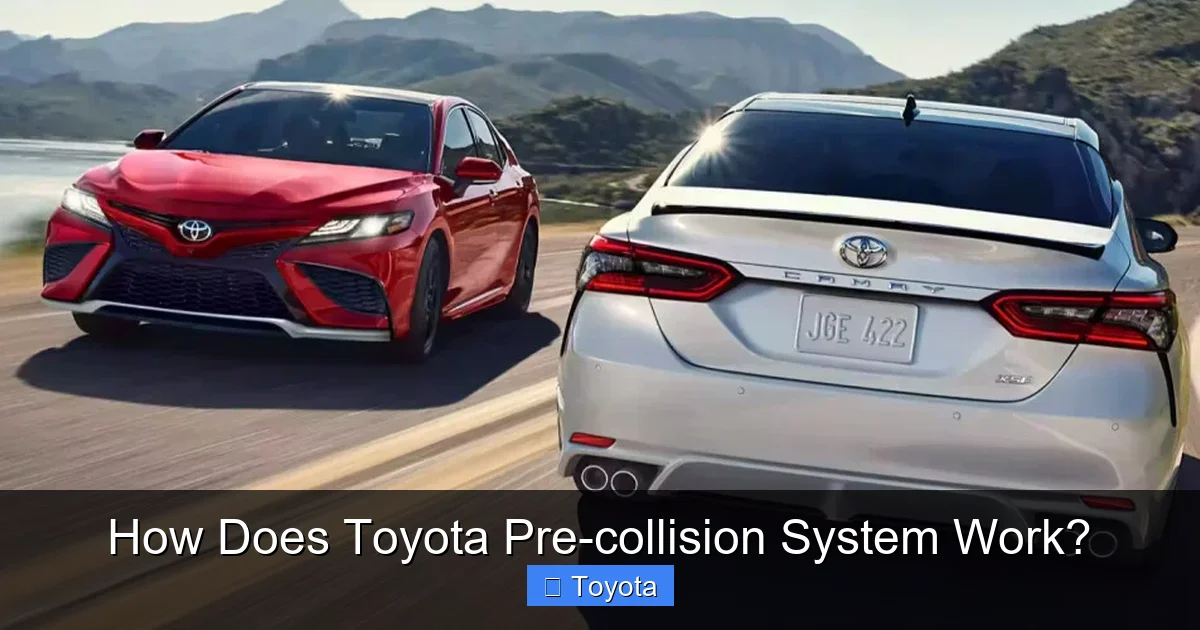
One of the most user-friendly aspects of the Toyota Pre-Collision System is how it communicates with the driver. It doesn’t just slam on the brakes without warning. Instead, it uses a staged approach to give you every chance to react.
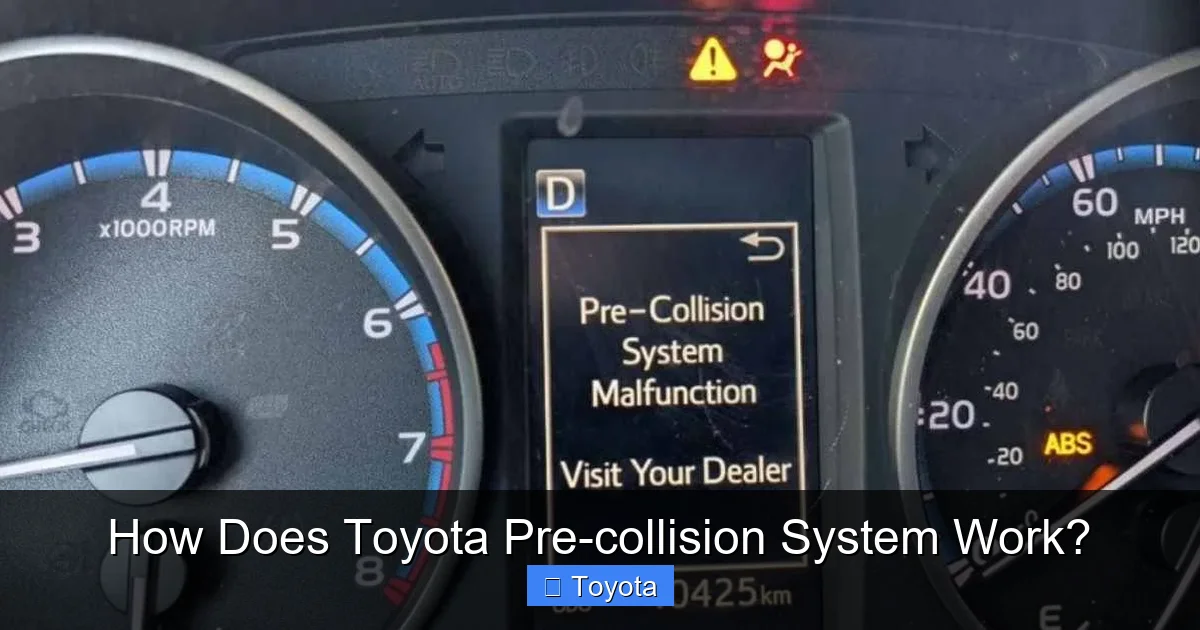
The first stage is a visual and audio warning. When the system detects a potential collision, a warning light flashes on the dashboard—usually a red icon with an exclamation point or a car symbol. At the same time, you’ll hear a beeping sound, similar to a seatbelt reminder. This is your cue to pay attention and prepare to brake.
In some Toyota models, the system also includes a haptic alert, which means the steering wheel or seat might vibrate slightly. This tactile feedback can be especially helpful if you’re distracted or wearing noise-canceling headphones.
If you don’t respond to the initial warning, the system moves to the second stage: brake support. This means the system pre-charges the brakes, getting them ready to apply maximum force the moment you press the pedal. It’s like priming a pump—so when you do hit the brakes, they respond instantly and with greater power.
Automatic Braking: When the System Takes Over
If the driver still doesn’t react, and a collision is imminent, the system enters its final stage: automatic braking. The Toyota Pre-Collision System can apply the brakes on its own, even if your foot isn’t on the pedal. This can significantly reduce your speed—or bring the vehicle to a complete stop—before impact.
The amount of braking force depends on the situation. If there’s still time, the system might apply partial braking to slow you down and give you a chance to steer away. If a crash is unavoidable, it will apply full braking to minimize the force of impact.
It’s important to understand that automatic braking doesn’t guarantee a collision will be avoided. Factors like speed, road conditions, and the size of the object ahead all play a role. But studies show that even reducing speed by just 10 mph before a crash can dramatically lower the risk of injury.
For example, if you’re traveling at 40 mph and the system slows you to 30 mph before impact, the energy of the crash is reduced by nearly 40%. That could mean the difference between a minor fender-bender and a serious accident.
Real-World Examples of PCS in Action
Let’s look at a few real-world scenarios where the Toyota Pre-Collision System could make a difference.
Imagine you’re driving home from work, tired after a long day. You’re approaching an intersection, and the light turns yellow. You decide to go through, but the car in front of you stops abruptly. Without PCS, you might not brake in time. But with the system, you get a warning, and if needed, it helps you stop safely.
Or consider a rainy evening when visibility is low. A pedestrian steps off the curb without looking. The camera might struggle in the rain, but the radar picks up the person’s movement. The system alerts you, and if you don’t react, it applies the brakes to reduce the impact.
Another common situation is highway driving. You’re cruising at 65 mph, and traffic suddenly slows down. The system detects the vehicles ahead and warns you. If you’re distracted by your phone or the radio, the automatic braking kicks in, potentially preventing a rear-end collision.
These examples show how PCS isn’t just for extreme situations—it’s a daily safety net that works quietly in the background, ready to help when you need it most.
Integration with Toyota Safety Sense
Visual guide about How Does Toyota Pre-collision System Work?
Image source: trucksauthority.com
The Pre-Collision System doesn’t work in isolation. It’s part of a larger ecosystem called Toyota Safety Sense (TSS), which has evolved over the years. TSS is standard on most new Toyota vehicles, and each version builds on the last with improved sensors, better algorithms, and expanded capabilities.
TSS 2.0, for example, introduced pedestrian detection during both day and night, as well as daytime cyclist detection. TSS 2.1 added intersection support, helping detect oncoming vehicles when turning left. TSS 3.0, the latest version, enhances object detection and improves performance in low-light conditions.
Other features in the TSS suite include:
– **Lane Departure Alert (LDA):** Warns you if you drift out of your lane without signaling.
– **Dynamic Radar Cruise Control (DRCC):** Automatically adjusts your speed to maintain a safe distance from the car ahead.
– **Automatic High Beams (AHB):** Switches between high and low beams based on traffic.
– **Road Sign Assist (RSA):** Recognizes speed limit signs and displays them on the dashboard.
All these systems share data and work together. For instance, if the Pre-Collision System detects a vehicle ahead, it can communicate with the cruise control to slow down smoothly. Or if the lane departure system notices you’re drifting, it can alert the PCS to be extra vigilant.
This integration creates a more cohesive and responsive driving experience. It’s like having a co-pilot who’s always watching the road, ready to assist with alerts, steering, or braking.
Evolution of Toyota Safety Sense
Toyota has been a leader in vehicle safety for decades, but the introduction of TSS in 2015 marked a major leap forward. The original TSS included basic versions of PCS, LDA, and AHB. Over time, Toyota refined the technology, adding more sensors, improving software, and expanding functionality.
One of the biggest improvements has been in pedestrian detection. Early systems could only detect people during the day. Now, with TSS 3.0, many Toyota models can spot pedestrians at night using enhanced camera sensitivity and infrared technology.
Another advancement is the use of machine learning. The system’s software is constantly updated to recognize new patterns and improve accuracy. For example, it can now better distinguish between a pedestrian and a mailbox, or a cyclist and a motorcycle.
These updates aren’t just for new cars. Some Toyota models can receive over-the-air software updates, meaning your vehicle can get smarter over time without needing a dealership visit.
Effectiveness and Real-World Impact
So, does the Toyota Pre-Collision System actually work? The answer is a resounding yes—backed by data from real-world studies and crash statistics.
According to the Insurance Institute for Highway Safety (IIHS), vehicles equipped with forward collision warning and automatic emergency braking—like Toyota’s PCS—have up to a 50% lower rate of front-to-rear crashes. That’s a significant reduction in accidents, injuries, and repair costs.
A study by the Highway Loss Data Institute (HLDI) found that Toyota vehicles with PCS had fewer insurance claims for property damage and bodily injury. The system was particularly effective in preventing low-speed collisions in urban areas, where most accidents occur.
But it’s not just about statistics. Many Toyota owners have shared stories of how PCS saved them from a crash. One driver recounted how the system stopped their car just inches from a child who ran into the street after a ball. Another described how automatic braking prevented a high-speed collision on the highway when traffic suddenly stopped.
Of course, no system is perfect. There have been cases where PCS didn’t activate as expected, often due to environmental factors or sensor blockages. But overall, the benefits far outweigh the limitations.
Tips for Maximizing System Performance
To get the most out of your Toyota Pre-Collision System, follow these practical tips:
1. **Keep the windshield clean:** Dirt, snow, or stickers can block the camera. Clean the area around the rearview mirror regularly.
2. **Avoid obstructing sensors:** Don’t place phone mounts or dash cams directly in front of the camera or radar sensor.
3. **Drive attentively:** PCS is a safety aid, not a substitute for focus. Stay alert and keep your hands on the wheel.
4. **Understand your system’s limits:** Know that it works best in clear conditions and at moderate speeds.
5. **Update software when available:** Check for Toyota software updates to ensure your system has the latest improvements.
6. **Test the system safely:** In a safe, empty parking lot, you can gently test the warnings by approaching a stationary object (like a cardboard box) at low speed—just don’t rely on it for daily driving.
Conclusion
The Toyota Pre-Collision System is more than just a fancy feature—it’s a life-saving technology that’s reshaping the way we think about vehicle safety. By combining radar, cameras, and intelligent software, it gives drivers an extra layer of protection in moments when every second counts.
From warning you of a slowing car ahead to automatically applying the brakes for a pedestrian, PCS is designed to prevent accidents before they happen. It’s not magic, but it’s close—working silently in the background, ready to act when you need it most.
While it’s not a replacement for safe driving, it’s a powerful tool that enhances your awareness and reaction time. As part of Toyota Safety Sense, it’s just one piece of a broader commitment to safety that includes lane keeping, cruise control, and more.
Whether you’re commuting to work, picking up the kids, or taking a road trip, the Pre-Collision System is there to help you arrive safely. It’s peace of mind built into every mile.
So the next time you’re behind the wheel of a Toyota, remember: you’re not just driving a car. You’re driving a smarter, safer vehicle—thanks to technology that’s always watching your back.
Frequently Asked Questions
How does the Toyota Pre-Collision System detect pedestrians?
The system uses a forward-facing camera to identify human shapes and movements, especially during daylight. Advanced versions can also detect pedestrians at night using enhanced sensors and infrared technology.
Can the Pre-Collision System work in the rain or snow?
Yes, but performance may be reduced. The radar sensor works well in bad weather, but heavy rain, snow, or fog can limit the camera’s visibility. Keeping the windshield clean helps maintain effectiveness.
Will the system stop my car completely?
It can bring the vehicle to a full stop in many situations, especially at lower speeds. However, the ability to stop completely depends on factors like speed, distance, and road conditions.
Does the Pre-Collision System work at highway speeds?
Yes, it functions at speeds up to 85 mph. It’s designed to detect fast-closing vehicles and can apply braking to reduce impact force, even at highway speeds.
Can I turn off the Toyota Pre-Collision System?
Yes, you can temporarily disable it using the vehicle settings menu. However, it typically resets to “on” each time you start the car, encouraging consistent use for safety.
Is the Pre-Collision System available on all Toyota models?
Most new Toyota vehicles come standard with PCS as part of Toyota Safety Sense. However, availability may vary by trim level and model year, so check your owner’s manual or consult a dealer.