How Do You Reset the Check Engine Light on a 2015 Toyota Highlander?

Contents
- 1 Key Takeaways
- 2 📑 Table of Contents
- 3 Understanding the Check Engine Light: It’s Not Just a “Check”
- 4 Preparation Before You Reset: The Golden Rule
- 5 Methods to Reset the Check Engine Light on Your 2015 Highlander
- 6 What to Do After You Reset the Light
- 7 When to Absolutely Seek Professional Help
- 8 Preventive Maintenance: Your Best Defense
- 9 Conclusion: Knowledge is Power (and a Healthy Engine)
- 10 Frequently Asked Questions


Resetting the check engine light on a 2015 Toyota Highlander clears the diagnostic trouble code but does not fix the underlying problem. You must first diagnose and repair the issue that triggered the light, or it will return. Common reset methods include using an OBD-II scanner, disconnecting the battery, or pulling a fuse. Always drive cautiously after a reset and monitor for recurrence, as a persistent light indicates a serious issue requiring professional diagnosis.
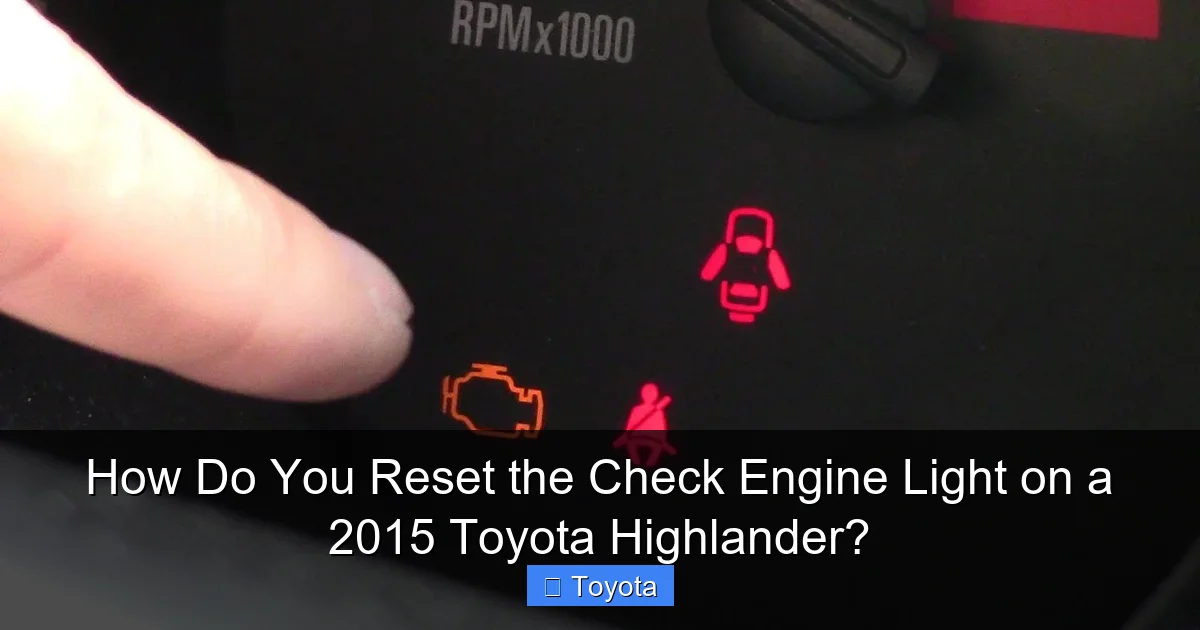
That glowing orange triangle on your dashboard, with the little engine icon, is enough to make any 2015 Toyota Highlander owner’s stomach drop. It’s the check engine light, and it’s your vehicle’s way of saying, “Hey, something needs attention.” Your first instinct might be to find the quickest way to make it go away. But before we dive into the “how,” we need to talk about the “why” and the “what next.” Resetting the light is a tool, not a cure. This comprehensive guide will walk you through everything you need to know about safely and effectively addressing the check engine light on your Highlander, from understanding its meaning to executing a reset and knowing when it’s time to call a pro.
Key Takeaways
- Reset ≠ Repair: Resetting the light only erases the error code; it does not solve the mechanical or electrical problem that caused it.
- Diagnosis is Mandatory: You must use an OBD-II scanner to read the specific trouble code (e.g., P0171, P0300) before considering a reset to understand what’s wrong.
- Battery Disconnect Has Downsides: This method can reset other vehicle systems like radio presets, power window calibrations, and steering angle sensors, requiring re-learning.
- Post-Reset Monitoring is Critical: After resetting, drive normally for 50-100 miles. If the light returns, the repair was incomplete or a new issue exists.
- Professional Help is Often Wise: For complex codes (especially those related to emissions, transmission, or safety systems), a certified mechanic should perform the diagnosis and repair.
- Know the Difference: A steady check engine light indicates a problem; a flashing light signals a severe issue (like misfire) that can damage the catalytic converter—stop driving immediately.
- Preventative Maintenance Helps: Regularly servicing your Highlander according to Toyota’s schedule (oil changes, air filters, spark plugs) is the best way to avoid unnecessary check engine lights.
📑 Table of Contents
- Understanding the Check Engine Light: It’s Not Just a “Check”
- Preparation Before You Reset: The Golden Rule
- Methods to Reset the Check Engine Light on Your 2015 Highlander
- What to Do After You Reset the Light
- When to Absolutely Seek Professional Help
- Preventive Maintenance: Your Best Defense
- Conclusion: Knowledge is Power (and a Healthy Engine)
Understanding the Check Engine Light: It’s Not Just a “Check”
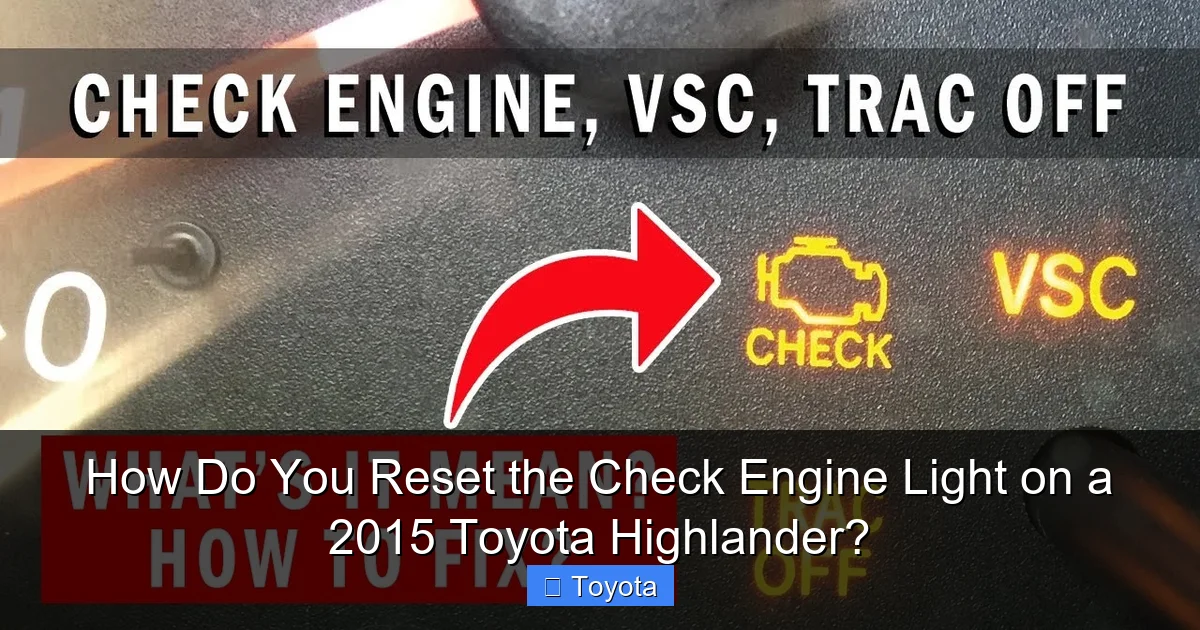
Let’s start with the fundamentals. The check engine light, or malfunction indicator lamp (MIL), is part of your Highlander’s On-Board Diagnostics II (OBD-II) system. This computer network constantly monitors dozens of sensors and components related to engine performance, emissions, and sometimes transmission. When a sensor sends a reading outside the expected parameters, the computer stores a Diagnostic Trouble Code (DTC) and illuminates the light to get your attention.
What Does a Steady Light vs. a Flashing Light Mean?
This distinction is critical for your safety and your wallet. A steady, solid check engine light indicates a non-emergency issue. It could be something as simple as a loose gas cap or a faulty oxygen sensor. You can usually drive the vehicle cautiously to a safe location for diagnosis. However, a flashing or blinking light is a severe warning. It often means a cylinder is misfiring badly, which can dump unburned fuel into the exhaust system, overheating and destroying the catalytic converter in minutes. If your light is flashing, pull over safely and shut off the engine immediately. Do not drive the vehicle. Have it towed to a repair shop.
Common Triggers in a 2015 Toyota Highlander
While the Highlander is known for reliability, several issues commonly trigger its check engine light. Knowing these can help you anticipate the problem. Frequent culprits include:
- Loose or Faulty Gas Cap: This is the #1 cause of an EVAP (evaporative emission) system code. A cap that doesn’t seal properly allows fuel vapors to escape, which the system detects.
- Oxygen (O2) Sensor Failure: These sensors monitor exhaust gases. A failing sensor reduces fuel efficiency and increases emissions.
- Mass Air Flow (MAF) Sensor Issues: This sensor measures incoming air. Dirt or failure leads to poor performance and codes like P0101/P0102.
- Catalytic Converter Problems: Less common on a 2015, but if triggered, it often means a secondary issue (like a misfire) has damaged it.
- Spark Plugs and Ignition Coils: Worn plugs or failing coils cause misfires (P0300-P0304 codes). The 3.5L V6 in the Highlander has six coils, one per spark plug.
- Exhaust Gas Recirculation (EGR) System: A clogged EGR valve or related component can trigger codes affecting idle quality.
For specific issues with other Toyota models, resources like our guide on resetting the check engine light on a Toyota Corolla can provide model-specific insights, as many diagnostic principles are similar across the brand.
Preparation Before You Reset: The Golden Rule
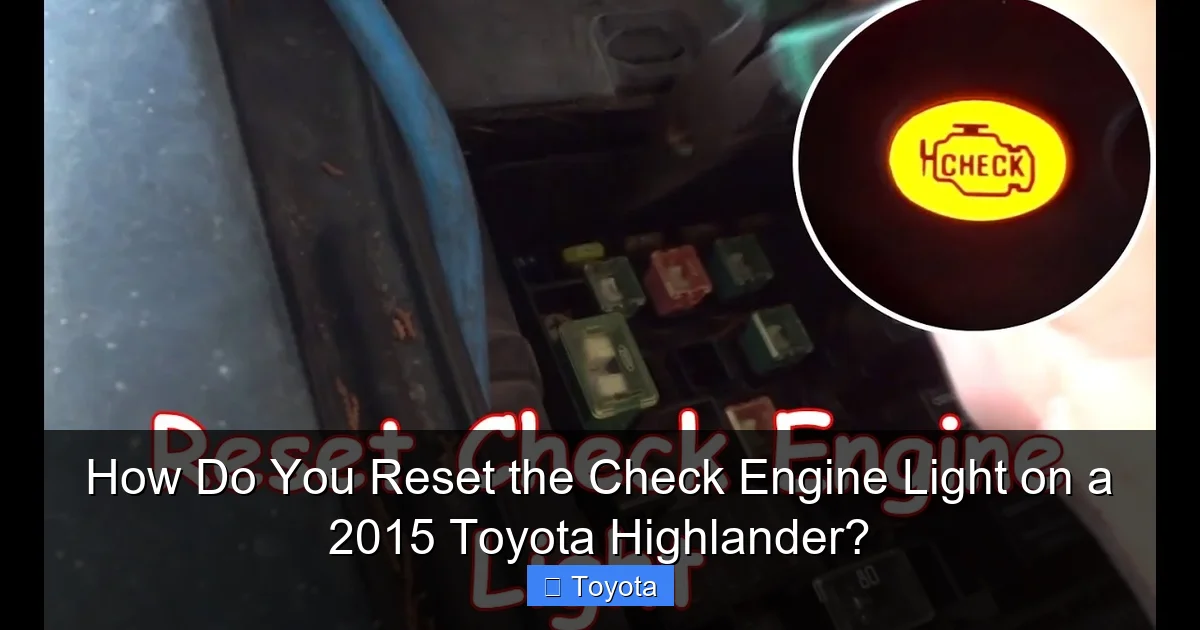
Here is the most important rule: NEVER reset the check engine light without first diagnosing and, if necessary, repairing the underlying cause. Resetting is simply erasing the computer’s memory of a problem. If you clear the code without fixing the faulty oxygen sensor, the sensor will send the same bad data, the computer will detect it again, and the light will come back—often within a few drive cycles. This turns a simple fix into a frustrating guessing game.
Visual guide about How Do You Reset the Check Engine Light on a 2015 Toyota Highlander?
Image source: i.ytimg.com
Step 1: Read the Diagnostic Trouble Code (DTC)
You need to know what the car is complaining about. For this, you’ll need an OBD-II scanner. These range from simple, inexpensive code readers (under $30) to advanced professional scanners (hundreds of dollars). For a 2015 Highlander, any basic OBD-II scanner will work.
- Locate the OBD-II Port: It’s under the dashboard, to the left of the steering column, usually within arm’s reach of the driver’s seat. It’s a trapezoidal 16-pin connector.
- Connect and Read: With the ignition in the “ON” position (engine off), plug in the scanner. Follow its prompts to “Read Codes.” It will display a code starting with “P” (e.g., P0420, P0171). Write this code down.
- Interpret the Code: Use the scanner’s built-in definition, an internet search for “P0XXX Toyota,” or a site like OBD-Codes.com. The code points to a system, not a specific part. P0302 means “Cylinder 2 Misfire Detected,” which could be a spark plug, coil, injector, or compression issue.
Step 2: Perform a Basic Visual Inspection
Before you assume the worst, do a quick look-over:
- Check the Gas Cap: Is it on tight? Listen for clicks. Is the seal damaged? Try tightening it and see if the light goes off after a few drive cycles.
- Inspect for Obvious Issues: Look under the hood for disconnected hoses, frayed wires, or damage. Check engine oil and coolant levels.
- Listen and Feel: Does the engine run rough? Any strange noises? Note any symptoms (hesitation, loss of power, poor fuel economy) to share with a mechanic.
If the code points to a simple fix like a gas cap, tighten or replace it. If it’s a more complex issue (misfire, O2 sensor, catalytic converter), you need to repair it before resetting. For those with a Dodge vehicle, similar diagnostic principles apply, as seen in our article on resetting the check engine light on a Dodge Durango.
Methods to Reset the Check Engine Light on Your 2015 Highlander
Once you’ve repaired the issue (or are certain it was a false alarm and you just want to clear the code), you can reset the light. Here are the three primary methods, from easiest to most invasive.
Visual guide about How Do You Reset the Check Engine Light on a 2015 Toyota Highlander?
Image source: i.ytimg.com
Method 1: The OBD-II Scanner (The Best & Easiest Way)
This is the professional and recommended method. The same scanner you used to read the code can almost always clear it.
- With the ignition ON (engine off), plug your scanner into the OBD-II port.
- Navigate the menu to find “Erase Codes,” “Clear DTCs,” or “Reset MIL.”
- Select it. You may get a confirmation prompt. Accept it.
- The light should extinguish immediately. Start the engine. The light should remain off.
Pro Tip: Some cheaper scanners may not be able to clear all manufacturer-specific codes or may require a “Powertrain” module selection. Ensure your scanner supports “All Systems” or “Powertrain” clearing. This method is clean, fast, and doesn’t disrupt any other vehicle electronics.
Method 2: The Battery Disconnect (The “Hard Reset”)
This old-school method works by draining the residual power from the computer’s memory (RAM). However, it comes with significant side effects.
- Turn off the engine and remove the key.
- Open the hood and locate the battery. The 2015 Highlander’s battery is in the engine bay.
- First, disconnect the negative (black) battery cable. Use a 10mm wrench. Loosen the terminal nut and pull the cable off the post. Secure it away from the battery so it can’t accidentally touch.
- Wait. This is crucial. You need to drain all residual power. Wait at least 10-15 minutes. Some sources recommend longer. You can press the brake pedal or honk the horn during this time to help drain the capacitors.
- Reconnect the negative cable and tighten the nut securely.
- Close the hood, start the vehicle. The check engine light should be off. However, you will likely need to reset other systems:
- Power windows: You may need to re-calibrate the auto-up/down feature by rolling the window fully up and holding the switch for 2-3 seconds.
- Steering Angle Sensor: The vehicle stability control (VSC) light may flash, requiring a few turns of the wheel to recalibrate.
- Radio presets and clock: These will be lost.
- Transmission shift points: The transmission may shift harshly for the first few miles as it re-learns your driving style.
Warning: On some newer vehicles, disconnecting the battery can also affect the Engine Control Module (ECM) and require a specialized scan tool to re-initialize it. While generally safe on a 2015 Highlander, it’s always the last resort. For other brands, like Nissan, procedures can be more delicate, as noted in our piece on resetting an airbag light on a Nissan Altima.
Method 3: The Fuse Pull (A Targeted Reset)
This method aims to reset the Engine Control Unit (ECU) by pulling its fuse. It’s more targeted than a battery disconnect but still carries some risk of affecting other systems that share the fuse.
- Consult the Owner’s Manual. Find the fuse box diagram (usually on the back of the fuse box cover or in the manual). Identify the fuse for the “ECU,” “ECM,” or “Engine.” On many 2015 Highlanders, it’s Fuse #4 or #9 in the engine compartment fuse box (15A). Double-check this for your specific VIN.
- Turn off the ignition.
- Using a fuse puller or needle-nose pliers, remove the identified fuse.
- Wait 30 seconds to 1 minute.
- Reinsert the fuse firmly.
- Start the vehicle. The light should be reset.
Caution: Pulling the wrong fuse can disable critical systems (fuel pump, ignition). If you are unsure, use Method 1 or 2. This method is less common for a simple check engine light reset and more often used for ECM re-learning procedures after major repairs.
What to Do After You Reset the Light
The reset is complete. The light is off. Don’t celebrate yet—this is the start of the most important phase: monitoring.

Visual guide about How Do You Reset the Check Engine Light on a 2015 Toyota Highlander?
Image source: dodgecheckenginelight.com
The Drive Cycle and Monitoring Period
Your Highlander’s computer needs to complete a “drive cycle” to verify that the problem is truly gone. This involves a specific set of conditions: start cold, drive at various speeds, include a deceleration, etc. It typically takes 50-100 miles of mixed driving (city and highway) for the computer to run all its internal tests.
- Drive normally. Do not baby the car or try to “trick” the system. Just drive as you would.
- Watch the dashboard. If the check engine light comes back on, note the exact conditions (e.g., “came on while accelerating uphill”). This information is gold for a diagnostician.
- If the light returns: Your repair was either incomplete or incorrect. The code will likely be the same or a new, related code. You must go back to the diagnostic step (reading the code) and address the root cause.
- If the light stays off: After a successful drive cycle, you can consider the issue resolved. However, keep an ear out for any odd noises or changes in performance, as they could signal a developing problem.
Will the Light Come Back for Emissions Testing?
This is a major practical concern. In most states, a vehicle cannot pass an emissions (smog) test if the check engine light is on or if the OBD-II system shows that the monitors have not run and passed (a “Not Ready” status). Simply resetting the light and immediately going for a test will fail because the monitors haven’t completed their drive cycles. You must complete the full drive cycle (as described above) so all system monitors (Catalyst, EVAP, O2 sensors, etc.) show “Ready” or “Complete” on the scanner’s readiness status screen. This can take several days of driving.
When to Absolutely Seek Professional Help
While a loose gas cap or a bad gas cap seal are DIY-friendly, many check engine light causes are not. Here’s when to put down the wrench and pick up the phone.
Signs You Need a Mechanic’s Expertise
- Flashing Light: As stated, stop driving and tow.
- Severe Driveability Issues: Engine is running very rough, shaking violently, lacks power, or won’t accelerate properly.
- Complex Codes: Codes involving the catalytic converter (P0420), transmission (P07xx), or multiple cylinder misfires (P0300) often require advanced diagnostics.
- Multiple Codes: If you have 5+ codes spanning different systems (engine, transmission, ABS), it could indicate a wiring harness problem, a bad ground, or a failed main computer (ECU/ECM).
- You’ve Tried Fixing It: You replaced the part the code suggested (e.g., new O2 sensor), but the light and code return immediately. This means either the new part is defective, the installation was wrong, or the problem is elsewhere (e.g., an exhaust leak before the sensor).
- Lack of Tools/Confidence: If you don’t have a scanner or aren’t comfortable with basic automotive troubleshooting, a professional diagnosis (which typically costs $80-$150) is a wise investment to avoid throwing parts at the problem.
What to Expect at the Shop
A reputable mechanic will follow a logical process: 1) Read all stored and pending codes. 2) Perform a visual inspection based on the code. 3) Possibly run live data on the scanner to see sensor readings in real-time. 4) Perform pinpoint tests (multimeter checks, smoke test for EVAP leaks, etc.). 5) Isolate and repair the faulty component. 6) Clear the codes and perform a drive cycle to verify the repair. They have access to factory service information and advanced tools that go far beyond a consumer-grade code reader. For complex issues, especially those that might relate to the AWD system in your Highlander, specialized knowledge is key, as detailed in our guide on checking the AWD system on a Toyota Highlander.
Preventive Maintenance: Your Best Defense
The goal is to never see that light, or at least to see it only for minor, easily resolved issues. Adhering to your 2015 Toyota Highlander’s maintenance schedule is the single most effective strategy.
Routine Checks That Keep the Light Off
- Gas Cap: Ensure it’s tightened until it clicks. Replace it every 5-7 years as the seal degrades.
- Air Filter: A clogged engine air filter restricts airflow, causing lean conditions and triggering codes. Replace it every 15,000-30,000 miles.
- Spark Plugs: The 2015 Highlander’s 3.5L V6 uses iridium spark plugs rated for 120,000 miles. If you’re over 100,000 miles, consider preemptive replacement to avoid misfires.
- Oxygen Sensors: These wear out. Typically, the upstream (before catalytic converter) sensors last 100,000+ miles. A failing one will hurt fuel economy.
- Mass Air Flow (MAF) Sensor: Clean it carefully with MAF-specific cleaner every 30,000-50,000 miles. Never touch the sensing wires.
- Oil Changes: Use the correct Toyota oil and change interval (often 5,000-10,000 miles depending on conditions). Poor lubrication can cause a host of sensor and performance issues.
Understanding Toyota’s Service Lights vs. Check Engine Light
Don’t confuse the check engine light (engine icon) with the maintenance required light (wrench icon). The maintenance light is a simple mileage-based reminder for scheduled service (oil change, tire rotation, etc.). It is not an emissions-related warning and is reset via a different procedure (usually via the odometer button and ignition). Resetting the check engine light will not turn off the maintenance light. For instructions on your Highlander’s maintenance light, see our specific guide for resetting the maintenance light on a 2016 Toyota Highlander—the process is nearly identical for your 2015 model. Keeping up with these routine services prevents many problems that would eventually trigger the check engine light.
Conclusion: Knowledge is Power (and a Healthy Engine)
Resetting the check engine light on your 2015 Toyota Highlander is a straightforward process, but it’s merely the final step in a responsible diagnostic and repair sequence. The power lies not in the act of resetting, but in the knowledge of what the code means and the discipline to fix the actual problem. Remember: Diagnose before you reset. Repair before you clear. Monitor after you’re done. By following this methodology, you protect your vehicle’s performance, fuel efficiency, and longevity, and you ensure that little orange engine icon becomes a useful tool for maintenance instead of a source of dread. Treat your Highlander’s warning systems with respect, and it will reward you with many more years of reliable service.
Frequently Asked Questions
Can I reset the check engine light without an OBD-II scanner?
Yes, you can use the battery disconnect method or pull the ECU fuse, but these are less precise and can cause side effects like resetting radio presets and requiring system re-calibration. The OBD-II scanner method is strongly recommended for its simplicity and lack of collateral impact.
How long does it take for the check engine light to come back after a reset if the problem isn’t fixed?
It varies. Some faults, like a loose gas cap, may trigger the light again within a single drive cycle (10-20 miles). Other, less critical faults might take several drive cycles or 50-100 miles to reappear as the computer completes its self-tests.
Will disconnecting the battery reset the check engine light?
Yes, disconnecting the negative battery cable for 10-15 minutes will typically clear the check engine light and its stored codes by draining the ECU’s memory. However, it will also reset all other vehicle memory, including radio stations, clock, and power window settings, and may require steering angle sensor re-calibration.
How much does it cost to have a shop diagnose a check engine light?
The typical diagnostic fee ranges from $80 to $150 at most independent shops and dealerships. This fee is usually applied toward the repair if you proceed with the recommended work. It’s a worthwhile investment for accurate diagnosis, especially for complex codes.
Is it safe to drive with a steady check engine light on?
Generally, yes, for a short distance to a safe location or repair shop, but with caution. A steady light indicates a non-emergency issue that is increasing emissions and potentially harming fuel economy or engine components over time. A flashing light, however, means stop driving immediately.
What’s the difference between a check engine light and a service engine soon light?
There is no functional difference. “Check Engine” and “Service Engine Soon” are just different phrasings used by automakers for the same malfunction indicator lamp (MIL). Both indicate the OBD-II system has detected a fault that needs attention.