How Do I Turn Off the Check Engine Light on a 2004 Toyota 4runner

Contents
- 1 Key Takeaways
- 2 📑 Table of Contents
- 3 Understanding Your 4Runner’s Check Engine Light: It’s a Message, Not a Menace
- 4 Diagnosing the Problem Before You Even Think About Resetting
- 5 Methods to Reset the Check Engine Light: The Right Way and The Last Resort
- 6 Step-by-Step: Resetting the Check Engine Light on Your 2004 4Runner with an OBD2 Scanner
- 7 When the Light Returns: Troubleshooting Recurring Issues
- 8 Preventative Maintenance: Your Best Defense Against the Glowing Light
- 9 Conclusion: Knowledge is Power (and Savings)
- 10 Frequently Asked Questions

Car Hydraulic Jack

Car Bumper Protector

Car Battery Charger

Car Cleaning Brush Set
Before you ever think about turning off the check engine light on your 2004 Toyota 4Runner, you must diagnose the underlying problem. Simply clearing the light without fixing the issue is like turning off a fire alarm while a fire burns—it’s dangerous and will lead to more expensive repairs later. The proper method involves using an OBD2 scanner to read and clear diagnostic trouble codes after the repair is made. If the light flashes, stop driving immediately and seek professional help, as this indicates a severe problem that could destroy your engine.
That glowing orange light on your dashboard. For any 2004 Toyota 4Runner owner, it’s a moment of dread. The check engine light—sometimes called the service engine soon light—has illuminated. Your first instinct might be to find the quickest, easiest way to make it go away. But here’s the critical truth you need to understand: the check engine light is your 4Runner’s way of talking to you. It is not a decoration to be turned off. It is a diagnostic message that must be heard and understood before any action is taken. This comprehensive guide will walk you through exactly what that light means, how to find out what’s wrong, and the safe, correct procedures to reset it on your 2004 Toyota 4Runner. We’ll cover everything from the simplest DIY method to when you absolutely must call a professional.
Key Takeaways
- Never reset the light without fixing the problem: The check engine light is a warning. Clearing it without addressing the cause masks a serious issue, leading to catastrophic engine damage, poor fuel economy, and failed emissions tests.
- An OBD2 scanner is the correct tool: This inexpensive tool plugs into your 4Runner’s port under the dash, reads the specific trouble code, and allows you to clear it after the repair is complete.
- A solid light means plan for service; a flashing light means stop now: A steady light indicates a problem that needs attention soon. A flashing light signals a severe misfire that can overheat and ruin the catalytic converter in minutes.
- Common 2004 4Runner causes include: Loose or faulty gas cap, failing oxygen (O2) sensors, catalytic converter issues, and ignition system problems like bad spark plugs or coils.
- The battery disconnect method is a last resort: Disconnecting the battery can clear the light but also erases radio presets, engine idle adaptations, and may not clear all manufacturer-specific codes.
- Professional diagnosis is often wise: If you’re not comfortable reading codes or interpreting them, a mechanic or auto parts store (many offer free code reading) can save you time and guesswork.
- Preventative maintenance is key: Regular servicing, including timely spark plug and air filter changes, is the best way to keep that light off for good.
📑 Table of Contents
- Understanding Your 4Runner’s Check Engine Light: It’s a Message, Not a Menace
- Diagnosing the Problem Before You Even Think About Resetting
- Methods to Reset the Check Engine Light: The Right Way and The Last Resort
- Step-by-Step: Resetting the Check Engine Light on Your 2004 4Runner with an OBD2 Scanner
- When the Light Returns: Troubleshooting Recurring Issues
- Preventative Maintenance: Your Best Defense Against the Glowing Light
- Conclusion: Knowledge is Power (and Savings)
Understanding Your 4Runner’s Check Engine Light: It’s a Message, Not a Menace
Let’s start by demystifying this little light. Your 2004 4Runner is equipped with a sophisticated computer called the Engine Control Module (ECM) or Powertrain Control Module (PCM). This computer constantly monitors dozens of sensors and systems—from oxygen levels in the exhaust to the position of the throttle—to ensure your engine runs efficiently, cleanly, and safely. When one of these monitored systems falls outside of its programmed parameters, the ECM stores a Diagnostic Trouble Code (DTC) and illuminates the check engine light to alert you.
What the Light Actually Means
The light itself doesn’t tell you what is wrong. It simply says, “Hey, I’ve detected a problem, and I’ve stored a code about it.” That code is a starting point, a clue for a mechanic or for you. For example, a code like P0420 means “Catalyst System Efficiency Below Threshold,” while P0300 means “Random/Multiple Cylinder Misfire Detected.” The light is a neutral party; it’s just doing its job. The real issue lies in the system that triggered it.
Solid vs. Flashing: A World of Difference
Pay close attention to how the light behaves. A solid, steady check engine light indicates a problem that, while serious, is likely not causing immediate, catastrophic damage. You can usually drive the vehicle for a short period to get it diagnosed, but you should schedule service promptly. A flashing or blinking check engine light is a dire emergency. This typically means a severe engine misfire is occurring. Unburned fuel is flooding the exhaust system and can overheat and melt the catalytic converter within minutes. If your light is flashing, pull over safely, shut off the engine, and have your 4Runner towed to a repair shop. Do not continue driving.
Diagnosing the Problem Before You Even Think About Resetting
This is the most important section of this entire article. Resetting the light without diagnosing and repairing the underlying cause is the single biggest mistake you can make. You will be back here in days or weeks with the same light, possibly with more damage done. The goal is to use the stored trouble code as a roadmap to the problem.
Visual guide about How Do I Turn Off the Check Engine Light on a 2004 Toyota 4runner
Image source: motorbiscuit.com
The OBD2 Port: Your 4Runner’s Diagnostic Gateway
Since 1996, all vehicles sold in the U.S., including your 2004 4Runner, have an On-Board Diagnostics II (OBD2) port. This is a standardized 16-pin connector, usually located under the dashboard, just to the left of the steering column. It might be behind a small plastic cover. This is your direct line to the ECM’s memory. You will plug a scan tool into this port to communicate with the computer.
Reading Trouble Codes: The Key to the Puzzle
To read the codes, you need an OBD2 scanner or code reader. These range from simple $20 models that just read and clear generic codes to advanced $100+ scanners that provide live data and manufacturer-specific codes. Here’s the process:
- Turn the ignition to the “ON” position (do not start the engine).
- Plug the scanner’s connector into your 4Runner’s OBD2 port.
- Follow the scanner’s on-screen instructions to “Read Codes” or “Scan for DTCs.”
- The scanner will display one or more alphanumeric codes (e.g., P0171, P0440). Write these down.
- Look up the meaning of these codes. You can search online (“2004 Toyota 4Runner P0420 meaning”) or use the scanner’s built-in library. This tells you which system or sensor is out of spec.
Pro Tip: Many national auto parts stores (like AutoZone, Advance Auto Parts, O’Reilly) offer free code reading as a customer service. This is a great zero-cost option if you don’t own a scanner.
Common 2004 Toyota 4Runner Check Engine Codes
While any code is possible, certain issues are prevalent on this generation of 4Runner. Knowing these can give you a head start:
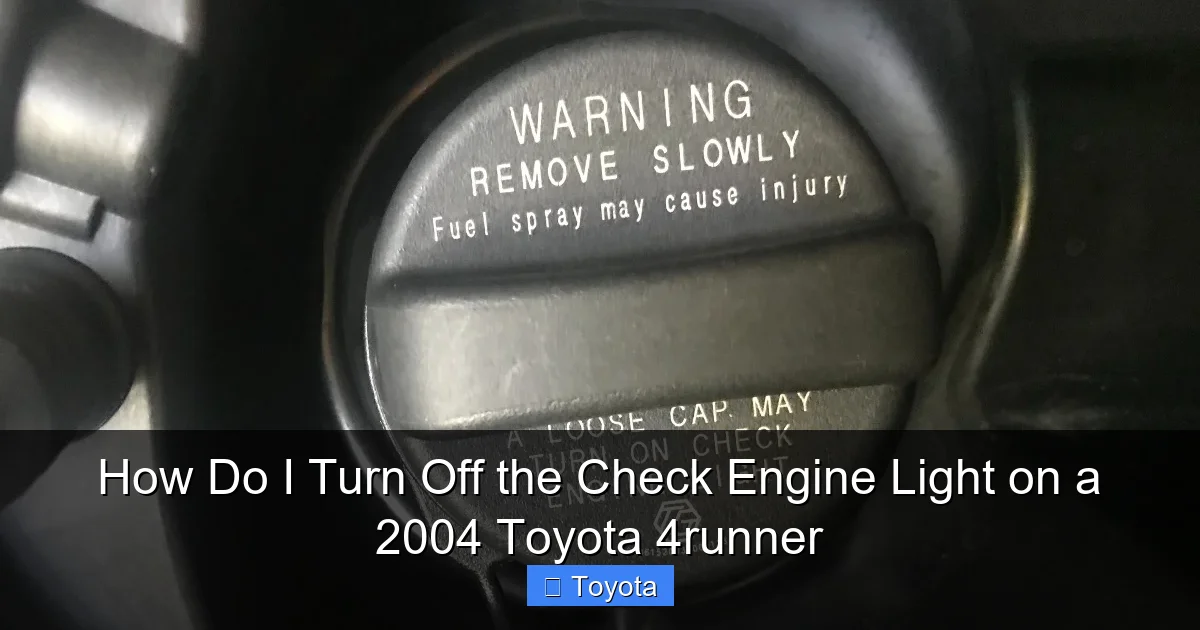
- P0440, P0441, P0446: Evaporative Emission (EVAP) System. Often a loose or cracked gas cap, but can also be a faulty purge valve or vent solenoid. Always start by tightening the gas cap until it clicks.
- P0420: Catalyst System Efficiency Below Threshold. This often means the catalytic converter is failing, but it can also be caused by a faulty O2 sensor or an exhaust leak.
- P0300 – P0304: Random or Cylinder-Specific Misfire. This is serious. Causes include worn spark plugs, bad ignition coils, faulty fuel injectors, or vacuum leaks.
- P0171, P0174: System Too Lean (Bank 1 or 2). The engine is getting too much air or not enough fuel. Causes include vacuum leaks, dirty MAF sensor, or weak fuel pump.
- P0135, P0155: O2 Sensor Heater Circuit. The oxygen sensor’s internal heater is faulty, preventing it from reaching operating temperature quickly.
Once you have the code and its likely cause, you can perform a targeted inspection and repair. Only after the repair is complete should you proceed to reset the light.
Methods to Reset the Check Engine Light: The Right Way and The Last Resort
Now that the problem is fixed, it’s time to clear the code and turn off that light. There are three primary methods, but only one is truly recommended for a permanent, correct reset.
Visual guide about How Do I Turn Off the Check Engine Light on a 2004 Toyota 4runner
Image source: rerev.com
Method 1: Using an OBD2 Scanner (The Correct & Recommended Method)
This is the professional, foolproof way. The same scanner you used to read the code is used to clear it.
- Ensure the ignition is “ON” (engine off).
- With the scanner still connected, navigate to the “Clear Codes” or “Erase DTCs” function.
- Select it. The scanner will communicate with the ECM and wipe the stored trouble code(s).
- Turn the ignition off, then back on. The check engine light should be off.
- Start the engine and let it idle for a minute. The light should remain off. Drive the vehicle normally. The code is cleared, but the ECM will continue to monitor the repaired system. If the problem recurs, the light will come back on, and a new code may be stored.
Why this is best: It’s specific, it doesn’t affect any other vehicle systems, and it’s what technicians do. It’s the clean, proper reset.
Method 2: The Battery Disconnect Trick (A Blunt Instrument)
This old-school method involves disconnecting the negative battery terminal for a period of time (usually 10-15 minutes). This cuts power to the ECM, forcing it to reset and lose all stored memory, including trouble codes.
How to do it: Pop the hood. Using a wrench, loosen and remove the negative (black, marked with a “-”) battery cable from the terminal. Wait 15 minutes. Reconnect the cable tightly. Start the 4Runner.
MAJOR DRAWBACKS: This method is a sledgehammer. It will also reset:
- Your radio presets and security code (you may need the radio code).
- The engine’s long-term fuel trim and idle adaptations. The ECM will have to relearn these over the next few drive cycles, which can cause rough idle or poor throttle response temporarily.
- It may not clear manufacturer-specific codes that are stored in non-volatile memory.
- It’s inconvenient and can cause other electronic gremlins.
Use this only if you have no scanner and have already repaired the issue, understanding the side effects.
Method 3: The Driving Cycle (Letting the ECM Do Its Job)
Sometimes, after a repair, the ECM will automatically clear a code once it sees the monitored system is functioning within spec for a set number of “drive cycles.” A drive cycle is a specific sequence of driving conditions (engine warm-up, steady cruising, deceleration, etc.). This can take several days of normal driving. Do not rely on this method if the light is on due to an active, unfixed problem. The code will simply return. This method is only effective after a successful repair has been made and the system has verified the fix.
Step-by-Step: Resetting the Check Engine Light on Your 2004 4Runner with an OBD2 Scanner
Let’s make this perfectly clear. Here is the definitive, safe procedure.
What You’ll Need
- An OBD2 scanner/reader (basic models are affordable and widely available).
- Your 4Runner’s ignition key.
The Process
- Diagnose First: Follow the steps in Section 2 to read and note the trouble code(s). Research the code to identify the faulty component (e.g., P0440 = gas cap or EVAP leak).
- Perform the Repair: Fix the identified problem. This could be as simple as tightening or replacing the gas cap, or as complex as replacing an O2 sensor or ignition coil. Do not skip this step.
- Verify the Repair: After the repair, it’s wise to clear the code and then drive the vehicle to see if the light returns immediately. If it does, your repair may not have been successful or there is an additional problem.
- Clear the Code: With the ignition ON (engine off), plug your scanner into the OBD2 port. Power on the scanner. Use its menu to select “Clear Codes” or “Erase DTCs.” Confirm the action. The scanner should report success.
- Final Check: Turn the ignition OFF for 10 seconds, then back to ON. The check engine light should not be illuminated. Start the engine. The light should stay off. If it comes back on immediately or after a short drive, the problem persists.
- Test Drive: Drive your 4Runner normally for at least 15-20 minutes, including highway speeds. Monitor the dash. The light should remain off. If it returns, re-scan for codes. A new or the same code indicates the repair failed or another issue exists.
When the Light Returns: Troubleshooting Recurring Issues
You’ve reset the light, driven happily for a week, and then—there it is again. This is a clear sign that the original problem was not fully resolved, or there is a secondary issue. Here’s what to do.
Visual guide about How Do I Turn Off the Check Engine Light on a 2004 Toyota 4runner
Image source: mechanicask.com
Why Did It Come Back? Common Scenarios
- Incomplete Repair: The gas cap was tightened but the seal is cracked. A new spark plug was installed but the ignition coil was the actual faulty part.
- Incorrect Part: A generic or incorrect replacement part (like an aftermarket O2 sensor) may not meet Toyota’s specifications and can trigger codes.
- Related Failure: Fixing one issue reveals another. For example, an exhaust leak (causing P0420) might have also damaged an O2 sensor, which now throws a new code.
- Faulty New Component: The part you just installed is defective (DOA – Dead On Arrival).
Fix the Problem, Not Just the Light
When the light returns, you must re-scan. The code may be the same, or it may be different. Treat it as a new diagnosis. Go back to the code’s definition and perform a thorough inspection. For a recurring EVAP code, check for cracks in the charcoal canister or hoses. For a recurring misfire, consider that all coils and plugs on that bank may need replacement. The check engine light is your persistent, honest advisor. When it returns, it’s telling you the job isn’t done yet.
Preventative Maintenance: Your Best Defense Against the Glowing Light
The ultimate way to “turn off” the check engine light is to never let it come on in the first place. Consistent, proper maintenance is the cornerstone of a healthy 4Runner.
Regular Servicing: Your Best Defense
Follow the severe or standard maintenance schedule in your owner’s manual. For a 2004 4Runner, this typically includes:
- Spark Plugs & Ignition Coils: Replace spark plugs every 30,000-60,000 miles. Worn plugs cause misfires (P0300 codes). Inspect/replace ignition coils as needed.
- Air Filter: A clogged air filter starves the engine of air, causing lean conditions (P0171). Replace every 15,000-30,000 miles.
- Oxygen Sensors: These wear out. Plan for replacement around 100,000 miles. Faulty O2 sensors hurt fuel economy and trigger codes (P0130-P0160).
- Fuel Cap: Ensure it’s tightened properly after every fill-up. Replace the cap if the seal is cracked or missing to prevent EVAP codes (P0440).
- PCV Valve & Hoses: A stuck PCV valve or cracked vacuum hose is a classic cause of lean codes and rough idle.
Adhering to this schedule addresses the most common causes of check engine lights. It’s also helpful to be aware of other dashboard service lights. For instance, your 4Runner has a separate maintenance required light that reminds you of oil changes and other routine service. Knowing how to turn off the maintenance light on a Toyota after you’ve done the work is a separate but related skill. Similarly, if you see a VSC TRAC light, that’s a different system altogether, and you’d need to consult a specific guide like how to turn off VSC TRAC light on a Toyota 4Runner.
Simple Checks You Can Do Yourself
Between services, be proactive:
- Listen for new noises (hissing = vacuum leak, popping = misfire).
- Notice changes in performance (rough idle, hesitation, poor fuel economy).
- Smell for fuel (evap leak) or sulfur (catalyst issue).
- Visually inspect under the hood for disconnected or cracked hoses and wires.
Catching a small problem early—like a slightly loose gas cap or a frayed wire—prevents it from becoming a big, code-triggering problem.
Conclusion: Knowledge is Power (and Savings)
Your 2004 Toyota 4Runner is a reliable, capable machine, but like any complex equipment, it needs care. The check engine light is a vital part of that care ecosystem. It is not an enemy to be silenced, but a messenger to be heeded. The correct sequence is always: Diagnose with an OBD2 scanner → Research the code → Repair the faulty component → Clear the code with the scanner → Verify the fix. By following this disciplined approach, you protect your investment, ensure your 4Runner runs cleanly and efficiently, pass emissions tests, and avoid the cycle of a light that keeps coming back. Remember, if at any point the diagnosis or repair feels beyond your comfort level—especially with a flashing light—there is no shame in consulting a certified Toyota technician. Your engine’s health is worth the professional investment. Now, go forth, diagnose wisely, and keep your 4Runner’s light off for the right reasons.
Frequently Asked Questions
Can I just pull the fuse for the check engine light to turn it off?
No. The check engine light is controlled by the Engine Control Module (ECM). Pulling a fuse may turn off the light temporarily, but it will also likely disable critical engine systems, preventing your 4Runner from starting or running. It does not clear the underlying trouble code, and the light will return as soon as the system powers back up.
How much does it cost to diagnose a check engine light?
The cost varies. Many auto parts stores, like AutoZone or O’Reilly, offer free code reading as a customer service. A repair shop or dealership will typically charge a diagnostic fee (often $80-$150) which is usually applied to the repair if you proceed with them. This fee covers their time, expertise, and advanced scan tools.
Will the check engine light reset itself?
It can, but only under very specific conditions. If the problem that triggered the code was a one-time, transient event (like a single loose gas cap click) and the ECM verifies the system is functioning correctly for a set number of drive cycles (often 3-5), it may automatically clear the code. However, for any persistent mechanical or electrical fault, the light will remain on until the code is manually cleared after a repair.
My 4Runner passed an emissions test with the light on. Is that possible?
Generally, no. In most states, a vehicle with an illuminated check engine light will automatically fail an emissions (smog) test. The light is a direct indicator that the vehicle’s emissions system is not operating within legal limits. If your light was on during a test, it likely failed, or the tester may have cleared the code before testing, which is often against regulations.
What’s the difference between a check engine light and a service engine soon light?
Functionally, they are the same thing. Both are amber/yellow lights that indicate the ECM has stored a diagnostic trouble code. “Service Engine Soon” is a common label on older vehicles, while “Check Engine” is more standard now. They serve the identical purpose of alerting you to a powertrain-related issue.
How often should I have my 4Runner’s codes checked?
You should only scan for codes when the light comes on. However, as part of preventative maintenance, it’s not a bad idea to have a professional scan done during a major service interval (e.g., every 30,000 miles) to catch any pending or intermittent codes before they trigger the light. This is especially useful for monitoring systems like the EVAP system that can have small leaks that don’t yet set a hard code.