
How Do I Know If My Toyota Is Built in Japan or the Usa

Knowing where your Toyota was built is easier than you think. By checking your Vehicle Identification Number (VIN) or the manufacturer’s label on the door jamb, you can quickly determine if your car originated in Japan or the USA. This information affects parts compatibility, resale value, and even your perception of quality.
Key Takeaways
- The VIN is your most reliable source: The 10th character of your 17-digit VIN directly codes the manufacturing plant country.
- Check the driver’s door jamb label: This sticker typically states “Made in Japan” or “Made in USA” clearly.
- Model matters: Certain Toyota models, like the 4Runner, are exclusively built in Japan, while others, like the Tacoma, are USA-only.
- Some models are built in both: Popular models like the Camry and RAV4 have production lines in both countries, so VIN decoding is essential.
- Production changes over time: A model’s manufacturing location can shift between model years, so always verify with your specific VIN.
📑 Table of Contents
- Why Does It Matter Where Your Toyota Was Built?
- Method 1: Decoding the VIN (The Gold Standard)
- Method 2: The Manufacturer’s Compliance Label (The Sticker)
- Method 3: Understanding Toyota’s Production Footprint
- Method 4: Other Clues and Cross-Verification
- Conclusion: The Quick and Certain Path to Your Answer
Why Does It Matter Where Your Toyota Was Built?
You might be curious about your Toyota’s birthplace for several reasons. Maybe you’ve heard the long-standing debate about Japanese versus American manufacturing quality. Perhaps you’re buying parts and need to ensure compatibility, as some components can vary slightly between production plants. Or you could be preparing to sell your car and know that certain buyers have preferences for vehicles from specific factories. Whatever your reason, the answer is firmly within your grasp. You don’t need to be a detective or contact Toyota headquarters. With a few simple checks, you can become an expert on your own vehicle’s origin.
The good news is that Toyota, like all major automakers, is required to provide this information transparently. They stamp it on the car itself and encode it in the unique Vehicle Identification Number. Forget myths and rumors; the truth is printed on a label in your driver’s door and hidden in plain sight on your dashboard. Let’s walk through the exact, foolproof methods to solve this mystery for your specific Toyota.
Method 1: Decoding the VIN (The Gold Standard)
The Vehicle Identification Number, or VIN, is a 17-character code that is your car’s unique fingerprint. It contains a wealth of information, and the 10th character is specifically dedicated to indicating the plant where your vehicle was assembled. This is the single most accurate and authoritative method available.
Visual guide about How Do I Know If My Toyota Is Built in Japan or the Usa
Image source: i.ytimg.com
What is a VIN?
A VIN is a standardized code used globally since 1981. Each character has a specific meaning. The first three characters are the World Manufacturer Identifier (WMI), which tells you the manufacturer (Toyota’s WMI starts with J for Japan, 5 for USA, etc.). Characters 4-8 describe the vehicle’s attributes (body style, engine type, series). The 9th character is a check digit used for security. The 10th character is the model year (with some nuances). The 11th character is the plant code. Characters 12-17 are the serial number.
Finding Your VIN
You can find your VIN in several places:
- Dashboard: Look through the driver’s side windshield at the bottom corner. It’s usually on a small metal plate.
- Driver’s Side Door Jamb: Open the door and look at the area where the door latches. There’s a sticker or plate there with the VIN.
- Vehicle Registration & Title: Your official paperwork will list the VIN.
- Insurance Card/Policy: Your insurer has it on file.
Decoding the 10th and 11th Characters
Here’s the critical part for our question. The 10th character represents the model year (e.g., A=2010, B=2011… with some exceptions for 1980s and 2020s). The 11th character is the plant code, which tells you the factory. However, the country is often inferred from the plant code, but the most direct method is to use an online VIN decoder that interprets the entire string for you.
For a quick manual check, you can look at the first character (the WMI). A VIN starting with J typically means the vehicle was manufactured in Japan. A VIN starting with 5 typically means it was manufactured in the USA. But this is not 100% foolproof for all models and years, as some WMIs are used for multiple plants. The plant code (11th character) is more precise.
Using Online VIN Decoders
The easiest way is to use a free online VIN decoder. Websites like the official Toyota owner’s portal, or reputable third-party sites like the National Highway Traffic Safety Administration (NHTSA) VIN decoder, will take your 17-digit number and provide a full report. This report will explicitly state the “Plant” or “Assembly Plant” and its location (city, state, country). Simply enter your VIN, and within seconds, you’ll have a definitive answer. This method eliminates all guesswork and is recommended for absolute certainty.
Method 2: The Manufacturer’s Compliance Label (The Sticker)
If you want a physical, on-the-car confirmation without a computer, look no further than the driver’s side door jamb. On the door pillar or the door edge itself, you’ll find a permanent sticker or metal plate. This is the vehicle’s certification label, required by the federal government.
Visual guide about How Do I Know If My Toyota Is Built in Japan or the Usa
Image source: thedrive.com
Where to Find It
Open the driver’s side door fully. Look at the large, usually yellow or white, sticker on the door pillar (the B-pillar) or sometimes on the door frame itself. It’s filled with codes for tire pressure, paint color, and weights.
Reading the “Made In” Statement
On this label, there is almost always a line that says “MANUFACTURED BY” or “MADE IN”. It will clearly state either “TOYOTA MOTOR CORPORATION” (indicating Japan) or “TOYOTA MOTOR MANUFACTURING, [State, USA]” (e.g., Kentucky, Indiana, Texas). Sometimes it simply says “JAPAN” or “USA”. This is a direct, unambiguous statement from the manufacturer placed on every vehicle at the factory. It is perhaps the second quickest method after a VIN decoder and requires no internet access.
Method 3: Understanding Toyota’s Production Footprint
Knowing which models are generally built where can give you a very strong educated guess before you even check the VIN or label. Toyota has strategically located plants to serve regional markets. However, it’s vital to remember that production assignments can and do change.

Visual guide about How Do I Know If My Toyota Is Built in Japan or the Usa
Image source: cdn.tuoitre.vn
Models Primarily Built in Japan
These models are often the core of Toyota’s global export strategy and are frequently associated with their “halo” vehicles.
- Toyota 4Runner: Has always been produced solely in Japan (Tahara plant). This is a consistent fact. If you own a 4Runner, it is Japanese-built. You can read more about the 4Runner’s dedicated Japanese production in our detailed guide Where Is The Toyota 4Runner Built.
- Toyota Land Cruiser & LX: The legendary Land Cruiser (and its Lexus LX sibling) is built exclusively in Japan.
- Toyota Prius & Prius Prime: Historically and currently, the primary production for the global hybrid pioneer has been in Japan.
- Toyota GR86 / Subaru BRZ: This sports car joint venture is assembled at Subaru’s Gunma plant in Japan.
- Toyota Corolla (Hatchback/Sedan for global markets): While the US gets some Corollas from Mississippi, many global Corollas, especially the hatchback, come from Japan or other plants.
Models Primarily Built in the USA
Toyota’s American manufacturing arm, Toyota Motor Manufacturing (TMM), operates large facilities in states like Kentucky, Indiana, Texas, Mississippi, and Alabama. Models built here are primarily for the North American market.
- Toyota Tacoma: The iconic midsize pickup is built exclusively in the USA (San Antonio, Texas, and Tijuana, Baja California). It is not exported from Japan. If you have a Tacoma, it is American-made. For specifics on Tacoma configurations, including its bed size, see our article How Big Is The Bed Of A Toyota Tacoma.
- Toyota Tundra & Sequoia: These full-size trucks and SUVs are built at Toyota’s massive plant in San Antonio, Texas.
- Toyota Sienna: The minivan has been produced exclusively in the USA (Indiana) since its inception.
- Toyota Camry: The best-selling car in America for years is a prime example of a model built in both countries. However, the vast majority of Camrys sold in the USA are built in Kentucky (Georgetown) or Indiana. Japanese-built Camrys are rare in the US market. For details on Camry specifications, including its gas tank capacity which can vary slightly, check How Big Is The Gas Tank On A Toyota Camry.
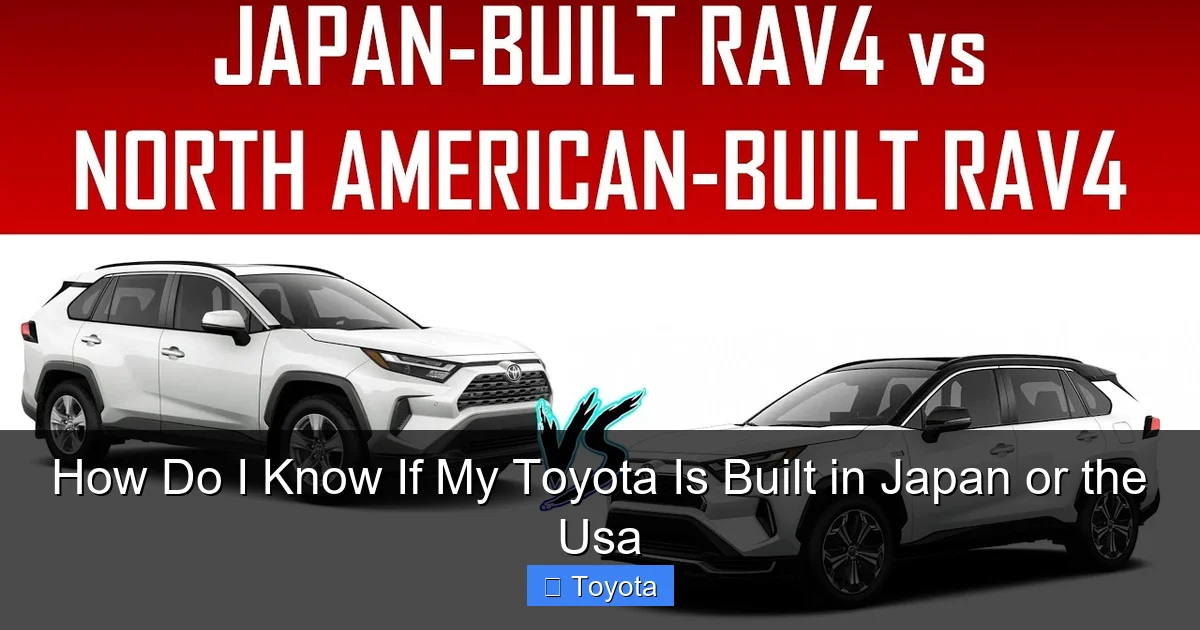
- Toyota RAV4: This is a complex case. RAV4s for the US market are now primarily built in Georgetown, Kentucky, and Princeton, Indiana. Some older models and those for other global markets come from Japan or Canada.
The “Both Countries” Category
For models like the Camry and RAV4, your specific VIN is the only way to know for sure where your individual car was assembled. A 2022 Camry built in Kentucky and a 2022 Camry built in Japan (for export) could both exist, but the US dealer inventory is overwhelmingly domestic. The same applies to the Corolla, which has production in Mississippi (USA) and other global plants.
Method 4: Other Clues and Cross-Verification
While the VIN and door jamb label are definitive, other pieces of information can support your findings or provide clues if labels are missing.
Build Date and Model Year
Cross-reference your car’s model year with known production shifts. For example, if you have a 2023 Tacoma, it was undoubtedly built in the USA because that model has never been produced in Japan. Conversely, a 2023 4Runner was built in Japan. For models with mixed production, the build date (often found on the driver’s door jamb sticker or in the VIN) can be compared against publicly available production start/end dates for specific plants. Toyota’s corporate press releases sometimes announce when a new plant starts building a model.
Dealer Documentation and Marketing
Your original window sticker (if you have it) or any dealer brochures from when the car was new might mention the assembly plant. Sometimes, marketing materials highlight “Built in [City, State]” as a selling point for American-made trucks. This is less common for imported models.
Common Misconceptions to Avoid
- “Japanese cars are always built in Japan”: False. Toyota builds millions of vehicles in North America for the local market.
- “A VIN starting with J always means Japan”: Mostly true for Toyotas, but the 11th character (plant code) is more precise. A J-prefix VIN could theoretically be from a plant outside Japan in rare legacy cases, but for modern Toyotas, J almost always means Japan.
- “The engine origin determines the car’s origin”: False. Engines and transmissions are often sourced from different plants, sometimes even different countries. The final assembly plant is what defines where the car is “built.”
- “My car feels/looks Japanese/American, so I know”: This is subjective and unreliable. Design and feel are not indicators of manufacturing location.
Conclusion: The Quick and Certain Path to Your Answer
So, how do you know if your Toyota is built in Japan or the USA? Start with the simplest, most direct method: open your driver’s side door and read the compliance label on the door jamb. The “MADE IN” statement is right there. For rock-solid verification that also gives you other details, use your VIN in a free online decoder. The 10th and 11th characters will reveal the plant code, which you can cross-reference with Toyota’s published plant codes.
Arm yourself with general knowledge about your model’s typical production—a 4Runner is Japanese, a Tacoma is American. But for the models that straddle the Pacific like the Camry and RAV4, your VIN is the final authority. This knowledge is more than a trivia answer; it’s practical information that can guide your maintenance decisions, inform your next purchase, and satisfy your curiosity about the global journey of your vehicle. Your Toyota’s birthplace is a fixed fact, and you now have the keys to unlock it.
Frequently Asked Questions
Can I determine the manufacturing country just from the license plate or registration?
No. The license plate and registration are issued by state or country governments and only link the vehicle to its owner and legal status. They do not contain manufacturing details. You must use the VIN or physical labels on the vehicle itself.
If my VIN starts with a ‘J’, does that always mean it was built in Japan?
For Toyota vehicles, a VIN starting with ‘J’ almost always indicates the vehicle was assembled in Japan. The ‘J’ is the World Manufacturer Identifier for Toyota Motor Corporation in Japan. However, for absolute certainty, you should still decode the full VIN to see the specific plant code (11th character), as this confirms the exact factory.
Are Toyotas built in the USA of lower quality than those built in Japan?
No. Toyota maintains identical global quality standards across all its manufacturing plants. A Toyota built in Georgetown, Kentucky, or San Antonio, Texas, undergoes the same rigorous Toyota Production System (TPS) and quality control processes as one built in Tahara, Japan. Consumer reports and reliability studies consistently show no significant quality difference based solely on the North American versus Japanese assembly plant for modern Toyotas.
Does the manufacturing location affect my warranty or service?
No. Your vehicle’s warranty is a global promise from Toyota Motor Corporation and is honored at any authorized Toyota dealership worldwide, regardless of where the vehicle was built. Service technicians are trained on all variants of a model, and parts logistics networks ensure necessary components are available everywhere.
My door jamb label is missing or faded. What should I do?
If the label is damaged or missing, do not panic. Your VIN is the ultimate backup. Use a free online VIN decoder as described above. You can also contact a Toyota dealership’s service department; they can look up your VIN in their internal systems and tell you the exact assembly plant. As a last resort, you can contact Toyota Customer Service with your VIN.
Can a single model year have both Japanese and USA-built examples in the same market?
Yes, but it’s model-dependent and market-specific. For instance, the Toyota Camry and RAV4 are both produced in the USA *for the USA market* and also in Japan *for export to other markets*. You generally will not find a Japanese-built Camry or RAV4 on a US dealer’s new car lot because the US plants produce enough volume to supply North America. However, in the used market, you might encounter a parallel import or a vehicle originally sold elsewhere. Therefore, for these models, always verify with the VIN if the origin is important to you.
