
How Bugatti’s Quad-turbo Tech Achieves Unmatched Speed

Bugatti’s quad-turbo technology is the secret behind its jaw-dropping speed, combining four turbochargers with a W16 engine to deliver over 1,500 horsepower. This advanced system eliminates turbo lag, maximizes airflow, and ensures relentless acceleration from standstill to over 300 mph.
When you think of speed, one name roars to the front of the mind: Bugatti. It’s not just about luxury or style—it’s about raw, unfiltered velocity. From the Veyron to the Chiron, Bugatti has consistently pushed the boundaries of what a road-legal car can achieve. But what’s the magic behind these mechanical marvels? The answer lies in a groundbreaking piece of engineering: the quad-turbocharged W16 engine.
This isn’t your average turbo setup. Most high-performance cars use one or two turbos to force more air into the engine, boosting power. But Bugatti takes it to another level—four turbos working in perfect harmony. The result? A symphony of speed, precision, and power that leaves competitors in the dust. Whether you’re accelerating from 0 to 60 mph in under 2.4 seconds or cruising at over 300 mph, Bugatti’s quad-turbo tech makes the impossible feel routine.
But how exactly does it work? And why is it so effective? In this deep dive, we’ll explore the science, engineering, and innovation behind Bugatti’s quad-turbo system. You’ll learn how four turbos eliminate lag, how the W16 engine handles extreme stress, and how every component is fine-tuned for peak performance. Whether you’re a car enthusiast, a tech lover, or just curious about speed, this is the story of how Bugatti turns physics into poetry.
Key Takeaways
- Quad-turbo setup eliminates turbo lag: By using two small and two large turbos, Bugatti ensures instant throttle response at all engine speeds.
- W16 engine delivers unmatched power: The 8.0-liter quad-turbocharged W16 engine produces over 1,500 horsepower, making it one of the most powerful production engines ever built.
- Precision engineering enables extreme speeds: Every component is meticulously crafted to handle immense heat, pressure, and stress at high velocities.
- Sequential turbocharging optimizes performance: Turbos activate in stages—small ones for low RPMs, large ones for high RPMs—ensuring smooth, continuous power delivery.
- Advanced cooling systems prevent overheating: Multiple radiators and oil coolers keep the engine and turbos operating within safe temperature ranges.
- Aerodynamics and weight reduction complement power: Lightweight materials and active aerodynamics help translate raw power into real-world speed.
- Real-world validation through record-breaking runs: The Chiron Super Sport 300+ proved the tech’s capability by exceeding 300 mph in a production car.
📑 Table of Contents
- The Heart of the Beast: The W16 Engine
- Understanding Turbocharging: The Basics
- The Quad-Turbo System: Engineering Genius
- Cooling the Beast: Managing Extreme Heat
- Aerodynamics and Weight: The Supporting Cast
- Real-World Validation: Record-Breaking Performance
- The Future of Quad-Turbo Technology
- Conclusion
The Heart of the Beast: The W16 Engine
At the core of every Bugatti hypercar is the legendary W16 engine. This isn’t just a big engine—it’s a masterpiece of mechanical design. Imagine two V8 engines fused together in a “W” configuration, creating 16 cylinders that fire in perfect sequence. The result is an 8.0-liter powerhouse capable of producing over 1,500 horsepower and 1,180 lb-ft of torque.
But size alone doesn’t explain its dominance. The W16’s true brilliance lies in its balance of power and refinement. Unlike older large-displacement engines that were heavy and inefficient, Bugatti’s W16 is compact, lightweight, and incredibly responsive. It’s built with advanced materials like forged aluminum pistons, titanium connecting rods, and a magnesium intake manifold—all designed to reduce weight while increasing strength.
Why a W16?
You might wonder: why not a V12 or a flat-12? The answer is packaging and performance. A W16 allows Bugatti to fit 16 cylinders into a space similar to a V12, making it ideal for a mid-engine layout. This compact design improves weight distribution and handling, crucial for a car that can hit 300 mph. Plus, the firing order and cylinder arrangement create a smooth, linear power delivery that feels almost electric.
The W16 also benefits from decades of racing and aerospace engineering. Bugatti’s parent company, Volkswagen Group, brought in experts from Audi, Lamborghini, and Porsche to refine the design. The result is an engine that’s not just powerful, but also reliable under extreme conditions.
Power Output and Real-World Performance
Let’s talk numbers. The Bugatti Chiron’s quad-turbo W16 produces 1,500 horsepower at 6,700 rpm and 1,180 lb-ft of torque from 2,000 to 6,000 rpm. That’s enough to launch the car from 0 to 60 mph in just 2.3 seconds and reach a top speed of 261 mph (electronically limited). The Chiron Super Sport 300+ goes even further, hitting 304.773 mph in a record-setting run.
But power isn’t just about peak numbers. It’s about how that power is delivered. The W16’s broad torque curve means instant acceleration at any speed. Whether you’re merging onto a highway or overtaking on a backroad, the response is immediate and brutal. This is where the quad-turbo system truly shines.
Understanding Turbocharging: The Basics
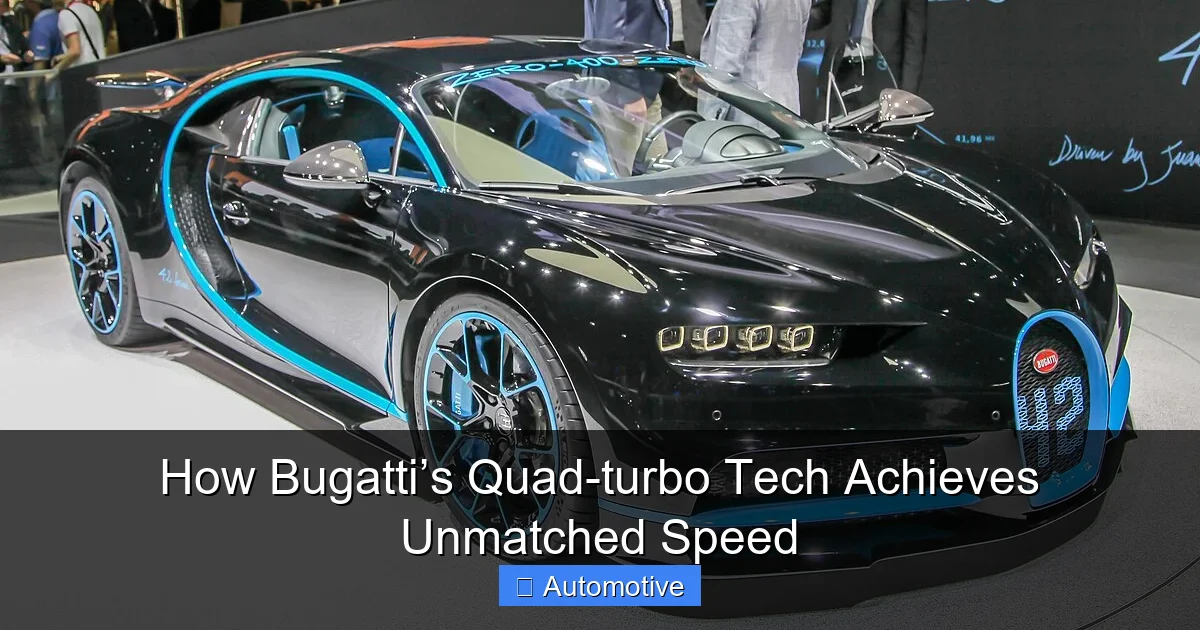
Visual guide about How Bugatti’s Quad-turbo Tech Achieves Unmatched Speed
Image source: upload.wikimedia.org
Before we dive into the quad-turbo magic, let’s quickly cover how turbocharging works. A turbocharger uses exhaust gases to spin a turbine, which drives a compressor that forces more air into the engine. More air means more fuel can be burned, creating more power.
But turbos have a well-known flaw: turbo lag. This is the delay between pressing the accelerator and feeling the surge of power. It happens because the turbine needs time to spool up, especially at low engine speeds. For a car that aims to dominate at both city speeds and racetrack velocities, lag is a dealbreaker.
Single vs. Twin vs. Quad Turbo
Most performance cars use a single turbo or twin-turbo setup. A single turbo is simple and cost-effective but suffers from lag. Twin turbos—either two small ones (twin-scroll) or one per bank of cylinders—reduce lag and improve response. But even twin turbos have limits, especially in a 16-cylinder engine.
That’s where quad-turbo comes in. By using four turbos, Bugatti can optimize performance across the entire rev range. The system uses a combination of small and large turbos, each designed for specific engine speeds. This approach eliminates lag, maximizes efficiency, and delivers seamless power.
How Turbo Lag Is Eliminated
Turbo lag is the enemy of performance. Bugatti’s solution? A sequential turbocharging strategy. At low RPMs, the two smaller turbos handle the load. They spool up quickly, providing instant boost and eliminating lag. As engine speed increases, the larger turbos kick in, delivering massive airflow for high-end power.
This staged approach ensures that there’s always a turbo ready to respond. No waiting. No hesitation. Just pure, uninterrupted acceleration. It’s like having a team of sprinters and marathon runners working together—each excelling in their zone, but all contributing to the same goal.
The Quad-Turbo System: Engineering Genius

Visual guide about How Bugatti’s Quad-turbo Tech Achieves Unmatched Speed
Image source: c4.wallpaperflare.com
Now, let’s get into the nitty-gritty of Bugatti’s quad-turbo system. This isn’t just four turbos bolted onto an engine—it’s a carefully orchestrated dance of airflow, timing, and precision.
Sequential Turbo Activation
The key to the system is sequential activation. At idle and low speeds, only the two smaller turbos are active. They’re designed to spool up quickly, providing boost as soon as you touch the throttle. This eliminates the dreaded lag that plagues many turbocharged engines.
As engine speed climbs past 3,000 rpm, the larger turbos begin to engage. These are bigger, more powerful units capable of moving vast amounts of air at high RPMs. They take over the heavy lifting, allowing the engine to breathe deeply and produce peak power.
The transition between small and large turbos is seamless, thanks to advanced engine management software. Sensors monitor engine load, RPM, and throttle position in real time, adjusting boost pressure and turbo engagement accordingly. The result? A smooth, linear power curve that feels more like a rocket launch than a car.
Airflow and Intercooling
More air means more power, but it also means more heat. Compressing air increases its temperature, which reduces density and can cause engine knocking. To combat this, Bugatti uses a sophisticated intercooling system.
After the air is compressed by the turbos, it passes through multiple intercoolers—devices that cool the air before it enters the engine. Bugatti uses both air-to-air and water-to-air intercoolers, depending on the model. These systems can reduce intake air temperatures by over 100°F, ensuring dense, cool air for maximum combustion efficiency.
The intercoolers are strategically placed to maximize airflow and minimize pressure drop. In the Chiron, for example, there are four intercoolers—one for each turbo. This ensures that each cylinder receives the same amount of cool, dense air, promoting even combustion and reducing stress on the engine.
Materials and Durability
Running four turbos at high boost pressures generates immense heat and stress. The turbine wheels spin at over 200,000 rpm, and exhaust gases can reach temperatures exceeding 1,600°F. To handle this, Bugatti uses exotic materials like Inconel, a nickel-based superalloy known for its strength and heat resistance.
The turbo housings are cast from high-grade stainless steel, while the compressor wheels are made from lightweight titanium aluminide. These materials not only withstand extreme conditions but also reduce rotational mass, allowing the turbos to spool up faster.
Every component is tested rigorously. Turbos are subjected to thermal cycling, vibration tests, and endurance runs to ensure they can handle the demands of real-world driving. Bugatti even uses computational fluid dynamics (CFD) simulations to optimize airflow and reduce turbulence.
Cooling the Beast: Managing Extreme Heat
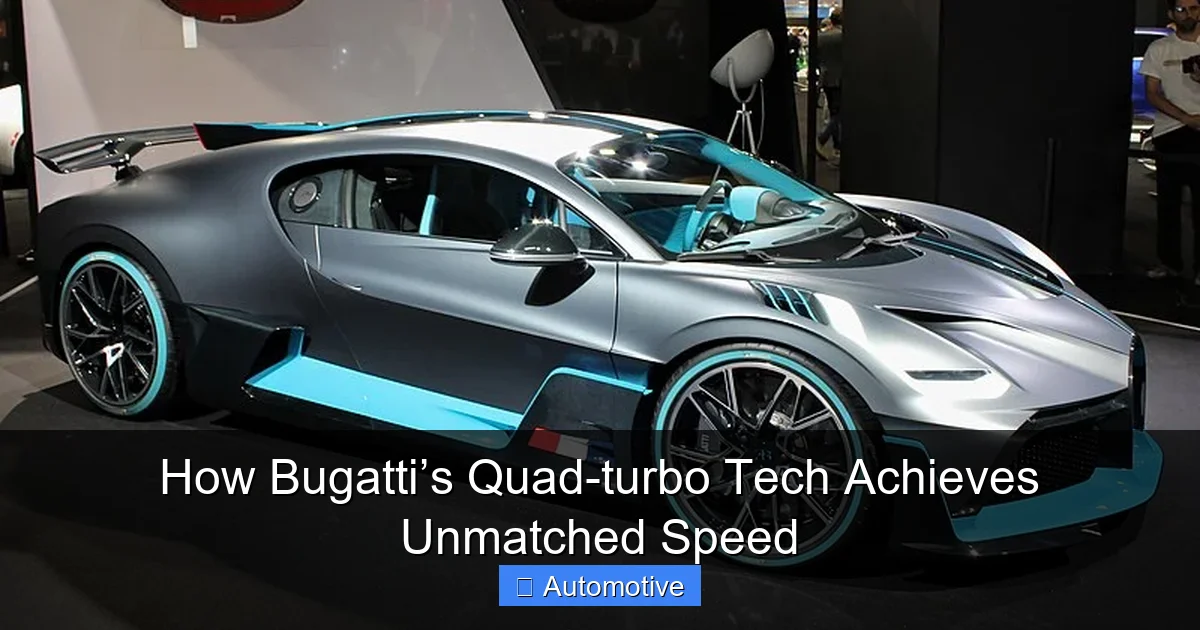
Visual guide about How Bugatti’s Quad-turbo Tech Achieves Unmatched Speed
Image source: carwiki.de
With great power comes great heat. The quad-turbo W16 generates enough thermal energy to warm a small house. If not managed properly, this heat can lead to engine failure, reduced performance, or even fire. That’s why Bugatti’s cooling system is just as advanced as its engine.
Multiple Radiators and Cooling Zones
The Chiron, for example, has 10 radiators—yes, ten. These aren’t just for the engine. They’re divided into separate cooling zones: engine coolant, transmission oil, differential oil, turbo oil, and intercooler coolant. Each system has its own radiator and cooling circuit, ensuring that heat is managed efficiently.
The radiators are mounted in strategic locations to maximize airflow. Some are behind the front bumper, while others are integrated into the side intakes. Active aerodynamic flaps open and close based on speed and temperature, directing air where it’s needed most.
Oil Cooling and Lubrication
Oil does more than lubricate—it also carries heat away from critical components. Bugatti uses a dry-sump oil system, which stores oil in a separate tank rather than the oil pan. This prevents oil starvation during high-G cornering and ensures consistent lubrication.
The oil is cooled by multiple heat exchangers, including one dedicated to the turbochargers. This keeps turbo temperatures in check and extends component life. The system can circulate over 20 liters of oil, maintaining optimal viscosity even under extreme loads.
Thermal Management Software
Modern cooling isn’t just about hardware—it’s also about software. Bugatti’s engine control unit (ECU) monitors over 2,000 parameters in real time, including coolant temperature, oil pressure, and turbo speed. If any value exceeds safe limits, the system adjusts boost pressure, fuel delivery, or cooling fan speed to prevent damage.
This intelligent thermal management allows the engine to operate at peak performance without overheating, even during prolonged high-speed runs.
Aerodynamics and Weight: The Supporting Cast
Power is nothing without control. Even the most powerful engine can’t achieve top speed if the car isn’t aerodynamically stable or too heavy. Bugatti understands this, which is why every Chiron and Veyron is a masterpiece of balance.
Active Aerodynamics
At high speeds, aerodynamics become critical. Too much drag slows the car down; too much lift makes it unstable. Bugatti uses active aerodynamics to adapt to driving conditions. The rear wing, for example, adjusts its angle based on speed. At low speeds, it lies flat to reduce drag. At high speeds, it tilts up to increase downforce.
The front splitter and underbody diffuser also work together to manage airflow. Vents and ducts channel air around the car, reducing turbulence and improving cooling. The result is a car that stays glued to the road, even at 300 mph.
Lightweight Materials
Every gram counts when you’re pushing the limits of physics. Bugatti uses carbon fiber extensively in the chassis, body panels, and interior. The monocoque is made from a single piece of carbon fiber, providing incredible strength with minimal weight.
Other lightweight materials include magnesium for the dashboard frame, titanium for exhaust components, and aluminum for suspension parts. The Chiron weighs around 4,400 pounds—heavy for a supercar, but impressive given its size and power.
Weight Distribution and Handling
With a mid-engine layout, Bugatti achieves near-perfect weight distribution—around 45% front, 55% rear. This improves traction, cornering, and stability. The all-wheel-drive system sends power to all four wheels, ensuring maximum grip during acceleration.
Advanced suspension systems, including adaptive dampers and hydraulic anti-roll bars, keep the car balanced and responsive. Whether you’re carving through corners or blasting down a straight, the Chiron feels planted and precise.
Real-World Validation: Record-Breaking Performance
Theory is one thing. Real-world performance is another. Bugatti has repeatedly proven its quad-turbo tech through record-setting runs and public demonstrations.
The Chiron Super Sport 300+
In 2019, Bugatti made history when the Chiron Super Sport 300+ became the first production car to exceed 300 mph. Driven by Andy Wallace on the Ehra-Lessien test track in Germany, the car reached 304.773 mph (490.484 km/h). This wasn’t a prototype or a one-off—it was a road-legal car with license plates.
The run required extensive modifications: a longer gear ratio, improved aerodynamics, and a tuned version of the quad-turbo W16. But the core technology remained the same. It proved that Bugatti’s engineering wasn’t just theoretical—it was capable of real-world extremes.
Everyday Usability
Despite its performance, the Chiron is surprisingly usable. The suspension can be adjusted for comfort, the interior is luxurious, and the infotainment system is modern and intuitive. You can drive it to the grocery store or on a cross-country trip—though you might attract some attention.
This balance of usability and performance is a testament to Bugatti’s holistic approach. It’s not just about speed; it’s about creating a complete driving experience.
The Future of Quad-Turbo Technology
As emissions regulations tighten and electric vehicles rise, the future of internal combustion engines is uncertain. But Bugatti isn’t standing still. The brand is exploring hybrid systems, like the one in the Bolide concept, which combines the W16 with electric motors for even greater performance.
The quad-turbo system may evolve, but its principles—eliminating lag, maximizing airflow, and managing heat—will remain relevant. Whether it’s used in a hypercar or a high-performance sedan, the technology pioneered by Bugatti will influence the automotive world for years to come.
Conclusion
Bugatti’s quad-turbo technology is more than just a marketing buzzword—it’s a feat of engineering that redefines what’s possible. By combining four turbos with a W16 engine, advanced cooling, and precision aerodynamics, Bugatti delivers unmatched speed without sacrificing usability.
From eliminating turbo lag to managing extreme heat, every aspect of the system is designed for peak performance. And with real-world validation through record-breaking runs, there’s no doubt that this technology works.
So the next time you see a Bugatti streak past, remember: it’s not just a car. It’s a rolling masterpiece of speed, science, and innovation.
Frequently Asked Questions
How does Bugatti’s quad-turbo system eliminate turbo lag?
Bugatti uses two small turbos for low RPM response and two large turbos for high-end power. The small turbos spool up instantly, eliminating lag, while the large ones take over at higher speeds for maximum airflow.
What engine does Bugatti use in its quad-turbo cars?
Bugatti uses an 8.0-liter W16 engine, which combines two V8 configurations into a compact, powerful unit. It’s paired with four turbochargers to deliver over 1,500 horsepower.
How fast can a Bugatti go with quad-turbo tech?
The Bugatti Chiron has a top speed of 261 mph (electronically limited), while the Chiron Super Sport 300+ reached 304.773 mph in a record-setting run, making it the first production car to break 300 mph.
How does Bugatti manage heat from the quad-turbo system?
Bugatti uses 10 radiators, multiple oil coolers, and advanced thermal management software to keep the engine and turbos cool. Intercoolers reduce intake air temperature, while dry-sump lubrication prevents oil starvation.
Is the quad-turbo system reliable under extreme conditions?
Yes. Bugatti uses high-strength materials like Inconel and titanium, along with rigorous testing and real-time monitoring, to ensure the system can handle extreme heat, pressure, and stress.
Can you drive a Bugatti in everyday conditions?
Absolutely. Despite its performance, the Chiron is comfortable, practical, and equipped with modern amenities. It’s designed to be driven daily, not just on racetracks.