Ford Focus Won’t Start but Has Power

Contents
- 1 Key Takeaways
- 2 📑 Table of Contents
- 3 Understanding the Symptom: “Has Power” vs. “Won’t Start”
- 4 The Fuel System: Is Gasoline Reaching the Engine?
- 5 The Ignition System: Where’s the Spark?
- 6 The Starter Motor & Starting Circuit
- 7 Security System & Key Issues (PATS)
- 8 Other Electrical Gremlins & Simple Checks
- 9 Step-by-Step Diagnostic Roadmap
- 10 Frequently Asked Questions


If your Ford Focus has power (lights, radio work) but won’t start, the problem isn’t the battery. It’s typically a fuel delivery failure, ignition system fault, faulty starter motor/circuit, immobilizer glitch, or a wiring issue. These problems prevent the engine from cranking or firing even though electrical systems are live. A methodical check of fuel pressure, spark, starter signal, and security systems is key to diagnosis.
You turn the key in your Ford Focus. The dashboard lights come on bright and steady. The radio blasts your favorite station. But when you turn to start, nothing happens. Or maybe the engine cranks and cranks but refuses to fire. Your heart sinks. This frustrating scenario—a Ford Focus that won’t start but has power—is incredibly common, and while stressful, it’s usually diagnosable and fixable without a tow truck. The good news? That full electrical power is your biggest clue. It instantly tells you the battery is likely good and the alternator is charging. The problem lies somewhere between that electrical power and the combustion happening inside the engine cylinders.
Think of starting your car like a recipe. You need fuel, air, spark, and compression. The electrical system (battery, ignition switch, starter) is the chef that initiates the process. When the chef has energy (power) but the meal isn’t made, you check the ingredients (fuel, air, spark) or the chef’s tools (starter, wiring). This guide will walk you through every possible reason your Focus is playing dead, from the simplest fuse check to the more complex immobilizer system. We’ll talk in plain language, focus on the most likely culprits for your model year, and give you actionable steps to diagnose the issue yourself before you call a mechanic. Let’s get to the bottom of why your Ford Focus won’t start but has power.
Key Takeaways
- Power rules out the battery: Working lights and radio confirm the battery and charging system are functional, pointing to starting or fuel systems.
- Listen for clues: A single “click” often means a starter or solenoid issue, while rapid clicks suggest a battery connection problem, and silence points to a security or circuit fault.
- Fuel is a prime suspect: A failed fuel pump, clogged filter, or bad relay will prevent fuel from reaching the engine, causing a no-start despite cranking.
- Ignition needs spark: Without a strong spark from coils or plugs, fuel won’t ignite. Faulty crankshaft sensors are a common Focus issue that kills spark.
- The immobilizer can lock you out: A faulty key fob, damaged antenna ring, or corrupted key chip can disable the starter, even with full electrical power.
- Starter motor failure is common: The starter can wear out, or its solenoid/relay can fail, preventing the engine from turning over.
- Check simple connections first: Corroded battery terminals, loose ground straps, or blown fuses in critical circuits are frequent, easy-to-fix culprits.
📑 Table of Contents
Understanding the Symptom: “Has Power” vs. “Won’t Start”
Before diving into parts, we must precisely define the symptom. “Has power” means when you insert the key (or press the start button without the brake on), the interior lights, dome lights, and dashboard instruments illuminate normally. The radio or infotainment system turns on. This confirms the battery has charge (typically 12.4+ volts) and major power distribution is working.
The “won’t start” part has two distinct behaviors, and each points to a different area of failure:
- No Crank, No Start: Turning the key produces absolutely no sound from the engine bay. No clicking, no whirring. The engine does not turn over at all. This is a “no-crank” condition. The starter motor is not engaging.
- Crank, No Start: Turning the key causes the engine to turn over (you hear the starter whirring and the engine pulsing), but it never fires and runs on its own. This is a “crank-no-start” condition. The starter is working, but combustion isn’t happening.
This distinction is your first diagnostic step. Listen carefully. Get a friend to turn the key while you listen near the engine. Is there a single loud clunk or click? A rapid click-click-click? A solid whirring sound? Or dead silence? The sound (or lack thereof) will guide your troubleshooting path. If you’re hearing rapid clicking, it often still points to a weak connection at the battery, even if lights are on, because the starter draws massive current. But if lights dim severely during the click, the battery might still be the weak link. If lights stay bright with rapid clicks, the starter solenoid or its control circuit is the likely issue.
Why Model Year Matters
Ford Focus models from the late 1990s through the 2010s have some common failure points, while the post-2018 Focus (if you have one in certain markets) has more sophisticated electronics. First-generation (1998-2005) and second-generation (2008-2011) models are notorious for ignition switch wear and fuel pump failures. Third-generation (2011-2018) models, especially with the 2.0L Duratec or 1.0L EcoBoost engines, frequently have issues with crankshaft position sensors and their passive immobilizer system (the PATS system). Knowing your approximate model year helps prioritize checks. For this guide, we’ll cover systems common to all, with notes on known Focus weak spots.
The Fuel System: Is Gasoline Reaching the Engine?
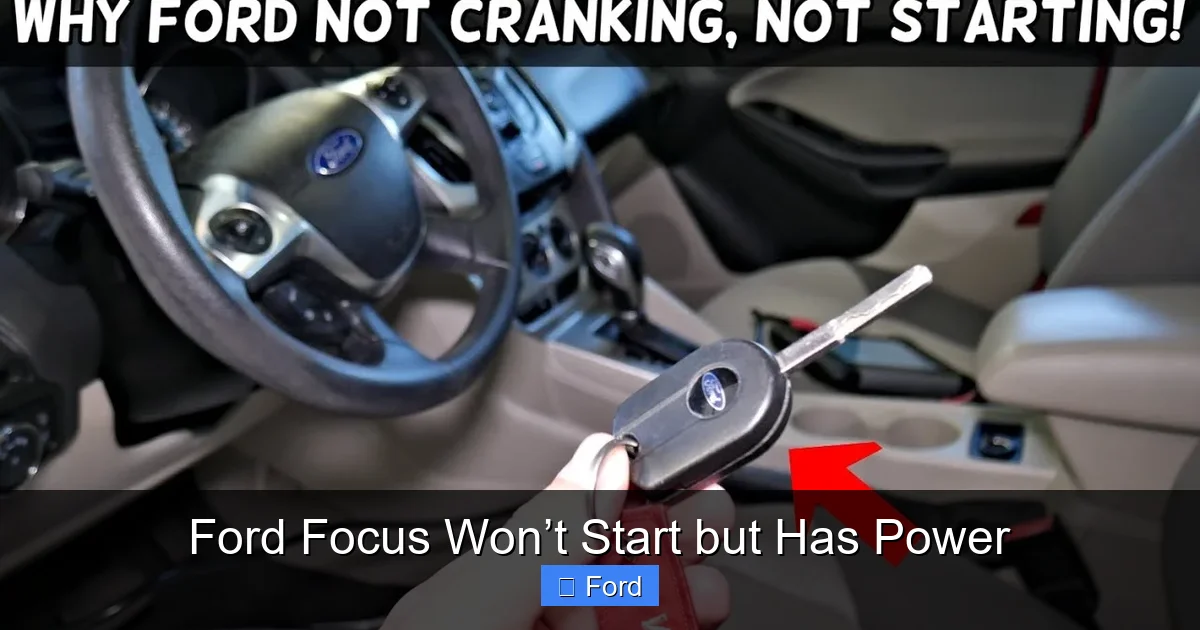
If your Focus cranks but won’t start, the fuel system is the #1 suspect. The engine can spin forever, but without a proper mist of gasoline vapor in the cylinders, it will never ignite. Modern fuel-injected engines like the Focus’s rely on high pressure from an electric fuel pump, located inside the fuel tank.
Visual guide about Ford Focus Won’t Start but Has Power
Image source: i.ytimg.com
Symptom: Engine Crank, No Start, Smell of Gas?
When you crank the engine, do you smell raw gasoline from the exhaust? That’s a sign fuel is reaching the cylinders but isn’t being ignited (pointing to spark or timing issues). If you smell nothing, fuel delivery is the prime suspect.
The Fuel Pump: These pumps fail with age. They might work intermittently—you hear a brief hum from the rear of the car when you turn the key to “on” (the pump primes), but it dies. Or it makes no sound at all. A failed pump means zero fuel pressure. Test: Have a helper turn the key to “ON” (don’t start) and listen at the filler neck or rear seat area for a 2-second whirring. No sound? Possible pump or its relay/fuse.
The Fuel Pump Relay: This small electrical component, usually in the engine bay fuse box, powers the pump. It’s a common failure point on many Foci. Swapping it with an identical relay (like the horn relay) is a quick test. If the car starts after the swap, you found the issue. Relays are cheap.
Clogged Fuel Filter: If your Focus has an in-line fuel filter (not all do; many are “lifetime” in the tank), it can clog over time, starving the engine of fuel. This causes hard starting and cranking issues. Replacement is the fix.
Failed Fuel Pressure Regulator: On some models, this can leak, causing too-low pressure or flooding. Check for fuel in the vacuum line connected to it.
Practical Tip: You can perform a basic “fuel pressure test” if you have a mechanical gauge that screws onto the fuel rail test port (Schrader valve). The Focus typically needs 35-55 PSI. No pressure? The pump, filter, or regulator is the culprit. If pressure is good, move on to ignition.
The Ignition System: Where’s the Spark?
Assuming fuel is present, the engine needs a powerful, correctly timed spark to ignite it. The Focus uses coil-on-plug (COP) ignitions on most modern engines. A failure here means fuel just gets pumped out unburned.
Visual guide about Ford Focus Won’t Start but Has Power
Image source: thetoolstrunk.com
Symptom: Crank, No Start, Check Engine Light?
If your Check Engine Light is on, plug in an OBD2 scanner (a cheap USB one works). Codes like P0300 (random misfire), P0351 (coil A circuit), or P0335 (crankshaft sensor) are huge clues. Even without a light, a bad crankshaft position sensor (CKP) is a classic Focus failure. This sensor tells the computer the engine’s speed and position. Without its signal, the computer won’t fire the spark plugs or injectors. It’s often located near the crankshaft pulley or behind the timing cover.
Ignition Coils (COP): A failed coil will kill spark on that cylinder. But if all coils fail at once (rare), the car won’t start. More commonly, one coil fails, causing a misfire code and rough running, but it might still start. However, a major ignition control module failure can kill all coils.
Spark Plugs & Wires: Worn, fouled, or gaps incorrectly set plugs can prevent ignition. On older Foci with plug wires, a cracked wire can leak spark to ground. Visually inspect plugs for carbon tracking (black soot) or excessive wear.
Testing for Spark: This is a critical manual test. CAUTION: This involves high voltage. Remove a spark plug wire or COP coil (if accessible), attach a spare plug to it, ground the plug’s metal body against the engine block, and have a helper crank the engine. You should see a strong, blue spark jumping the plug gap. A weak, yellow spark or no spark indicates an ignition problem. If you have no spark, the CKP sensor is the most likely culprit on a Focus.
The Starter Motor & Starting Circuit
This is the system responsible for the actual “crank.” If you have a “no crank” symptom, this is your focus.
Visual guide about Ford Focus Won’t Start but Has Power
Image source: vehq.com
Symptom: Single Loud Click
This is the classic sound of a starter solenoid engaging but the starter motor itself not turning. The solenoid is a heavy-duty relay on top of the starter. It can fail mechanically. The click means the ignition switch is sending the signal and the solenoid is trying to work, but the contacts inside are burnt out or the motor is dead. Fix: Replace the starter assembly.
Symptom: Rapid Clicking
As mentioned, this is often a voltage drop issue. The solenoid is clicking on and off rapidly because the battery can’t sustain the huge current draw the starter needs. Even if lights are on, a battery with a bad cell might show 12V at rest but drop to 6V under load. Test: Clean the battery terminals and ground strap first. If that fails, try jump-starting. If it starts with a jump, the battery is failing. If it still just clicks, the starter or its connections are faulty.
Symptom: Silence
No sound at all. This could be a blown fuse for the starter circuit (check the under-hood fuse box for a “starter” or “ignition” fuse), a failed ignition switch (the worn-out tumbler that your key goes into), a broken wire in the starting circuit, or a faulty clutch pedal switch (manual) or brake pedal switch (automatic). The Focus has a neutral safety switch (automatic) or clutch safety switch (manual) that must be activated for the starter to engage. A failed switch will cause silence.
Starter Solenoid Relay: Some Foci use a separate starter relay in the fuse box. If this fails, you get silence. Try swapping it with a known good relay of the same type.
Practical Test: You can perform a “bypass” test to determine if the fault is in the ignition switch/safety circuit or the starter itself. Locate the small terminal on the starter solenoid (the one connected to the ignition switch wire). Using a insulated wrench or screwdriver, momentarily touch this terminal to the large battery-positive terminal on the solenoid. CAUTION: The car will crank immediately and could move. Ensure it’s in Neutral/Park and wheels are chocked. If the engine cranks, your starter is good and the problem is in the ignition switch, safety switch, or wiring. If it doesn’t crank, the starter/solenoid is bad.
Security System & Key Issues (PATS)
This is a very common and frustrating cause, especially on 1996+ Foci with the Passive Anti-Theft System (PATS). The system uses a chip in your key that must be recognized by a ring antenna around the ignition cylinder. If the computer doesn’t see the correct code, it disables the fuel injectors and/or the starter.
Symptom: Rapid Clicking or No Crank, Security Light Blinking
Does a small red light on the dashboard blink rapidly when you try to start? That’s the security indicator. This means the PATS system is active and not recognizing your key. The car has power, but the engine control module (PCM) is being told to stay disabled.
Causes:
- Worn/damaged key: The chip in the key can fail. Try your spare key.
- Faulty antenna ring: The ring around the ignition that reads the key can break or have loose connections.
- Lost key programming: Keys can become unprogrammed, especially after a battery disconnect. You may need a dealer or locksmith with a special programmer to reprogram the key(s) to the car’s PCM.
- Failed PCM: Rare, but the PCM itself can lose its ability to read the PATS signal.
What to do: First, try your spare key. If that works, the primary key is bad. If neither works, check for any aftermarket alarms or remote starters that might have been installed incorrectly and are interfering. Often, the fix requires professional programming. There is a “emergency start” procedure for some years (turning the key to “on” for 10 seconds, then to “start” within 3 seconds), but it’s not guaranteed. This is where you might need a dealer or a specialist with a scan tool that can interface with the PATS system.
Other Electrical Gremlins & Simple Checks
Before you assume a major component failure, don’t skip the basics. A surprising number of “won’t start” issues are caused by simple, overlooked items.
The Ground Strap
The engine and battery must share a clean, solid ground. A corroded or broken engine-to-chassis ground strap is a classic culprit. It prevents the starter from getting enough return current, causing slow cranking or no crank. Locate the thick black braided strap from the engine block to the firewall or frame. Pull on it. Is it tight and clean at both ends? If it’s rusty or loose, clean the contact points and retighten or replace it. This is a $20 fix that solves countless problems.
Fuses and Relays Galore
Your Focus has multiple fuse boxes. The main one under the hood is critical. Check every fuse related to “IGNITION,” “STARTER,” “PCM,” “FUEL PUMP,” and “ECU” with a test light or multimeter. A blown fuse points to a short circuit in that circuit, which must be found. Also, identify and test the fuel pump relay and ignition relay as mentioned earlier.
Automatic Transmission Range Switch
If you have an automatic, the car must know it’s in Park or Neutral to start. A misadjusted or failed neutral safety switch (sometimes part of the transmission range sensor) will prevent starter engagement. Try wiggling the gear shifter firmly through Park, Neutral, and back while attempting to start. If it starts in Neutral but not Park, the switch is faulty.
Clutch Pedal Switch (Manual)
For manuals, you must depress the clutch pedal to start. The switch at the top of the pedal arm can fail. Press the pedal firmly and listen for a click near the switch. You can also try starting with the clutch pedal held all the way down and the key turned while gently rocking the car back and forth—sometimes a misadjusted switch is the issue.
Step-by-Step Diagnostic Roadmap
Let’s put it all together into a logical order to check things. This method saves time and money.
- Confirm the Symptom: Are there lights? Is there a crank? Note the exact sound.
- Check the Obvious: Ensure the car is in Park/Neutral. Try both keys. Check for fuel (is the gauge on E?).
- Inspect Connections: Open the hood. Clean the battery terminals. Check the main ground strap. Visually inspect for loose, corroded wires at the starter and battery.
- Check Fuses/Relays: Pull and inspect all relevant fuses in the under-hood box. Swap the fuel pump and starter relays with known good ones.
- Listen for Fuel Pump: Turn key to ON. Listen for 2-second hum from rear. No hum? Check fuel pump fuse/relay. If you have pressure, move on.
- Check for Spark: Perform the spark test. No spark? Focus on CKP sensor, ignition coils, and ignition control module. Have your OBD2 scanner ready for codes.
- Test Starter Signal: If no crank, perform the starter bypass test. If it cranks with bypass, the problem is in the ignition switch, clutch/brake switch, or wiring to the starter.
- Consider PATS: If all else seems good but it still won’t start, especially with a blinking security light, the immobilizer is the likely barrier. This often requires professional tool intervention.
When to Call a Pro: If you’ve checked fuel pressure, spark, and starter signal and everything seems functional, the issue may be internal (timing belt jumped, engine seizure) or a deeply embedded computer fault. At that point, a trusted mechanic with Ford-specific diagnostic tools is necessary.
It’s also worth noting that some issues, like a failing fuel pump, can be diagnosed by listening or checking for pressure, but the repair often requires dropping the gas tank (on many Foci) or accessing the pump through a panel under the rear seats. That’s a bigger job. Similarly, a bad crankshaft sensor on a Focus might be buried behind the timing cover, requiring significant disassembly. Knowing the common failure points for your specific engine (2.0L, 2.3L, 1.0T, etc.) from Focus enthusiast forums can be invaluable.
Frequently Asked Questions
My Ford Focus cranks but won’t start. What’s the most common cause?
For a cranking Focus, the most common culprits are a faulty crankshaft position sensor, a failed fuel pump, or clogged fuel injectors. The crankshaft sensor is a known weak point on many Focus models and will prevent spark and fuel injection. Start by checking for spark and fuel pressure.
My Focus won’t crank at all, but the lights are on. Is it the starter?
It could be the starter, but also check the starter solenoid relay in the fuse box, the battery terminals for corrosion, and the main engine ground strap. A single loud click usually points to the starter/solenoid, while rapid clicking often indicates a poor connection or weak battery cell. A complete silence could be a blown fuse, failed ignition switch, or a safety switch (clutch/brake).
Could a bad key fob cause my Focus not to start even with power?
Yes, but not the remote functions. The physical key blade has a transponder chip for the PATS immobilizer system. If this chip is damaged or deprogrammed, the car’s computer will disable the starter and fuel system. Try your spare key first. If both fail, the antenna ring or PCM may need service.
I smell gas when I crank my Focus. What does that mean?
The smell of raw gasoline from the exhaust means fuel is reaching the cylinders but isn’t being ignited. This points squarely to an ignition system failure—likely a bad crankshaft position sensor, ignition coils, or a major timing issue (like a jumped timing belt). Check for spark immediately.
Is there a way to reset the Ford Focus immobilizer myself?
There is a limited “emergency start” procedure for some model years: Turn the key to the “ON” position for 10-15 seconds, then quickly turn it to “START” within 3 seconds. If the security light is solid instead of blinking, it may work. However, most PATS issues require a professional dealer or locksmith with a specific scan tool to reprogram the keys to the vehicle’s PCM.
My Focus was running fine, then suddenly won’t start. What’s the first thing I should check?
First, confirm the exact symptom (crank vs. no crank). Then, pop the hood and visually inspect the battery terminals for heavy corrosion—clean them if needed. While you’re there, check the large black ground strap from the engine to the firewall/frame for tightness and condition. These two checks solve a surprising number of sudden no-start problems.