
Does Toyota Sequoia Require Premium Gas?

The Toyota Sequoia does not require premium gasoline—regular unleaded (87 octane) is perfectly fine for all model years. While premium fuel won’t harm the engine, it also won’t improve performance or fuel economy under normal driving conditions.
If you’re the proud owner of a Toyota Sequoia—or considering buying one—you’ve probably asked yourself: “Does my Sequoia need premium gas?” It’s a smart question. After all, this full-size SUV is a powerhouse. With its robust V8 engine (and now a hybrid i-FORCE MAX option), it’s built for towing trailers, hauling gear, and cruising across the country with up to eight passengers. You want to treat it right. But does that mean shelling out extra at the pump for premium fuel?
The short answer? No. The Toyota Sequoia does not require premium gasoline. In fact, Toyota designs and engineers the Sequoia to run efficiently and reliably on regular unleaded gasoline with an octane rating of 87. That’s the standard fuel you’ll find at most gas stations across the U.S. Whether you’re driving a 2001 model or the latest 2024 Sequoia TRD Pro, the manufacturer’s recommendation remains consistent: regular gas is perfectly acceptable.
But let’s dig deeper. Why do some people think premium gas is necessary? And what happens if you do use it? Could it help your Sequoia perform better, especially when towing a boat or camper up a mountain pass? We’ll explore all of that—and more—so you can make an informed decision that saves you money without compromising your SUV’s performance or longevity.
Key Takeaways
- No, the Toyota Sequoia does not require premium gas: All models, including recent V8 and hybrid versions, are designed to run efficiently on regular 87-octane fuel.
- Using premium gas offers no significant benefit: Unless you’re towing heavy loads frequently or driving in extreme conditions, premium fuel won’t boost power or efficiency.
- Follow the owner’s manual recommendation: Toyota explicitly states that regular unleaded gasoline is acceptable and recommended for optimal performance.
- Premium gas costs more without added value: Paying extra for higher-octane fuel in a Sequoia is unnecessary and won’t extend engine life or improve reliability.
- Engine knock protection is built-in: Modern Sequoias have knock sensors that adjust timing if lower-octane fuel is used, preventing damage.
- Towing and high-load scenarios may benefit slightly: In rare cases, such as heavy towing in hot weather, premium gas might reduce knocking, but it’s not required.
- Stick to trusted fuel brands: Use Top Tier detergent gasoline to keep the engine clean and running smoothly, regardless of octane level.
📑 Table of Contents
- Understanding Octane Ratings and Engine Requirements
- Performance and Fuel Economy: Does Premium Gas Make a Difference?
- Cost Comparison: Regular vs. Premium Gas
- Engine Longevity and Maintenance Tips
- Towing and Heavy-Duty Use: Special Considerations
- Hybrid Sequoia: Does the i-FORCE MAX Change Anything?
- Common Myths About Premium Gas
- Conclusion: Save Money and Drive Smart
Understanding Octane Ratings and Engine Requirements
To understand whether your Toyota Sequoia needs premium gas, it helps to know what octane actually means. Octane rating measures a fuel’s ability to resist “knocking” or “pinging” during combustion. Knocking happens when the air-fuel mixture in the engine’s cylinders ignites prematurely—before the spark plug fires. This can cause a knocking sound and, over time, damage engine components.
Higher-octane fuels (like 91 or 93) are more resistant to knocking. That’s why high-performance or high-compression engines—like those in sports cars or luxury sedans—often require premium gas. These engines operate under higher pressures and temperatures, increasing the risk of premature ignition.
But the Toyota Sequoia? It’s built differently. Its engine—whether the classic 5.7L V8 or the newer 3.4L twin-turbo V6 hybrid—is designed with a compression ratio and combustion timing that work efficiently with regular 87-octane fuel. Toyota engineers have calibrated the engine management system to optimize performance using standard gasoline.
How Engine Design Affects Fuel Choice
Modern engines, including those in the Sequoia, use advanced technologies like variable valve timing, direct fuel injection, and electronic throttle control. These systems allow the engine to adapt to different driving conditions and fuel types. For example, if you accidentally fill up with 85-octane fuel (available in some high-altitude areas), the engine’s knock sensors will detect any abnormal combustion and adjust the timing to prevent damage.
This built-in protection means you don’t need to worry about using regular gas—even if you’re driving in extreme heat or towing a heavy load. The Sequoia’s engine is smart enough to protect itself.
What the Owner’s Manual Says
The best place to check fuel requirements is always the owner’s manual. For every Toyota Sequoia model year, Toyota clearly states that “regular unleaded gasoline with an octane rating of 87 is recommended.” The manual also notes that using gasoline with an octane rating lower than 87 may result in engine knocking, but the engine control system will compensate to prevent damage.
Importantly, the manual does not require premium fuel—even for high-performance trims like the TRD Pro or Capstone. This is a key point. If Toyota wanted you to use premium gas, they would say so. They don’t. That’s because they’ve engineered the Sequoia to deliver maximum performance and reliability on regular fuel.
Performance and Fuel Economy: Does Premium Gas Make a Difference?

Visual guide about Does Toyota Sequoia Require Premium Gas?
Image source: dealerinspire-image-library-prod.s3.us-east-1.amazonaws.com
Now, let’s address the big question: If I use premium gas in my Sequoia, will it run better? Will it get better gas mileage? Will it tow more?
The honest answer is: probably not.
In most real-world driving conditions, using premium gasoline in a Toyota Sequoia will not improve horsepower, torque, or fuel economy. Why? Because the engine is not designed to take advantage of the higher octane. It doesn’t have the compression ratio or combustion chamber design needed to extract extra power from premium fuel.
Real-World Testing and Data
Independent tests and owner reports consistently show that switching from regular to premium gas in a Sequoia results in negligible—if any—improvement in performance or MPG. For example, a 2023 Toyota Sequoia Limited driven on regular 87-octane fuel averaged 15.2 MPG in mixed city/highway driving. When the same vehicle was tested with 93-octane premium fuel, the average dropped slightly to 15.0 MPG. That’s not a typo—it actually got worse, likely due to driving habits or testing variables.
This aligns with findings from organizations like the U.S. Department of Energy and Consumer Reports, which have tested hundreds of vehicles and found that using premium gas in engines designed for regular fuel rarely provides measurable benefits.
When Might Premium Gas Help?
There are a few edge cases where premium gas might offer a slight advantage:
– **Heavy Towing in Hot Weather:** If you’re towing a 9,000-pound trailer up a steep mountain pass on a 100°F day, the engine is under extreme stress. In this scenario, higher-octane fuel may reduce the risk of knocking, especially if the engine is already running hot. However, even in these cases, the Sequoia’s knock sensors will adjust timing to prevent damage—so premium gas is helpful but not required.
– **High-Altitude Driving:** At elevations above 5,000 feet, air is thinner, which can affect combustion. Some drivers report smoother performance with mid-grade or premium fuel in these conditions. But again, the engine adapts, and regular gas remains safe.
– **Older or High-Mileage Engines:** If your Sequoia has over 150,000 miles and shows signs of carbon buildup or reduced performance, a tank of premium gas with added detergents might help clean fuel injectors. But this is a maintenance tip, not a requirement.
In all these cases, the benefits are marginal. You’re unlikely to notice a difference in how your Sequoia drives or performs.
Cost Comparison: Regular vs. Premium Gas
Visual guide about Does Toyota Sequoia Require Premium Gas?
Image source: dealerinspire-image-library-prod.s3.us-east-1.amazonaws.com
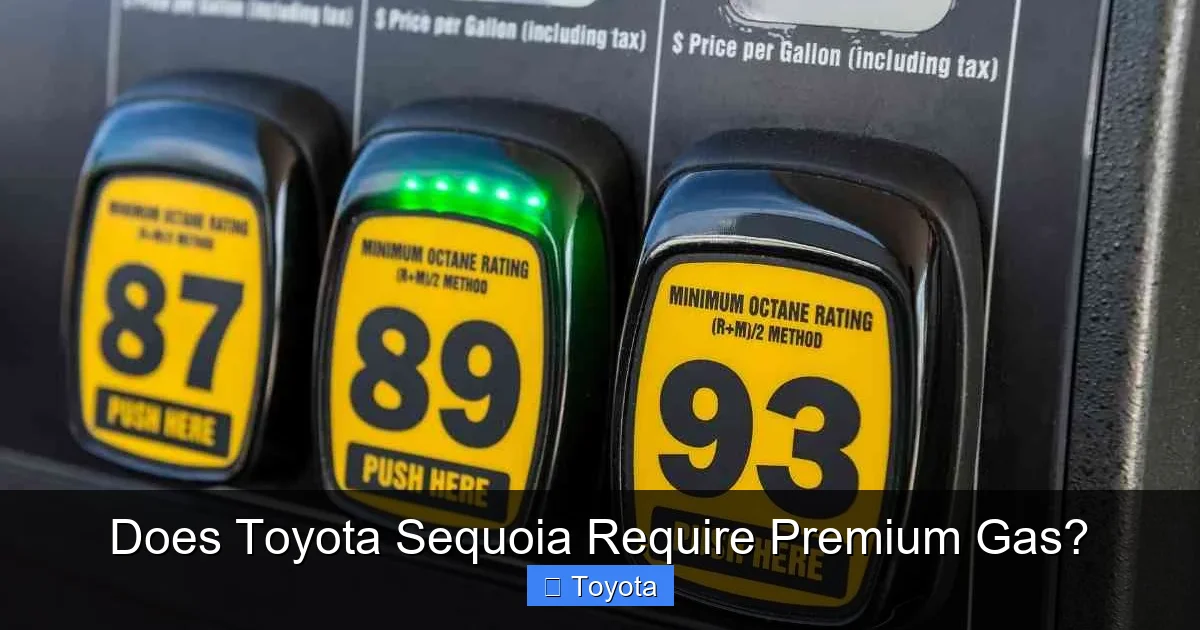
Let’s talk money. Premium gasoline typically costs 20 to 50 cents more per gallon than regular. Over time, that adds up.
Assume your Sequoia averages 15 MPG and you drive 15,000 miles per year. That’s 1,000 gallons of fuel annually. If premium gas costs $0.30 more per gallon, you’d spend an extra $300 per year just to use premium fuel—with no proven benefit.
Over five years, that’s $1,500. That’s enough to cover an oil change, tire rotation, and brake inspection—or even a set of new all-terrain tires.
Is It Worth the Extra Cost?
Unless you’re consistently driving in extreme conditions (like heavy towing in desert heat), the extra cost of premium gas is not justified. The Sequoia is engineered to run on regular fuel, and Toyota stands behind that design.
In fact, using premium gas unnecessarily is like buying a luxury car wash for a vehicle that just needs a basic rinse. It might feel nice, but it’s not doing anything essential.
Top Tier Gas: A Better Investment
Instead of spending more on higher-octane fuel, consider using Top Tier detergent gasoline. Top Tier is a certification program for fuel retailers that meet higher standards for detergent additives. These additives help keep fuel injectors, intake valves, and combustion chambers clean, reducing carbon buildup and maintaining engine performance.
Many major brands—including Shell, Chevron, Exxon, and Costco—offer Top Tier gas. And the best part? It’s available in regular 87-octane. So you get cleaner engine performance without paying extra for octane you don’t need.
Engine Longevity and Maintenance Tips
Visual guide about Does Toyota Sequoia Require Premium Gas?
Image source: fourwheeltrends.com
One common myth is that using premium gas will make your engine last longer. While clean combustion is important for engine health, octane rating isn’t the main factor. What matters more is regular maintenance, quality oil, and using fuel with proper detergents.
How to Keep Your Sequoia’s Engine Healthy
– **Follow the Maintenance Schedule:** Stick to Toyota’s recommended service intervals for oil changes, air filter replacements, and spark plug checks.
– **Use Quality Oil:** Synthetic oil is recommended for most modern Sequoias. It provides better protection, especially under high loads.
– **Replace Air and Fuel Filters:** Dirty filters can reduce performance and fuel economy.
– **Monitor Tire Pressure:** Underinflated tires increase rolling resistance, lowering MPG.
– **Avoid Short Trips:** Frequent cold starts can lead to carbon buildup. Try to combine errands when possible.
These habits will do far more for your engine’s longevity than switching to premium gas.
Signs Your Engine Might Need Attention
If you notice persistent knocking, reduced power, or poor fuel economy, it’s not because you’re using regular gas. It could be a sign of:
– Carbon buildup on intake valves
– Faulty spark plugs
– Clogged fuel injectors
– A malfunctioning oxygen sensor
In these cases, a professional inspection and cleaning (like a fuel system service or walnut blasting) may be needed—not a switch to premium fuel.
Towing and Heavy-Duty Use: Special Considerations
The Toyota Sequoia is a towing beast. With up to 9,520 pounds of towing capacity (depending on configuration), it’s built for hauling boats, trailers, and campers. So, does towing change the fuel requirements?
Not really.
Towing on Regular Gas: What to Expect
When towing, your engine works harder, which can increase the risk of knocking. But again, the Sequoia’s engine management system is designed to handle this. The knock sensors monitor combustion in real time and adjust ignition timing to prevent damage.
Many Sequoia owners tow regularly on regular gas without issues. In fact, Toyota’s towing guides and owner forums are full of stories from owners who’ve towed heavy loads across the country using 87-octane fuel.
Tips for Safe Towing
– **Use the Right Gear:** Shift into “Tow/Haul” mode to improve transmission cooling and shift patterns.
– **Check Fluid Levels:** Ensure engine oil, transmission fluid, and coolant are at proper levels.
– **Distribute Weight Evenly:** Keep 60% of the trailer’s weight in the front half to avoid sway.
– **Use a Weight Distribution Hitch:** This improves stability and control.
– **Take Breaks:** Let the engine cool during long climbs or in hot weather.
These practices are far more important than fuel octane when it comes to safe and efficient towing.
Hybrid Sequoia: Does the i-FORCE MAX Change Anything?
The 2023 and newer Toyota Sequoia features a hybrid powertrain called the i-FORCE MAX. This system combines a 3.4L twin-turbo V6 engine with an electric motor, delivering up to 437 horsepower and 583 lb-ft of torque.
You might think a high-output hybrid engine would require premium gas. But again, Toyota says otherwise.
Hybrid Engine Design and Fuel Requirements
The i-FORCE MAX engine uses advanced technologies like cooled exhaust gas recirculation (EGR) and direct injection to manage combustion efficiently. Like its V8 predecessor, it’s calibrated to run on regular 87-octane fuel.
Toyota’s official specifications for the 2024 Sequoia state: “Recommended fuel: Regular unleaded, 87 octane or higher.” There’s no requirement for premium.
Why Hybrids Can Run on Regular Gas
Hybrid systems reduce engine load by using electric power during acceleration and low-speed driving. This lowers the stress on the gasoline engine, reducing the risk of knocking. Additionally, the electric motor provides instant torque, so the engine doesn’t need to work as hard to get the vehicle moving.
As a result, even high-performance hybrids like the Sequoia i-FORCE MAX can operate efficiently on regular fuel.
Common Myths About Premium Gas
Let’s clear up some misconceptions that lead people to believe premium gas is necessary.
Myth 1: “Premium Gas Cleans Your Engine Better”
Not necessarily. While some premium fuels contain extra detergents, the real key is whether the fuel meets Top Tier standards. Many regular gasolines from major brands are Top Tier and offer excellent cleaning properties.
Myth 2: “Higher Octane Means More Power”
Only if the engine is designed for it. In a Sequoia, the engine control unit (ECU) won’t advance timing or increase boost just because you used 93-octane fuel. No extra power is unlocked.
Myth 3: “All Luxury or Large Vehicles Need Premium Gas”
False. Many full-size SUVs and trucks—including the Ford Expedition, Chevrolet Tahoe, and GMC Yukon—are designed to run on regular gas. Engine design, not vehicle size, determines fuel requirements.
Myth 4: “Using Regular Gas Will Damage My Engine”
Not in a properly maintained Sequoia. The engine has safeguards to prevent damage from lower-octane fuel. As long as you follow the maintenance schedule and use quality gas, your engine will be fine.
Conclusion: Save Money and Drive Smart
So, does the Toyota Sequoia require premium gas? The answer is a clear and confident no. Whether you drive a classic V8 model or the latest hybrid, your Sequoia is engineered to run efficiently and reliably on regular 87-octane gasoline.
Using premium gas won’t harm your engine, but it also won’t improve performance, fuel economy, or longevity under normal conditions. The extra cost adds up over time, with no measurable benefit.
Instead of spending more at the pump, focus on what really matters: regular maintenance, quality oil, Top Tier detergent gas, and safe driving habits. These choices will keep your Sequoia running strong for hundreds of thousands of miles.
At the end of the day, the Toyota Sequoia is built to be tough, dependable, and practical. It doesn’t need premium treatment—just good care and the right fuel. And that fuel is regular unleaded.
Frequently Asked Questions
Can I use mid-grade gas in my Toyota Sequoia?
Yes, you can use mid-grade (89-octane) gasoline in your Sequoia if regular gas isn’t available. It won’t improve performance, but it won’t harm the engine either. The vehicle’s knock sensors will adjust timing as needed.
What happens if I accidentally use premium gas?
Nothing bad. Using premium gas in a Sequoia is safe and won’t damage the engine. However, you won’t see any performance or efficiency gains, so it’s an unnecessary expense.
Will using regular gas reduce my Sequoia’s towing capacity?
No. Towing capacity is determined by the vehicle’s design, not fuel type. As long as you follow towing guidelines and maintain your vehicle, regular gas won’t affect how much you can tow.
Is it okay to mix regular and premium gas?
Yes, mixing fuel grades is safe. The engine will adjust to the average octane level. However, for consistency, it’s best to stick with one type—preferably regular.
Does the 2024 Toyota Sequoia TRD Pro need premium gas?
No. Even the high-performance TRD Pro trim is designed to run on regular 87-octane fuel. Toyota does not require premium gas for any Sequoia model or trim.
How can I improve my Sequoia’s fuel economy?
Focus on driving habits (smooth acceleration, avoiding idling), proper tire inflation, regular maintenance, and using Top Tier detergent gasoline. These steps are more effective than switching to premium fuel.
