Does Toyota Highlander Qualify for Section 179?

Contents



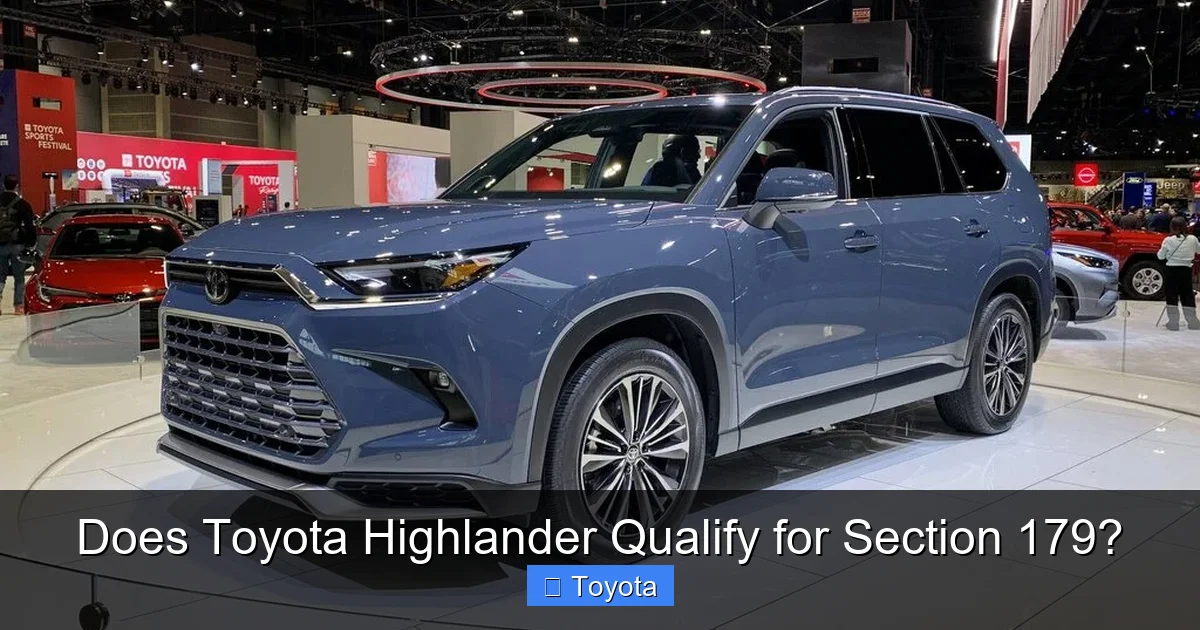
The Toyota Highlander may qualify for Section 179 tax deductions if used primarily for business purposes and meets specific IRS criteria. This guide breaks down eligibility, weight requirements, and how to claim the deduction correctly to maximize your tax savings.
If you’re a business owner considering purchasing a Toyota Highlander, you might be wondering: Does the Toyota Highlander qualify for Section 179? It’s a smart question—and one that could save you thousands in taxes. The Section 179 deduction is a powerful tax incentive designed to encourage businesses to invest in equipment and vehicles. But not all vehicles qualify, and the rules can be tricky. The Toyota Highlander, a popular midsize SUV known for its reliability, comfort, and versatility, sits in a gray area when it comes to this tax benefit.
So, can you write off the full cost of a Toyota Highlander under Section 179? The short answer is: maybe. It depends on several factors, including the vehicle’s weight, how it’s used, and which trim level you choose. In this comprehensive guide, we’ll walk you through everything you need to know about Section 179 eligibility for the Toyota Highlander. We’ll explain the IRS rules, break down the weight requirements, discuss business use percentages, and offer practical tips to help you make the most of this tax opportunity. Whether you’re using the Highlander for client meetings, transporting equipment, or running a mobile service, understanding these rules can make a big difference at tax time.
Let’s dive in and clear up the confusion so you can make an informed decision—and keep more money in your pocket.
Key Takeaways
- Section 179 allows businesses to deduct the full purchase price of qualifying vehicles in the year they are placed in service. This can significantly reduce taxable income for small and medium-sized businesses.
- The Toyota Highlander qualifies for Section 179 only if it meets the IRS definition of a “heavy SUV” — weighing over 6,000 pounds. Most standard Highlander models fall below this threshold, but certain trims with added equipment may qualify.
- Business use must be 50% or more to claim the deduction. Personal use reduces the allowable deduction proportionally.
- There is a $28,900 deduction limit for SUVs over 6,000 lbs under Section 179 (2024 limit). This cap applies even if the vehicle costs more.
- Bonus depreciation may be available in addition to Section 179. For 2024, 60% bonus depreciation applies to new vehicles, further increasing tax savings.
- Proper documentation is essential. Keep records of purchase, usage logs, and business purpose to support your claim during an audit.
- Consult a tax professional before claiming. Tax laws change frequently, and professional advice ensures compliance and maximizes benefits.
📑 Table of Contents
What Is Section 179 and How Does It Work?
Section 179 of the Internal Revenue Code is a tax deduction that allows businesses to deduct the full purchase price of qualifying equipment—including vehicles—in the year they are placed in service, rather than depreciating the cost over several years. This means instead of spreading out the deduction over five or seven years, you can potentially write off the entire cost upfront, up to certain limits.
The goal of Section 179 is to stimulate economic growth by encouraging small and medium-sized businesses to invest in themselves. It’s especially beneficial for business owners who need vehicles for work but want to reduce their taxable income quickly. For example, if you buy a $50,000 work truck and it qualifies, you could deduct the full $50,000 from your taxable income in that year—assuming you stay within the annual limits.
However, not all vehicles qualify. The IRS has specific rules about what counts as a “qualifying vehicle.” Generally, the vehicle must be used for business purposes more than 50% of the time, and it must meet certain definitions based on weight and type. Passenger cars, for instance, are subject to strict depreciation limits, while heavier vehicles—like SUVs over 6,000 pounds—get more favorable treatment.
This is where the Toyota Highlander comes into play. As a midsize SUV, it’s often used by businesses for client transport, sales calls, or mobile operations. But because most Highlander models weigh under 6,000 pounds, they don’t automatically qualify for the full Section 179 deduction. That said, there are exceptions and strategies that might allow you to claim the benefit—especially if you choose a heavier trim or add equipment to increase the vehicle’s weight.
How Section 179 Differs from Bonus Depreciation
It’s important to understand that Section 179 is not the same as bonus depreciation, though they can be used together. Section 179 is an election you make on your tax return, and it has annual dollar limits and business income limitations. Bonus depreciation, on the other hand, is an additional first-year depreciation allowance that applies to new property.
For 2024, bonus depreciation is set at 60% for new vehicles. This means if your Toyota Highlander doesn’t fully qualify for Section 179, you might still be able to deduct 60% of its cost in the first year under bonus depreciation—provided it’s new and used for business. However, bonus depreciation is being phased down over the next few years (to 40% in 2025, 20% in 2026, and 0% in 2027), so timing matters.
Combining Section 179 and bonus depreciation can lead to massive tax savings. For example, if you buy a $60,000 Highlander that qualifies for both, you could deduct $28,900 under Section 179 (the SUV limit) and then apply 60% bonus depreciation to the remaining $31,100, resulting in an additional $18,660 deduction. That’s a total first-year deduction of over $47,000.
Does the Toyota Highlander Qualify for Section 179?
Now for the big question: Does the Toyota Highlander qualify for Section 179? The answer hinges on one critical factor: weight. According to IRS guidelines, SUVs must have a gross vehicle weight rating (GVWR) of more than 6,000 pounds to qualify for the enhanced Section 179 deduction. This rule was created to prevent businesses from claiming large deductions on standard passenger vehicles.
So, what’s the GVWR of a Toyota Highlander? Most standard Highlander models—including the L, LE, XLE, and Limited trims—have a GVWR between 5,915 and 5,960 pounds. That’s just under the 6,000-pound threshold, which means they do not automatically qualify for the full Section 179 SUV deduction.
However, there’s a loophole. The IRS allows you to increase the vehicle’s weight by adding qualifying equipment at the time of purchase. This is known as the “equipment-upfitted” rule. If you add heavy-duty components—such as reinforced suspension, larger tires, roof racks, or towing packages—before the vehicle is placed in service, the total GVWR may exceed 6,000 pounds, making it eligible.
For example, the Toyota Highlander Hybrid MAX trim, with its more powerful engine and heavier components, may come closer to the weight limit. When combined with optional equipment like a tow hitch, all-weather flooring, and cargo management systems, it’s possible to push the GVWR over 6,000 pounds. But this requires careful planning and documentation.
How to Check the GVWR of Your Highlander
To determine if your Toyota Highlander qualifies, you’ll need to check its GVWR. This information is usually found on the driver’s side door jamb sticker, in the owner’s manual, or on the manufacturer’s website. Look for a label that lists the “Gross Vehicle Weight Rating” or “GVWR.”
You can also contact a Toyota dealership and provide the VIN (Vehicle Identification Number) to get accurate weight details. Some online VIN decoders also show GVWR, but it’s best to confirm with official sources.
Keep in mind that the GVWR includes the weight of the vehicle, passengers, cargo, and any added equipment. So even if the base model is under 6,000 pounds, modifications can push it over—if done correctly and before the vehicle is used.
What If My Highlander Is Under 6,000 Pounds?
If your Toyota Highlander doesn’t meet the weight requirement, you still have options—just not the full Section 179 SUV deduction. Instead, it will be treated as a passenger automobile, which is subject to much lower depreciation limits.
For 2024, the first-year depreciation limit for passenger cars is $12,400 if bonus depreciation applies, or $20,400 if the vehicle is electric or fuel-efficient. These limits increase slightly each year, but they’re still far below the $28,900 SUV cap.
That said, if you use the vehicle for business more than 50% of the time, you can still claim depreciation—just at a slower rate. You’ll use the Modified Accelerated Cost Recovery System (MACRS) to depreciate the vehicle over five years. While this doesn’t offer the same immediate tax benefit as Section 179, it’s better than nothing.
Another strategy is to lease the vehicle instead of buying. Lease payments for business use are often fully deductible, and you avoid the complexities of depreciation. However, leases come with mileage limits and wear-and-tear restrictions, so they’re not ideal for everyone.
Business Use Requirements and Documentation
Even if your Toyota Highlander meets the weight requirement, you must use it for business at least 50% of the time to qualify for Section 179. The IRS is strict about this rule. If your business use drops below 50% in any year, you may have to recapture part of the deduction—meaning you’ll owe back taxes plus interest.
So, how do you prove business use? Documentation is key. You’ll need to keep detailed records that show how the vehicle is used. This includes:
– A mileage log that tracks business vs. personal miles
– Receipts for fuel, maintenance, and repairs
– Records of business trips, client meetings, or deliveries made using the vehicle
– Photos or notes showing the vehicle being used for work purposes
A simple logbook or a mobile app like Everlance or MileIQ can help automate this process. These tools track your drives and categorize them as business or personal, making it easy to generate reports at tax time.
Calculating the Deduction Based on Business Use
The Section 179 deduction is prorated based on the percentage of business use. For example, if your Highlander qualifies as a heavy SUV and you use it 80% for business, you can deduct 80% of the allowable amount.
Let’s say the vehicle costs $60,000 and qualifies for the $28,900 SUV limit. If your business use is 80%, your deduction would be:
$28,900 × 80% = $23,120
You can then apply bonus depreciation to the remaining cost, again prorated for business use. This layered approach maximizes your tax savings while staying compliant.
What Happens If Business Use Drops Below 50%?
If your business use of the Highlander falls below 50% in a later year, the IRS requires you to recapture part of the Section 179 deduction. This means you’ll need to report the excess deduction as income and pay taxes on it.
For example, if you claimed $23,120 based on 80% business use but later used the vehicle only 40% for business, you’d have to recapture the difference. The recapture amount is calculated based on the change in use and the depreciation method used.
To avoid this, many business owners choose to use the vehicle consistently for work or switch to a different depreciation method if their usage changes. It’s always wise to plan ahead and consider how your business needs might evolve.
Maximizing Tax Savings with the Toyota Highlander
Even if your Highlander doesn’t fully qualify for Section 179, there are still ways to maximize your tax savings. The key is to understand all available options and plan strategically.
Combine Section 179 with Bonus Depreciation
As mentioned earlier, you can often use both Section 179 and bonus depreciation in the same year. This is especially powerful for new vehicles. For 2024, bonus depreciation is 60%, so even if you can’t claim the full Section 179 amount, you can still deduct a significant portion of the cost.
Let’s walk through an example:
– You buy a new Toyota Highlander for $62,000.
– It qualifies as a heavy SUV (GVWR over 6,000 lbs) due to added equipment.
– You use it 100% for business.
Step 1: Claim the maximum Section 179 deduction for SUVs: $28,900
Step 2: Apply 60% bonus depreciation to the remaining $33,100: $19,860
Total first-year deduction: $48,760
That’s over 78% of the vehicle’s cost written off in year one. Not bad for a single purchase!
Consider Leasing or Purchasing Used
If buying new isn’t in your budget, consider a used Highlander. While bonus depreciation only applies to new vehicles, you can still use Section 179 on used vehicles—as long as they’re new to you and meet the other requirements.
Leasing is another option. Lease payments for business use are typically 100% deductible, and you avoid the hassle of depreciation. Just make sure the lease terms align with your business needs and that you stay within mileage limits.
Work with a Tax Professional
Tax laws are complex and change frequently. What’s allowed this year might not be next year. A qualified tax advisor or CPA can help you navigate the rules, ensure compliance, and identify all available deductions.
They can also help you decide whether to claim Section 179, use bonus depreciation, or take the standard depreciation method—based on your business income, vehicle usage, and long-term goals.
Common Mistakes to Avoid
When claiming Section 179 for a Toyota Highlander, it’s easy to make mistakes that could trigger an audit or reduce your deduction. Here are some common pitfalls to avoid:
– Assuming all SUVs qualify: Just because it’s an SUV doesn’t mean it’s eligible. Weight matters.
– Not documenting business use: Without a mileage log or trip records, the IRS may disallow your deduction.
– Claiming 100% business use when it’s not true: Be honest. The IRS can spot inconsistencies.
– Forgetting to reduce the deduction if business use drops: Recapture rules are strict—don’t ignore them.
– Not checking the GVWR before purchase: Don’t assume your Highlander qualifies. Verify the weight first.
Taking the time to do it right can save you from headaches—and penalties—down the road.
Conclusion
So, does the Toyota Highlander qualify for Section 179? The answer is: it depends. If your Highlander has a GVWR over 6,000 pounds—either from the factory or through added equipment—and you use it for business at least 50% of the time, then yes, it can qualify for the enhanced Section 179 deduction. This could mean writing off up to $28,900 in 2024, plus additional savings through bonus depreciation.
However, most standard Highlander models fall just short of the weight requirement, so careful planning is essential. By choosing the right trim, adding qualifying equipment, and maintaining thorough records, you can position your vehicle to meet IRS standards.
Even if your Highlander doesn’t qualify for the full deduction, you’re not out of options. Depreciation, leasing, and bonus depreciation can still provide meaningful tax benefits. The key is to understand the rules, keep good records, and consult a tax professional to make the most of your investment.
At the end of the day, the Toyota Highlander is a reliable, versatile vehicle that can serve your business well—both on the road and at tax time. With the right strategy, you can drive away with more than just a great SUV. You can drive away with serious tax savings.
Frequently Asked Questions
Can I claim Section 179 on a used Toyota Highlander?
Yes, you can claim Section 179 on a used Toyota Highlander as long as it’s new to you and meets the IRS requirements, including weight and business use. The vehicle must be placed in service during the tax year you’re claiming the deduction.
What if my Highlander is used 60% for business?
If your Highlander is used 60% for business, you can deduct 60% of the allowable Section 179 amount. For example, if the SUV limit is $28,900, your deduction would be $17,340. The rest can be depreciated over time.
Does the Toyota Highlander Hybrid qualify for Section 179?
The Toyota Highlander Hybrid may qualify if its GVWR exceeds 6,000 pounds. Some hybrid trims, especially with added equipment, come close to or exceed this threshold. Check the door jamb sticker or consult Toyota for exact weight details.
Can I claim Section 179 if I lease the Highlander?
No, Section 179 applies only to purchased vehicles. However, lease payments for business use are generally deductible as a business expense, which can still provide significant tax benefits.
What happens if I sell my Highlander after claiming Section 179?
If you sell the vehicle, you may need to recapture part of the deduction, especially if business use dropped below 50%. The IRS treats the sale as a disposition, and you may owe taxes on the excess depreciation claimed.
Is there a limit to how much I can deduct under Section 179?
Yes, for SUVs over 6,000 pounds, the maximum Section 179 deduction is $28,900 in 2024. This limit applies regardless of the vehicle’s purchase price. Additional costs may be depreciated under bonus depreciation or MACRS.