Does the Toyota 4runner Qualify for Section 179?

Contents
- 1 Key Takeaways
- 2 📑 Table of Contents
- 3 What Is Section 179 and Why Does It Matter?
- 4 Does the Toyota 4Runner Meet the Weight Requirement?
- 5 Business Use: The 50% Rule
- 6 Combining Section 179 with Bonus Depreciation
- 7 Leasing vs. Buying: Which Is Better for Section 179?
- 8 Real-World Examples and Practical Tips
- 9 Common Mistakes to Avoid
- 10 Conclusion
- 11 Frequently Asked Questions

Dash Cam

Digital Tire Pressure Gauge

Diesel Fuel Additive

Octane Booster
The Toyota 4Runner may qualify for Section 179 tax deductions—but only if it meets specific IRS criteria. This includes having a gross vehicle weight rating (GVWR) over 6,000 pounds and being used primarily for business purposes. Understanding these rules can help business owners save thousands on their tax bill.
If you’re a business owner eyeing a rugged, reliable SUV like the Toyota 4Runner, you might be wondering: “Can I write this off on my taxes?” The short answer is—maybe. The longer, more accurate answer involves understanding IRS Section 179, vehicle weight classifications, and how your business uses the vehicle. While the 4Runner isn’t a pickup truck or a commercial van, it can still qualify for significant tax deductions under certain conditions. And that’s great news for contractors, landscapers, real estate agents, delivery drivers, and other professionals who need a capable off-road vehicle for work.
The Toyota 4Runner has long been a favorite among outdoor enthusiasts and professionals alike. Known for its durability, off-road capability, and timeless design, it’s more than just a weekend warrior—it’s a tool for many small businesses. Whether you’re hauling equipment to a job site, transporting clients across rough terrain, or making deliveries in remote areas, the 4Runner can pull double duty as both a personal and professional asset. But to unlock the tax advantages, you’ve got to play by the IRS rules. That’s where Section 179 comes in—a powerful tax incentive designed to encourage businesses to invest in equipment and vehicles. But not every vehicle qualifies, and not every use case counts. So let’s break it down: Does the Toyota 4Runner qualify for Section 179? And if so, how can you make sure you’re taking full advantage?
Key Takeaways
- Section 179 allows businesses to deduct the full purchase price of qualifying vehicles: Instead of depreciating a vehicle over several years, you can write off the entire cost in the year of purchase, up to certain limits.
- The Toyota 4Runner must have a GVWR over 6,000 pounds to qualify: Most 4Runners fall into this category, especially TRD Pro and Limited trims with heavier builds, but it’s essential to verify the specific model’s weight rating.
- Business use must exceed 50%: The IRS requires that the vehicle be used more than half the time for business activities to claim the full deduction.
- Bonus depreciation may also apply in addition to Section 179: In 2024, businesses can often combine Section 179 with 80% bonus depreciation for even greater tax savings.
- Leased vehicles have different rules: If you lease a 4Runner, you may still benefit from Section 179 through lease inclusion amounts, but the process is more complex.
- Keep detailed records of mileage and usage: To support your deduction, maintain logs showing business trips, client meetings, deliveries, or other work-related use.
- Consult a tax professional before filing: Tax laws change frequently, and a CPA or tax advisor can ensure you’re maximizing benefits while staying compliant.
📑 Table of Contents
What Is Section 179 and Why Does It Matter?
Section 179 of the Internal Revenue Code is a tax deduction that allows businesses to deduct the full purchase price of qualifying equipment—including vehicles—in the year they are placed into service, rather than depreciating the cost over several years. This means instead of writing off $5,000 a year for five years, you could potentially deduct the entire $50,000 cost of a new 4Runner in year one. That’s a huge cash flow advantage, especially for small businesses looking to reinvest savings into growth.
The purpose of Section 179 is to stimulate economic activity by incentivizing businesses to buy equipment now rather than later. It’s particularly beneficial for companies that need vehicles for operations but want to reduce their taxable income in the current year. For 2024, the maximum deduction under Section 179 is $1,220,000, with a spending cap of $3,050,000. Once your total equipment purchases exceed that cap, the deduction begins to phase out dollar for dollar. But for most small businesses buying one or two vehicles, this isn’t a concern.
However, not all vehicles qualify. The IRS has strict rules about what counts as a “qualified vehicle” under Section 179. Passenger cars, for example, are subject to much lower deduction limits—often just a few thousand dollars per year. But heavier vehicles, like SUVs and trucks with a gross vehicle weight rating (GVWR) over 6,000 pounds, are treated more favorably. This is where the Toyota 4Runner has a real advantage. Most 4Runner models, especially the higher trims, exceed that 6,000-pound threshold, making them eligible for the full Section 179 deduction—provided they meet other requirements.
Does the Toyota 4Runner Meet the Weight Requirement?

Visual guide about Does the Toyota 4runner Qualify for Section 179?
Image source: motorbiscuit.com
One of the most critical factors in determining whether the Toyota 4Runner qualifies for Section 179 is its gross vehicle weight rating (GVWR). The GVWR is the maximum operating weight of the vehicle, including passengers, cargo, fuel, and accessories—as specified by the manufacturer. The IRS uses this number to classify vehicles. If the GVWR is 6,000 pounds or less, the vehicle is considered a passenger automobile and is subject to strict depreciation limits. But if it’s over 6,000 pounds, it falls into the “heavy SUV” category and becomes eligible for the full Section 179 deduction.
So, what’s the GVWR of a Toyota 4Runner? The answer varies slightly by model year and trim level, but most modern 4Runners comfortably exceed the 6,000-pound mark. For example, the 2024 Toyota 4Runner TRD Pro has a GVWR of 6,300 pounds. The Limited and TRD Off-Road trims typically range between 6,100 and 6,300 pounds. Even the base SR5 model often comes in just over 6,000 pounds, especially when equipped with four-wheel drive and additional features.
To verify the exact GVWR for your specific 4Runner, check the door jamb sticker (usually on the driver’s side) or consult the owner’s manual. You can also find this information on Toyota’s official website or by contacting a dealership. It’s important to note that the GVWR is not the same as curb weight. Curb weight is how much the vehicle weighs when empty. GVWR includes everything the vehicle can safely carry. So even if your 4Runner feels light when you drive it, its GVWR is what matters for tax purposes.
One common misconception is that you can increase the GVWR by adding aftermarket parts like bumpers, winches, or roof racks. Unfortunately, the IRS uses the manufacturer’s stated GVWR, not the modified weight. So while those upgrades might make your 4Runner more capable off-road, they won’t change its tax classification. The good news? Most factory-equipped 4Runners already meet the requirement, so you likely don’t need to worry about modifications.
Business Use: The 50% Rule

Visual guide about Does the Toyota 4runner Qualify for Section 179?
Image source: prolinetrailers.com
Even if your Toyota 4Runner has a GVWR over 6,000 pounds, it still won’t qualify for the full Section 179 deduction unless it’s used primarily for business. The IRS requires that the vehicle be used more than 50% of the time for business purposes. If you use it 60% for work and 40% for personal errands, you can only deduct 60% of the purchase price under Section 179. This rule is designed to prevent individuals from buying luxury vehicles and claiming full business deductions while using them mostly for personal travel.
So how do you prove business use? The IRS expects detailed records. This includes mileage logs, trip purposes, dates, destinations, and the nature of the business activity. For example, if you drive your 4Runner to a construction site to inspect a project, that’s a business trip. If you use it to transport tools, materials, or clients, that counts too. But weekend trips to the mountains or school drop-offs? Those are personal use and don’t qualify.
Many business owners use apps like MileIQ, QuickBooks Self-Employed, or even a simple spreadsheet to track mileage. Some even install GPS tracking devices that automatically log trips and categorize them as business or personal. The key is consistency. If you’re audited, the IRS will want to see a clear pattern of business use. A few handwritten notes won’t cut it—digital records with timestamps are much more credible.
It’s also worth noting that the 50% rule applies to the entire time the vehicle is in service. If you start using the 4Runner 70% for business but later shift to 40%, your deduction could be reduced or disallowed in future years. The IRS may require you to recapture some of the deduction if business use drops below 50%. So it’s important to plan your usage carefully and maintain accurate records from day one.
Combining Section 179 with Bonus Depreciation
Visual guide about Does the Toyota 4runner Qualify for Section 179?
Image source: ramair.co
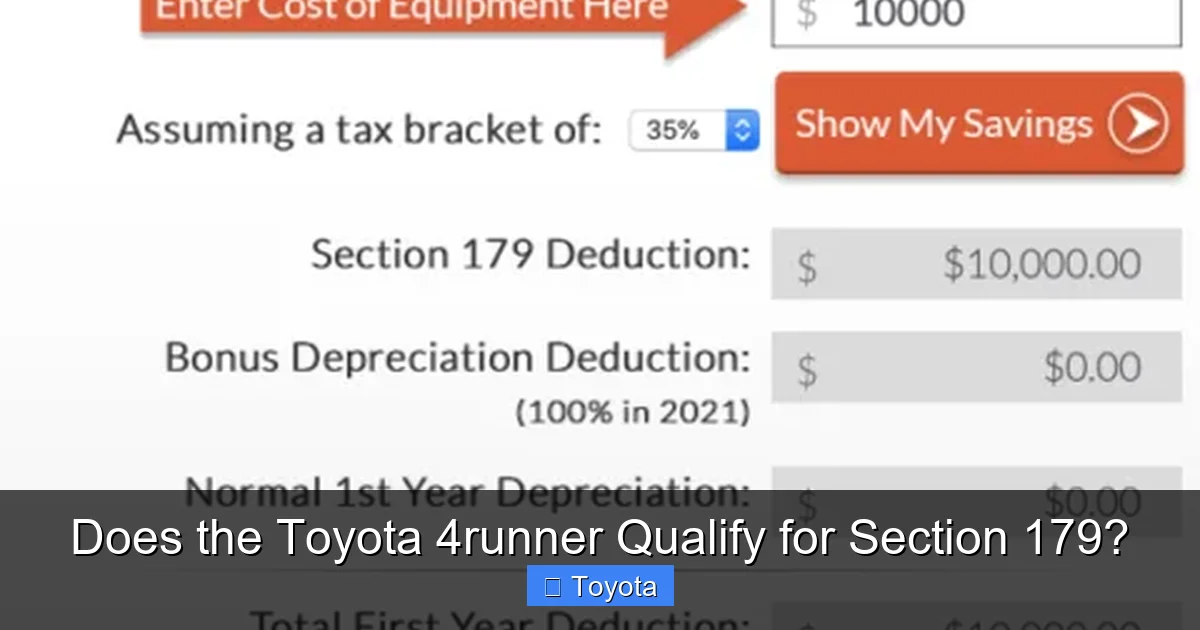
One of the best ways to maximize your tax savings on a Toyota 4Runner is to combine Section 179 with bonus depreciation. Bonus depreciation is another tax incentive that allows businesses to deduct a large percentage of the cost of qualifying property in the first year. For 2024, the bonus depreciation rate is 80%, meaning you can deduct 80% of the remaining cost after applying Section 179.
Here’s how it works in practice. Let’s say you buy a 2024 Toyota 4Runner TRD Pro for $55,000. You use it 80% for business. First, you apply the Section 179 deduction to the business portion: 80% of $55,000 = $44,000. That’s your Section 179 deduction. Now, the remaining basis is $11,000. You can then apply 80% bonus depreciation to that amount: 80% of $11,000 = $8,800. So your total first-year deduction is $44,000 + $8,800 = $52,800. That leaves just $2,200 to be depreciated over future years.
This combination can significantly reduce your taxable income. In some cases, businesses can deduct nearly the entire cost of the vehicle in the first year. But there are limits. The total Section 179 deduction cannot exceed your business’s net income. If your business only makes $30,000 this year, you can’t deduct $44,000 under Section 179—you’d be limited to $30,000. However, any unused portion can be carried forward to future years.
Bonus depreciation doesn’t have the same income limitation, so it can help you push past that cap. But it’s important to note that bonus depreciation is being phased down in future years. In 2025, it drops to 60%, then 40% in 2026, and 20% in 2027. So if you’re planning a purchase, 2024 is a great time to act.
Leasing vs. Buying: Which Is Better for Section 179?
Another common question is whether you can claim Section 179 on a leased Toyota 4Runner. The short answer is yes—but it’s more complicated. When you lease a vehicle, you don’t own it, so you can’t take the full Section 179 deduction upfront. Instead, the deduction is spread over the lease term through a process called “lease inclusion amounts.”
Essentially, the IRS allows you to deduct a portion of the lease payments each year, adjusted for business use. The exact amount depends on the vehicle’s fair market value and the year of the lease. For heavy SUVs like the 4Runner, the inclusion amounts are relatively small, which means you still get a meaningful deduction. But it’s not as powerful as buying and claiming the full cost under Section 179.
That said, leasing has its advantages. You may have lower monthly payments, and you can upgrade to a new vehicle every few years. It’s also easier to manage cash flow if you don’t want to tie up a large sum in a purchase. But if your goal is to maximize tax deductions, buying is usually the better option—especially if you plan to keep the vehicle long-term.
One strategy some businesses use is a “lease-to-own” agreement, where they lease the vehicle with the option to buy at the end of the term. This can give you flexibility while still allowing you to claim deductions. But again, the rules are complex, and it’s best to consult a tax advisor before making a decision.
Real-World Examples and Practical Tips
Let’s look at a few real-world scenarios to see how the Toyota 4Runner and Section 179 work together.
Example 1: The Landscaper
Maria runs a landscaping business in Colorado. She needs a reliable vehicle to transport mulch, tools, and crew members to job sites. She buys a 2024 Toyota 4Runner TRD Off-Road for $52,000. The GVWR is 6,200 pounds, and she uses it 85% for business. She claims $44,200 under Section 179 (85% of $52,000) and an additional $6,240 in bonus depreciation (80% of the remaining $7,800). Her total first-year deduction is $50,440. She saves over $12,000 in taxes, which she reinvests in new equipment.
Example 2: The Real Estate Agent
James is a real estate agent who frequently shows properties in rural areas with rough roads. He leases a 4Runner for $650/month. He uses it 70% for work. Each year, he deducts $5,460 in lease payments (70% of $7,800) plus a small lease inclusion amount. While he doesn’t get the big upfront deduction, he still reduces his taxable income and enjoys the latest model every three years.
Practical Tips:
- Always verify the GVWR before purchasing. Don’t assume—check the sticker or manual.
- Use mileage tracking apps to log business trips automatically.
- Keep receipts for all vehicle-related expenses, including fuel, maintenance, and insurance.
- Consult a CPA before filing to ensure you’re maximizing deductions and staying compliant.
- Consider the total cost of ownership—fuel efficiency, maintenance, and resale value—alongside tax benefits.
Common Mistakes to Avoid
Even with the best intentions, business owners often make mistakes when claiming Section 179 on vehicles. One of the most common is assuming all SUVs qualify. Just because a vehicle looks tough doesn’t mean it meets the GVWR requirement. For example, the Toyota RAV4 has a GVWR under 5,000 pounds and doesn’t qualify for the full deduction.
Another mistake is overestimating business use. If you claim 80% business use but your logs show only 50%, the IRS can disallow the deduction and impose penalties. Be honest and accurate in your records.
Failing to document purchases is another pitfall. Keep the sales contract, title, registration, and any financing documents. These prove ownership and cost basis.
Finally, don’t forget state tax implications. While Section 179 is a federal deduction, some states don’t conform to it. Check your state’s rules to avoid surprises.
Conclusion
So, does the Toyota 4Runner qualify for Section 179? The answer is a cautious yes—if it meets the weight and usage requirements. With a GVWR typically over 6,000 pounds and strong off-road capability, the 4Runner is well-suited for many business applications. By combining Section 179 with bonus depreciation and maintaining accurate records, business owners can significantly reduce their tax burden and put more money back into their operations.
But tax laws are complex and ever-changing. What works today might not work tomorrow. That’s why it’s essential to work with a qualified tax professional who understands vehicle deductions and can guide you through the process. Whether you’re buying or leasing, tracking mileage, or planning for future purchases, a little preparation goes a long way.
The Toyota 4Runner isn’t just a rugged SUV—it’s a potential tax-saving tool for savvy business owners. With the right strategy, you can enjoy the adventure of ownership while keeping more of your hard-earned money where it belongs: in your business.
Frequently Asked Questions
Can I claim Section 179 on a used Toyota 4Runner?
Yes, as long as the used 4Runner has a GVWR over 6,000 pounds and is used more than 50% for business. Section 179 applies to both new and used vehicles, provided they are placed into service for the first time by your business.
What if I use my 4Runner for personal trips occasionally?
Occasional personal use is fine as long as business use exceeds 50%. The IRS allows mixed use, but you must prorate your deduction based on the percentage of business miles driven.
Do I need to keep mileage logs forever?
You should keep records for at least three to six years after filing your tax return, in case of an audit. Digital logs with timestamps are the most reliable form of documentation.
Can I claim Section 179 if I’m self-employed?
Yes, self-employed individuals can claim Section 179 on qualifying vehicles used for business. The same rules apply—GVWR over 6,000 pounds and more than 50% business use.
What happens if my business use drops below 50% later?
If business use falls below 50%, you may need to recapture part of the Section 179 deduction. The IRS requires you to adjust your taxes in the year the usage changes.
Is the Toyota 4Runner the best SUV for Section 179?
The 4Runner is a strong contender due to its high GVWR and durability. However, other SUVs like the Ford Expedition, Chevrolet Tahoe, and Jeep Grand Cherokee also qualify. Choose based on your business needs and budget.