Does Subaru Turbo Need Premium Gas

Contents
- 1 Key Takeaways
- 2 📑 Table of Contents
- 3 Does Subaru Turbo Need Premium Gas? The Truth Behind the Fuel Debate
- 4 Understanding Octane Ratings and Why They Matter
- 5 Subaru’s Official Stance on Fuel Requirements
- 6 Real-World Performance: Premium vs. Regular Gas
- 7 When Is It Okay to Use Regular Gas?
- 8 Cost-Benefit Analysis: Is Premium Gas Worth It?
- 9 Tips for Subaru Turbo Owners
- 10 Conclusion: Premium Gas Is the Smart Choice for Subaru Turbos
- 11 Frequently Asked Questions


Subaru turbocharged engines are designed to run optimally on premium gasoline (91+ octane), but they can operate on regular fuel in a pinch. However, using regular gas may reduce performance, fuel efficiency, and long-term engine health, especially under heavy load or high temperatures.
Key Takeaways
- Subaru recommends premium gas (91+ octane) for all turbocharged models to ensure peak performance, fuel efficiency, and engine protection.
- Using regular gas in a Subaru turbo is possible but not ideal—it can trigger engine knock, reduce power, and increase wear over time.
- Premium fuel resists pre-ignition better, which is critical in high-compression turbo engines that generate more heat and pressure.
- Long-term use of regular gas may void your warranty if engine damage occurs due to improper fuel, so check your owner’s manual.
- Modern Subaru turbos have knock sensors that adjust timing to protect the engine, but this comes at the cost of reduced performance.
- Fuel cost vs. performance trade-off: While premium gas costs more, the improved efficiency and engine longevity often justify the expense.
- Always follow the owner’s manual—Subaru’s official guidance is the best source for your specific model and year.
📑 Table of Contents
- Does Subaru Turbo Need Premium Gas? The Truth Behind the Fuel Debate
- Understanding Octane Ratings and Why They Matter
- Subaru’s Official Stance on Fuel Requirements
- Real-World Performance: Premium vs. Regular Gas
- When Is It Okay to Use Regular Gas?
- Cost-Benefit Analysis: Is Premium Gas Worth It?
- Tips for Subaru Turbo Owners
- Conclusion: Premium Gas Is the Smart Choice for Subaru Turbos
Does Subaru Turbo Need Premium Gas? The Truth Behind the Fuel Debate
If you own or are considering a Subaru with a turbocharged engine—like the WRX, Forester XT, or Outback XT—you’ve probably asked yourself: *Does my Subaru turbo really need premium gas?* It’s a common question, and the answer isn’t always black and white. While Subaru officially recommends premium gasoline for its turbo models, many drivers have used regular gas without immediate issues. But does that mean it’s safe? And what are the real consequences of cutting corners at the pump?
Turbocharged engines are more complex and demanding than their naturally aspirated counterparts. They compress air before sending it into the combustion chamber, which increases power output—but also heat and pressure. This means they’re more sensitive to fuel quality. Premium gasoline, with its higher octane rating (typically 91 or higher), is designed to resist premature ignition (also known as knocking or pinging), which can damage engine components over time.
So, while your Subaru turbo *can* run on regular gas, doing so regularly may compromise performance, efficiency, and longevity. In this guide, we’ll break down everything you need to know about fuel requirements for Subaru turbo engines, including manufacturer recommendations, real-world impacts, and practical tips to keep your ride running smoothly.
Understanding Octane Ratings and Why They Matter
Visual guide about Does Subaru Turbo Need Premium Gas
Image source: autozonic.com
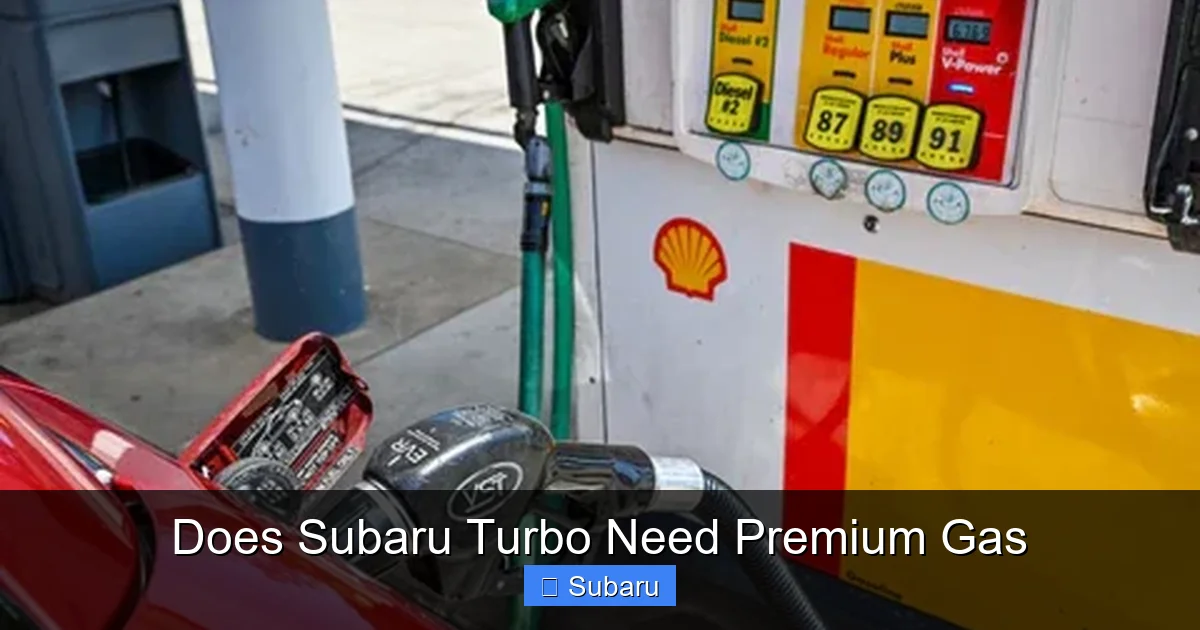
Before diving into Subaru-specific advice, it helps to understand what octane actually means. Octane rating measures a fuel’s ability to resist “knocking” or “pinging” during combustion—caused by the air-fuel mixture igniting too early in the engine cycle. Higher octane fuels are more stable under pressure and heat, making them ideal for high-performance or turbocharged engines.
Most gas stations offer three main grades:
– Regular (87 octane)
– Mid-grade (89 octane)
– Premium (91–93 octane)
In the U.S., premium is typically 91 or higher, though some regions offer 93 (often labeled as “super” or “premium plus”). In other countries, the scale may differ slightly, but the principle remains the same: higher octane = greater resistance to knock.
Turbocharged engines, like those in Subaru’s performance lineup, operate at higher compression ratios and generate more heat. This increases the risk of pre-ignition, especially under acceleration or when towing. Premium fuel helps prevent this by burning more evenly and resisting spontaneous combustion.
Think of it like this: regular gas is like a lightweight runner—it gets the job done on flat ground. But when you add hills (turbo boost), you need a stronger, more resilient fuel—like premium—to maintain pace without breaking down.
How Turbocharging Increases Fuel Demands
Turbochargers force more air into the engine’s combustion chamber, allowing more fuel to be burned and producing more power. But this process also raises cylinder pressures and temperatures significantly. Under these conditions, lower-octane fuels are more likely to ignite prematurely, causing knocking.
Knocking might sound like a minor annoyance, but over time, it can lead to:
– Piston damage
– Rod bearing wear
– Reduced engine efficiency
– Increased emissions
Modern engines, including Subaru’s, are equipped with knock sensors that detect abnormal combustion and adjust ignition timing to prevent damage. However, this “protection mode” often results in reduced power and fuel economy—exactly what you don’t want in a performance-oriented vehicle.
The Role of Engine Management Systems
Subaru’s turbocharged engines are managed by sophisticated engine control units (ECUs) that monitor everything from air intake to exhaust gas temperature. These systems are designed to optimize performance while protecting the engine.
When you use regular gas, the ECU may retard ignition timing to prevent knocking. While this protects the engine, it also reduces horsepower and torque. You might notice your WRX feels sluggish or less responsive—especially during hard acceleration or uphill driving.
Additionally, running lower-octane fuel can cause the ECU to enrich the air-fuel mixture (adding more fuel), which lowers efficiency and increases emissions. Over time, this can lead to carbon buildup on valves and spark plugs, further degrading performance.
Subaru’s Official Stance on Fuel Requirements

Visual guide about Does Subaru Turbo Need Premium Gas
Image source: autozonic.com
Subaru is clear in its owner’s manuals: **premium gasoline (91 octane or higher) is recommended for all turbocharged models**. This includes popular vehicles like:
– Subaru WRX and WRX STI
– Forester XT (2014–2018)
– Outback XT (2020–present)
– Legacy GT (older models)
The automaker emphasizes that using premium fuel ensures optimal performance, fuel economy, and engine durability. While the engine can operate on regular gas, Subaru warns that doing so may result in reduced power, increased fuel consumption, and potential long-term damage.
What the Owner’s Manual Says
If you flip open your Subaru’s owner’s manual, you’ll likely find a section titled “Fuel Requirements” or “Recommended Fuel.” For turbo models, it typically states:
> “Use premium unleaded gasoline with an octane rating of 91 or higher for optimum performance. If premium is not available, you may use regular unleaded gasoline with an octane rating of 87, but engine performance and fuel economy may be reduced.”
This wording is important. Subaru doesn’t say regular gas is *prohibited*—just that it’s not ideal. The key phrase is “may be reduced,” which leaves room for interpretation but clearly signals a trade-off.
Warranty Implications
One critical consideration is your vehicle’s warranty. Subaru’s warranty covers defects in materials and workmanship, but it does not cover damage caused by improper maintenance—including using the wrong fuel.
If an engine fails due to chronic knocking from regular gas use, Subaru may deny warranty claims, arguing that the driver failed to follow recommended maintenance guidelines. This is especially true if diagnostic data shows repeated knock events or timing adjustments due to low-octane fuel.
To protect your investment, it’s wise to follow Subaru’s fuel recommendations—especially during the warranty period.
Real-World Performance: Premium vs. Regular Gas

Visual guide about Does Subaru Turbo Need Premium Gas
Image source: autozonic.com
So, what happens when you actually put regular gas in your Subaru turbo? The effects aren’t always immediate, but they can add up over time.
Power and Acceleration
One of the most noticeable differences is in performance. Turbocharged Subarus are built for responsiveness and power. When you use regular gas, the ECU pulls timing to prevent knock, which directly reduces horsepower and torque.
For example, a 2023 Subaru WRX with a 2.4L turbo engine is rated at 271 hp and 258 lb-ft of torque—but only when running on premium fuel. On regular gas, real-world dyno tests show a drop of 10–15 hp and similar torque loss. That might not sound like much, but it’s the difference between a quick merge onto the highway and a sluggish one.
Drivers often report:
– Slower 0–60 mph times
– Hesitation during hard acceleration
– Reduced towing capacity
– Less “punch” when passing
Fuel Economy
You might think using cheaper regular gas saves money, but the reality is more complicated. Because the engine runs less efficiently on lower-octane fuel, you may actually see a drop in miles per gallon (MPG).
Studies and user reports suggest that running regular gas in a turbo Subaru can reduce fuel economy by 5–10%. For a vehicle that gets 25 MPG on premium, that’s a drop to 22–23 MPG. Over 15,000 miles, that could mean an extra 10–15 fill-ups per year—offsetting any savings from cheaper fuel.
Engine Longevity and Maintenance
The long-term effects of using regular gas are harder to quantify but equally important. Chronic knocking, even if mild, can cause micro-fractures in pistons and cylinder walls. Over time, this leads to increased wear and potential failure.
Additionally, lower-octane fuels often contain more impurities and detergents that can contribute to carbon buildup. This affects:
– Intake valves
– Fuel injectors
– Spark plugs
– Turbocharger components
Carbon deposits can reduce airflow, disrupt fuel spray patterns, and cause misfires. Cleaning these components requires costly maintenance, such as walnut blasting or fuel system cleaning.
Real Driver Experiences
Many Subaru owners have shared their experiences online. Some report using regular gas for years with no issues—especially in mild climates or with light driving. Others notice immediate performance drops and switch back to premium.
One WRX owner on a popular forum said:
> “I tried regular gas once during a road trip when premium wasn’t available. The car felt sluggish, and the turbo seemed quieter. I filled up with premium at the next stop, and within a few miles, it felt like a different car—more responsive, smoother, and louder (in a good way).”
Another driver noted:
> “I used regular for six months to save money. My fuel economy dropped, and I started hearing a faint pinging under hard acceleration. I switched back to premium, and the noise went away. I wish I’d listened to the manual sooner.”
These stories highlight a common theme: while regular gas may not cause immediate failure, it often leads to noticeable performance degradation and subtle engine stress.
When Is It Okay to Use Regular Gas?
Despite the risks, there are situations where using regular gas in your Subaru turbo might be acceptable—especially as a temporary measure.
Short-Term Use in Emergencies
If you’re on a long road trip and premium gas isn’t available, filling up with regular gas once or twice is unlikely to cause serious damage. Modern engines are designed with safeguards, and a single tank of 87-octane fuel won’t destroy your turbo.
However, it’s best to:
– Avoid hard acceleration
– Drive gently until you can refill with premium
– Mix in a higher-octane fuel (like mid-grade) if possible to raise the overall octane
Some drivers carry a bottle of octane booster for emergencies, though these products vary in effectiveness and should be used cautiously.
Climate and Driving Conditions
Environmental factors also play a role. In cooler climates, the risk of knocking is lower because combustion temperatures are reduced. Similarly, if you primarily drive in city traffic with light loads, the engine may not generate enough heat to trigger knock on regular gas.
However, in hot weather, at high altitudes, or when towing, the risk increases significantly. Turbo engines under load are more prone to pre-ignition, making premium fuel even more important.
Older vs. Newer Models
Older Subaru turbos (like the EJ20 and EJ25 engines in the 2000s WRX) were known for being particularly sensitive to fuel quality. Many enthusiasts insist on 93-octane fuel for these models, especially if they’ve been modified.
Newer turbocharged Subarus (like the FA24 engine in the 2022+ WRX) are more tolerant due to advanced engine management and direct injection. Still, Subaru continues to recommend premium fuel for all turbo models.
Cost-Benefit Analysis: Is Premium Gas Worth It?
Let’s do the math. Premium gas typically costs $0.20–$0.50 more per gallon than regular. For a 15-gallon tank, that’s an extra $3–$7.50 per fill-up.
Over a year, assuming 12 fill-ups, the additional cost ranges from $36 to $90.
Now consider the benefits:
– 5–10% better fuel economy
– Full horsepower and torque output
– Reduced engine wear and maintenance
– Peace of mind and warranty protection
If premium gas improves your MPG by 2 miles per gallon (e.g., from 23 to 25 MPG), you’ll save about 1.2 gallons per 100 miles. Over 15,000 miles, that’s 180 gallons saved—worth roughly $600 at $3.50/gallon. Even after subtracting the extra cost of premium, you come out ahead.
Additionally, protecting your engine from premature wear can save thousands in repair costs down the line. A turbocharger rebuild or engine overhaul can easily exceed $5,000.
Environmental Impact
Higher-octane fuels often burn cleaner, producing fewer emissions. While the difference may be small, using the correct fuel contributes to better air quality and aligns with Subaru’s commitment to environmental responsibility (evidenced by their focus on all-wheel drive efficiency and lower emissions).
Tips for Subaru Turbo Owners
To get the most out of your turbocharged Subaru, follow these practical tips:
Always Check the Owner’s Manual
Your vehicle’s manual is the ultimate authority. Don’t rely on hearsay or forum opinions—check what Subaru says for your specific model and year.
Use Top-Tier Premium Gasoline
Not all premium fuels are created equal. Look for “Top Tier” certified brands (like Shell, Chevron, Exxon, or Costco), which contain higher levels of detergents to keep your engine clean.
Monitor Engine Performance
Pay attention to how your car feels. If you notice hesitation, knocking, or reduced MPG, it could be a sign of fuel-related issues.
Consider an OBD2 Scanner
A basic OBD2 scanner can help you monitor knock counts, fuel trims, and timing adjustments. If you see frequent knock events, it’s a clear sign your engine is struggling with lower-octane fuel.
Don’t Mix Fuels Frequently
While mixing premium and regular gas occasionally is fine, constantly switching can confuse the ECU and lead to inconsistent performance. Stick to one fuel type when possible.
Plan Ahead for Road Trips
If you’re traveling to an area with limited premium fuel, plan your route to include stations that offer 91+ octane. Apps like GasBuddy can help you find the best options.
Conclusion: Premium Gas Is the Smart Choice for Subaru Turbos
So, does your Subaru turbo need premium gas? The short answer is: **yes, it’s strongly recommended**. While you can run regular gas in a pinch, doing so regularly sacrifices performance, efficiency, and long-term reliability.
Subaru designs its turbocharged engines to perform at their best with high-octane fuel. Premium gasoline prevents knocking, protects critical components, and ensures you get the full power and responsiveness your vehicle was built for. The small extra cost at the pump is a worthwhile investment in your car’s health and your driving experience.
Whether you’re pushing your WRX on a mountain road or cruising in your Outback XT, using the right fuel makes all the difference. Follow Subaru’s guidance, listen to your engine, and enjoy the ride—knowing you’re giving your turbo the care it deserves.
Frequently Asked Questions
Can I use regular gas in my Subaru WRX?
Yes, you can use regular gas in a Subaru WRX, but it’s not recommended. The engine may run, but you’ll likely experience reduced power, lower fuel economy, and increased risk of engine knock over time.
What happens if I put 87 octane in my turbo Subaru?
Using 87 octane fuel can cause the engine control unit to retard ignition timing to prevent knocking. This reduces horsepower and torque, and may lead to long-term engine wear if done frequently.
Is it safe to mix premium and regular gas in a Subaru turbo?
Occasionally mixing fuels is generally safe and can raise the overall octane slightly. However, it’s best to avoid frequent mixing and stick to premium when possible for consistent performance.
Will using regular gas void my Subaru warranty?
Using regular gas won’t automatically void your warranty, but if engine damage occurs due to knocking from low-octane fuel, Subaru may deny coverage. Always follow the owner’s manual to protect your warranty.
Does premium gas clean my Subaru’s engine?
Premium gas itself doesn’t clean the engine, but Top Tier premium fuels contain extra detergents that help prevent carbon buildup. Regular use can keep fuel injectors and valves cleaner over time.
Can I use ethanol-free premium gas in my Subaru turbo?
Yes, ethanol-free premium gas is safe and often preferred by performance drivers. It has a higher energy density and reduces the risk of moisture-related issues, making it a great choice for turbocharged engines.