
Does Audi Own Porsche?

Contents
- 1 Key Takeaways
- 2 📑 Table of Contents
- 3 Does Audi Own Porsche? The Truth Behind the German Auto Giants
- 4 The Volkswagen Group: The Real Parent Company
- 5 The History of Porsche and Volkswagen: A Family Affair
- 6 Audi and Porsche: Collaboration Over Competition
- 7 The Future of Audi and Porsche: Electric and Autonomous
- 8 Common Misconceptions and Clarifications
- 9 Conclusion: Siblings Under One Roof
- 10 Frequently Asked Questions

Car USB Charger

Car Paint Touch Up Pen

Car Window Tint Film

Car Wax Polish
Audi does not own Porsche—but both are part of the Volkswagen Group. While they operate as separate brands, their shared parent company and deep engineering collaborations create a unique automotive alliance. This article breaks down the corporate structure, history, and future of these legendary manufacturers.
Key Takeaways
- Audi does not own Porsche: Despite common misconceptions, Audi is not the parent company of Porsche. Both are subsidiaries under the Volkswagen Group.
- Volkswagen Group is the true owner: The Volkswagen Group owns both Audi and Porsche, along with other major brands like Lamborghini, Bentley, and Ducati.
- Porsche attempted to acquire Volkswagen: In the mid-2000s, Porsche launched a bold takeover bid for Volkswagen, which ultimately failed and led to the reverse—Volkswagen acquiring Porsche.
- Shared platforms and technology: Audi and Porsche collaborate on vehicle platforms, engines, and electric vehicle development, especially under the VW Group’s modular strategy.
- Distinct brand identities: Despite shared ownership, Audi and Porsche maintain separate design philosophies, target markets, and brand images.
- Ferdinand Porsche’s legacy: The Porsche family played a key role in founding both Porsche and Volkswagen, creating a deep historical connection between the brands.
- Future of collaboration: As the auto industry shifts to electric and autonomous vehicles, Audi and Porsche are working together on next-gen technologies like the Premium Platform Electric (PPE).
📑 Table of Contents
- Does Audi Own Porsche? The Truth Behind the German Auto Giants
- The Volkswagen Group: The Real Parent Company
- The History of Porsche and Volkswagen: A Family Affair
- Audi and Porsche: Collaboration Over Competition
- The Future of Audi and Porsche: Electric and Autonomous
- Common Misconceptions and Clarifications
- Conclusion: Siblings Under One Roof
Does Audi Own Porsche? The Truth Behind the German Auto Giants
If you’ve ever stood next to an Audi RS6 or a Porsche 911 and wondered how these two performance legends are connected, you’re not alone. Both brands are synonymous with German engineering, precision, and luxury. They share design cues, technology, and even production facilities. But does Audi own Porsche? The short answer is no—but the full story is far more fascinating.
At first glance, it might seem logical that Audi, known for its Quattro all-wheel-drive system and high-performance RS models, could be the parent company of Porsche, the maker of iconic sports cars like the 911 and Cayman. After all, both brands are German, both are premium, and both are often mentioned in the same breath when discussing high-end automobiles. However, the reality is more complex and rooted in decades of corporate maneuvering, family legacies, and strategic alliances.
To understand the relationship between Audi and Porsche, we need to look beyond surface-level similarities and dive into the corporate structure of the Volkswagen Group—the true powerhouse behind both brands. This article will explore the history, ownership, technological collaboration, and future direction of Audi and Porsche, clarifying once and for all whether one owns the other.
The Volkswagen Group: The Real Parent Company
Visual guide about Does Audi Own Porsche?
Image source: acrosstheblvd.com
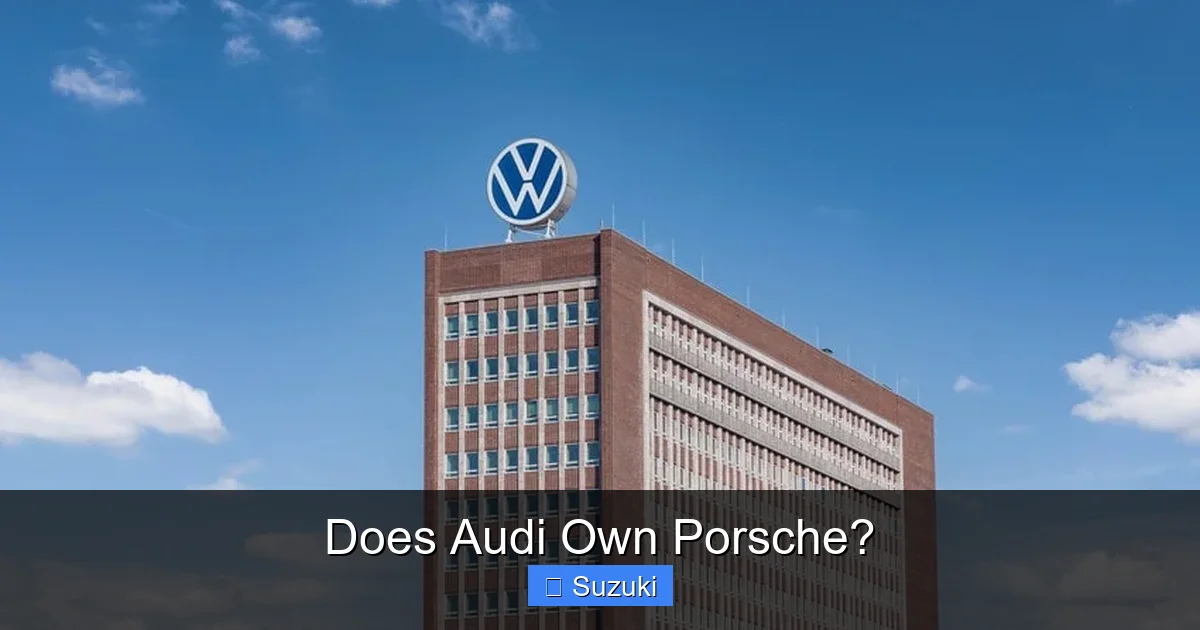
To answer the question “Does Audi own Porsche?” we must first identify who actually owns both companies. The answer lies with the Volkswagen Group, one of the largest automotive conglomerates in the world.
Founded in 1937, the Volkswagen Group began as a state-backed project in Germany to produce an affordable “people’s car”—the original Beetle. Over the decades, it expanded through acquisitions and strategic partnerships, eventually becoming a global leader in automotive manufacturing. Today, the group owns a diverse portfolio of brands, including Volkswagen, Audi, SEAT, Škoda, Porsche, Lamborghini, Bentley, Bugatti, and Ducati.
Audi became part of the Volkswagen Group in 1964 when Volkswagen acquired a majority stake in Auto Union, the predecessor to modern-day Audi. This move allowed Volkswagen to enter the premium car market and compete with brands like BMW and Mercedes-Benz. Over time, Audi evolved into a flagship brand within the group, known for innovation, design, and performance.
Porsche, on the other hand, has a more complicated history with Volkswagen. The two companies were originally linked through Ferdinand Porsche, the legendary engineer who designed the original Volkswagen Beetle and later founded his own company, Dr. Ing. h.c. F. Porsche AG, in 1931. The Porsche and Piëch families—descendants of Ferdinand Porsche—have played a central role in both companies’ development.
In the early 2000s, Porsche attempted to take over Volkswagen, a move that shocked the automotive world. However, the plan backfired due to financial pressures and market volatility, leading to a reversal: in 2012, Volkswagen officially acquired Porsche AG, bringing the sports car manufacturer under its corporate umbrella.
Today, both Audi and Porsche operate as independent brands within the Volkswagen Group, each with its own management, design teams, and product lines. However, they share resources, technology, and strategic direction under the group’s leadership.
Corporate Structure and Brand Autonomy
Despite being under the same parent company, Audi and Porsche maintain a high degree of autonomy. Each brand has its own headquarters—Audi in Ingolstadt, Germany, and Porsche in Stuttgart—and operates with distinct brand identities.
Audi positions itself as a leader in technology and innovation, emphasizing features like virtual cockpits, advanced driver assistance systems, and electric mobility through its e-tron lineup. Porsche, meanwhile, focuses on driving dynamics, heritage, and emotional appeal, with a strong emphasis on sports cars and performance vehicles.
This separation allows both brands to target different customer segments while benefiting from shared engineering and manufacturing capabilities. For example, Audi’s Q7 and Porsche’s Cayenne share a platform, but they are tuned and marketed very differently—one as a luxury SUV, the other as a sporty performance vehicle.
The History of Porsche and Volkswagen: A Family Affair
Visual guide about Does Audi Own Porsche?
Image source: brandsownedby.com
The connection between Porsche and Volkswagen runs deeper than corporate ownership—it’s rooted in family history and engineering legacy.
Ferdinand Porsche, the founder of the Porsche brand, was also the chief designer of the original Volkswagen Beetle. Commissioned by Adolf Hitler in the 1930s to create an affordable car for the German people, Porsche’s design became one of the most iconic vehicles in history. After World War II, Ferdinand’s son, Ferry Porsche, founded the Porsche company to produce sports cars, starting with the Porsche 356 in 1948.
The Porsche and Piëch families—Ferry Porsche’s children—became influential figures in both companies. Ferdinand Anton Ernst Porsche (Ferry’s son) led Porsche AG for decades, while Ferdinand Piëch (Ferry’s nephew) rose to become CEO of both Audi and later the entire Volkswagen Group.
This family connection created a unique dynamic. While Audi and Porsche were technically competitors, they were also intertwined through shared leadership and vision. Ferdinand Piëch, in particular, played a pivotal role in shaping both brands. As CEO of Audi in the 1980s and 1990s, he pushed the brand toward technological excellence and all-wheel-drive dominance. Later, as head of the Volkswagen Group, he oversaw the integration of Porsche into the corporate structure.
The Failed Porsche Takeover of Volkswagen
One of the most dramatic chapters in the Audi-Porsche relationship occurred in the mid-2000s, when Porsche attempted to acquire Volkswagen.
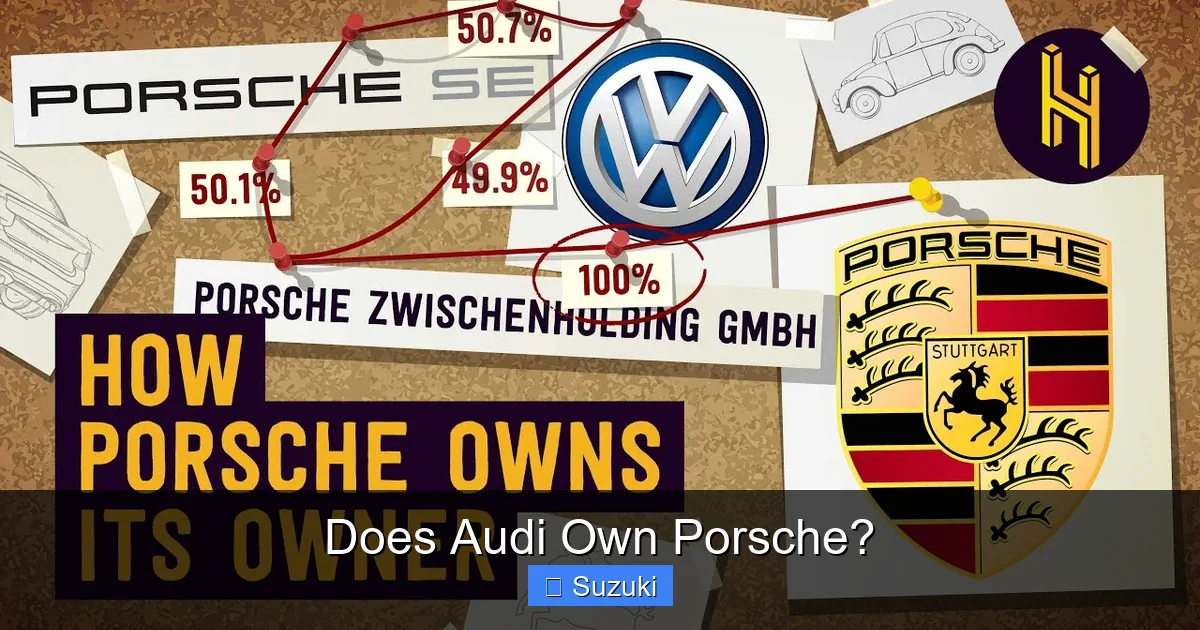
In 2005, Porsche announced its intention to take a controlling stake in Volkswagen, citing strategic synergy and long-term growth. Over the next few years, Porsche steadily increased its ownership, eventually holding over 50% of Volkswagen’s shares and gaining significant influence over the group’s direction.
However, the plan unraveled during the 2008 financial crisis. Porsche had taken on massive debt to fund the acquisition and was unable to secure additional financing. Meanwhile, Volkswagen’s stock price plummeted, and the German government—which held a blocking minority stake in VW—resisted the takeover.
In a stunning reversal, Volkswagen launched a counter-bid to acquire Porsche AG. By 2012, the deal was complete: Volkswagen had purchased Porsche’s automotive operations, making it a fully owned subsidiary. The Porsche family retained control of Porsche SE, the holding company that owns a majority stake in Volkswagen Group, creating a circular ownership structure that still confuses observers today.
This episode highlights the complex relationship between the brands. While Audi did not own Porsche, the two were deeply entangled through corporate strategy, family ties, and financial maneuvering.
Audi and Porsche: Collaboration Over Competition
Visual guide about Does Audi Own Porsche?
Image source: auto-porsche.com
Although Audi and Porsche are separate brands, they collaborate extensively within the Volkswagen Group. This cooperation spans engineering, platform sharing, and future technology development.
One of the most visible examples of collaboration is the use of shared platforms. The Volkswagen Group employs a modular strategy, where multiple brands build vehicles on the same underlying architecture. This reduces costs, improves efficiency, and allows for faster innovation.
For instance, the Audi Q7, Porsche Cayenne, and Volkswagen Touareg all share the same MLB (Modular Longitudinal Matrix) platform. While each vehicle is tailored to its brand’s identity—Audi emphasizing luxury and tech, Porsche focusing on performance—they benefit from shared components like engines, transmissions, and suspension systems.
Shared Engines and Powertrains
Engine sharing is another area where Audi and Porsche work closely together. Many high-performance models from both brands use similar or identical powertrains.
The Audi RS4 and Porsche Cayman GT4, for example, both use a naturally aspirated 4.0-liter V8 engine, tuned differently for each application. Similarly, the Audi RS Q8 and Porsche Cayenne Turbo share a 4.0-liter twin-turbo V8, delivering over 500 horsepower in both vehicles.
This collaboration extends to electric vehicles as well. Audi and Porsche are jointly developing the Premium Platform Electric (PPE), a dedicated architecture for high-end electric cars. The first models on this platform include the Audi Q6 e-tron and the Porsche Macan EV, set to launch in the coming years.
By sharing technology, both brands can reduce development costs and accelerate time-to-market, while still offering unique driving experiences.
Design and Brand Identity
Despite their collaboration, Audi and Porsche maintain distinct design languages and brand philosophies.
Audi is known for its sleek, modern aesthetic—clean lines, sharp angles, and a focus on interior technology. The brand’s tagline, “Vorsprung durch Technik” (Advancement through Technology), reflects its emphasis on innovation and digital integration.
Porsche, in contrast, embraces heritage and emotion. Its designs are evolutionary rather than revolutionary, with the 911 serving as a prime example. The brand prioritizes driver engagement, analog controls, and timeless styling.
This difference is evident even in shared platforms. While the Audi Q7 and Porsche Cayenne may look similar under the skin, their exteriors, interiors, and driving dynamics are tailored to appeal to different customers.
The Future of Audi and Porsche: Electric and Autonomous
As the automotive industry shifts toward electrification and autonomy, Audi and Porsche are positioning themselves as leaders in premium electric mobility.
Both brands have committed to ambitious electrification goals. Audi plans to offer 20 fully electric models by 2025, while Porsche aims for 80% of its sales to be electric by 2030.
The Premium Platform Electric (PPE) is central to this strategy. Developed jointly by Audi and Porsche, PPE is designed for high-performance electric vehicles with long range, fast charging, and advanced driver assistance systems.
The upcoming Porsche Macan EV and Audi Q6 e-tron will be the first models on this platform, showcasing cutting-edge technology like 800-volt architecture, which enables ultra-fast charging.
Autonomous Driving and Connectivity
Beyond electrification, both brands are investing in autonomous driving and connected car technologies.
Audi has been a pioneer in this space, offering Level 3 autonomous driving in the A8 sedan (in select markets). Porsche, while more cautious, is integrating advanced driver aids into its vehicles and exploring autonomous features for future models.
Collaboration on software and digital services is also increasing. Both brands use the Volkswagen Group’s CARIAD software division to develop unified infotainment systems, over-the-air updates, and cloud-based services.
This shared approach ensures consistency across the group while allowing each brand to customize the user experience.
Common Misconceptions and Clarifications
Despite clear evidence, the idea that “Audi owns Porsche” persists. Let’s address some common misconceptions.
First, some people assume that because Audi and Porsche share technology, one must own the other. However, platform sharing is common in the automotive industry—Toyota and Subaru, for example, co-developed the Supra and BRZ without one owning the other.
Second, the family ties between the Porsche and Piëch families can create confusion. While members of these families have held leadership roles at both Audi and Volkswagen, this doesn’t mean Audi controls Porsche.
Finally, the failed Porsche takeover of Volkswagen adds to the myth. Because Porsche once sought to acquire VW, some assume it succeeded—or that Audi was involved. In reality, the deal collapsed, and Volkswagen ended up acquiring Porsche.
Why the Confusion Exists
The confusion stems from the intertwined history, shared technology, and high-profile family connections. Add in the fact that both brands are German, premium, and performance-oriented, and it’s easy to see why people assume a direct ownership link.
However, understanding the Volkswagen Group’s structure clarifies the relationship: Audi and Porsche are siblings, not parent and child.
Conclusion: Siblings Under One Roof
So, does Audi own Porsche? The answer is a clear no. Audi and Porsche are both independent brands under the Volkswagen Group, each with its own identity, strategy, and customer base.
Their relationship is one of collaboration, not ownership. They share platforms, engines, and future technologies, but they compete in the marketplace with distinct products and brand images.
The story of Audi and Porsche is a testament to the power of strategic alliances in the automotive industry. By working together under a common parent, both brands can innovate faster, reduce costs, and deliver exceptional vehicles to customers worldwide.
As the industry evolves, Audi and Porsche will continue to push the boundaries of performance, luxury, and sustainability—proving that sometimes, the strongest partnerships aren’t about ownership, but about shared vision.
Frequently Asked Questions
Does Audi own Porsche?
No, Audi does not own Porsche. Both brands are subsidiaries of the Volkswagen Group, which is the true parent company. They operate independently but collaborate on technology and platforms.
Who owns Audi and Porsche?
The Volkswagen Group owns both Audi and Porsche. Porsche SE, the holding company controlled by the Porsche and Piëch families, holds a majority stake in Volkswagen Group, creating a unique circular ownership structure.
Did Porsche ever try to buy Volkswagen?
Yes, in the mid-2000s, Porsche launched a takeover bid for Volkswagen and acquired a majority stake. However, the plan failed during the 2008 financial crisis, and Volkswagen eventually acquired Porsche AG in 2012.
Do Audi and Porsche share car platforms?
Yes, Audi and Porsche share platforms like the MLB and the upcoming PPE (Premium Platform Electric). Examples include the Audi Q7 and Porsche Cayenne, which use the same underlying architecture.
Are Audi and Porsche competitors?
Yes, Audi and Porsche compete in the premium automotive market, but they target slightly different segments. Audi focuses on technology and luxury, while Porsche emphasizes performance and driving dynamics.
Will Audi and Porsche merge in the future?
There are no plans to merge Audi and Porsche. Both brands will continue to operate independently under the Volkswagen Group, maintaining their unique identities while collaborating on technology and innovation.


