Does a 2004 Toyota 4runner Have a Timing Belt or Chain?

Contents
- 1 Key Takeaways
- 2 📑 Table of Contents
- 3 Understanding the Heartbeat: Timing Belts vs. Timing Chains
- 4 The 2004 Toyota 4Runner: A Chain-Driven Powerhouse
- 5 Maintenance Implications: “Lifetime” Doesn’t Mean “Ignore It”
- 6 What Are the Warning Signs of a Problem?
- 7 Debunking Myths and Addressing Common Questions
- 8 Conclusion: A Major Reliability Win for the 4Runner
- 9 Frequently Asked Questions


Your 2004 Toyota 4Runner is equipped with a timing chain, not a timing belt. This is a major reliability advantage, as timing chains are designed to last the lifetime of the engine with proper maintenance. Unlike timing belts, they don’t require scheduled replacement, saving you significant cost and preventive maintenance hassle. The key is ensuring the chain tensioners and associated components are well-maintained with regular oil changes.
If you own a 2004 Toyota 4Runner or are considering buying one, one of the most important questions about long-term reliability is about its internal engine timing system. Is it a timing belt or a timing chain? This single detail has huge implications for your maintenance schedule, potential repair costs, and overall peace of mind. Getting this wrong can lead to a neglected service or an unexpected, expensive bill. So, let’s clear the air once and for all: your 2004 4Runner has a timing chain. This is fantastic news for owners, as it represents one of the pillars of the 4Runner’s legendary durability. In this comprehensive guide, we’ll dive deep into what that means, why it matters, and exactly how to care for this critical system so your SUV can effortlessly conquer trails and highways for hundreds of thousands of miles.
Key Takeaways
- It has a timing chain: All 2004 Toyota 4Runner models, regardless of engine (4.0L V6 or 4.7L V8), use a durable timing chain system.
- No scheduled replacement: Unlike a timing belt, the chain itself is not a routine maintenance item and is designed to last the engine’s life.
- Maintenance is still critical: The chain’s longevity depends entirely on regular oil changes using the correct oil to lubricate the tensioners and chain.
- Chain failure is rare but catastrophic: While extremely uncommon in a well-maintained 4Runner, a broken timing chain causes severe engine damage.
- Listen for warning signs: Ticking noises from the front of the engine or poor performance can indicate a failing tensioner or chain issue.
- It’s a design for longevity: Toyota’s use of chains in this era of 4Runners is a key reason for their reputation for long-term reliability.
- Other belts still need service: Your 4Runner has accessory belts (like the serpentine belt) that do require periodic inspection and replacement.
📑 Table of Contents
- Understanding the Heartbeat: Timing Belts vs. Timing Chains
- The 2004 Toyota 4Runner: A Chain-Driven Powerhouse
- Maintenance Implications: “Lifetime” Doesn’t Mean “Ignore It”
- What Are the Warning Signs of a Problem?
- Debunking Myths and Addressing Common Questions
- Conclusion: A Major Reliability Win for the 4Runner
Understanding the Heartbeat: Timing Belts vs. Timing Chains
Before we get into the specifics of the 2004 4Runner, let’s establish a foundational understanding of these two components. Both a timing belt and a timing chain serve the exact same fundamental purpose: they synchronize the rotation of the crankshaft and the camshaft(s). This synchronization ensures the engine’s intake and exhaust valves open and close at precisely the right moments relative to the pistons’ movement. Get this timing off, even by a fraction, and the engine runs poorly or not at all. Get it catastrophically off (like from a broken belt/chain), and the pistons can collide with the open valves, causing instant, total engine destruction—a “interference” engine design failure.
The Timing Belt: The High-Maintenance Performer
A timing belt is typically made of reinforced rubber with teeth that mesh with gears. Its primary advantages are that it’s quieter, lighter, and cheaper to manufacture. However, it comes with a major drawback: it’s a wear item. Rubber degrades over time due to heat, tension, and chemical exposure. Manufacturers mandate its replacement at strict intervals, usually between 60,000 and 105,000 miles, depending on the vehicle. Missing this service is playing Russian roulette with your engine. The cost of a belt replacement (often $500-$1,000) is high, but it’s a fraction of the $3,000-$5,000+ needed to replace or rebuild an engine after a belt failure. It’s a classic case of “pay me now or pay me much, much later.”
The Timing Chain: The “Lifetime” Workhorse
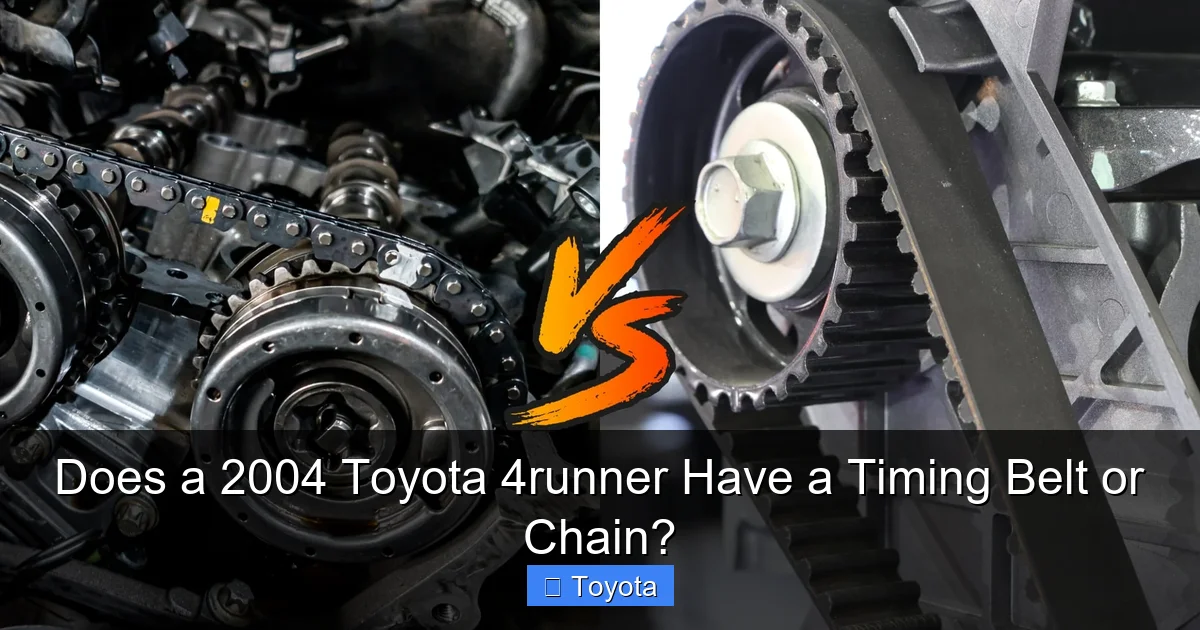
A timing chain is, as the name suggests, a metal chain, similar to a bicycle chain but far more robust. It rides on hardened sprockets and is kept under tension by a hydraulic or mechanical tensioner. Its key advantages are strength and durability. It’s not susceptible to dry rot or heat cracking like rubber. In theory, a well-maintained timing chain can last the entire lifespan of the engine without needing replacement. This design is heavier, can be slightly noisier (though modern engineering has minimized this), and has a higher initial manufacturing cost. For the automaker and the owner, it’s an investment in long-term reliability and lower scheduled maintenance costs.
The 2004 Toyota 4Runner: A Chain-Driven Powerhouse
Now, to the heart of your question. For the 2004 model year, the Toyota 4Runner was available with two gasoline engines:

Visual guide about Does a 2004 Toyota 4runner Have a Timing Belt or Chain?
Image source: hondatheotherside.com
- The standard 4.0-liter V6 (1GR-FE), producing 245 horsepower.
- The optional 4.7-liter V8 (2UZ-FE), producing 271 horsepower.
Here is the definitive answer: both of these engines utilize a timing chain system. This was not an accident; it was a deliberate engineering choice by Toyota for its SUV and truck lines during this period. The 4Runner, sharing its platform with the Tacoma and Tundra, was built for durability and off-road prowess. A timing belt, with its finite service interval and vulnerability to premature failure from oil starvation or coolant leaks, simply did not align with the “built tough” ethos of the 4Runner. Toyota prioritized a system that an owner could largely forget about, provided they adhered to basic maintenance. This design philosophy is consistent with many other Toyota models of the era. If you’re curious about when other Toyota trucks made the switch, you can read about the Toyota Tundra’s transition to timing chains, which followed a similar reliability-focused path.
Inside the 4.0L V6 (1GR-FE) and 4.7L V8 (2UZ-FE)
While both engines are chain-driven, their internal architectures differ slightly. The 4.0L V6 is a single overhead cam (SOHC) design with two valves per cylinder. It uses one timing chain to connect the crankshaft to the camshaft in each cylinder bank. The 4.7L V8 is a dual overhead cam (DOHC) design with four valves per cylinder. It uses a more complex system with two timing chains per cylinder bank to drive both the intake and exhaust camshafts. Despite this added complexity, the core principle remains: metal chains, not rubber belts. The chains run inside the front of the engine, protected by the front cover. They are lubricated by engine oil, which is why oil quality and change intervals are so paramount for their health.
Maintenance Implications: “Lifetime” Doesn’t Mean “Ignore It”
Saying a timing chain is “lifetime” can be misleading if owners interpret it as “no maintenance required.” The chain itself is robust, but it relies on a system of components that absolutely need care. Think of it like a high-quality bicycle chain: the chain links may be strong, but if the derailleur (tensioner) seizes or the lubricant (oil) turns to sludge, the system fails.

Visual guide about Does a 2004 Toyota 4runner Have a Timing Belt or Chain?
Image source: weldingtroop.com
The Critical Role of Oil and the Tensioner
The timing chain tensioner is the unsung hero of this system. In your 2004 4Runner, it’s almost certainly a hydraulic tensioner. It uses engine oil pressure to maintain constant, precise tension on the chain. If your engine oil is low, dirty, or of poor quality, this tensioner can’t function correctly. A slack chain can develop a “jump” or excessive wear, while an over-tensioned chain can put undue stress on bearings and sprockets. Furthermore, the chain and sprockets themselves require a constant film of clean oil to prevent metal-on-metal wear. This is why using the correct viscosity and quality of oil (Toyota’s recommended 5W-30 is a safe bet for most climates) and changing it at or before the recommended interval (usually 5,000-7,500 miles for severe service) is non-negotiable for timing chain longevity. Neglecting oil changes is the number one cause of premature timing chain wear and failure.
Other Components in the Timing Cover
While you’re under there for an oil change, it’s good to be aware of other components. The timing chain guides (or rails) are plastic or composite pieces that the chain rides on to keep it aligned and dampen vibration. These can become brittle and break over many years and extreme heat. A broken guide will cause a loud rattling noise and can lead to chain derailment. The front main seal, which sits right around the crankshaft pulley and is part of the timing cover assembly, is also a common wear point that can leak. A small oil leak here is often just an annoyance, but a significant leak can lead to low oil pressure, affecting the tensioner. Speaking of other belts, your 4Runner also has a serpentine belt that drives the alternator, power steering pump, and air conditioning compressor. That belt is rubber and absolutely does wear out. You can learn more about the typical lifespan of a Toyota serpentine belt to avoid a different, but still inconvenient, breakdown.
What Are the Warning Signs of a Problem?
Timing chain issues on a well-maintained 4Runner are rare, but they are not impossible, especially as the vehicle approaches or surpasses 200,000 miles. Being attuned to the symptoms can help you catch a small problem before it becomes a catastrophic engine failure.
Visual guide about Does a 2004 Toyota 4runner Have a Timing Belt or Chain?
Image source: rerev.com
The Classic Symptom: Rattling or Ticking on Cold Start
The most common indicator of a failing timing chain tensioner or a worn chain is a distinct rattling or high-pitched ticking noise coming from the front of the engine (the timing cover area). This noise is usually loudest upon a cold start and may diminish or disappear after a few seconds as oil pressure builds and the tensioner extends. If you hear this, it’s a serious red flag. It means the tensioner is likely worn, not holding pressure, and the chain is slapping against the guides or cover. Have this diagnosed immediately. Continuing to drive with this noise dramatically increases the chance of the chain jumping a tooth or breaking.
Performance Issues and Check Engine Lights
A timing chain that has jumped one or more teeth (due to a worn tensioner or stretched chain) will throw the engine’s timing out of spec. This will cause noticeable performance problems: the engine may run rough, misfire, lack power, or have poor fuel economy. The engine control unit (ECU) will detect this through sensors (like the camshaft position sensor) and trigger a Check Engine Light. Common codes might relate to camshaft/crankshaft correlation. While these can sometimes be sensor issues, they must be investigated to rule out a timing problem. A stretched chain might also cause a subtle, consistent rattling at all engine speeds, not just on startup.
Visual Inspection During Service
The best way to assess timing chain health is during a major service. When a mechanic is replacing the front main seal, water pump, or doing a major valve job, they will remove the timing cover and can physically inspect the chain, tensioner, and guides for wear, stretch, or damage. For a high-mileage 4Runner, some proactive owners opt to have the timing cover removed for an inspection around 200,000-250,000 miles as a preventative measure, though this is a significant labor-intensive job. More commonly, mechanics will inspect the tensioner and guides if they are already in the area for another repair.
Debunking Myths and Addressing Common Questions
Let’s clear up some confusion that often surrounds this topic, especially with a vehicle as popular and long-lived as the 4Runner.
Myth: “All 4Runners Have Timing Chains”
This is mostly true for the generation we’re discussing (2003-2009, the N210 platform). However, it’s crucial to verify by model year and engine. Earlier 4Runners (like some 1990s models) and certain international markets sometimes used belts. Always confirm for your specific VIN. The rule of thumb for this generation: if it’s a 4.0L V6 or 4.7L V8, it’s a chain. The later 4.0L V6 in the 2010+ generation (1GR-FE) also uses a chain. But for absolute certainty, your owner’s manual or a trusted mechanic is the final authority.
What About the 4-Cylinder?
This is an important distinction. The 2004 4Runner was not sold with a 4-cylinder engine in the North American market. However, the related Toyota Tacoma pickup of the same era offered a 2.4L 2RZ-FE 4-cylinder (which used a timing belt) and later a 2.7L 3RZ-FE 4-cylinder (which also used a timing belt). The 4Runner’s truck-based roots mean it skipped the 4-cylinder entirely, going straight to the more robust V6 and V8 chain-driven engines. So, you don’t have to worry about that belt.
The Cost of a Timing Chain Replacement
Because it’s not a scheduled service, the cost of replacing a timing chain on a 2004 4Runner is not something most owners budget for. It is a major engine repair. The timing chain itself is not terribly expensive, but the labor is immense. The mechanic must remove the entire front of the engine—harmonic balancer, water pump, accessories, timing cover—to access the chain. This is easily a 10-15 hour job for a professional shop. Total costs, including parts (chain, tensioner, guides, seals, gaskets) and labor, can easily range from $1,500 to over $3,000 depending on your location and shop rates. This starkly contrasts with a belt job, which is preventative and scheduled. The chain job is reactive and emergency-level. This financial reality underscores why preventing the problem through diligent oil maintenance is so critical.
Conclusion: A Major Reliability Win for the 4Runner
So, does a 2004 Toyota 4Runner have a timing belt or chain? The clear and reassuring answer is a timing chain. This is not a minor detail; it’s a cornerstone of the model’s enduring reputation for reliability and low-cost ownership. You have been spared the anxiety and expense of a mandatory, high-mileage timing belt replacement service. Your primary responsibility is simple but vital: perform engine oil and filter changes with high-quality products at or before the recommended intervals. This single habit protects the hydraulic tensioner and provides the lubrication the chain and sprockets need to function silently for the life of the engine. While no mechanical system is 100% foolproof, the 2004 4Runner’s chain-driven engine is a testament to Toyota’s engineering philosophy of building vehicles that last. By understanding this system and treating your oil changes as non-negotiable maintenance, you can enjoy your 4Runner’s capability and dependability for many more years and miles to come. For any other questions about your specific model’s features or maintenance, don’t hesitate to consult your owner’s manual or a Toyota specialist.
Frequently Asked Questions
Does a 2004 Toyota 4Runner have a timing belt or chain?
The 2004 Toyota 4Runner uses a timing chain in both its available 4.0L V6 and 4.7L V8 engines. It does not have a timing belt.
Does the timing chain on a 2004 4Runner ever need to be replaced?
The timing chain itself is designed to last the engine’s lifetime and is not on a scheduled replacement interval. However, the tensioner and guides can wear out, especially in high-mileage engines or with neglected oil changes, and may require replacement.
What are the signs of a failing timing chain on a 2004 4Runner?
The most common sign is a loud rattling or ticking noise from the front of the engine, particularly on cold starts. Other signs include poor engine performance, misfires, and a Check Engine Light with codes related to camshaft/crankshaft timing.
What happens if the timing chain breaks on a 4Runner?
A broken timing chain will cause the engine to stop immediately and will almost certainly result in catastrophic internal damage, as pistons collide with open valves. This requires a full engine rebuild or replacement.
Is the 2004 4Runner engine an interference engine?
Yes, both the 4.0L V6 and 4.7L V8 engines are interference engines. This means that if the timing chain fails, the pistons and valves will collide, causing severe damage.
What maintenance is actually required for the timing chain system?
The single most important maintenance is regular oil changes using the correct oil viscosity. Clean oil at the proper level is essential for the hydraulic tensioner to function and to lubricate the chain and sprockets, preventing premature wear.