
Can Lightning Strike a Car?

Yes, lightning can and does strike cars, but the vehicle’s metal body typically protects occupants by acting as a Faraday cage. The real danger lies in potential damage to the car’s sensitive electronics, not electrocution for those inside. Understanding this can turn a scary situation into a manageable one.
You’re driving home, and the sky turns an ominous green. Rain lashes your windshield, and the first distant rumbles of thunder shake the air. A jagged bolt of lightning cracks the sky, illuminating the scene for a split second. Your heart leaps into your throat. Can lightning strike a car? And if it does, what happens? These are terrifying, valid questions for any driver caught in a sudden summer squall or a powerful thunderstorm. The good news is that your car is one of the safest places you can be during a lightning storm. The bad news is that your car itself might not walk away unscathed. Let’s pull back the curtain on the science, the myths, and the very real practicalities of what happens when a hundred million volts of electricity meets your four-wheeled sanctuary.
This isn’t just a cocktail-party curiosity. For millions of drivers, understanding this phenomenon is a practical piece of safety knowledge. We’ll debunk the persistent myths, explain exactly why your car acts as a shield, explore the kinds of damage that can occur, and give you a clear, actionable checklist of what to do if you’re ever in this shocking situation. So buckle up, and let’s drive into the heart of the storm.
Key Takeaways
- The Faraday Cage Effect: A car’s metal exterior body conducts lightning around the passenger compartment, not through it, keeping occupants safe.
- The Rubber Tire Myth: Tires do not insulate you from lightning; the protection comes from the car’s continuous metal shell, not its rubber wheels.
- Electronics Are Vulnerable: A strike can send power surges through a car’s wiring, frying computers, sensors, and infotainment systems, leading to costly repairs.
- Stay Inside & Avoid Contact: During a storm, the safest place is inside the car. Avoid touching metal parts like the steering wheel, gearshift, or door handles.
- Post-Strike Protocol: Even if the car seems fine, have a professional mechanic inspect it for hidden damage to electrical and engine management systems.
- Insurance Typically Covers It: Comprehensive auto insurance usually covers “acts of God” like lightning damage, but you’ll likely pay a deductible.
- Risk of Fire & Blowouts: A direct strike can superheat the metal or rubber, potentially causing tire blowouts or igniting flammable fluids.
📑 Table of Contents
The Science of the Strike: Why Your Car is a Faraday Cage
To understand why you’re likely safe inside a car during a lightning strike, we need to talk about a 19th-century scientist named Michael Faraday and his famous experiment. A Faraday cage is an enclosure made of conductive material that blocks external electric fields. When lightning—a massive, instantaneous flow of electrons—strikes the metal shell of a car, it doesn’t penetrate the interior. Instead, the massive electrical current flows *around* the outside of the metal body, following the path of least resistance along the surface, and eventually jumps to the ground. The passengers inside, insulated by the seats and air, are effectively in a zero-voltage zone. It’s not the rubber tires that save you; it’s the continuous, unbroken metal skin of your vehicle’s body.
Debunking the Rubber Tire Myth
This is the most common misconception. People think the thick rubber of their all-season tires acts as an insulator, preventing the lightning’s current from reaching the ground through the car. This is false, and dangerously so. Lightning has an voltage potential of hundreds of millions of volts. It doesn’t care about a half-inch of rubber. It will simply blast right through it, or more likely, find a better path. The lightning current travels along the car’s metal frame and exits through another point, like the axle or a wheel rim, arcing to the ground. The tires might get a hole burned in them, but they are not the primary safety feature. Relying on this myth could lead someone to incorrectly believe they should jump out of the car during a storm, which is one of the most dangerous things you can do.
The Role of Modern Materials
What about cars with plastic bumpers, fiberglass hoods, or composite materials? Modern vehicles use a mix of materials, but the core safety structure—the unibody or frame—is still predominantly steel or aluminum. As long as there is a continuous conductive path around the passenger compartment (which there is in virtually every production car), the Faraday cage principle holds. Even a convertible with a soft top is generally safe because the metal roll hoop and side rails create a conductive cage. The key is that the metal forms a complete enclosure. A fully plastic-bodied car, like some classic kit cars, would not offer this protection, but they are exceedingly rare on today’s roads.
The Real Danger: What Lightning Does to Your Car’s Electronics
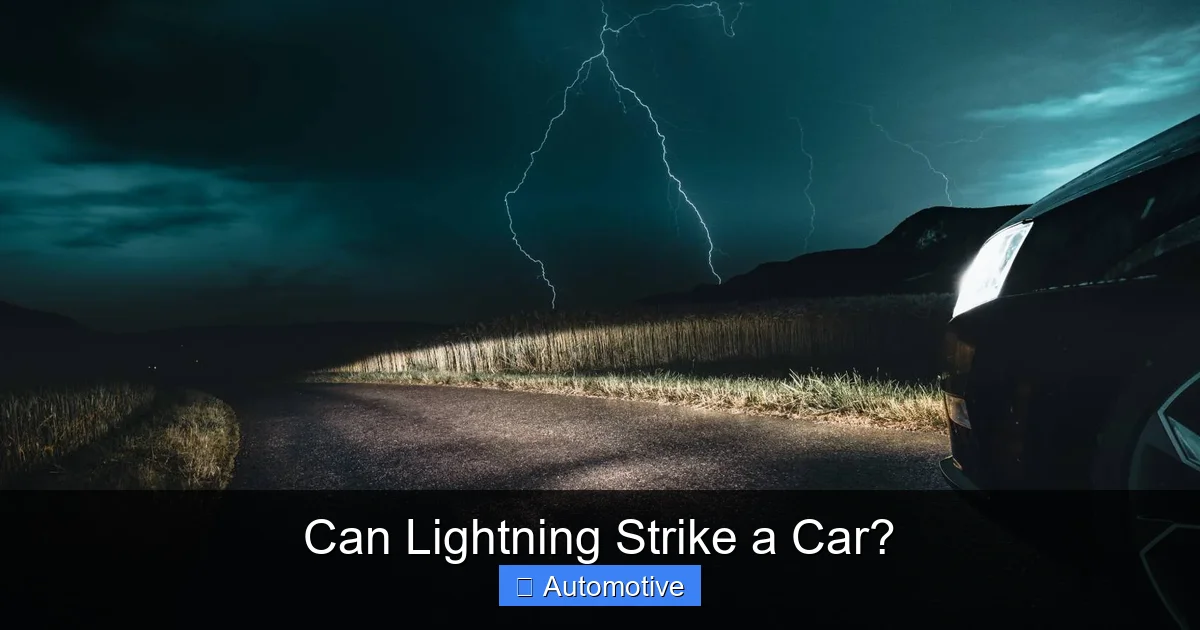
While you, the human, are remarkably safe, your car’s computer brain is not. This is where the real damage and expense happen. Modern vehicles are rolling networks of sensitive microprocessors, sensors, and wiring harnesses. A lightning strike is an electromagnetic pulse (EMP) of staggering power on a tiny scale. Even if the main current flows around the body, the intense electromagnetic field it generates can induce huge voltages in any wiring loop inside the car—your radio antenna, the wiring to the engine control unit (ECU), the sensors for the anti-lock brakes, or the infotainment screen.
Visual guide about Can Lightning Strike a Car?
Image source: homegrail.com
This induced surge is like a heart attack for your car’s electronics. It can instantly fry delicate semiconductor chips that operate on fractions of a volt. The result? A car that won’t start, a dashboard full of dead warning lights, a navigation system that’s a brick, or even a total electrical system failure. The damage can be immediate and obvious, or it can be subtle and progressive, causing intermittent glitches for weeks until a component finally fails. Diagnosing this requires a professional with advanced scan tools. It’s a complex and often expensive repair, sometimes requiring the replacement of multiple control modules. This is a key reason why a post-strike professional inspection is non-negotiable, even if the car seems to drive fine.
The Antenna Effect
The car’s radio antenna is the perfect literal lightning rod for this induced surge. It’s a long piece of metal designed to catch radio waves, and it’s directly connected to the car’s electrical system. A strike nearby can send a massive surge straight down this wire into the radio and any other devices it’s linked to. This is why the radio and sound system are often the first casualties. In some cases, the surge can travel from the antenna into the car’s main data bus (like the CAN bus), crippling communication between all the car’s computers.
This electronic vulnerability is a major difference from older cars. A 1970s muscle car with a points ignition and minimal electronics might suffer a burned spark plug wire or a melted fuse but could often be driven away. A 2020s car with a dozen computers might need a tow truck and a parts bill that rivals the car’s value. It highlights our increasing dependence on fragile microelectronics. For more on how car electrical systems can fail, understanding the basics of your car’s battery and circuitry is helpful, though a lightning surge is an extreme event compared to normal wear and tear.
Real-World Cases and Statistics
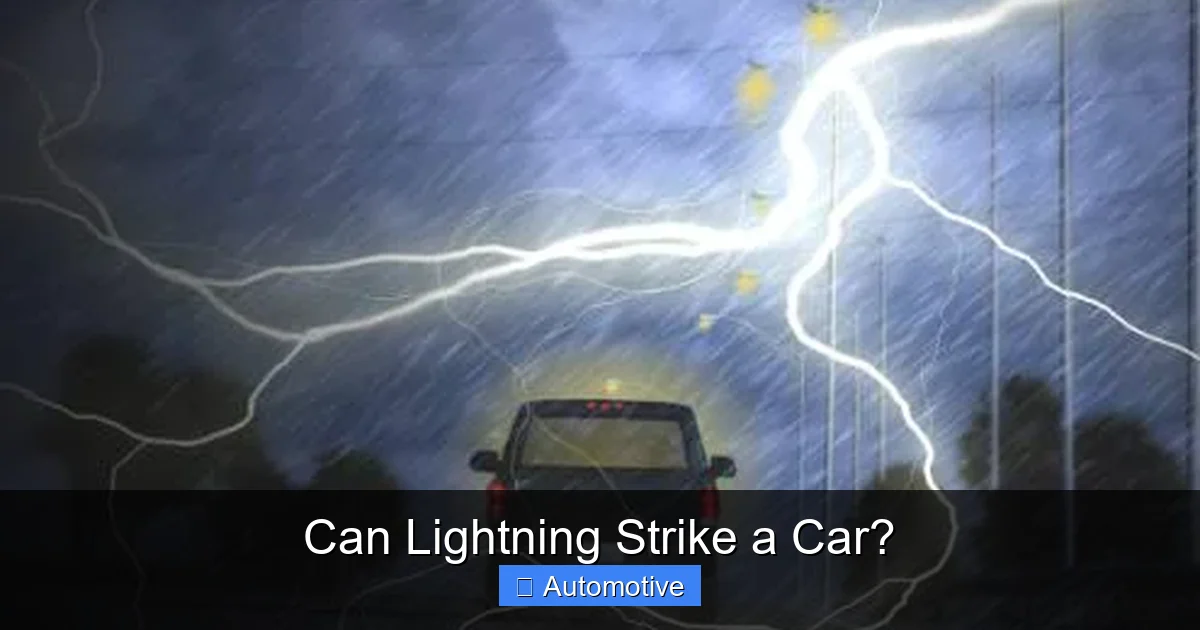
This isn’t just theoretical. The National Weather Service and insurance companies track these events. It’s estimated that a car is struck by lightning about 1 in 1,000 chance per year in the U.S., with higher frequencies in storm-prone states like Florida and Texas. The outcomes vary widely. There are countless viral videos of cars being struck, with the flash and bang followed by… nothing. The driver drives away, bewildered but unharmed. Then there are the less publicized cases where a $30,000 car is totaled because the ECU and transmission control module were vaporized.
Visual guide about Can Lightning Strike a Car?
Image source: homegrail.com
A study of insurance claims shows that while occupant injury is exceptionally rare, property damage is common. The most frequent claims involve fried electronics, damaged tires (from the heat or explosive force), and melted wiring. Less frequently, the strike can cause a fire. Gasoline vapors in the fuel tank or a leaking fuel line can be ignited by the intense heat. There are also reports of the strike causing airbags to deploy prematurely due to the surge hitting the airbag control module. The psychological impact on the driver should not be overlooked either; the experience is profoundly startling.
The “Close Call” Scenario
More common than a direct hit is a “side flash” or “ground current” strike. Lightning hits the road or a nearby tree and then jumps to the car’s metal frame. This still subjects the car’s electronics to a massive surge, though potentially less intense than a direct strike. The car’s tires can also be a point of entry for ground current. This is why the advice to “pull over and wait” is so important—you’re reducing your car’s profile as a target and minimizing contact with the ground. Even if you’re not directly hit, being the tallest object in a flat field makes you a target.
What to Do If You’re Caught in a Storm
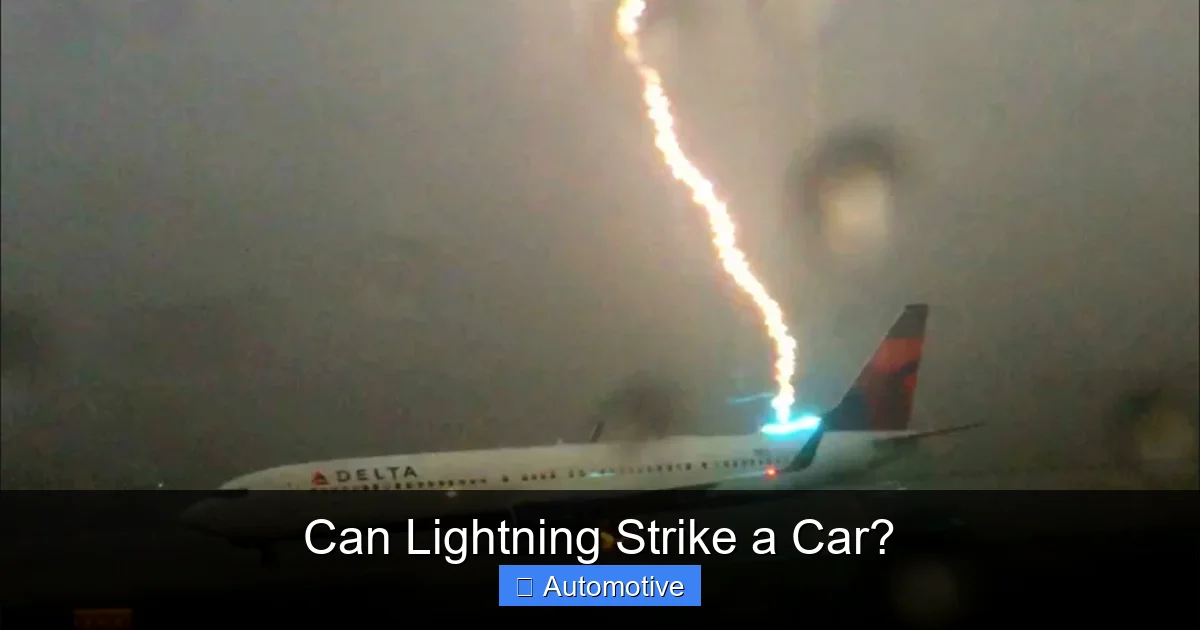
Knowing what to do in the moment is your most powerful tool. Your goal is to minimize your car’s “attractiveness” to lightning and avoid being a conduit for current if a strike occurs. Here is your step-by-step action plan.
Visual guide about Can Lightning Strike a Car?
Image source: storypick.com
1. Pull Over Safely and Turn Off the Engine
If the storm is severe and you see frequent strikes, your first move should be to exit the roadway. Find a safe spot to pull over, turn on your hazard lights, and shut off the engine. You’re not pulling over because the car is unsafe; you’re pulling over to become a smaller, lower-profile target. An idling car is still a conductor, but a stationary one is slightly less likely to be the highest point. Turn off the engine to reduce any potential path for current through the electrical system. This also prevents you from being in contact with the pedals and gearshift if a surge comes through.
2. Assume the “Lightning Safety Position” Inside the Car
Once stopped, your safe haven is the interior. But you must become an insulator yourself. Do not rest your hands or body on any metal parts of the car. This means:
- Keep both hands in your lap, away from the steering wheel, gearshift lever, and door handles.
- Do not use the radio, phone charger, or any plugged-in device.
- If you have a convertible top up, remain inside. Do not attempt to put the top down.
- Tuck your feet up so they aren’t touching the metal floor pan.
You are essentially making yourself a “ball” of non-conductive materials (clothes, seats, air) inside the Faraday cage. The goal is to avoid becoming a path for current that might enter through one point (e.g., a door handle) and exit another (e.g., your foot on the floor).
3. What to Absolutely Avoid
Do not get out of the car during the storm. Your instinct might be to run for a building, but exiting the car makes you a tall, isolated target—the worst possible position. You are safer inside the metal shell. Do not stand near the car if you must exit for an emergency. The current can jump from the car to the ground and then through you. Also, avoid using any device connected to the car’s exterior, like a phone charger plugged into the 12V socket. The surge can travel those wires.
The Aftermath: Inspection, Insurance, and Repair
If the unthinkable happens and a bolt connects with your car, your actions afterward are critical. Do not simply drive away and hope for the best, even if everything seems normal.
The Mandatory Professional Inspection
You must have your vehicle towed to a reputable repair shop or dealer for a complete electrical system diagnostic. A standard mechanic’s “look-over” is insufficient. They need to use specialized scan tools to check every control module for fault codes, test the alternator and starter for damage, and inspect all wiring harnesses for melted insulation or burnt components. Hidden damage is common. A seemingly fine car might have a compromised ECU that fails completely in two weeks, leaving you stranded. The inspection should also include a close look at the tires, brakes, and undercarriage for signs of the strike’s entry and exit points, which may look like melted metal or pitted rubber.
Navigating Insurance Claims
This is where comprehensive coverage proves its worth. Lightning damage is classified as an “act of God” or a “comprehensive” claim (as opposed to collision). You will need to file a claim with your insurance company. An adjuster will likely want to see the repair shop’s diagnostic report. Be prepared for a deductible, which is the amount you pay out of pocket before insurance covers the rest. In cases of severe damage where the repair cost approaches or exceeds the car’s actual cash value, the insurer may declare it a total loss. Understanding your policy’s terms beforehand is smart. For those considering their coverage options, knowing how to refinance a car loan can be useful if you’re suddenly left with a loan on a totaled vehicle and need to finance a replacement.
The Cost of Repair vs. Replacement
The repair bill can be shocking. Replacing a single ECU can cost $1,000-$2,000 for the part alone, plus labor. If multiple modules are damaged (body control, transmission, HVAC), the bill can easily exceed $5,000 or $10,000 on a newer car. On an older car with lower value, this often means the car is totaled. You’ll receive the car’s actual cash value from your insurer, minus your deductible. This is a harsh reality, but it’s the nature of insuring complex technology against a force of nature. Sometimes, the most practical decision is to accept the payout and move on, even if it’s emotionally difficult.
Myths vs. Reality: A Final Debunking
Let’s cement the facts by crushing a few more lingering myths.
- Myth: The car’s rubber tires provide the insulation.
Reality: The continuous metal body is the shield. Tires may be damaged but are not the primary safety feature. - Myth: You should open the windows during a strike to let the lightning out.
Reality: Never do this. You’re creating a path for current to enter the passenger compartment. Keep windows closed. - Myth: Lightning only strikes the highest point.
Reality: While height is a factor, lightning is unpredictable. It can and does strike flat ground and low-lying objects. A car is simply a conductive object in the open. - Myth: If my car is struck, the gas tank will explode.
Reality: The metal fuel tank is sealed and well-grounded. A direct hit is extremely unlikely to cause an explosion, though it could ignite a fuel leak from a damaged line. - Myth: Hybrid and electric cars are more dangerous because of the big battery.
Reality: Their high-voltage battery packs are heavily shielded and grounded. The Faraday cage principle still applies. The main risk is still to the low-voltage electronics, not a catastrophic battery explosion.
Frequently Asked Questions
Is it truly safe to be inside a car during a lightning storm?
Yes, it is statistically one of the safest places you can be. The car’s metal body acts as a Faraday cage, directing the dangerous current around the passenger compartment and not through it. Your risk of injury is extremely low if you avoid touching metal parts.
Can lightning destroy my car’s computer and electronics?
Absolutely. This is the most common form of damage. The intense electromagnetic pulse from a strike can induce power surges in wiring, frying sensitive chips in the engine computer, infotainment system, and other control modules. This damage is often severe and expensive to repair.
What should I do immediately if I see a storm approaching while driving?
Your priority is to get off the road and reduce your profile. Safely pull over, turn off the engine, and turn on your hazard lights. Stay inside the vehicle, keep your hands off all metal components (steering wheel, gearshift), and wait for the storm to pass. Do not stand near the car.
Will my car insurance cover lightning damage?
Yes, if you have comprehensive coverage. Lightning damage is considered an “act of God” and is covered under comprehensive policies. You will be responsible for your deductible, and the insurance company will pay for repairs up to the car’s actual cash value, which may result in a total loss settlement for severe damage.
Can a lightning strike cause my car to catch fire?
It is possible but not common. The intense heat can superheat metal components or ignite leaking flammable fluids like gasoline or oil. The most frequent fire risk comes from a strike causing an electrical short that sparks a fire in the engine bay or wiring harness.
Do I need to get my car checked even if it seems fine after being struck?
Yes, a professional diagnostic inspection is absolutely essential. Hidden damage to electronics is very common and may not manifest until days or weeks later, potentially leaving you stranded. Have a dealer or qualified shop perform a full systems scan before you consider the car safe to drive regularly.