Can I Use E85 in My Car?

Contents
- 1 Key Takeaways
- 2 📑 Table of Contents
- 3 What Exactly Is E85?
- 4 Which Cars Can Actually Use E85? The Flex-Fuel Vehicle (FFV)
- 5 The Alluring Benefits of Using E85 (If You Have an FFV)
- 6 The Crucial Drawbacks and Considerations
- 7 What Happens If I Put E85 in a Non-FFV? (The Danger Zone)
- 8 How to Be 100% Certain: A Step-by-Step Compatibility Check
- 9 Practical Tips for E85 Users
- 10 The Bottom Line: Should You Use E85?
- 11 Frequently Asked Questions


E85 is an ethanol-gasoline blend that only certain vehicles (flex-fuel vehicles) can safely use. Using it in a non-FFV can cause severe engine and fuel system damage. Always verify your car’s compatibility before fueling to avoid costly repairs, reduced performance, and potential warranty voids. If compatible, E85 offers environmental benefits and potential cost savings, but comes with lower fuel economy and limited availability.
Can I Use E85 in My Car?
You’re at the pump, eyeing that “E85” label. It’s often cheaper than regular unleaded. You think, “Why not give it a try?” But then a little voice of doubt chimes in. Can I use E85 in my car? It’s a simple question with a critically important answer. The short response is: maybe, but probably not, and you must be absolutely sure before you squeeze that nozzle. Using the wrong fuel isn’t like using the wrong type of oil; it can cause immediate and irreversible harm to your engine. This guide will walk you through everything you need to know about E85, from what it really is to how to tell if your car is one of the chosen few that can handle it.
Think of your car’s engine as a highly specialized athlete. It’s trained and built for a specific diet—in this case, standard gasoline. E85 is like a completely different meal plan. Some athletes (engines) are built to handle it and even thrive on it. Others will quickly break down. Let’s figure out which category your car falls into.
Key Takeaways
- Only Flex-Fuel Vehicles (FFVs) can safely use E85. These cars have specially designed engines and fuel systems to handle ethanol’s unique properties.
- E85 provides lower emissions but significantly reduces fuel economy. Ethanol contains about 30% less energy than gasoline, so you’ll fill up more often.
- Check your owner’s manual, gas cap, or vehicle badge for FFV identification. Many post-2001 models from Ford, GM, and Chrysler are FFVs, but confirmation is essential.
- Using E85 in a non-FFV risks corrosion, fuel pump failure, and engine damage. Ethanol can degrade rubber, plastic, and metal components not designed for it.
- E85 station availability is limited, primarily in the Midwest. Use online tools like the DOE’s Alternative Fuel Station Locator before relying on it.
- E85 cost-per-mile is often comparable to regular gasoline. While the pump price may be lower, the drop in MPG usually erases the savings.
- Seasonal E85 blends adjust for cold weather. Winter blends have less ethanol to improve cold-start performance, but still require an FFV.
📑 Table of Contents
- What Exactly Is E85?
- Which Cars Can Actually Use E85? The Flex-Fuel Vehicle (FFV)
- The Alluring Benefits of Using E85 (If You Have an FFV)
- The Crucial Drawbacks and Considerations
- What Happens If I Put E85 in a Non-FFV? (The Danger Zone)
- How to Be 100% Certain: A Step-by-Step Compatibility Check
- Practical Tips for E85 Users
- The Bottom Line: Should You Use E85?
What Exactly Is E85?
Before we talk about your car, let’s talk about the fuel. E85 is not a magic new formula; it’s a specific blend of two common substances: gasoline and ethanol.
The Ethanol-Gasoline Mix
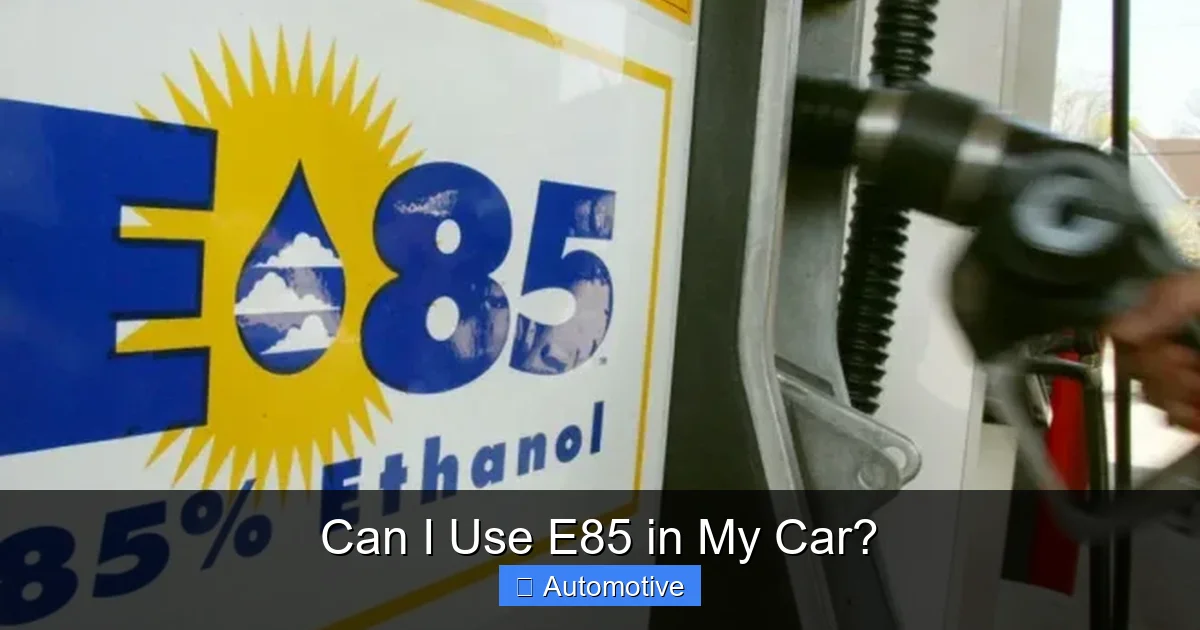
The “85” in E85 refers to the ethanol content. It’s a flex-fuel blend that can contain anywhere from 51% to 83% ethanol, with the rest being gasoline. The exact percentage changes seasonally and by region. In winter, the ethanol content is lowered (sometimes to E70 or E75) to help engines start more easily in cold weather, since ethanol vaporizes at a higher temperature than gasoline. The “E” simply stands for ethanol, which is an alcohol-based fuel typically made from corn in the United States, though it can also be produced from sugarcane, cellulose, or other biomass.
Why Do We Have E85?
Ethanol is a renewable resource. Plants absorb carbon dioxide as they grow, which offsets some of the carbon emissions from burning the ethanol. It’s part of a strategy to reduce dependence on fossil fuels and lower greenhouse gas emissions. For farmers and certain industries, it’s also a major economic driver. But for the average driver, its primary appeal is often a lower price per gallon at the pump, though, as we’ll see, that price can be misleading.
Which Cars Can Actually Use E85? The Flex-Fuel Vehicle (FFV)
This is the million-dollar question. The only cars designed to run on E85 are called Flex-Fuel Vehicles (FFVs). These are not just cars with a “flex-fuel” sticker on the bumper. They are engineered from the ground up (or with specific modifications) to handle the unique challenges of high-ethanol fuel.
Visual guide about Can I Use E85 in My Car?
Image source: thetechedvocate.org
What Makes an FFV Different?
Ethanol is a fantastic cleaner in some ways, but it’s also a harsh solvent and is corrosive to many materials used in standard fuel systems. An FFV has several key upgrades:
- Fuel System Components: All fuel lines, seals, gaskets, injectors, and fuel pumps are made from ethanol-compatible materials like stainless steel, special polymers, and fluorinated rubber. Standard rubber parts can swell, crack, and fail when exposed to ethanol.
- Engine Management Tuning: The car’s computer (ECU) is programmed to recognize the fuel blend via a sensor. It then adjusts ignition timing, fuel injection, and air-fuel ratios to optimize performance and prevent damage. An FFV running on pure gasoline will run slightly differently than one running on E85.
- Stainless Steel Fuel Tank: To prevent corrosion from the inside out.
An FFV can seamlessly run on any mixture of gasoline and E85, from 100% gasoline (E0) to 100% E85. The car’s sensor constantly monitors the ethanol content and makes adjustments on the fly.
How to Identify a Flex-Fuel Vehicle
You cannot guess. You must verify. Here are the definitive ways to check:
- Look for the Badge: Most FFVs have a small badge on the trunk lid, rear quarter panel, or fuel door. It often says “Flex Fuel,” “E85,” “FFV,” or displays a stylized cornstalk or leaf. Note: Some manufacturers, like Ford, use a yellow gas cap on FFVs. A yellow cap is a strong indicator, but not a 100% guarantee on its own.
- Check the Owner’s Manual: This is your most reliable source. It will have a section specifying if your vehicle is FFV-compatible and detail any special considerations for using E85.
- Check the Fuel Door or Cap: As mentioned, a bright yellow fuel cap is a common sign. Sometimes the fuel door itself will have labeling.
- Use Your VIN: You can decode your Vehicle Identification Number (VIN) using the manufacturer’s website or a paid service to see if your specific model was built as an FFV. The 8th character of the VIN often indicates the engine type, which can correspond to an FFV variant.
- Contact the Dealer: Call a dealership for your car’s make with your VIN. They can look up the exact specifications.
Common FFV Models: For years, many full-size trucks and SUVs from American manufacturers were offered as FFVs. This includes models like the Ford F-150 (certain years), Chevrolet Silverado/GMC Sierra, Dodge Ram 1500, and various Ford Explorer and Escape models. Many Chevrolet Impala and Malibu models were also FFVs. However, the availability of the FFV option varied by year, engine type (often V8s and some V6s), and region. Always verify your specific VIN.
The Alluring Benefits of Using E85 (If You Have an FFV)
Assuming your car is an FFV, why would you choose to use E85? There are several potential advantages.
Visual guide about Can I Use E85 in My Car?
Image source: thedrive.com
1. Renewable and Domestic Energy Source
Ethanol is made from crops grown primarily in the U.S. Using it supports American agriculture and reduces the need to import crude oil. It’s a step, however debated, toward energy independence.
2. Lower Greenhouse Gas Emissions (On a Full Lifecycle)
When burned, ethanol produces fewer carbon-based emissions than gasoline. The argument is that the plants used to make ethanol absorb CO2 as they grow, creating a more closed carbon loop. The full lifecycle analysis (including farming, processing, and transport) is complex and debated, but most studies show a net reduction in greenhouse gases compared to pure gasoline.
3. Higher Octane Rating
E85 has an octane rating of about 100-105, significantly higher than regular (87) or premium (91-93) gasoline. This high octane allows for more advanced ignition timing in FFVs, which can translate to a modest increase in horsepower and torque—often in the range of 5-15%. For performance enthusiasts with an FFV, this is a real perk. The higher octane also helps resist engine knock.
4. Potential for Lower Pump Price
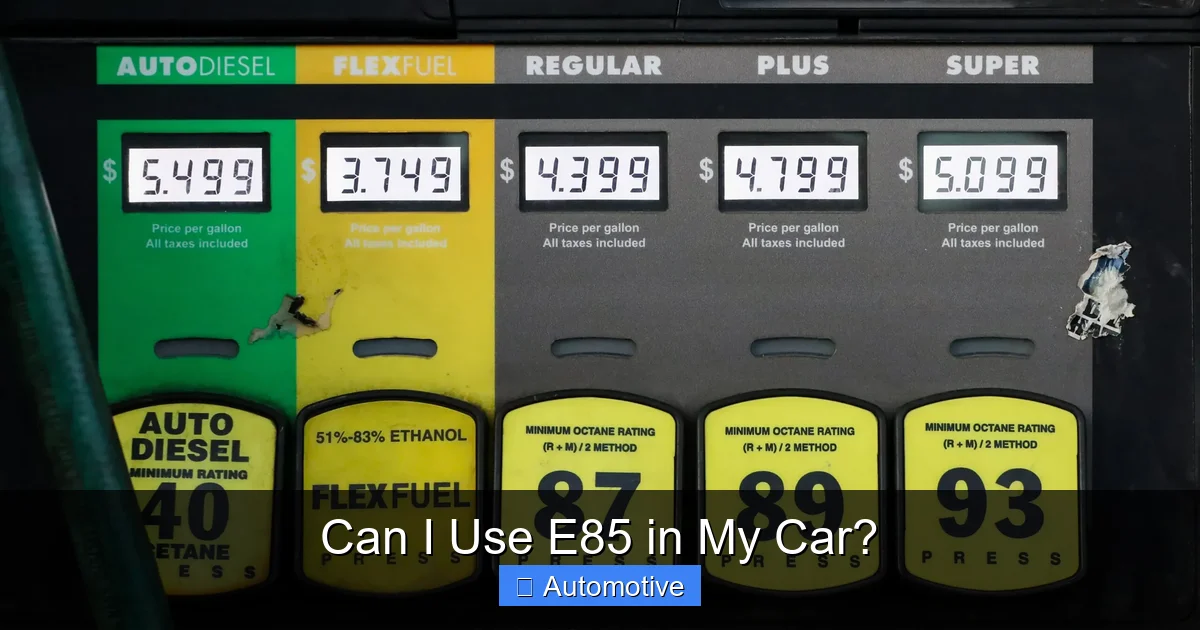
This is the most visible benefit. E85 is frequently priced 15-30% lower per gallon than regular gasoline. The keyword is per gallon. Because E85 has lower energy density, you get fewer miles per gallon. The cost-per-mile is the true metric. We’ll break down the math in the drawbacks section, but sometimes the savings can still be realized, especially if the price spread is large.
5. Cleaner Burning
Ethanol burns cleaner than gasoline, producing fewer carbon monoxide and particulate emissions. It also has a higher heat of vaporization, which can help cool the intake charge, providing a minor performance benefit and reduced stress on engine components under heavy load.
The Crucial Drawbacks and Considerations
The E85 story isn’t all green fields and cheap fills. There are significant trade-offs to consider, even in a perfect FFV scenario.
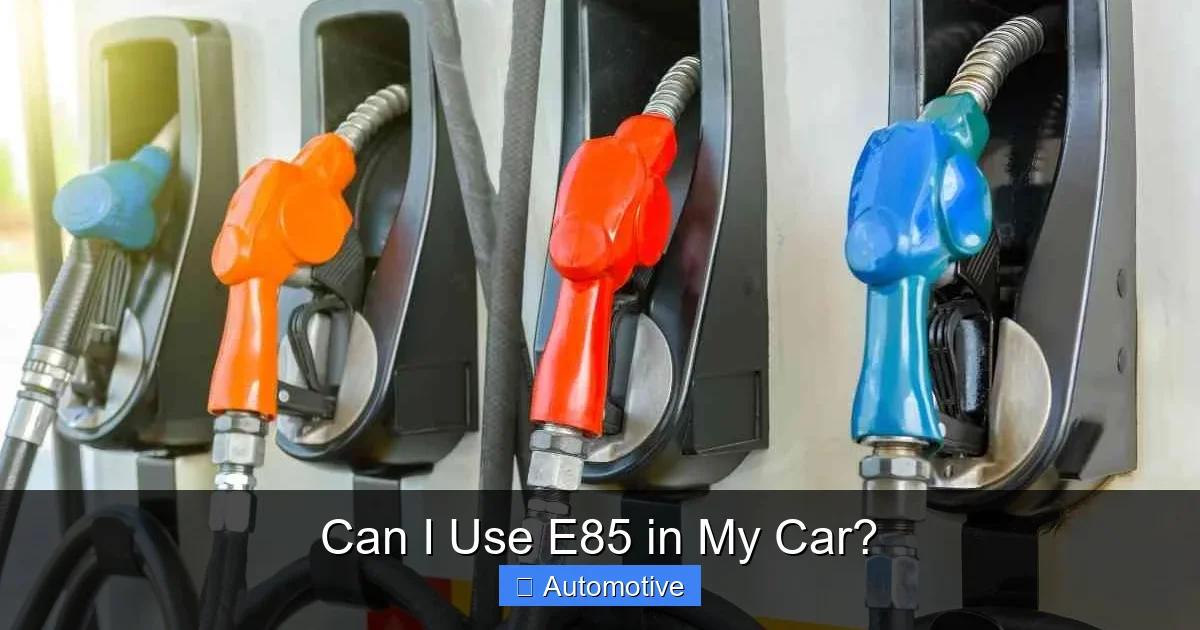
Visual guide about Can I Use E85 in My Car?
Image source: autocareaids.com
1. The Fuel Economy Penalty (The Big One)
This is the single largest factor affecting the cost-per-mile. Ethanol has about 67% of the energy content of pure gasoline by volume. A gallon of E85 simply does not take you as far as a gallon of gasoline. You can expect a 25-33% drop in miles per gallon (MPG) when running on E85 compared to gasoline.
- The Math: If your car gets 30 MPG on gasoline, you might get 20-22 MPG on E85. To travel 300 miles, you’d need 10 gallons of gas but about 14-15 gallons of E85.
- Cost-Per-Mile Calculation: Let’s say gas is $3.50/gal and E85 is $2.80/gal.
- Gas: 300 miles / 30 MPG = 10 gallons * $3.50 = $35.00
- E85: 300 miles / 21 MPG = 14.3 gallons * $2.80 = $40.04
In this example, E85 is actually more expensive per mile. For E85 to be cheaper, the price spread needs to be much wider. If E85 is $2.50/gal, the cost drops to $35.75, making it slightly cheaper. You must do this math for your local prices and your car’s real-world MPG on E85.
2. Limited Availability
E85 stations are not ubiquitous. They are concentrated in the Midwest “Corn Belt.” If you live on the coasts or in rural areas, finding E85 can be a major expedition. Relying on it for daily driving is impractical without a reliable, nearby station. Use the DOE’s Alternative Fuel Station Locator to check your area.
3. Cold-Weather Starting (A Minor Issue for Modern FFVs)
Pure ethanol is very hard to vaporize in cold weather. This is why you’ll never see E85 at a gas station in the dead of winter in Minnesota. Stations sell a seasonal blend with less ethanol (E70 or E75) to ensure FFVs start reliably. Modern FFVs have sophisticated systems to handle this, but it’s a reason why E85 isn’t a year-round 85% blend everywhere.
4. Potential for Increased Maintenance (Debated)
Ethanol is an excellent solvent. It can clean out old deposits in your fuel system, which is good. But that gunk has to go somewhere—it can clog your fuel filter initially. Some mechanics recommend more frequent fuel filter changes when first switching to E85. Also, ethanol is hygroscopic, meaning it absorbs water from the air. While FFV fuel systems are sealed, long-term storage of E85 (like in a seasonal vehicle) can lead to phase separation, where water and ethanol separate from the gasoline, causing operational issues.
What Happens If I Put E85 in a Non-FFV? (The Danger Zone)
Let’s be perfectly clear: If your car is not a certified Flex-Fuel Vehicle, you should never, ever put E85 in it. Doing so is not a “maybe it’ll be okay” situation. It is a direct path to expensive damage. The risks are not immediate in every case, but they are severe and cumulative.
1. Fuel System Corrosion and Degradation
Standard fuel systems use rubber and plastic components (fuel pump seals, injector O-rings, fuel rail gaskets) that are not formulated to withstand ethanol. Ethanol will cause these parts to swell, soften, crack, and eventually fail. This leads to fuel leaks, which are a major fire hazard. It can also draw in air, causing the engine to run lean and hot.
2. Fuel Pump Failure
The fuel pump, especially the in-tank variety, relies on gasoline for lubrication and cooling. Ethanol is a poor lubricant. Running E85 can cause the fuel pump to overheat and wear out prematurely. A failed fuel pump leaves you stranded.
3. Engine Damage
While the engine’s metal parts can handle ethanol, the fuel system failures mentioned above can lead to secondary damage. A leaking or failing fuel injector can cause improper fuel atomization, leading to cylinder washing (where fuel washes away the protective oil film on cylinder walls), increased wear, and potentially bent connecting rods from detonation (pre-ignition/knock) if the ECU can’t compensate for the different air-fuel ratio.
4. Check Engine Lights and Poor Performance
Even before catastrophic failure, the oxygen sensors and catalytic converter are designed for a specific range of exhaust gases. The different combustion characteristics of an ethanol-rich fuel in a non-FFV can confuse the oxygen sensors, leading to a constantly illuminated check engine light, poor drivability, stalling, and failed emissions tests.
5. Voided Warranty
Using the wrong fuel is a clear violation of your warranty terms. Any damage caused by E85 will be denied coverage, leaving you with the full repair bill.
Important Note: There is a common myth that a single tank of E85 in a non-FFV will destroy your car. This is usually an exaggeration. The damage is typically a result of long-term use. However, even a single tank can cause immediate issues like rough running and a check engine light. The safest policy is zero tolerance: if you are not 100% sure your car is an FFV, use only regular gasoline.
How to Be 100% Certain: A Step-by-Step Compatibility Check
Don’t rely on guesswork, a friend’s advice, or what you think your car is. Follow this definitive checklist.
- Find Your Owner’s Manual. Go to the “Fuel” or “Specifications” chapter. Look for language like “Your vehicle is designed to operate on E85 Flex Fuel” or a list of approved fuels that includes “E85” or “Ethanol blends up to 85%.”
- Physically Inspect the Vehicle. Look for a bright yellow fuel cap. Search the trunk lid, rear bumper, or driver’s side door jamb for a badge that says “Flex Fuel,” “E85,” “FFV,” or shows a leaf/corn icon. When selling a car, having documentation of FFV status can be a selling point for the right buyer.
- Decode Your VIN. Find your 17-digit VIN on the dashboard (driver’s side), door jamb, or insurance card. Use an online VIN decoder specific to your manufacturer (e.g., Ford’s VIN decoder, GM’s VIN lookup). You may need to contact a dealer’s service department for a definitive answer.
- Contact the Manufacturer. Call the customer service line for your car’s brand (e.g., Ford, Toyota, Honda). Have your VIN ready. They can confirm the original factory specifications.
- When in Doubt, Assume You Cannot. If you cannot find concrete proof, your car is almost certainly not an FFV. The majority of vehicles on the road today are not. It is not worth the risk.
Practical Tips for E85 Users
If you’ve confirmed you have an FFV and want to use E85, here’s how to do it smartly.
Finding and Using E85
Plan your fill-ups using station locator apps. Remember that not all pumps at a station that sells E85 are dedicated; some are multi-product hoses. Ensure you select the correct nozzle. It’s usually a separate, often brightly colored (green or yellow) hose with its own dedicated pump.
Switching Between Fuels
One of the great things about an FFV is you can switch back and forth. If you’re going on a long road trip where E85 isn’t available, fill up with regular gas. Your car will adjust instantly. There’s no need to “burn off” one fuel before adding another. However, try not to constantly switch between very low and very high ethanol blends, as it can cause slight variations in performance and fuel trims.
Maintenance Considerations
Follow the manufacturer’s maintenance schedule. Some recommend more frequent spark plug changes when using E85 due to the different combustion characteristics. Keep an eye on your fuel filter. As mentioned, the cleaning effect of ethanol can dislodge deposits, potentially clogging the filter faster initially. Using quality fuel from reputable stations is always important.
Storing an FFV with E85
If you won’t be driving your FFV for several months (e.g., a classic car, seasonal vehicle), it’s better to store it with regular gasoline (E0-E10). E85’s hygroscopic nature can lead to phase separation over time, where the ethanol/water mixture separates from the gasoline and settles at the bottom of the tank, causing corrosion and starting problems.
The Bottom Line: Should You Use E85?
The answer hinges entirely on one fact: Is your vehicle a certified Flex-Fuel Vehicle?
- If YES: You have the option. Weigh the pros and cons. Do the cost-per-mile math based on your local prices and your car’s real-world E85 MPG (you’ll need to calculate it over a few tanks). Consider the convenience of station locations. Enjoy the potential power bump and support for renewable fuels, but be prepared for more frequent fill-ups and slightly different engine sounds/feel.
- If NO or UNSURE: Do not use E85. Stick to regular unleaded gasoline (E10 is fine for all modern cars; the 10% ethanol is standard and all cars since the early 2000s are designed for it). The risk of damaging your fuel system, engine, and voiding your warranty far outweighs any perceived savings at the pump. Remember, using the correct fuel is as fundamental as using the right oil or the correct octane gasoline for your engine’s requirements.
Your car is a major investment. Protecting it means using only the fuels and fluids it was designed for. Take the time to verify your FFV status with certainty. That cheap gallon of E85 could end up costing you thousands if it’s in the wrong tank.
Frequently Asked Questions
Can a single tank of E85 damage my non-FFV car?
One tank is unlikely to cause immediate, catastrophic damage, but it can lead to rough running, a check engine light, and potential sensor issues. The real danger comes from long-term use, which will degrade fuel system components and lead to costly repairs. Drain and flush the system as soon as possible if you made this mistake.
Is E85 actually cheaper than regular gas when you factor in lower MPG?
Often, no. Because E85 provides about 25-33% fewer miles per gallon, the pump price must be significantly lower for it to be cost-effective. You need to calculate the price per mile. If regular gas is $3.50/gal and E85 is $2.80/gal, E85 is usually more expensive per mile. A spread of 25-30% or more is typically needed for savings.
Where can I find E85 fueling stations near me?
E85 stations are not common everywhere. The best resource is the U.S. Department of Energy’s Alternative Fuel Station Locator (afdc.energy.gov). You can search by zip code. Stations are most concentrated in the Midwest. Always call ahead to confirm the station is operational and has E85 available.
Does using E85 improve my car’s performance?
In a certified FFV, yes, but modestly. The high octane rating (100-105) of E85 allows the engine’s computer to advance ignition timing, which can increase horsepower and torque by 5-15%. You might notice a slight difference in acceleration, especially in larger engines. However, the reduced fuel economy will offset any performance gain for most daily drivers.
Can I switch back and forth between gasoline and E85 in my FFV?
Yes, absolutely. That’s the whole point of a flex-fuel vehicle. The on-board sensor detects the ethanol content and the engine computer adjusts automatically. You can fill up with regular gas when E85 isn’t available or during long trips. No special procedure is needed; just refuel normally.
Will E85 work in cold weather?
Yes, but with a caveat. Pure E85 (85% ethanol) can make cold-starting very difficult because ethanol doesn’t vaporize easily in the cold. Therefore, E85 sold in winter months is actually a seasonal blend with a lower ethanol content (often E70 or E75). This “winter E85” allows FFVs to start reliably in freezing temperatures. The fuel you buy is always appropriate for the season in your region.