Can I Use 5w-30 Instead of 5w-20 in My Toyota Camry?

Contents
- 1 Key Takeaways
- 2 📑 Table of Contents
- 3 Understanding the Numbers: What Do 5W-20 and 5W-30 Actually Mean?
- 4 Toyota Camry Oil Requirements: It’s Not One-Size-Fits-All
- 5 The Real Risks of Using 5W-30 in a 5W-20 Engine
- 6 Are There Any Exceptions? The “It Depends” Scenarios
- 7 What To Do If You’ve Already Used 5W-30 in Your Camry
- 8 Best Practices: Protecting Your Camry’s Engine for the Long Haul
- 9 Frequently Asked Questions

Windshield Washer Fluid

Battery Terminal Cleaner

Fuel Injector Cleaner

Car Floor Mats (Universal)
No, you should not use 5W-30 oil as a regular substitute for 5W-20 in a Toyota Camry designed for 5W-20. Using the wrong viscosity can damage modern engines, void your warranty, and reduce fuel efficiency. Always follow the oil specification in your owner’s manual, which for most recent Camrys is 5W-20 or 0W-20.
It’s a simple question that comes up a lot in parking lots and online forums: “My local store is out of 5W-20. Can I just use 5W-30 instead in my Toyota Camry?” On the surface, it seems logical—they’re both “5-weight” oils for cold starts, so how different could they be? The answer is a critical lesson in automotive maintenance: you should not use 5W-30 as a substitute for 5W-20 in a Camry that requires 5W-20. Let’s break down exactly why, what the real risks are, and what you should do instead.
Key Takeaways
- Manufacturer Specification is Law: Your Camry’s engine is engineered for a specific oil viscosity (usually 5W-20 or 0W-20). Deviating from this is not a trivial choice but a potential mechanical risk.
- Viscosity Matters for Fuel Economy: Thicker 5W-30 oil increases internal engine friction, directly lowering the fuel efficiency your Camry is designed to achieve, costing you money at the pump.
- Warranty Could Be Voided: If engine damage occurs and an investigation reveals the use of non-specified oil, Toyota may deny your warranty claim, leaving you with a costly repair bill.
- Not All Camrys Are the Same: The correct oil depends on your specific model year and engine type (e.g., the turbocharged 2.0L 8AR-FTS has different needs than the naturally aspirated 2.5L 2AR-FE).
- Emergency Top-Off is Different from Routine Changes: Adding a quart of 5W-30 to nearly empty 5W-20 in an emergency is low-risk for a short period, but a full oil change with 5W-30 is a different story entirely.
- Modern Engines are Precision Instruments: Today’s engines have tighter tolerances, variable valve timing (VVT-i), and sometimes even hydraulic adjusters that rely on the correct oil flow characteristics provided by 5W-20.
- Consult Your Manual or Dealer First: The only authoritative source is your owner’s manual. When in doubt, a quick call to your Toyota service department can save you from a major mistake.
📑 Table of Contents
- Understanding the Numbers: What Do 5W-20 and 5W-30 Actually Mean?
- Toyota Camry Oil Requirements: It’s Not One-Size-Fits-All
- The Real Risks of Using 5W-30 in a 5W-20 Engine
- Are There Any Exceptions? The “It Depends” Scenarios
- What To Do If You’ve Already Used 5W-30 in Your Camry
- Best Practices: Protecting Your Camry’s Engine for the Long Haul
Understanding the Numbers: What Do 5W-20 and 5W-30 Actually Mean?
Before we talk about your Camry, we need to understand what these codes mean. The “W” stands for “Winter,” and the number before it (5) indicates the oil’s viscosity, or thickness, at cold temperatures. A lower number means the oil flows more easily when it’s cold, which is crucial for protecting your engine on startup. Both 5W-20 and 5W-20 have the same cold-weather performance (5W).
The difference is in the second number: 20 vs. 30. This number represents the oil’s viscosity at the standard operating temperature of 100°C (212°F). 5W-20 is thinner at high temperatures than 5W-30. This isn’t a minor detail; it’s a fundamental engineering specification.
Why Thinner Oil (5W-20) is Used in Modern Engines
Automakers like Toyota have been systematically moving to lower viscosity oils (like 0W-16, 0W-20, and 5W-20) for the last 15+ years. The primary reasons are:
- Improved Fuel Economy: Thinner oil creates less friction (drag) on moving parts like pistons, bearings, and the valvetrain. This reduced parasitic loss means the engine uses less energy to run, directly improving miles per gallon (MPG).
- Better Cold-Start Flow: Lower “W” numbers (like 0W or 5W) ensure oil reaches critical components faster on a cold morning, preventing dry starts and wear.
- Compatibility with Tight Tolerances: Modern engines are built with incredibly precise clearances. Thicker oil may not flow quickly or thoroughly enough through these narrow passages, especially in systems like variable valve timing (VVT-i).
Toyota Camry Oil Requirements: It’s Not One-Size-Fits-All
Assuming all Camrys need the same oil is a dangerous mistake. The specification changed dramatically over the years and varies by engine. Here’s a general breakdown, but your owner’s manual is the only true authority.

Visual guide about Can I Use 5w-30 Instead of 5w-20 in My Toyota Camry?
Image source: autopassionate.com
Model Years 2012 and Newer (Most Common on Roads Today)
For the vast majority of 2012-2024 Camry models, Toyota specifies 0W-20 (for the 2.5L 2AR-FE and 2.5L A25A-FKS engines) or 5W-20 (for some earlier 2AR-FE engines and the 3.5L 2GR-FE V6). The 2018+ Camry with the optional 2.0L turbocharged 8AR-FTS engine also uses 0W-20. For these engines, using 5W-30 is explicitly outside of Toyota’s recommendation.
Model Years 2007-2011
This generation (XV40) typically used 5W-20 for the 2AR-FE 2.4L and 2GR-FE 3.5L engines. The earlier 2002-2006 (XV30) often called for 5W-30. This highlights why knowing your specific model year and engine code is essential.
How to Find Your Correct Oil
1. Owner’s Manual: The “Fluid Capacities” or “Lubrication” section is definitive.
2. Oil Cap: Many modern Camrys have the recommended viscosity printed right on the oil filler cap (e.g., “Toyota Genuine Motor Oil 0W-20”).
3. Dealership or Trusted Mechanic: They can look up your VIN for the exact specification. When considering oil types, it’s also wise to understand the differences between synthetic and conventional options. You can learn more about that in our detailed guide on Can I Use Synthetic Oil In My Car?.
The Real Risks of Using 5W-30 in a 5W-20 Engine
Okay, so Toyota says use 5W-20. What’s the worst that could happen with 5W-30? It’s not an immediate explosion, but it’s a slow-burn problem that can lead to expensive failure.

Visual guide about Can I Use 5w-30 Instead of 5w-20 in My Toyota Camry?
Image source: m.media-amazon.com
1. Reduced Fuel Economy
This is the most immediate and guaranteed consequence. The thicker oil creates more internal resistance. The engine’s computer may not compensate enough, and you’ll see a drop in MPG. Over thousands of miles, that “savings” from using a cheaper or more available oil will be eaten up by extra fuel costs.
2. Potential for VVT-i (Variable Valve Timing) System Damage
This is the most technical and serious risk for modern Toyotas. The VVT-i system uses hydraulic pressure, controlled by oil flow, to advance and retard camshaft timing. This system has tiny orifices and precise tolerances. Thicker 5W-30 oil can flow too slowly, especially when cold, to properly actuate the VVT-i mechanism. This can cause:
- Sluggish VVT-i response, hurting performance and efficiency.
- Increased wear on VVT-i components like the cam phaser.
- Diagnostic trouble codes (P0010, P0011, etc.) and a check engine light.
- In extreme cases, catastrophic failure requiring a cylinder head rebuild.
3. Inadequate Lubrication on Cold Starts
While both are “5W,” the “20” and “30” ratings are measured at high heat. At cold temperatures, the difference is less pronounced, but 5W-20 is still formulated to be slightly more fluid. On a frigid morning, every millisecond counts for oil reaching the top of the engine. A thicker oil film can delay this, increasing wear during the most damaging phase of engine operation.
4. Warranty Denial
Toyota’s warranty is contingent on following the maintenance schedule in your manual, which includes using the specified oil. If your engine develops a problem—especially one related to VVT-i, bearings, or piston rings—and an analysis shows you used 5W-30, they have a clear, documented reason to deny your warranty claim. This is not a hypothetical; it’s a standard practice in the industry. Protecting your warranty is a primary reason to stick to the spec. If you have questions about service and warranties, our article on Can I Take My Toyota To Any Dealer For Service? provides important insights.
Are There Any Exceptions? The “It Depends” Scenarios
Automotive guidelines are rarely absolute. There are a few narrow, context-specific scenarios where 5W-30 might not be an immediate disaster, but they are not reasons to make it your routine choice.
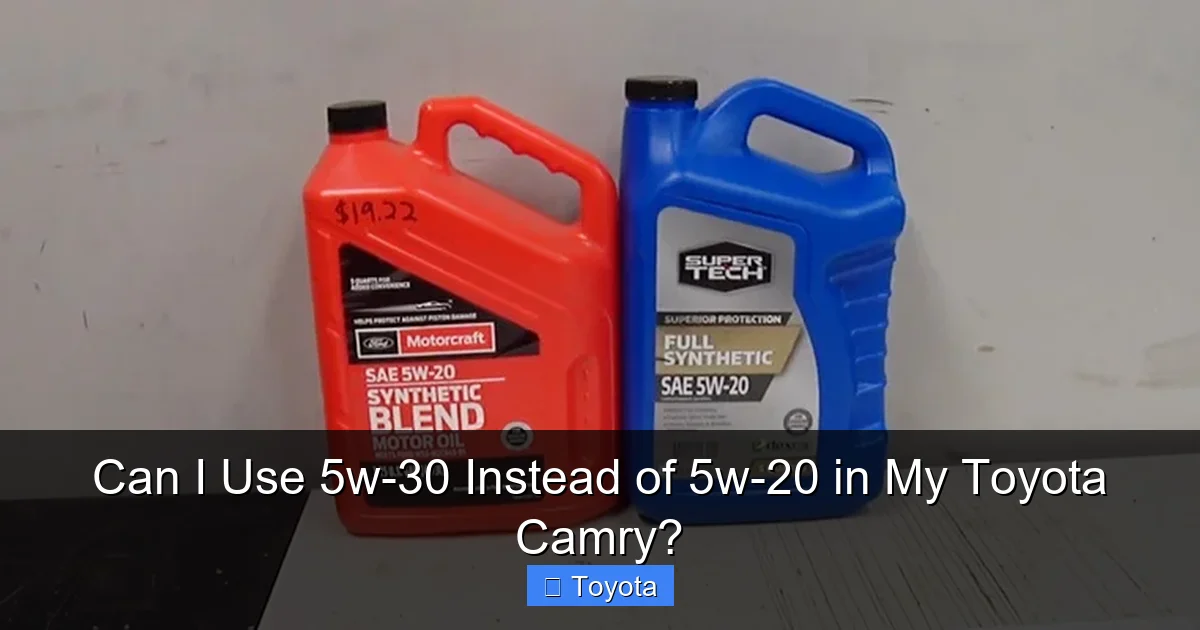
Visual guide about Can I Use 5w-30 Instead of 5w-20 in My Toyota Camry?
Image source: hondatheotherside.com
Very High-Mileage Engines with Consumption Issues
An older Camry (e.g., 2005-2010) with 200,000+ miles that is burning or leaking oil might benefit slightly from a *slightly* thicker oil to maintain better pressure and reduce consumption. However, the jump from 5W-20 to 5W-30 is still significant. A better approach is to use a high-quality 5W-20 High-Mileage oil designed for this purpose, which contains seal conditioners. Jumping to 5W-30 should only be considered after consulting a trusted mechanic and potentially a Toyota Technical Service Bulletin (TSB) for your specific engine.
Extreme Heat or Severe Driving Conditions
If you regularly tow a trailer in 100°F+ desert heat, some might argue for a slightly thicker oil. However, Toyota engineers already account for “severe service” conditions in their recommendation. The 5W-20 they specify is designed to maintain its film strength at operating temperature. If you have extreme needs, a full synthetic 5W-20 from a top brand (like Mobil 1, Pennzoil Platinum) is a far better solution than switching to 5W-30.
The Emergency Top-Off
This is the most common “exception.” If you are on a long trip, the oil light comes on, and the only thing available at the gas station is a quart of 5W-30, adding it to get you to a proper service center is acceptable. You are not performing a full fluid change; you are temporarily topping off a system that already has the correct oil. Add the minimum to reach the “full” mark on the dipstick and get an oil change with the correct 5W-20 as soon as possible (within 500 miles). Do not make a habit of it.
What To Do If You’ve Already Used 5W-30 in Your Camry
Panic is not the answer. A single oil change with 5W-30 is unlikely to cause instant harm. The key is to correct it promptly and monitor.
- Schedule an Oil Change Immediately: Drain the 5W-30 and replace it with the correct 5W-20 (or 0W-20) oil and a new filter. Do not wait for your next scheduled interval.
- Do Not Switch Back and Forth: Consistency is key. Once you correct it, stay with the correct oil for all future changes.
- Monitor Your Engine: For the next few thousand miles, pay attention to:
- Fuel economy (has it dropped noticeably?)
- Engine noise, especially a ticking or tapping from the top end (could be VVT-i)
- Check engine light, particularly codes related to variable valve timing.
- For Turbocharged Models (2.0L Camry): Be extra vigilant. Turbochargers run extremely hot and rely heavily on proper oil flow for cooling. Using incorrect oil can accelerate turbo wear. If you have a turbo and accidentally used 5W-30, change it promptly and consider having a mechanic inspect the turbo for any signs of distress if you notice unusual noise or smoke.
If you’re unsure about the long-term impact, consult a Toyota specialist. They can use diagnostic tools to check VVT-i performance and oil pressure parameters.
Best Practices: Protecting Your Camry’s Engine for the Long Haul
Moving forward, here is your foolproof plan for oil changes:
1. Always Verify Before You Buy
Don’t grab the first bottle that says “5W-30.” Check your owner’s manual or the oil cap. If you have a 2018+ Camry, you almost certainly need 0W-20. For a 2012-2017 non-turbo, it’s likely 0W-20 or 5W-20. When in doubt, look it up.
2. Choose Quality Oil That Meets Toyota’s Specifications
It’s not just about the viscosity numbers. The oil must meet the correct performance standards. Toyota typically requires oils that meet API SN/SP and ILSAC GF-6 standards, and often specifically calls for “Toyota Genuine Motor Oil” or oils meeting Toyota’s own specification (like “Toyota Oil Specification”). Any reputable full synthetic oil from a major brand (Mobil 1, Castrol, Valvoline, Pennzoil) that states it meets the “Toyota/Lexus specification” or is “ILSAC GF-6” is acceptable. You can find more general guidance on oil selection in our article What Kind Of Oil Can I Put In My Car?.
3. Use the Correct Oil Filter
A poor-quality filter can negate the benefits of good oil. Use a genuine Toyota filter or a high-quality aftermarket filter (like Wix XP, Mobil 1, K&N) that is designed for your engine and has the correct anti-drain back valve.
4. Keep Up with Change Intervals
Even the best oil breaks down. For most Camrys using 0W-20 or 5W-20 synthetic, Toyota’s recommended interval is 5,000-10,000 miles (or 6-12 months), depending on driving conditions. Never exceed the interval. Severe conditions (short trips, extreme temps, heavy loads) require more frequent changes.
5. Document Everything
Keep your oil change receipts. They are your proof of proper maintenance if a warranty issue ever arises. Note the brand, viscosity, and filter used.
Frequently Asked Questions
Can I use 5W-30 in my older 2005 Toyota Camry?
Possibly, but you must check your owner’s manual. Many 2002-2006 Camrys with the 2AZ-FE 2.4L engine originally specified 5W-30. However, if your manual calls for 5W-20, you should still use 5W-20. For a 2005 model, it’s more likely to require 5W-30, but verification is essential.
What happens if I accidentally put 5W-30 in my 2018 Camry with a 2.5L engine?
If it was a full oil change, schedule an oil change immediately to replace it with 0W-20 (the specified oil for that engine). A single mistake is unlikely to cause instant damage if corrected promptly. However, running it for thousands of miles could lead to VVT-i issues and reduced fuel economy. Monitor for any check engine lights or changes in performance.
Is it okay to mix 5W-20 and 5W-30 if I’m just topping off?
In a low-quantity top-off situation (e.g., adding a half-quart), mixing is generally acceptable and low-risk. The existing oil in the sump will dilute the new oil’s properties. The goal is to get to a proper service center for a full change with the correct oil as soon as possible. Do not intentionally mix oils as a long-term strategy.
Will using 5W-30 hurt my Camry’s fuel economy?
Yes, almost certainly. The thicker oil increases internal friction, which the engine must overcome. You can expect a measurable drop in MPG, especially in city driving where the engine cycles through heat and cool more often. The cost of the extra fuel will likely exceed any minor savings on the oil itself.
My friend says he uses 5W-30 in his Camry and it’s fine. Why shouldn’t I?
He might be getting away with it, but he’s accepting risk. His engine might be an older model that originally called for 5W-30. Or, he might be unaware of developing VVT-i sluggishness or slightly higher fuel consumption. He is also gambling with his warranty. “Fine for now” does not equal “correct” or “recommended by Toyota.”
Does the oil filter I use matter if I’m using the right viscosity?
Absolutely. A low-quality filter can allow contaminants to circulate or have poor flow characteristics, negating the benefits of good oil. Always use a filter that meets or exceeds Toyota’s specifications. Genuine Toyota filters are engineered for your engine’s specific needs, but many premium aftermarket brands are also excellent.