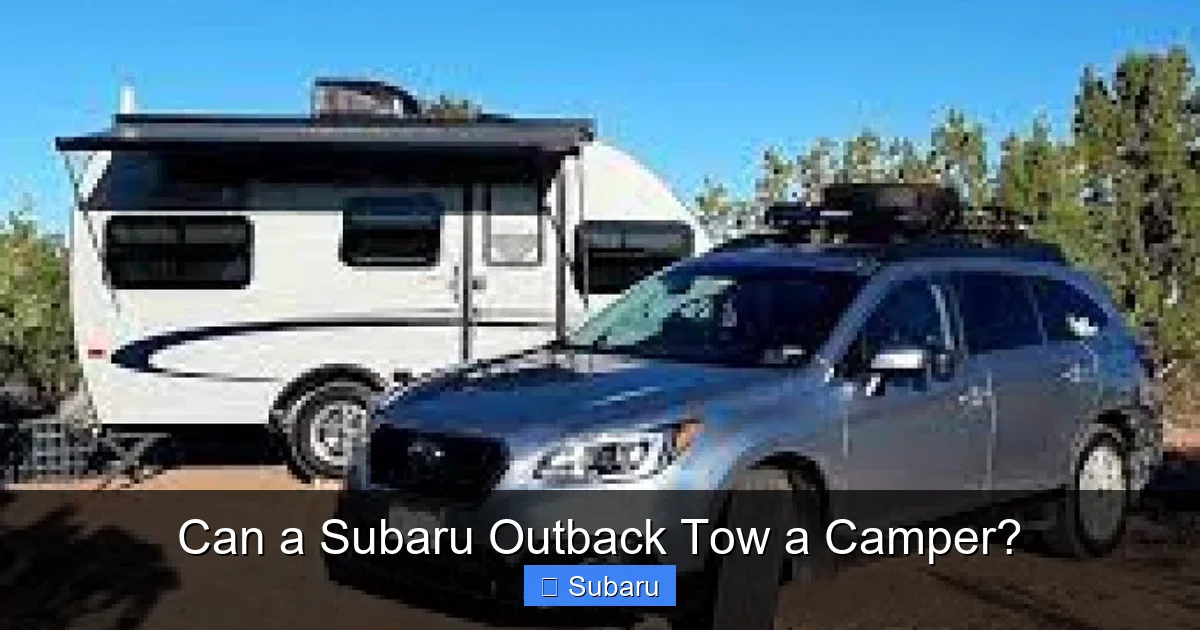
Can a Subaru Outback Tow a Camper?

Contents
- 1 Key Takeaways
- 2 📑 Table of Contents
- 3 Can a Subaru Outback Tow a Camper? The Honest Answer
- 4 Understanding Subaru Outback Towing Capacity
- 5 What Types of Campers Can You Tow with a Subaru Outback?
- 6 Essential Equipment for Safe Towing
- 7 Driving Tips for Towing with a Subaru Outback
- 8 Maintenance and Long-Term Care
- 9 When to Consider an Upgrade
- 10 Final Thoughts: Is the Outback Right for You?
- 11 Frequently Asked Questions

Car Fog Light Bulb

OBD2 Scanner Tool

Car Wax Polish

Reflective Stickers
The Subaru Outback can tow a camper—but only if you choose the right model and stay within its towing limits. With proper equipment and planning, many Outback owners successfully tow lightweight travel trailers, pop-up campers, and teardrop RVs for weekend getaways and cross-country trips.
Key Takeaways
- Towing capacity varies by model year and engine: Most modern Outbacks (2020–2024) with the 2.4L turbocharged engine can tow up to 3,500 pounds, while older or base models with the 2.5L engine are limited to 2,700 pounds.
- Only lightweight campers are suitable: Ideal options include pop-up campers, teardrop trailers, A-frame campers, and small travel trailers under 3,000 pounds.
- Factory tow package is recommended: Subaru offers an optional towing package that includes a transmission cooler, wiring harness, and hitch receiver—critical for safe towing.
- Weight distribution matters: Always account for cargo, water, propane, and passengers when calculating total trailer weight to avoid overloading.
- Driving dynamics change when towing: Expect reduced acceleration, longer braking distances, and decreased fuel economy—plan accordingly.
- Regular maintenance is essential: Towing puts extra strain on your Outback’s engine, transmission, and brakes—routine checks are a must.
- Consider alternatives for heavier loads: If your camper exceeds 3,500 pounds, consider upgrading to a larger SUV or truck for safer, more reliable towing.
📑 Table of Contents
- Can a Subaru Outback Tow a Camper? The Honest Answer
- Understanding Subaru Outback Towing Capacity
- What Types of Campers Can You Tow with a Subaru Outback?
- Essential Equipment for Safe Towing
- Driving Tips for Towing with a Subaru Outback
- Maintenance and Long-Term Care
- When to Consider an Upgrade
- Final Thoughts: Is the Outback Right for You?
Can a Subaru Outback Tow a Camper? The Honest Answer
If you’re a Subaru Outback owner dreaming of weekend escapes to national parks, lakeside retreats, or mountain cabins, you’ve probably asked yourself: *Can my Outback really tow a camper?* It’s a fair question—and one that deserves a clear, practical answer.
The short version? Yes, a Subaru Outback can tow a camper—but with important caveats. Not all Outbacks are created equal when it comes to towing, and not all campers are light enough to be safely pulled by this popular crossover. The key lies in understanding your specific Outback’s towing capacity, choosing the right type of camper, and preparing both your vehicle and your gear for the journey ahead.
Subaru has long marketed the Outback as a rugged, adventure-ready vehicle. With standard all-wheel drive, generous ground clearance, and a comfortable interior, it’s no surprise that outdoor enthusiasts love this SUV. But while it excels on dirt roads and snowy trails, its towing abilities are more modest compared to full-size trucks or heavy-duty SUVs. That doesn’t mean it’s incapable—just that it requires careful planning and realistic expectations.
In this guide, we’ll break down everything you need to know about towing a camper with a Subaru Outback. From towing capacities and compatible camper types to essential equipment and driving tips, we’ll help you determine whether your Outback is up for the task—and how to do it safely and confidently.
Understanding Subaru Outback Towing Capacity

Visual guide about Can a Subaru Outback Tow a Camper?
Image source: shunauto.com
Before you even think about hitching up a camper, you need to know your Outback’s towing capacity. This number tells you the maximum weight your vehicle can safely pull—and it varies significantly depending on the model year and engine type.
Engine Matters: 2.5L vs. 2.4L Turbo
The biggest factor affecting towing capacity is the engine under the hood. Subaru has offered two main engines in the Outback over the past decade: the naturally aspirated 2.5-liter four-cylinder and the turbocharged 2.4-liter four-cylinder.
– **2.5L Engine (Base Models):** Found in most base and mid-tier trims (especially pre-2020 and non-turbo 2020+ models), this engine produces around 182 horsepower. Its towing capacity is limited to **2,700 pounds**.
– **2.4L Turbo Engine (XT Models):** Available in higher trims like the Touring, Limited, and Wilderness, this turbocharged engine delivers 260 horsepower and 277 lb-ft of torque. It bumps the towing capacity up to **3,500 pounds**.
So, if you have a 2021 Outback Limited with the 2.4L turbo, you’re in luck—you can tow more than someone with a 2018 Outback Premium running the 2.5L engine. Always check your owner’s manual or Subaru’s official website to confirm your specific model’s towing rating.
Model Year Differences
Towing capacity has evolved over the years. Older Outbacks (pre-2015) often had even lower limits—sometimes as low as 2,000 pounds—and lacked modern towing aids. The 2015–2019 models improved slightly, but the real jump came with the 2020 redesign, which introduced the more powerful 2.4L turbo option and better cooling systems.
For example:
– **2015–2019 Outback (2.5L):** 2,700 lbs
– **2020–2024 Outback (2.5L):** 2,700 lbs
– **2020–2024 Outback (2.4L Turbo):** 3,500 lbs
Note: The 2022 Outback Wilderness, Subaru’s most off-road-capable trim, also features the 2.4L turbo and retains the 3,500-pound towing capacity—making it one of the best Outback choices for campers.
Factory Tow Package: A Must-Have
Even if your Outback has the right engine, you’ll need the proper equipment to tow safely. Subaru offers an optional **factory tow package** (often included on higher trims or available as an add-on) that includes:
– Class III hitch receiver (2-inch)
– 4-pin wiring harness
– Transmission cooler
– Upgraded cooling system
The transmission cooler is especially important—it helps prevent overheating when towing, which can damage your Outback’s CVT (continuously variable transmission). Without it, prolonged towing—especially in hot weather or uphill terrain—can lead to serious mechanical issues.
If your Outback didn’t come with the tow package, you can have one installed by a Subaru dealer. It’s a worthwhile investment if you plan to tow regularly.
What Types of Campers Can You Tow with a Subaru Outback?
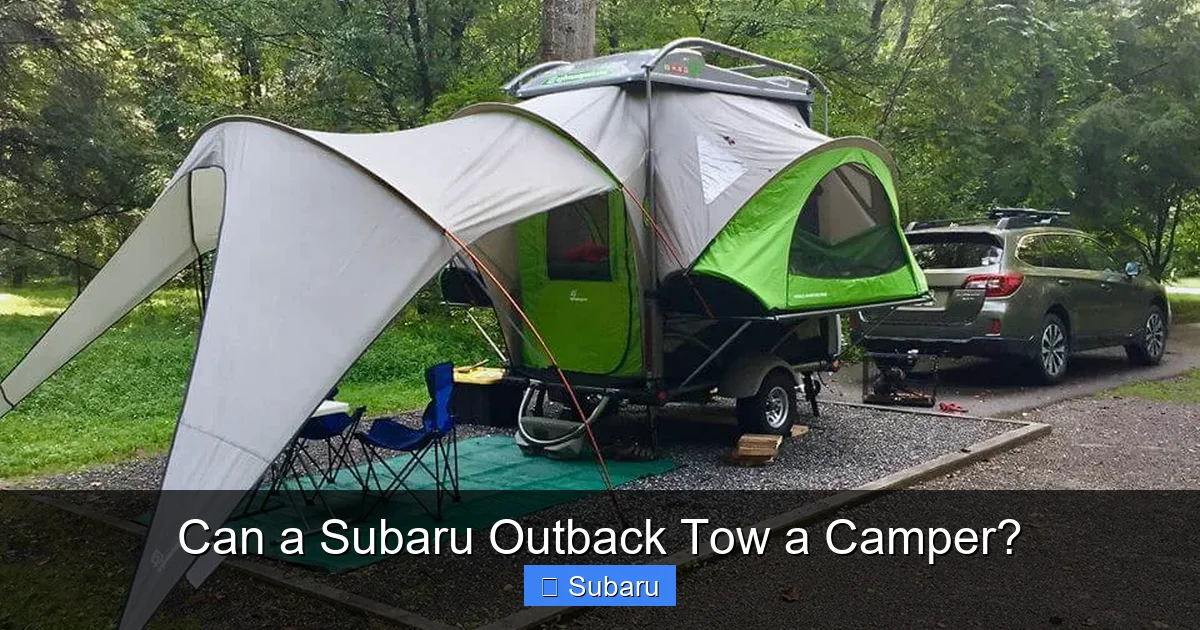
Visual guide about Can a Subaru Outback Tow a Camper?
Image source: sylvansport.com
Now that you know your Outback’s towing limits, the next question is: *What kind of camper can I actually pull?* The answer depends on the camper’s dry weight, loaded weight, and design.
Best Campers for the Outback
The Subaru Outback is best suited for **lightweight campers**—those that stay well below its towing capacity when fully loaded. Here are the most compatible types:
– **Pop-Up Campers:** These fold-down trailers are lightweight (typically 1,500–2,500 lbs when loaded) and aerodynamic. Models like the Jayco Jay Series or Forest River R-Pod are excellent matches.
– **Teardrop Trailers:** Compact and stylish, teardrops (like the Little Guy Mini Max or Happier Camper HC1) usually weigh between 1,000 and 2,000 pounds. They’re perfect for two people and easy to maneuver.
– **A-Frame Campers:** These innovative trailers (e.g., SylvanSport GO or Airstream Basecamp) fold into an A-shape for compact storage and weigh around 2,000–2,800 pounds. Their low profile reduces wind resistance.
– **Small Travel Trailers:** Some ultra-light travel trailers, such as the Casita Spirit Deluxe or the Scamp 13’, can work if kept under 3,000 pounds fully loaded.
Campers to Avoid
Avoid larger travel trailers, fifth wheels, or toy haulers. These often exceed 3,500 pounds even when empty and can easily overload your Outback. For example:
– A typical 20-foot travel trailer weighs 4,000–6,000+ pounds.
– Fifth wheels require a pickup truck with a bed-mounted hitch.
– Toy haulers are heavy due to built-in garages for ATVs or motorcycles.
Even some “lightweight” trailers can become too heavy once you add water, propane, gear, and passengers. Always check the **Gross Vehicle Weight Rating (GVWR)**—the maximum weight the trailer can safely carry when fully loaded—not just the dry weight.
Real-World Example: Towing a Pop-Up Camper
Let’s say you have a 2022 Outback Wilderness with the 2.4L turbo and factory tow package. You’re eyeing a Jayco Jay Series pop-up camper with a dry weight of 1,800 pounds. After loading it with camping gear, bedding, food, water, and two bikes, the total weight climbs to 2,400 pounds.
That’s well within your 3,500-pound limit—and leaves a comfortable safety margin. You’ll still have room for passengers and cargo in the Outback itself. This setup is ideal for weekend trips to state parks or mountain campsites.
But if you load that same camper with a generator, extra water tanks, and a full cooler, you could easily hit 2,800–3,000 pounds. Still safe, but you’ll notice the difference in performance—especially on hills.
Essential Equipment for Safe Towing
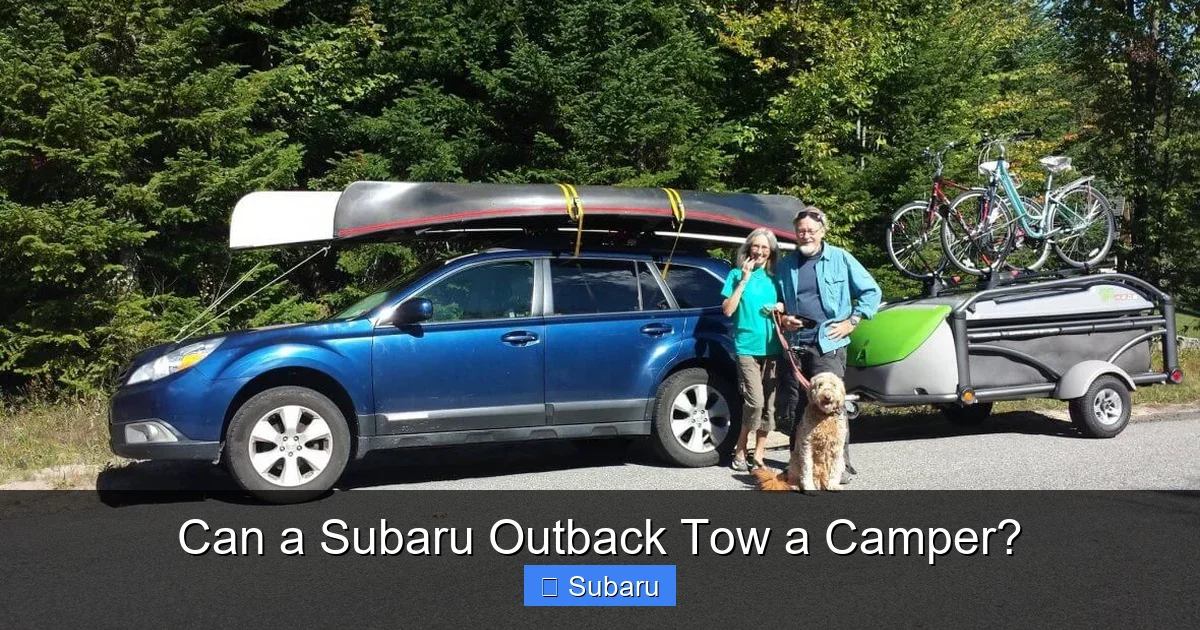
Visual guide about Can a Subaru Outback Tow a Camper?
Image source: sylvansport.com
Towing isn’t just about hitching up and driving. You need the right gear to ensure safety, stability, and peace of mind.
Hitch and Wiring
Start with a **Class III hitch receiver** (2-inch opening), which is standard with Subaru’s tow package. Avoid cheap aftermarket hitches—opt for OEM or high-quality brands like Curt or Draw-Tite.
You’ll also need a **4-pin or 7-pin wiring harness** to connect your camper’s lights (brake, turn, tail) to your Outback. Subaru’s factory harness plugs in seamlessly and is weather-resistant.
Weight Distribution and Sway Control
Even lightweight campers can sway in wind or when passing trucks. A **weight distribution hitch** helps balance the load between your Outback’s front and rear axles, improving steering and braking.
For added stability, consider a **sway control device**—a friction bar or hydraulic damper that reduces side-to-side movement. These are especially helpful with taller trailers like pop-ups.
Brake Controller (If Needed)
Most small campers under 3,000 pounds don’t require electric brakes, but some pop-ups and A-frames do. If your camper has brakes, you’ll need a **brake controller** installed in your Outback. Subaru doesn’t include one factory, but you can add an aftermarket unit like the Tekonsha Voyager.
The controller lets you adjust brake force from the driver’s seat, ensuring your camper slows down smoothly with your vehicle.
Tire Pressure and Load Ratings
Check your Outback’s tire pressure before every trip—underinflated tires can overheat when towing. Also, ensure your tires have a sufficient **load rating** (usually marked on the sidewall). If you’re frequently towing near capacity, consider upgrading to higher-load-range tires.
Driving Tips for Towing with a Subaru Outback
Towing changes how your Outback handles. Here’s how to adapt.
Expect Slower Performance
With a camper in tow, your Outback will accelerate more slowly, especially from a stop or uphill. The 2.4L turbo helps, but don’t expect sports-car speed. Leave extra space when merging onto highways and avoid aggressive driving.
Braking Takes Longer
The added weight increases stopping distance. Leave at least **double your normal following distance** and brake earlier than usual. Use engine braking (downshifting) on long descents to reduce strain on your brakes.
Fuel Economy Drops
Towing can cut your Outback’s fuel economy by 20–30%. A normally efficient 28 MPG might drop to 20 MPG when towing a 2,500-pound camper. Plan for more frequent fuel stops and budget accordingly.
Watch for Overheating
Even with a transmission cooler, monitor your temperature gauge—especially in summer or mountainous terrain. If the needle climbs, pull over, let the engine cool, and check fluid levels.
Practice Before You Go
If you’ve never towed before, practice in an empty parking lot. Get used to backing up (it’s counterintuitive—turn the wheel opposite the direction you want the trailer to go), turning wide, and using your mirrors.
Maintenance and Long-Term Care
Towing puts extra stress on your Outback. Regular maintenance is crucial.
Transmission and Cooling System
The CVT and cooling system work harder when towing. Follow Subaru’s recommended service intervals and consider more frequent fluid changes if you tow often. Flush the transmission cooler if you notice overheating.
Brake Inspection
Have your brakes inspected annually—or more often if you tow frequently. Worn pads or rotors can compromise safety when stopping a loaded vehicle.
Suspension Check
Towing can wear out shocks and struts faster. If your Outback sags in the rear or bounces excessively, it may be time for new suspension components.
Tire Rotation and Alignment
Rotate tires every 5,000–7,000 miles and check alignment annually. Misaligned wheels can cause uneven wear and poor handling when towing.
When to Consider an Upgrade
While the Outback is capable, it’s not the ideal tow vehicle for everyone.
If you frequently tow near or at the 3,500-pound limit, or if your camper exceeds that, consider upgrading to a more robust vehicle like:
– Subaru Ascent (up to 5,000 lbs)
– Toyota Highlander (up to 5,000 lbs)
– Ford Explorer (up to 5,600 lbs)
– Full-size truck (e.g., Ford F-150, up to 13,000+ lbs)
These vehicles offer stronger frames, better cooling, and higher towing capacities—making them safer and more comfortable for heavy loads.
Final Thoughts: Is the Outback Right for You?
The Subaru Outback can absolutely tow a camper—if you’re realistic about your needs and prepared for the challenges. With the right model (2.4L turbo), proper equipment, and a lightweight trailer, you can enjoy countless adventures without sacrificing Subaru’s signature comfort and capability.
But remember: towing is a responsibility. Always stay within your limits, maintain your vehicle, and drive defensively. When in doubt, err on the side of caution.
For weekend warriors, minimalist campers, and couples seeking simplicity, the Outback is a fantastic companion. Just don’t expect it to replace a pickup truck. With smart planning, your Outback can open the door to a world of outdoor exploration—one safe, scenic mile at a time.
Frequently Asked Questions
Can a 2023 Subaru Outback tow a camper?
Yes, a 2023 Subaru Outback can tow a camper, but only if it has the 2.4L turbocharged engine (XT trim), which allows for a 3,500-pound towing capacity. Base models with the 2.5L engine are limited to 2,700 pounds.
What is the best camper for a Subaru Outback?
The best campers for a Subaru Outback are lightweight options like pop-up campers, teardrop trailers, A-frame campers, and small travel trailers under 3,000 pounds when fully loaded.
Do I need a special hitch to tow with my Outback?
Yes, you need a Class III hitch receiver, preferably from Subaru’s factory tow package, which includes a transmission cooler and wiring harness for safe towing.
Can I tow a camper with a 2.5L Outback?
Yes, but only campers under 2,700 pounds. This engine is suitable for very lightweight trailers like small teardrops or unloaded pop-ups, but lacks the power for heavier loads.
Does towing reduce Subaru Outback fuel economy?
Yes, towing can reduce fuel economy by 20–30%, dropping from around 28 MPG to 20 MPG or lower, depending on trailer weight and driving conditions.
Can the Subaru Outback tow a 3,000-pound camper?
Only if it has the 2.4L turbo engine and is equipped with the factory tow package. The 2.5L engine models cannot safely tow 3,000 pounds.