Can a Ford F150 Pull a Camper

Contents
- 1 Key Takeaways
- 2 📑 Table of Contents
- 3 So, Can a Ford F150 Really Pull a Camper?
- 4 Understanding Your F150’s Towing Capacity: It’s Not One Number
- 5 The Real Limiting Factor: Payload Capacity
- 6 Choosing the Right Camper for Your F150
- 7 The Essential Gear: You Need More Than a Ball Hitch
- 8 Driving and Towing Best Practices
- 9 Common Mistakes and How to Avoid Them
- 10 The Verdict: A Capable Partner with Conditions
- 11 Frequently Asked Questions

LED Indicator Light

Car Back Support Cushion

Torque Wrench Set

Car Roof Rack Cross Bars
Absolutely, a Ford F150 can pull a camper. Its impressive towing capacities, ranging from 5,000 to over 14,000 pounds depending on the configuration, make it one of the most capable half-ton trucks for RV towing. However, success depends entirely on matching your specific F150’s configuration to your camper’s weight and using the correct towing equipment. Proper setup and understanding your truck’s limits are non-negotiable for a safe and enjoyable trip.
Key Takeaways
- Your F150’s max tow rating is a starting point, not a target: It’s the absolute maximum under ideal conditions. Always aim to stay at least 10-15% below this number for safety, margin, and wear on your vehicle.
- Configuration is everything: Engine size, rear axle ratio, cab style, bed length, and whether it’s a 4×2 or 4×4 drastically change your truck’s rated capacity. You must know your specific truck’s door-jamb sticker.
- Payload is the silent killer: Towing capacity gets the glory, but payload (what you can carry *in* the truck) is often the real limiting factor. A loaded camper’s hitch weight plus passengers, gear, and a full fuel tank must stay under your payload rating.
- You need more than a hitch: A proper weight distribution hitch with sway control is essential for most campers over 3,500 lbs to safely manage the load and keep your truck level.
- The manual is your bible: Your Ford owner’s manual contains the definitive towing guidelines, procedures, and warnings for your specific vehicle. Ignore it at your peril.
- Practice makes perfect: Before hitting the open road, practice maneuvering, backing, and braking in a large, empty parking lot with your fully loaded setup.
📑 Table of Contents
- So, Can a Ford F150 Really Pull a Camper?
- Understanding Your F150’s Towing Capacity: It’s Not One Number
- The Real Limiting Factor: Payload Capacity
- Choosing the Right Camper for Your F150
- The Essential Gear: You Need More Than a Ball Hitch
- Driving and Towing Best Practices
- Common Mistakes and How to Avoid Them
- The Verdict: A Capable Partner with Conditions
So, Can a Ford F150 Really Pull a Camper?
Let’s get straight to the heart of the matter. Yes, a Ford F150 can absolutely pull a camper. In fact, it’s one of the most popular and versatile tow vehicles on the market for exactly this purpose. For decades, the F150 has been the best-selling vehicle in America, and a huge part of that success is its reputation as a capable, reliable workhorse that can handle everything from a weekend project to a cross-country family adventure in a travel trailer or fifth-wheel.
But—and this is a big, important “but”—the answer isn’t a simple yes for every single F150 and every single camper. The real answer is: It depends entirely on your specific truck’s configuration and the weight of your camper. Saying an F150 can tow a camper is like saying a person can lift a box. A small box? Easy. A huge, 500-pound safe? Not so much. We need to talk specifics.
The good news is that the F150 offers an incredibly wide range of towing capacities. From the most basic, naturally aspirated V8 models to the turbocharged powerhouse of the Raptor or the hybrid-equipped PowerBoost, there’s likely an F150 configuration that can match the camper you have your eye on. The key is becoming an expert on your truck. This guide will walk you through everything you need to know, from decoding your door jamb sticker to understanding why a weight distribution hitch isn’t just an optional accessory. We’ll make sure you hook up with confidence and tow safely.
Understanding Your F150’s Towing Capacity: It’s Not One Number
This is the most critical section. If you only learn one thing from this article, let it be this: There is no single “Ford F150 towing capacity.” The number you see in a glossy commercial—often a staggering 14,000 pounds—is the maximum possible for a very specific, top-tier, bare-bones configuration. Your truck, with its options, cab style, bed, and engine, has its own unique number. Finding it is your first and most important step.
Visual guide about Can a Ford F150 Pull a Camper
Image source: carglassadvisor.com
Where to Find Your Truck’s Real Max Tow Rating
Forget the internet brochures. The only authoritative source for your truck’s ratings is the yellow and white Tire and Loading Information sticker located on the driver’s side door jamb. Open your door and look for it. On this sticker, you’ll find several crucial numbers:
- GVWR (Gross Vehicle Weight Rating): The maximum allowable total weight of your truck + passengers + cargo + fuel + the hitch weight of the trailer. You cannot exceed this.
- GAWR (Gross Axle Weight Rating): Separate ratings for the front and rear axles. The weight on each axle must stay under its rating.
- Max Trailer Weight: This is the number you’re looking for. It assumes a properly equipped truck with a specific engine/axle combo, a driver only (150 lbs), and no additional payload. This is your starting point.
For the most precise and detailed breakdown, your Ford owner’s manual is the ultimate resource. It will have charts that cross-reference your engine, axle ratio, cab, and bed style to give you the exact maximum trailer weight for your configuration.
The Big Factors That Change Your Capacity
Why are there so many different numbers? Here’s what makes the biggest difference:
- Engine: This is the biggest factor. The standard 3.3L V6 has a lower max tow rating (~7,700 lbs) than the 5.0L V8 (~11,000-13,000 lbs), which is lower than the 3.5L EcoBoost V6 (~12,000-14,000 lbs). The 5.0L and 3.5L EcoBoost are the primary heavy-duty engines for towing.
- Rear Axle Ratio: A numerically higher ratio (e.g., 3.73 vs. 3.31) gives you more towing grunt but reduces fuel economy. Trucks ordered for towing often come with a higher ratio.
- Drivetrain: 4×2 models typically have a slightly higher max tow rating than 4×4 models because the 4×4 system adds weight and complexity.
- Cab and Bed Length: Generally, a Regular Cab with a long bed is the lightest configuration, allowing for the highest tow rating. As you add seats (SuperCab, SuperCrew) and shorten the bed, you add weight to the truck itself, which reduces the available capacity for a trailer. A SuperCrew with a 5.5′ bed will have a lower max tow rating than a Regular Cab with an 8′ bed, even with the same engine.
Pro Tip: If you’re buying a used F150, you must find the original window sticker (Monroney label) or use the Ford VIN decoder online to determine its exact factory configuration. A “tow package” is more than just a hitch; it usually includes a heavy-duty radiator, transmission cooler, and upgraded rear axle.
The Real Limiting Factor: Payload Capacity
Here’s where most new tower’s get a nasty surprise. You’re focused on the big “tow rating,” but you’re about to be stopped in your tracks by the much smaller payload rating. This is the weight your truck can carry inside—passengers, cargo, and, most importantly for you, the hitch weight (or tongue weight) of the trailer.
Visual guide about Can a Ford F150 Pull a Camper
Image source: images.rvwholesalers.com
What is Hitch Weight and Why Does It Matter?
Hitch weight is the downward force the trailer exerts on the hitch ball. It’s typically 10-15% of the trailer’s total loaded weight. For a 6,000 lb camper, you’re looking at 600-900 lbs of hitch weight. This weight sits directly on your truck’s rear axle and counts against your payload rating.
Let’s do a quick, sobering example:
- Your F150’s door jamb says: GVWR = 6,500 lbs. Curb weight (truck’s weight with fluids) = 4,800 lbs.
- Your available payload = GVWR – Curb Weight = 6,500 – 4,800 = 1,700 lbs.
- Now, subtract the weight of:
- Driver & passengers: 400 lbs
- Full tank of gas (26 gal x 6 lbs/gal): ~156 lbs
- Gear in the bed (coolers, tools, firewood): 200 lbs
- Hitch weight from camper: 750 lbs
- Total used = 400 + 156 + 200 + 750 = 1,506 lbs.
- Remaining payload for extra gear? Only about 200 lbs.
See how quickly that payload gets eaten up? A family of four with a week’s worth of camping gear might easily push 500-700 lbs in the truck. You must calculate this before you buy or load a camper. If your payload is maxed out, your truck will sag dangerously in the rear, your headlights will point at the sky, your braking will suffer, and you’ll be over your GVWR—which is illegal and unsafe. For more on understanding weight limits, our article on how much weight you can pull without a CDL provides excellent foundational knowledge.
Choosing the Right Camper for Your F150
Armed with your truck’s real numbers, you can now shop for a camper intelligently. The goal is to find a trailer whose Gross Vehicle Weight Rating (GVWR)—the max it could weigh when fully loaded—is comfortably below your truck’s maximum trailer rating. But more importantly, you must ensure its typical loaded weight and resulting hitch weight fit within your payload.
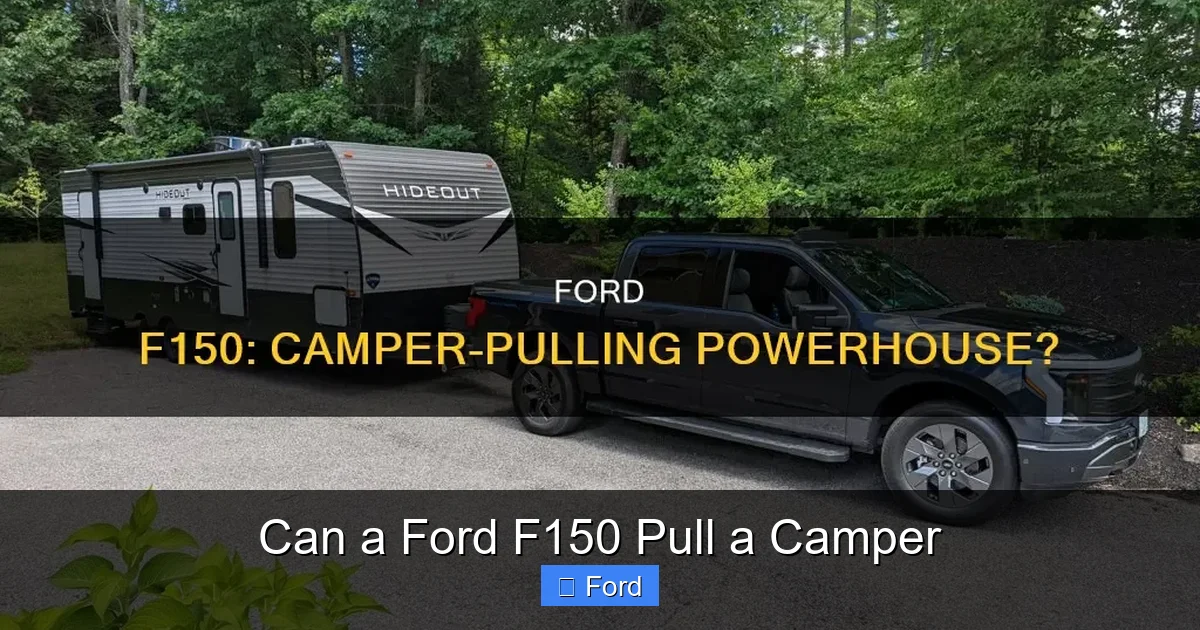
Visual guide about Can a Ford F150 Pull a Camper
Image source: shunauto.com
Camper Types & Typical Weights
- Pop-Up Campers / Tent Trailers: These are the lightest. Weighing often between 1,500 and 3,000 lbs loaded, they are easily handled by almost any F150. The hitch weight is minimal. Great for first-time towers.
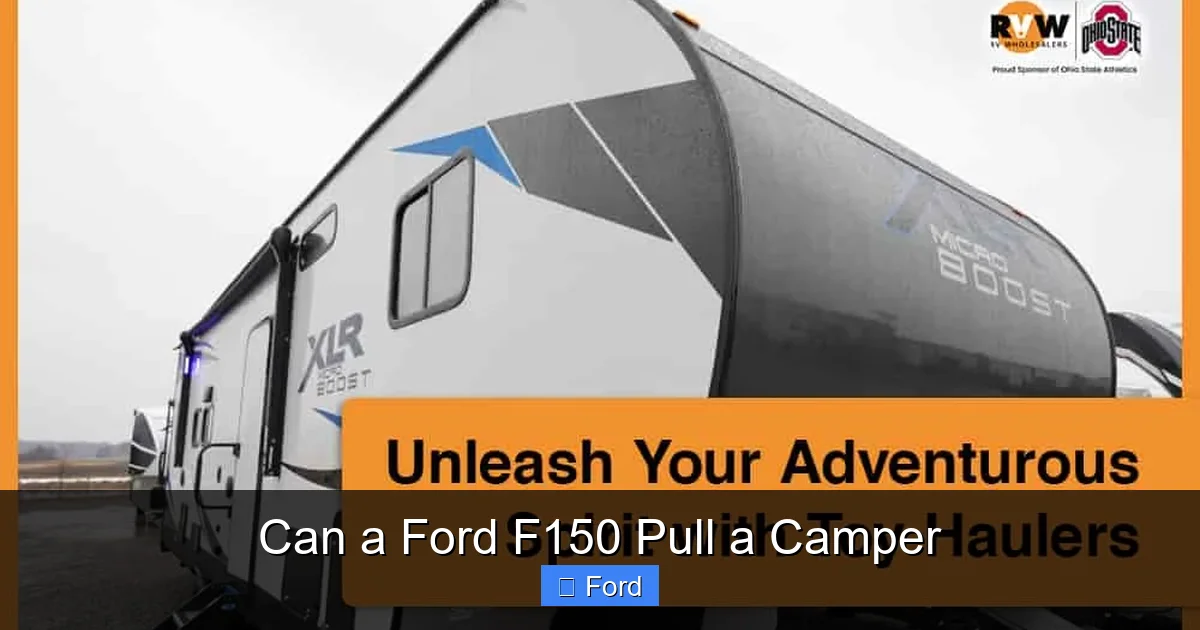
- Small Travel Trailers (15′-25′): This is the sweet spot for many F150 owners. Models like the Jayco Jay Feather, Airstream Sport, or Forest River Rockwood Mini Lite can range from 2,500 to 5,000 lbs loaded. A properly equipped F150 can tow these with ease.
- Mid-Size Travel Trailers (25′-30′): Here’s where you need a seriously capable F150 (EcoBoost or 5.0L with the right axle). Weights jump to 5,000 – 7,500 lbs loaded. You must pay close attention to payload for the hitch weight.
- Large Travel Trailers (30’+): These often start at 7,000 lbs and can easily exceed 10,000 lbs. Towing one requires a maxed-out F150 and leaves very little margin for payload. You’ll be living at the absolute limit of the truck’s design.
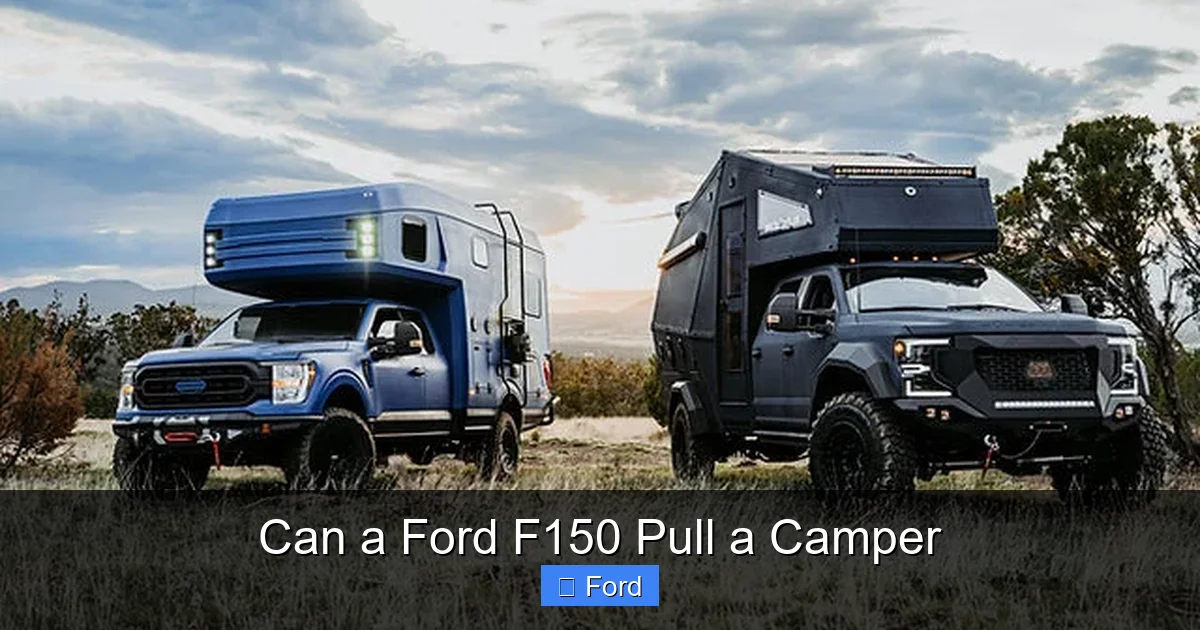
- Fifth-Wheels: These go in the bed of the truck. They are heavier for their length due to the front “gooseneck” over the truck bed. A 30′ fifth-wheel can weigh 8,000-10,000 lbs. They put less strain on the rear hitch but consume a huge amount of payload and bed space. An F150 can pull smaller fifth-wheels (under 8,000 lbs), but larger ones push into F250/F350 territory. We have a dedicated guide on whether a Toyota Tundra can pull a fifth-wheel that discusses the unique considerations for these larger campers.
The Essential Gear: You Need More Than a Ball Hitch
If your camper’s loaded weight is over about 3,500-4,000 lbs, a simple ball hitch is insufficient and dangerous. You need a Weight Distribution Hitch (WDH) with Sway Control.
How a Weight Distribution Hitch Works
A WDH uses spring bars that tension between the trailer tongue and the truck’s receiver. This system lifts some of the trailer’s weight off the rear axle of the truck and redistributes it to the front axle of the truck and the trailer’s own axles. The result is:
- A level truck: Prevents dangerous rear sag, keeping your steering, braking, and headlight aim correct.
- Increased stability: Reduces trailer sway dramatically, especially in crosswinds or when passed by large trucks.
- Better weight distribution: Keeps you within your truck’s GAWRs.
Sway control is built into many modern WDH systems (like the Reese Strait-Line or Equal-i-zer) or can be added as a separate friction-based or cam-based device. For any sizable camper, this is not a place to cut corners. For tips on protecting your truck’s bed, see our article on the best camper shell for Ford F150.
Other Critical Accessories
- Brake Controller: Required by law if your trailer has brakes (almost all campers over 1,500 lbs do). This is installed in your cab and lets you control the trailer’s brakes from your foot pedal. The factory Ford brake controller (if equipped) is good, but aftermarket units like the Tekonsha Prodigy are excellent.
- Proper Wiring: A 7-pin round connector is standard for RV use. It provides lights, brakes, and a 12V charge line to keep the trailer battery topped up.
- Mirrors: You’ll need towing mirrors that extend your view past the trailer’s width. Clip-on or replacement mirrors are a must-have for safety.
- Safety Chains & Breakaway Switch: Always cross the chains and ensure the breakaway system (which applies the trailer brakes if it comes unhitched) is connected and functional.
Driving and Towing Best Practices
Your F150 is now hitched up and ready. Driving with a trailer is a skill. Here’s how to do it safely.
Pre-Trip Checklist is Law
Before every trip, do this:
- Check tire pressures on both truck and trailer. Inflate to the max PSI on the sidewall for highway towing.
- Verify all lights (tail lights, brake lights, turn signals) work.
- Check the WDH setup. Are the bars tensioned correctly? Is the trailer level?
- Do a “walk-around” to check for loose items, secure all camper doors and compartments, and stow the steps.
- Load heavy items low and centered in the trailer. Keep the truck’s bed as light as possible to maximize payload for hitch weight.
On the Road: Slow and Steady
Your driving style must change.
- Accelerate and brake early and gently. Your stopping distance has increased exponentially. Use the brake controller to apply the trailer brakes first, then the truck brakes.
- Take wide turns. Your trailer’s wheels will cut inside the truck’s path. Avoid clipping curbs.
- Allow for extra following distance. 4-5 seconds is a good rule.
- Use the right gear. In mountains, use the “T” or “L” gear positions or steering wheel paddle shifters to manually select lower gears. Do not ride the brakes continuously downhill. Let engine braking do the work.
- Be a target in the wind. High-profile vehicles and campers are susceptible to crosswinds. Reduce speed and keep a firm grip on the wheel. When passed by a large truck, be prepared for a “wake” of air. The sway control on your WDH will help, but you may need to counter-steer slightly.
- Backing up is an art. Practice in an empty lot. Go slow. Remember: to make the trailer go left, turn the steering wheel right (and vice versa). Use your mirrors extensively. A spotter is invaluable for tight spots.
Common Mistakes and How to Avoid Them
Even experienced tower’s make these errors. Here’s what to watch out for.
Ignoring the Payload Calculation
This is the #1 mistake. They see “11,000 lb tow rating” and buy a 9,000 lb trailer, then load the family, the dog, a full cooler, and the generator in the truck. Suddenly, they are 500 lbs over their GVWR. The truck sags, the headlights blind oncoming traffic, and the brakes are overheating. Always, always do the math on payload first.
Underestimating the Need for a WDH
“My truck doesn’t sag much” is a common thought. But even a slight sag can cause premature wear on your rear axle, cause the front end to feel light and unstable, and reduce the effectiveness of your truck’s own braking system. A WDH is about safety and vehicle health, not just comfort.
Not Matching the Hitch to the Load
Using a Class III hitch (6,000-8,000 lb capacity) on a truck rated to tow 12,000 lbs is a recipe for failure. Your hitch must be rated for at least your trailer’s GVWR. Most tow-capable F150s come with a factory Class IV receiver (10,000-12,000+ lb capacity), but verify this.
Overlooking the Transmission
The 10-speed automatic in modern F150s is excellent for towing. However, if you have an older model with a 6-speed, be extra diligent about manually selecting gears on grades to prevent transmission overheating. The best tires for your Ford F150 will also provide crucial stability and traction.
The Verdict: A Capable Partner with Conditions
So, can a Ford F150 pull a camper? The final, definitive answer is yes, it is one of the best half-ton trucks on the market for the job. Its range of powerful engines, available tow packages, and widespread aftermarket support make it a top choice for RV enthusiasts.
But its capability is not unlimited or magical. Your success hinges on three pillars:
- Knowledge: Know your truck’s exact GVWR, payload, and max tow rating from the door jamb sticker and manual.
- Matchmaking: Choose a camper whose loaded weight and hitch weight fall comfortably within those ratings. Leave yourself a 10-15% safety margin.
- Equipment: Use a properly sized weight distribution hitch with sway control, a brake controller, and perform a diligent pre-trip inspection every single time.
When you respect these boundaries, the Ford F150 transforms from a simple pickup into a key to freedom, reliably pulling your home-on-wheels to countless beautiful destinations. It’s a partnership built on understanding and respect—for both your truck’s limits and the road ahead.
Frequently Asked Questions
What is the maximum camper weight my specific Ford F150 can tow?
There is no single number. You must find your truck’s unique “Max Trailer Weight” on the Tire and Loading Information sticker on your driver’s door jamb. This number is based on your exact engine, axle ratio, cab, and bed configuration. The owner’s manual will provide the detailed chart to confirm this.
Do I absolutely need a weight distribution hitch?
For any camper over approximately 3,500-4,000 lbs, a weight distribution hitch with sway control is highly recommended and often considered essential for safety. It prevents rear-end sag, improves steering and braking, and drastically reduces trailer sway. Check your F150’s manual; it may specify a minimum trailer weight for WDH use.
Can my F150’s factory tow package handle a large camper?
The factory tow package typically includes a heavy-duty radiator, transmission cooler, and upgraded rear axle, which are great starting points. However, you must still verify your specific truck’s max tow rating and payload. The package doesn’t change the fundamental GVWR or GAWR stamped on your door jamb. It simply equips the truck to better handle loads near its factory-rated limits.
How do I calculate if my camper’s hitch weight will exceed my payload?
First, find your truck’s payload rating (GVWR minus curb weight) on the door jamb. Then, add up the weight of all passengers, cargo in the bed, a full fuel tank, and the estimated hitch weight of the camper (usually 10-15% of its loaded weight). This total must be less than your payload rating. If you’re close, you need to lighten the load in the truck.
Is a Ford F150 with the 3.5L EcoBoost good for towing?
Yes, the 3.5L EcoBoost V6 is arguably the best all-around engine in the F150 lineup for towing. It produces immense torque low in the RPM range, which is perfect for moving a heavy trailer from a stop and managing grades. It generally offers the highest max tow ratings (up to 14,000 lbs in certain configurations) and excellent fuel economy when towing compared to the larger V8s.
What’s the biggest mistake new F150 tower’s make?
The most common and dangerous mistake is focusing solely on the maximum tow rating and ignoring the payload capacity. They buy a trailer that is within the tow rating but whose hitch weight, plus family and gear, pushes the truck over its GVWR and rear axle rating. This leads to poor handling, brake fade, and unsafe driving conditions. Always calculate payload first.