
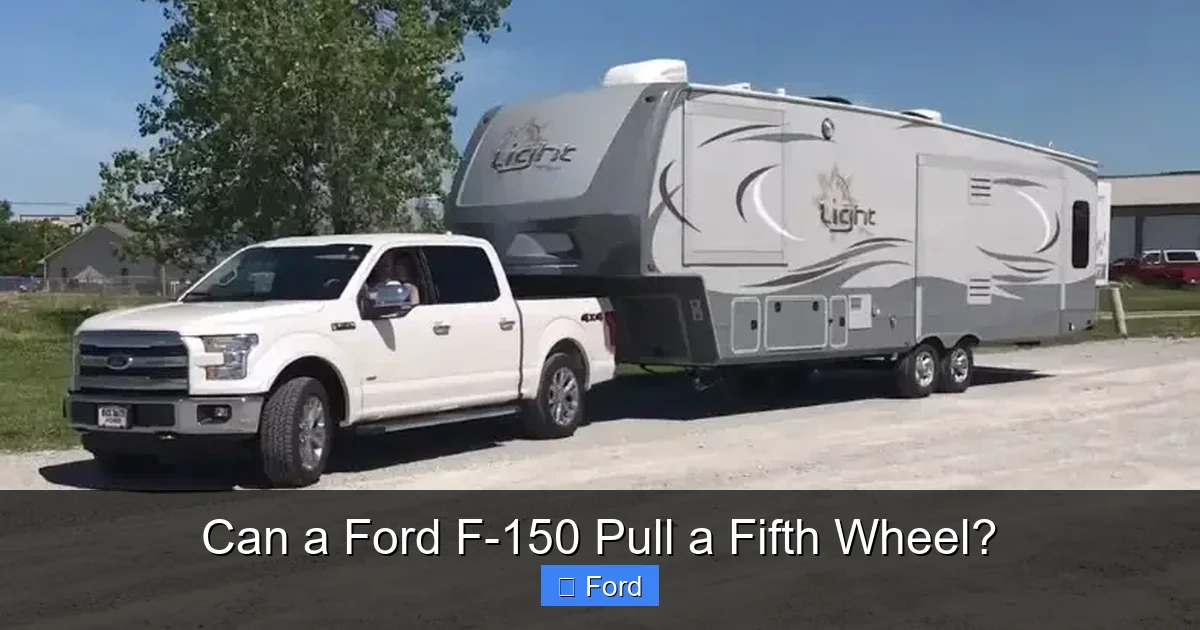
Can a Ford F-150 Pull a Fifth Wheel?
Contents
- 1 Key Takeaways
- 2 📑 Table of Contents
- 3 Can a Ford F-150 Pull a Fifth Wheel? The Short Answer
- 4 Understanding the Critical Difference: Payload vs. Tow Rating
- 5 Ford F-150 Configurations for Fifth Wheel Towing
- 6 Fifth Wheel Hitch Selection and Installation
- 7 Real-World Examples and Practical Scenarios
- 8 Safety Considerations and Final Recommendations
- 9 Conclusion: Yes, But With Smart Preparation
- 10 Frequently Asked Questions
Yes, a properly configured Ford F-150 can pull a fifth wheel trailer, but payload—not tow rating—is the critical factor. You must select an F-150 model with a high enough payload capacity to handle the trailer’s pin weight, which typically runs 15-25% of the trailer’s gross weight. Success depends on choosing the right engine, cab/bed configuration, and optional Max Payload Package, plus installing a compatible fifth wheel hitch. Always weigh your fully loaded setup to ensure you’re within all axle and combined weight limits.
Key Takeaways
- Payload is King: The F-150’s payload capacity (what it can carry in the bed and cab) is the limiting factor for fifth wheeling, not its maximum tow rating.
- Max Payload Models: F-150s with the 3.5L EcoBoost V6 or 5.0L V8 in SuperCrew, 5.5′ or 6.5′ bed configurations with the Max Payload Package offer the highest capacities, up to ~3,270 lbs.
- Hitch Choice Matters: You need a dedicated fifth wheel or gooseneck hitch. The factory “Fifth Wheel Tow Prep Package” (available on select models) provides a strong mounting solution.
- Pin Weight is Key: The trailer’s pin weight (the downward force on the truck bed) must be less than your F-150’s available payload after accounting for passengers, cargo, and fuel.
- Weigh Your Rig: Always get a certified weight at a public scale for your fully loaded truck and trailer to verify you are within the F-150’s GVWR, GAWR, and GCWR.
- Tires & Components: Ensure your F-150’s tires are rated for the load and consider heavy-duty brake and suspension components for regular towing.
- It’s a Half-Ton Truck: While capable, the F-150 is a half-ton pickup. It will pull a fifth wheel best with a lightweight, well-balanced trailer, typically under 10,000 lbs GVWR.
[FEATURED_IMAGE_PLACEHOLDER]
📑 Table of Contents
- Can a Ford F-150 Pull a Fifth Wheel? The Short Answer
- Understanding the Critical Difference: Payload vs. Tow Rating
- Ford F-150 Configurations for Fifth Wheel Towing
- Fifth Wheel Hitch Selection and Installation
- Real-World Examples and Practical Scenarios
- Safety Considerations and Final Recommendations
- Conclusion: Yes, But With Smart Preparation
Can a Ford F-150 Pull a Fifth Wheel? The Short Answer
This is one of the most common questions in truck forums, and the answer is a qualified yes. The Ford F-150, America’s best-selling vehicle, is more capable than many people realize. However, the real answer isn’t a simple yes or no—it’s a “yes, if.” The “if” depends entirely on understanding a critical distinction in towing terminology and choosing the correct truck configuration.
Many shoppers see the F-150’s impressive maximum tow ratings—sometimes over 14,000 lbs—and assume that means it can pull any trailer under that weight. This is a dangerous misconception, especially for fifth wheels. A fifth wheel sits directly over the truck’s rear axle, placing its weight (called pin weight) squarely in the bed. This weight counts against the truck’s payload capacity, not its tow rating. Your F-150’s payload is the total weight it can carry in its cab and bed, including passengers, cargo, fuel, and that crucial pin weight. For fifth wheel towing, your available payload is the single most important number to know.
So, can your specific Ford F-150 pull a fifth wheel? Let’s break down exactly how to find out, what you need, and how to do it safely.
Understanding the Critical Difference: Payload vs. Tow Rating
To grasp whether an F-150 can handle a fifth wheel, you must first understand the two key weight ratings on the driver’s door jamb sticker and in your owner’s manual.

Visual guide about Can a Ford F-150 Pull a Fifth Wheel?
Image source: rvlifemag.com
What is Payload Capacity?
Payload is the maximum weight your truck can safely carry. It’s calculated by subtracting the truck’s curb weight (its weight when empty with all fluids) from its Gross Vehicle Weight Rating (GVWR). The GVWR is the absolute maximum weight the truck can be when fully loaded. Everything you put into the truck—your family, your tools, a full tank of gas, and the weight of the fifth wheel’s kingpin pressing down on the bed—eats into this payload number. For a fifth wheel, the pin weight (usually 15-25% of the trailer’s total weight) is part of your payload.
What is Maximum Tow Rating?
The maximum tow rating is the heaviest trailer the truck can pull, assuming the truck itself is empty except for a 150-lb driver. This rating is based on the truck’s structural strength, engine power, transmission cooling, and rear axle capacity. It does not account for the weight of passengers, cargo, or fuel in the truck. This is why you often see a truck rated to tow 12,000 lbs but with a payload of only 1,800 lbs. If you load up the truck with people and gear, your actual safe towing capacity can drop dramatically.
Why Payload Trumps Tow Rating for Fifth Wheels
A bumper-pull travel trailer puts only a small amount of tongue weight (10-15%) on the truck’s hitch, which is then distributed by the trailer’s own axles. A fifth wheel, however, places its full pin weight directly over the truck’s rear axle. This is a concentrated load that directly consumes your payload. You could have an F-150 with a 14,000-lb tow rating but a payload of only 1,500 lbs. That truck might only be able to handle a fifth wheel with a GVWR of 6,000-7,000 lbs (giving a pin weight of 900-1,400 lbs), leaving little room for anything else in the bed. The fifth wheel’s weight is limited by your truck’s payload, not its tow rating.
Ford F-150 Configurations for Fifth Wheel Towing
Not all F-150s are created equal. Your truck’s configuration—engine, cab style, bed length, and optional packages—dictates its ultimate payload. To maximize your chances, you need to target the models with the highest payload numbers.
Visual guide about Can a Ford F-150 Pull a Fifth Wheel?
Image source: tfltruck.com
Engine Choice: EcoBoost vs. V8
Both the 3.5L EcoBoost V6 and the 5.0L V8 can be excellent choices. Historically, the 3.5L EcoBoost in certain configurations has offered the highest payload ratings due to its lighter engine weight compared to the V8, leaving more capacity for cargo. However, the difference is often minimal, and the best choice may come down to personal preference for power delivery and fuel economy. The high-output 3.5L EcoBoost (available on Raptor and some Limited/Platinum models) prioritizes power over payload. For max payload, look for the standard-output 3.5L EcoBoost or 5.0L V8.
Cab and Bed Length: The Payload Equation
This is where it gets specific. Generally, a smaller cab and a longer bed yield a higher payload because there’s less structural weight from the cab and more frame length to distribute weight. For fifth wheeling, the most popular and capable configurations are:
- SuperCrew (4-door) with 5.5′ bed: A great balance of passenger space and payload. Many max payload models use this setup.
- SuperCrew with 6.5′ bed: Offers slightly more bed length for cargo, often with a payload nearly as high as the 5.5′ bed.
- Regular Cab with 8′ bed: This is the absolute payload king for the F-150 line, but you sacrifice rear passenger space.
A SuperCab (2+2 door) with a long bed can also be a strong contender. Avoid the shortest bed (5.5′ on Regular Cab) and the heaviest cabs (like the four-door SuperCrew with the shortest bed) if payload is your sole goal.
The Essential Max Payload Package
To get the highest published payload numbers, you must order the F-150 with the Max Payload Package. This isn’t just a marketing term; it includes specific components designed to increase capacity:
- Heavy-Duty Suspension: Up-rate springs and shocks to handle more weight.
- Larger Brakes: Often includes upgraded front and rear brakes.
- LT235/70R18C or similar load-range tires: Tires with a higher load index (e.g., Load Range E) are mandatory. This is a non-negotiable item. If you’re looking at a used F-150, verify it has the correct, heavy-duty tires. For new trucks, this package includes them. Proper tires are fundamental; you might also consider upgrading to premium all-terrain tires for better durability, and you can find recommendations for specific model years in our guides to the best tires for Ford F-150 Lariat or other trims.
- 7,000-lb Rear Axle: A stronger axle to handle the increased load.
You must check the yellow GVWR sticker on the driver’s door jamb of the specific truck you are buying. The Max Payload Package will be listed there, and it will state the truck’s specific GVWR and payload. Never rely on general brochure numbers; the sticker on the vehicle is the law.
Fifth Wheel Hitch Selection and Installation
Assuming you’ve found an F-150 with sufficient payload, you need the right hardware to connect the trailer. This is not a place to cut corners.
Visual guide about Can a Ford F-150 Pull a Fifth Wheel?
Image source: cardeeply.com
Fifth Wheel vs. Gooseneck Hitches
A true fifth wheel hitch has a large, flat plate with a set of jaws that clamp onto the trailer’s kingpin. A gooseneck hitch uses a ball and socket, similar to a bumper pull but mounted in the bed. Many fifth wheel trailers can be adapted to use a gooseneck with a special adapter plate (often called a “fifth wheel gooseneck adapter” or “kingpin riser”). Gooseneck hitches are simpler and often have a higher weight capacity, but they can offer a slightly different towing experience. For most modern fifth wheels, a dedicated fifth wheel hitch is the standard. The choice often comes down to personal preference and trailer compatibility.
The Ford Factory Fifth Wheel Tow Prep Package
For certain F-150 models (typically those with the 6.5′ or 8′ bed), Ford offers a factory-installed Fifth Wheel Tow Prep Package. This is a fantastic option because it includes:
- Pre-wired harness for a hitch light.
- Pre-installed, strong frame brackets in the bed.
- A dedicated 7-pin and 4-pin trailer wiring connector.
- An integrated brake controller (in later model years).
This package provides a clean, OEM-looking installation and ensures the truck’s frame is properly prepared. If you’re buying new and plan to tow a fifth wheel, this package is highly recommended. For used trucks without it, aftermarket hitches from brands like B&W, Reese, or Curt are excellent and bolt directly to the truck’s frame.
Installation and Bed Protection
Professional installation is crucial. The hitch must be torqued to the manufacturer’s specifications and mounted to solid frame points. Consider adding a bed mat or liner to protect your truck’s bed from the hitch hardware and road debris. Some hitches also come with a “drop-in” bed liner that protects the bed floor. While not directly related to towing capacity, protecting your investment is smart. You might also look into wheel locks for your Ford F-150 for added security when your truck and trailer are parked at the campground.
Real-World Examples and Practical Scenarios
Let’s make this concrete with some examples of F-150 configurations and the fifth wheels they could realistically pull.
Example 1: The Family Adventurer
You have a 2021 Ford F-150 SuperCrew, 5.5′ bed, with the 3.5L EcoBoost and Max Payload Package. The door sticker shows a GVWR of 7,500 lbs and a payload of 1,950 lbs. Your family of four (600 lbs), full fuel (100 lbs), and your gear in the bed (200 lbs) consume 900 lbs of payload. That leaves you with 1,050 lbs for pin weight. You could safely tow a fifth wheel with a GVWR of 5,000-6,000 lbs (pin weight 750-1,200 lbs). A lightweight 25-28 foot trailer from brands like Grand Design or Jayco would fit perfectly.
Example 2: The Solo or Couple’s Rigger
You have a 2018 F-150 Regular Cab, 8′ bed, with the 5.0L V8 and Max Payload. Your payload might be as high as 3,000 lbs. With just you (200 lbs), fuel (100 lbs), and minimal gear (100 lbs), you have 2,600 lbs for pin weight. This opens up a much larger trailer, potentially a 32-35 foot fifth wheel with a GVWR of 12,000-14,000 lbs (pin weight 1,800-2,800 lbs). However, you must still check your truck’s GCWR (Gross Combined Weight Rating) to ensure the total weight of truck plus trailer is within limits. A heavier trailer also requires more robust braking and sway control.
The Weigh Station is Your Best Friend
No matter your calculations, the only way to know for sure is to weigh your fully loaded rig. Drive your loaded F-150 (with all passengers, fuel, and cargo as if you were leaving for a trip) to a public scale (truck stop, farm supply store). Weigh the truck by itself. Then, hook up the fully loaded fifth wheel (with propane, water, and gear as if on a trip) and weigh the entire combination. Finally, weigh the truck again with the trailer attached to get the pin weight indirectly. These three weights will tell you if you are under your truck’s GVWR, the trailer’s GVWR, and the truck’s GAWR (Gross Axle Weight Rating) for both front and rear axles. This is the gold standard for safe towing.
Safety Considerations and Final Recommendations
Towing a heavy fifth wheel changes your F-150’s dynamics dramatically. Stopping distances increase, wind sway becomes a serious issue, and hill climbing requires more planning.
Weight Distribution and Sway Control
While fifth wheels are inherently more stable than bumper pulls due to their centered weight, a weight distribution hitch is not typically used (they are for bumper pulls). However, you must ensure the trailer is properly balanced. The pin weight must be within the trailer manufacturer’s recommended range. Too little pin weight can cause trailer sway; too much can overload your truck’s rear axle and reduce steering control. Always load your trailer with heavy items (propane, batteries, water) low and near the front (over the axles).
Braking and Legal Requirements
Most states require a trailer brake controller for any trailer over a certain weight (often 1,500-3,000 lbs). Your F-150’s factory brake controller (if equipped with the prep package) or an aftermarket unit like those from Tekonsha is essential. It must be properly adjusted to your trailer’s brakes. Also, check your state’s laws regarding fifth wheel hitches, brake requirements, and maximum combined lengths. Don’t forget your trailer’s own tires are critical—under-inflated or worn tires are a major hazard. For year-round readiness, consider dedicated winter tires for your Ford F-150 if you tow in cold climates.
Conclusion: Yes, But With Smart Preparation
So, can a Ford F-150 pull a fifth wheel? The answer is a resounding yes, provided you follow the golden rule: payload first, tow rating second. Start by identifying the exact payload capacity of the specific F-150 you own or plan to buy by reading the door jamb sticker. Then, select a fifth wheel whose pin weight leaves you plenty of margin for passengers and cargo. Choose a truck with the Max Payload Package, appropriate load-range tires, and a robust fifth wheel or gooseneck hitch. Finally, validate everything with a trip to the public scales.
With this methodical approach, your Ford F-150 can be a fantastic, comfortable fifth wheel tow vehicle, opening up a world of RV adventure. It’s a testament to the truck’s versatility. Just remember, the capability is there, but it must be unlocked with the right knowledge and equipment. If your payload needs are extreme, you might eventually look at a Super Duty, but for many lightweight to mid-weight fifth wheels, a well-equipped F-150 is more than up to the task. And if you’re cross-shopping, you might also wonder if a Toyota Tundra can pull a fifth wheel—the same payload-first principles apply there, too.
Frequently Asked Questions
What’s the most important factor for an F-150 towing a fifth wheel?
Payload capacity. The fifth wheel’s pin weight (15-25% of its total weight) counts directly against your truck’s payload. You must have enough remaining payload for passengers, cargo, and fuel after accounting for the pin weight.
Which Ford F-150 model has the highest payload for fifth wheeling?
Models with the Max Payload Package, typically the 3.5L EcoBoost or 5.0L V8 engines in a SuperCrew with a 5.5′ or 6.5′ bed, or a Regular Cab with an 8′ bed. Always check the specific door jamb sticker for the exact payload number.
What is the maximum fifth wheel weight my F-150 can handle?
There’s no single number. Calculate it by taking your truck’s available payload (after people/gear) and dividing by 0.20 (assuming 20% pin weight). For example, 1,000 lbs available payload supports a 5,000 lb GVWR fifth wheel. You must also stay under the truck’s Gross Combined Weight Rating (GCWR).
Can I use a gooseneck hitch instead of a fifth wheel hitch?
Yes, many fifth wheels can be adapted with a gooseneck adapter plate. Gooseneck hitches are often simpler and have high weight capacities. Ensure your specific trailer manufacturer approves the use of an adapter and that the gooseneck ball size matches the adapter.
Do I need a brake controller for my F-150 to tow a fifth wheel?
Almost certainly yes. Any trailer over a few thousand pounds requires its own braking system, which must be activated by a brake controller in your truck’s cab. Many F-150s with the Fifth Wheel Tow Prep Package include an integrated controller; otherwise, you’ll need to install an aftermarket unit.
Can a half-ton truck like the F-150 really pull a full-size fifth wheel?
It can pull a lightweight full-size fifth wheel, but not the largest, heaviest models. Focus on trailers with a GVWR under 10,000 lbs for the safest and most capable experience with a half-ton truck. Always verify the pin weight against your specific truck’s payload.