
Can a Car Run Without a Battery?

Most cars cannot run without a battery, even if the engine is already started. While older manual vehicles might idle briefly without one, modern cars rely heavily on the battery to power critical electronics and maintain engine operation.
Key Takeaways
- Modern cars need a battery to run: Even after starting, ECUs, fuel injectors, and ignition systems depend on battery power.
- Older manual cars may idle briefly without a battery: If already running, some vintage models can keep going for a short time, but performance suffers.
- Alternators can’t start a car alone: They only recharge the battery and assist once the engine is running—they can’t replace the battery’s role in startup.
- Battery powers essential electronics: From sensors to infotainment, nearly every system in a modern vehicle relies on stable 12V power.
- Jump-starting proves the battery’s importance: A dead battery prevents starting, showing it’s not just a backup—it’s central to operation.
- Electric and hybrid vehicles are even more dependent: Their high-voltage systems still require a 12V battery for control modules and safety features.
- Driving without a battery is risky and unreliable: Even if possible in rare cases, it can damage electronics and leave you stranded.
📑 Table of Contents
- Can a Car Run Without a Battery? The Surprising Truth
- What Does a Car Battery Actually Do?
- Can You Drive a Car Without a Battery? Real-World Scenarios
- What Happens When You Remove the Battery While Driving?
- Why the Alternator Can’t Replace the Battery
- Practical Tips: What to Do If Your Battery Dies
- The Bottom Line: Why You Should Never Drive Without a Battery
Can a Car Run Without a Battery? The Surprising Truth
Imagine you’re on a quiet country road, the engine humming smoothly. Suddenly, you remember—you left your headlights on all night. The battery is completely dead. You manage to jump-start the car, and it roars to life. But then a thought hits: *What if I disconnect the battery now? Will the car keep running?* This is a question many drivers have asked, especially those tinkering with old cars or trying to save weight in performance vehicles.
The short answer? It depends—but mostly, no. While there are rare exceptions, especially with older manual-transmission vehicles, most modern cars simply cannot run without a battery. Even if the engine is already running, removing the battery often leads to stalling, electrical failures, or system shutdowns. Why? Because today’s vehicles are more like computers on wheels than mechanical machines. Every system—from fuel delivery to braking—relies on electrical power, and that power starts with the battery.
In this article, we’ll explore why the battery is so crucial, how different types of vehicles respond when the battery is removed, and what really happens under the hood when you try to drive without one. Whether you’re a weekend mechanic, a daily commuter, or just curious about how your car works, understanding the role of the battery will help you appreciate just how essential it really is.
What Does a Car Battery Actually Do?
Visual guide about Can a Car Run Without a Battery?
Image source: annewetey.com
At first glance, a car battery might seem like just a backup power source—something that starts the engine and then sits idle while the alternator takes over. But that’s a big misconception. The battery is the heart of your vehicle’s electrical system, and its role goes far beyond just cranking the engine.
Starting the Engine: The Battery’s Primary Job
When you turn the key or press the start button, the battery sends a powerful burst of electricity to the starter motor. This motor spins the engine’s crankshaft, initiating the combustion process. Without this initial surge, the engine won’t turn over—no matter how healthy the alternator or fuel system is. This is why a dead battery is one of the most common reasons cars won’t start.
But once the engine is running, the alternator begins generating electricity to recharge the battery and power the car’s systems. So, in theory, couldn’t the alternator keep everything running without the battery? Not quite.
Stabilizing Electrical Power
Modern cars have dozens of electronic control units (ECUs), sensors, and actuators that require stable, clean power. The alternator produces alternating current (AC), which is converted to direct current (DC) and regulated to around 13.5–14.5 volts. However, this output isn’t perfectly smooth—it has fluctuations and noise. The battery acts as a buffer, absorbing surges and filling in gaps when demand spikes.
For example, when you turn on the headlights, air conditioning, or infotainment system, the electrical load increases suddenly. The battery provides instant power to meet this demand, preventing voltage drops that could cause flickering lights or system resets. Without the battery, these fluctuations could damage sensitive electronics or cause the engine to stall.
Powering Critical Systems When the Engine Is Off
Even when the engine isn’t running, the battery keeps essential systems alive. Think about your car’s security system, clock, radio presets, and onboard diagnostics. These features rely on a small but steady supply of power from the battery. In hybrid and electric vehicles, the 12V battery also powers the control systems that manage the high-voltage battery and electric motor.
In fact, many modern cars won’t even allow you to shift out of park or unlock the doors if the battery is completely dead—highlighting how deeply integrated it is into daily operation.
Can You Drive a Car Without a Battery? Real-World Scenarios
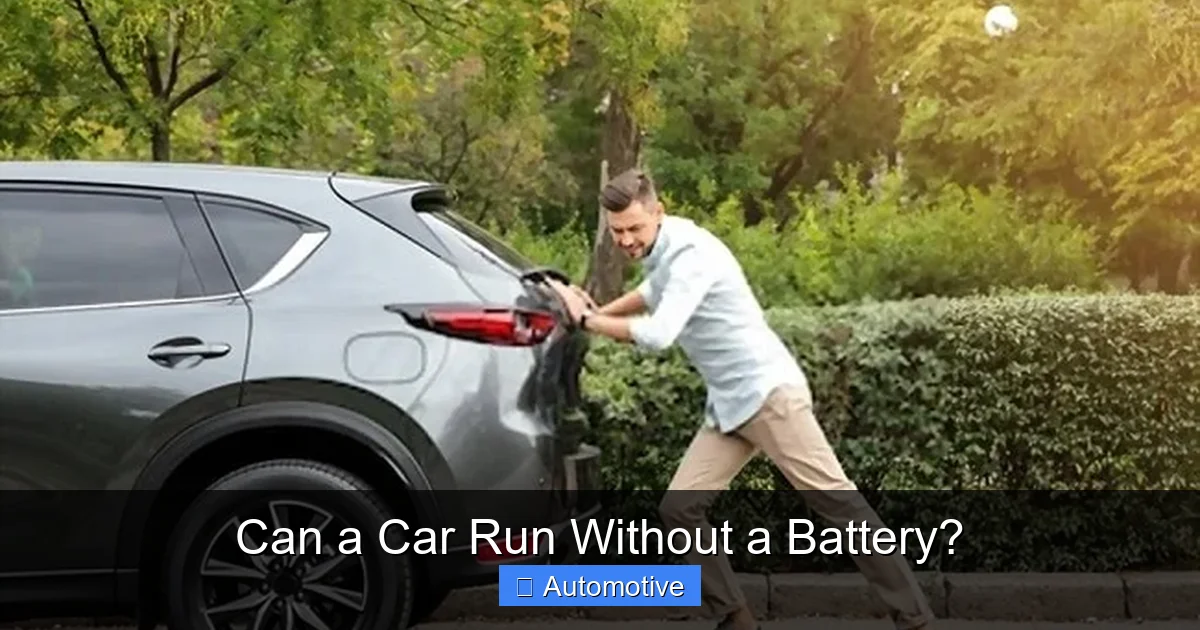
Visual guide about Can a Car Run Without a Battery?
Image source: autoguysland.com
Now, let’s get to the core question: *Can you actually drive a car without a battery?* The answer varies depending on the type of vehicle, its age, and how it’s being used.
Older Manual Transmission Cars: A Rare Possibility
In the past, some mechanics and drivers experimented with running cars without batteries—especially in older, carbureted vehicles with manual transmissions. If the engine was already running, it was sometimes possible to disconnect the battery and keep the car going for a short distance.
Why? These older engines used simple ignition systems (like points and condensers) and didn’t rely on complex electronics. The alternator could generate enough power to keep the spark plugs firing and the fuel pump running—at least for a while. Some drivers even used “bump starts” or push-starts to get the engine going without a battery.
But even in these cases, performance was compromised. Voltage fluctuations could cause misfires, and turning on accessories like headlights or the radio could drain power faster than the alternator could supply it. Eventually, the engine would stall, especially at idle or low RPMs.
Modern Cars: Almost Always a No-Go
Today’s vehicles are a different story. With fuel injection, electronic ignition, advanced driver-assistance systems (ADAS), and countless sensors, modern cars are heavily dependent on stable electrical power. Removing the battery while the engine is running often causes immediate problems.
For example, the engine control unit (ECU) monitors inputs from oxygen sensors, throttle position sensors, and crankshaft position sensors. If the voltage drops or becomes unstable, the ECU may misinterpret signals, leading to poor fuel mixture, misfires, or even a complete shutdown. In some cases, the car might run rough for a few seconds before stalling.
Additionally, safety systems like ABS, airbags, and electronic stability control rely on the battery for power. Disconnecting it could disable these features, creating a dangerous driving situation.
Electric and Hybrid Vehicles: Even More Dependent
Electric vehicles (EVs) and hybrids take battery dependency to another level. While they have large high-voltage battery packs for propulsion, they still use a standard 12V battery to power control modules, lights, infotainment, and safety systems.
In an EV, the 12V battery is essential for waking up the high-voltage system. Without it, you can’t even turn the car on. And if the 12V battery dies while driving, critical systems may shut down, potentially leaving you stranded—even if the main battery has plenty of charge.
What Happens When You Remove the Battery While Driving?
Visual guide about Can a Car Run Without a Battery?
Image source: autoguysland.com
Some curious drivers have tried disconnecting the battery while the engine is running to see what happens. The results are often surprising—and not in a good way.
Immediate Electrical Instability
The moment the battery is disconnected, the alternator becomes the sole source of power. But alternators aren’t designed to handle sudden load changes or provide stable voltage under all conditions. Without the battery’s buffering effect, voltage can spike or drop rapidly.
This instability can cause lights to flicker, the radio to reset, or the instrument cluster to go haywire. In some cases, the ECU may detect a fault and trigger a limp mode or shut down the engine entirely.
Risk of Damaging Electronics
Modern cars contain thousands of dollars’ worth of sensitive electronics. A voltage spike caused by disconnecting the battery can fry control modules, sensors, or even the alternator itself. This is why manufacturers strongly warn against removing the battery while the engine is running.
In fact, some vehicles have protective circuits that prevent the battery from being disconnected under power—but these aren’t foolproof. Even a brief disconnection can cause damage.
Real-Life Example: The “Battery Disconnect Test”
A common myth among car enthusiasts is that you can test an alternator by disconnecting the battery while the engine is running. If the car keeps running, the alternator is working; if it stalls, the alternator is bad.
While this test might have worked on older cars, it’s extremely risky on modern vehicles. Many cars will stall immediately, not because the alternator is faulty, but because the electrical system can’t handle the sudden loss of the battery. Even if the car keeps running, the voltage spike could damage components.
Mechanics now use multimeters and diagnostic tools to test alternators safely—without risking expensive repairs.
Why the Alternator Can’t Replace the Battery
A common misconception is that the alternator can fully replace the battery once the engine is running. After all, it generates electricity, right? So why can’t it power the car on its own?
The Alternator Needs the Battery to Function
Here’s the catch: the alternator itself requires electricity to work. It uses a small amount of current from the battery to energize its rotor (the spinning part inside). This creates a magnetic field, which induces current in the stator (the stationary part), producing electricity.
Without the battery to provide this initial excitation current, the alternator can’t generate power. It’s a bit like trying to start a fire without a spark—the fuel is there, but there’s no ignition.
Limited Output at Low RPMs
Alternators are most efficient at higher engine speeds. At idle or low RPMs, their output drops significantly. This means they may not produce enough power to run all the car’s systems, especially if accessories like headlights, AC, or heated seats are turned on.
The battery fills this gap, providing extra power when demand exceeds the alternator’s output. Without it, the electrical system would struggle to keep up, leading to dim lights, weak spark, and poor performance.
No Power When the Engine Is Off
Finally, the alternator only works when the engine is running. If you turn off the car, it stops generating electricity. That’s why the battery is essential for powering systems when the engine is off—like the alarm, key fob, or interior lights.
In short, the alternator and battery work together as a team. The battery provides the initial power and stability, while the alternator recharges it and assists during operation. Neither can fully replace the other.
Practical Tips: What to Do If Your Battery Dies
Now that we’ve established how important the battery is, let’s talk about what to do if it fails—because it will happen to most drivers at some point.
Jump-Starting: The Quick Fix
The most common solution for a dead battery is jump-starting. This involves connecting your car’s battery to another vehicle’s battery using jumper cables. The good battery provides the power needed to start your engine.
Here’s a quick step-by-step:
- Park the working car close to yours (but not touching).
- Turn off both engines and engage the parking brakes.
- Connect the red (positive) clamp to your dead battery’s positive terminal.
- Connect the other red clamp to the good battery’s positive terminal.
- Connect the black (negative) clamp to the good battery’s negative terminal.
- Attach the final black clamp to an unpainted metal surface on your car (like a bolt or bracket)—not the dead battery’s negative terminal.
- Start the working car and let it run for a few minutes.
- Try starting your car. If it starts, leave it running to recharge the battery.
- Disconnect the cables in reverse order.
Always follow safety precautions: wear gloves, avoid sparks near the battery, and never let the clamps touch each other.
Using a Portable Jump Starter
A portable jump starter is a battery-powered device that can jump-start your car without another vehicle. These are great for emergencies, especially if you’re alone or in a remote area.
Simply connect the clamps to your battery (positive to positive, negative to negative), turn on the device, and start your car. Many models also include USB ports for charging phones and built-in flashlights.
When to Replace the Battery
Car batteries typically last 3–5 years, depending on climate, driving habits, and maintenance. Signs of a failing battery include:
- Slow engine crank (takes longer to start)
- Dim headlights or interior lights
- Electrical issues (radio resetting, power windows slow)
- Check engine or battery warning light
- Swollen or leaking battery case
If you notice these signs, have your battery tested at an auto parts store or by a mechanic. Most offer free testing and can recommend a replacement if needed.
Preventing Battery Failure
To extend your battery’s life:
- Avoid short trips that don’t allow the alternator to fully recharge the battery.
- Turn off lights, AC, and infotainment when the engine is off.
- Use a battery maintainer if the car sits unused for long periods.
- Keep terminals clean and tight to ensure good connections.
- Park in a garage during extreme cold or heat, which can degrade batteries faster.
The Bottom Line: Why You Should Never Drive Without a Battery
So, can a car run without a battery? In very specific, outdated scenarios—maybe. But for the vast majority of drivers, the answer is a clear no. The battery is not just a starter motor helper; it’s a critical component that ensures stability, reliability, and safety.
From powering the ECU to buffering electrical loads, the battery plays a role in nearly every aspect of modern vehicle operation. Removing it—even while the engine is running—can lead to stalling, electronic damage, or complete system failure.
And with the rise of electric and hybrid vehicles, battery dependency is only increasing. These cars rely on complex software and high-tech systems that demand consistent, clean power—something only a healthy battery can provide.
So the next time you think about disconnecting your battery to save weight or test the alternator, think again. The risks far outweigh any perceived benefits. Instead, focus on maintaining your battery, recognizing early signs of failure, and being prepared with a jump starter or roadside assistance plan.
Your car—and your safety—depend on it.
Frequently Asked Questions
Can a car run without a battery if the alternator is working?
No, not reliably. While the alternator generates electricity, it needs the battery to stabilize voltage and provide initial power. Most modern cars will stall or experience electrical issues without a battery, even if the alternator is functioning.
What happens if you disconnect the battery while driving?
Disconnecting the battery while the engine is running can cause voltage spikes, flickering lights, system resets, or engine stalling. It may also damage sensitive electronics like the ECU or sensors.
Can you push-start a car without a battery?
Only in older manual-transmission vehicles with simple ignition systems. Modern cars with fuel injection and electronic controls usually won’t start or run properly without a battery, even with a push-start.
Do electric cars need a 12V battery?
Yes. Electric vehicles use a 12V battery to power control systems, lights, infotainment, and safety features. Without it, the high-voltage system can’t be activated, and the car won’t start.
How long can a car run without a battery?
In rare cases, older manual cars might idle for a few minutes without a battery, but performance degrades quickly. Most modern cars will stall within seconds or minutes due to electrical instability.
Is it safe to drive with a weak battery?
Not recommended. A weak battery can cause starting problems, electrical failures, and leave you stranded. It’s best to test and replace it before it fails completely.