Are Mazda Rx-7 Cars Legal in the Us?

Contents
- 1 Key Takeaways
- 2 📑 Table of Contents
- 3 Understanding the Federal Gateway: EPA, DOT, and the 25-Year Rule
- 4 EPA and DOT Compliance Documentation: Your Paper Trail
- 5 State-Specific Regulations: Where the Real Battle Begins
- 6 Rotary-Specific Considerations: Beyond Paperwork
- 7 Practical Steps for the Prospective Buyer in 2026
- 8 Conclusion: The Dream is Attainable, But Knowledge is Power
- 9 Frequently Asked Questions


In 2026, Mazda RX-7 cars are legal in the US if they meet specific federal and state criteria. The key is the 25-year import rule, which generally exempts vehicles 25 years or older from federal safety and emissions standards. However, states like California have stricter emissions laws that can still prohibit registration. Always verify a specific vehicle’s EPA and DOT compliance before purchasing to ensure it’s legally drivable on US roads.
So, you’ve fallen in love with the sleek lines, the high-revving symphony, and the legendary status of the Mazda RX-7. That iconic FD3S with its pop-up headlights and balanced chassis is a dream for many car enthusiasts. But then reality hits: can you actually drive that beautiful Japanese Domestic Market (JDM) machine on American soil? The question “Are Mazda RX-7 cars legal in the US?” doesn’t have a simple yes or no answer. It’s a puzzle wrapped in federal regulations, state laws, and the unique quirks of the rotary engine. In 2026, the landscape is clearer than it was a decade ago, but still fraught with pitfalls for the unwary buyer. Let’s break it down, piece by piece.
Key Takeaways
- The 25-year rule is the primary federal gateway: Vehicles at least 25 years old can be imported and registered, regardless of original US certification, provided they meet the age threshold in the year of import.
- EPA and DOT compliance paperwork is mandatory: Even exempt vehicles must have documented proof of compliance with original US emissions (EPA) and safety (DOT) standards, or they must be modified to meet them, which is rare and costly.
- State laws override federal exemptions: States with strict emissions programs, like California, can refuse registration for vehicles that don’t meet their specific standards, even if federally exempt.
- Rotary engines present unique emissions challenges: The RX-7’s 13B rotary engine often struggles to pass modern smog tests due to its design and the unavailability of original catalytic converters for many model years.
- Model year matters immensely: FD3S models (1992-2002) from 1995 and earlier are generally easier to import under the 25-year rule, while later models (1996-2002) face more hurdles until they age into exemption.
- Documentation is everything: A clean title, original Japanese market paperwork (or lack thereof indicating US model), and a verified vehicle identification number (VIN) are critical to proving a car’s legal status.
📑 Table of Contents
- Understanding the Federal Gateway: EPA, DOT, and the 25-Year Rule
- EPA and DOT Compliance Documentation: Your Paper Trail
- State-Specific Regulations: Where the Real Battle Begins
- Rotary-Specific Considerations: Beyond Paperwork
- Practical Steps for the Prospective Buyer in 2026
- Conclusion: The Dream is Attainable, But Knowledge is Power
Understanding the Federal Gateway: EPA, DOT, and the 25-Year Rule
To grasp RX-7 legality, you must first understand the two main federal agencies that govern vehicle imports: the Environmental Protection Agency (EPA) and the Department of Transportation (DOT). Their rules are the first gatekeepers. For a vehicle to be legally imported and titled in the US, it must either be originally certified for the US market or meet current federal safety and emissions standards. Most JDM RX-7s were never built for the US, so they fail the first criterion. This is where the famous 25-year import rule comes into play.
What Exactly is the 25-Year Rule?
This regulation, administered by the DOT, states that any motor vehicle that is at least 25 years old from the date of its original manufacture is exempt from federal motor vehicle safety standards (FMVSS). Similarly, the EPA has a corresponding policy exempting such vehicles from its emissions standards. In simple terms, if a car is 25 years old or older, the federal government says, “We won’t make you change its headlights, bumpers, or exhaust to meet modern rules.” For the Mazda RX-7, this means:
- For 2026: Any RX-7 manufactured in 2001 or earlier is federally exempt from DOT and EPA compliance requirements upon import.
- For a 1995 RX-7: It turned 25 in 2020 and has been legally importable under the exemption since then.
- For a 1998 RX-7: It won’t turn 25 until 2023, meaning in 2026 it is 29 years old and fully exempt. Wait, that’s not right. Let me correct: A 1998 model year car turns 25 in 2023. So in 2026, a 1998 model is 28 years old—well over 25. The key cutoff for 2026 is the 2001 model year. Any 2001 or older RX-7 is exempt. A 2002 model (the final RX-7 year) will not turn 25 until 2027, so it remains subject to federal standards in 2026.
This is crucial. The “25-year” clock starts from the model year, not the calendar year of sale. A 1995 model year car built in late 1994 is still a 1995 model. You must verify the exact model year from the vehicle’s VIN and Japanese registration documents.
The Importance of “Compliance” vs. “Exemption”
Here’s where people get confused. An RX-7 being “federally exempt” does not mean it automatically slides through customs with no questions. You must still file the proper paperwork (EPA Form 3520-1 and DOT HS-7) and prove the vehicle’s age and identity. Customs and Border Protection (CBP) will want to see the original Japanese title (or a certified translation), the export certificate, and evidence the car is indeed 25 years old. If you cannot prove it, it may be held or seized. Furthermore, the exemption only applies to federal standards. It does not guarantee your state will let you register it for road use. That’s the next hurdle.
EPA and DOT Compliance Documentation: Your Paper Trail
Even with the 25-year exemption, you need to present the correct forms. The process is bureaucratic but straightforward if you have the documents. The main forms are:

Visual guide about Are Mazda Rx-7 Cars Legal in the Us?
Image source: wallup.net
- EPA Form 3520-1: This declares the vehicle’s emissions status. For an exempt vehicle, you check the box for “vehicle over 21 years old” (the EPA’s rule is 21 years, but they defer to the DOT’s 25 for the exemption) and provide the model year, VIN, and engine details.
- DOT HS-7 Form: This declares the vehicle’s safety compliance. For an exempt vehicle, you check box “G” for “vehicle over 25 years old.”
These forms must be submitted to CBP at the port of entry before the vehicle is released. An experienced customs broker or importer will handle this, but you should understand what’s being filed. The critical supporting document is the original Japanese title (Shaken) and a certified English translation. The title must clearly show the vehicle’s first registration date in Japan, which establishes its age. Some older titles might only have a “shaken” (inspection) date, which is less definitive. In such cases, additional proof like the original sales invoice or factory build sheet becomes vital.
What About “Grey Market” Imports and Show & Display?
Before the 25-year rule solidified, a “grey market” existed for importing non-compliant cars under special provisions. This is largely closed now. Another route is the “Show or Display” exemption from the DOT for vehicles of “historic or technological significance.” This is incredibly rare, expensive, and requires proving the car is not capable of safe highway operation in its original form (which an RX-7 is). It also limits annual mileage to 2,500. For 99% of enthusiasts, the 25-year rule is the only viable path. If you see an RX-7 advertised as “Show or Display,” treat it with extreme skepticism and demand to see the official DOT exemption letter.
State-Specific Regulations: Where the Real Battle Begins
This is where many buyers are blindsided. You can clear federal customs with your exempt RX-7, but when you take the title to your local DMV, they may refuse to register it. Why? Because states have their own laws, particularly concerning emissions testing and safety inspections. The most notorious is California.

Visual guide about Are Mazda Rx-7 Cars Legal in the Us?
Image source: wallup.net
The California Conundrum
California’s Air Resources Board (CARB) has its own, stricter emissions standards. Even if a car is federally exempt, California will not register it unless it meets CARB requirements or is explicitly exempt by age. California’s exemption age is also 25 years (model year), but with a catch: the vehicle must be originally manufactured to meet US EPA standards or have a CARB Executive Order number proving its equipment meets their rules. A pure JDM RX-7, built for the Japanese market with different emission controls, does not have this. Therefore, in 2026, California will not register a JDM RX-7, even if it’s a 1995 model. The only RX-7s legal in California are the ones originally sold there (1993-1995 US-spec FD3S) or those that have been retrofitted with a full, CARB-compliant exhaust and emissions system—a nearly impossible and astronomically expensive task for a rotary.
States following California’s standards (often called “CARB states”) include New York, Vermont, Maine, Massachusetts, Rhode Island, Connecticut, New Jersey, Pennsylvania, Oregon, Washington, and others. In these states, the California rule typically applies. You must check your specific state’s DMV website for “non-resident” or “imported vehicle” regulations.
Emissions Testing: The Rotary Hurdle
Even in states with basic emissions tests (like many in the Midwest or South), the RX-7’s rotary engine can be problematic. The test measures tailpipe pollutants. A healthy, well-tuned rotary with a functioning catalytic converter can sometimes pass. But here’s the issue: the original Japanese-market catalytic converters on RX-7s are often over 25 years old, clogged, or inefficient by modern standards. Replacing them with a direct OEM equivalent is impossible because they were never sold new in the US. Aftermarket “catalytic converters” for the RX-7 are often not designed to pass the stringent test cycles, especially on OBD-II equipped models (1996+). For a 1996-2002 RX-7, even though it may be federally exempt in 2026, it will have an OBD-II system. Some states will plug into the OBD port and if the car reports any emissions-related fault codes, it fails automatically. A rotary-specific issue can trigger these codes, leading to a fail. This is a major reason why later-model RX-7s (1996-2002) are so much harder to register anywhere, even after they turn 25.
Rotary-Specific Considerations: Beyond Paperwork
Legality isn’t just about forms and model years. The very nature of the 13B engine affects your ability to keep the car legal and on the road.
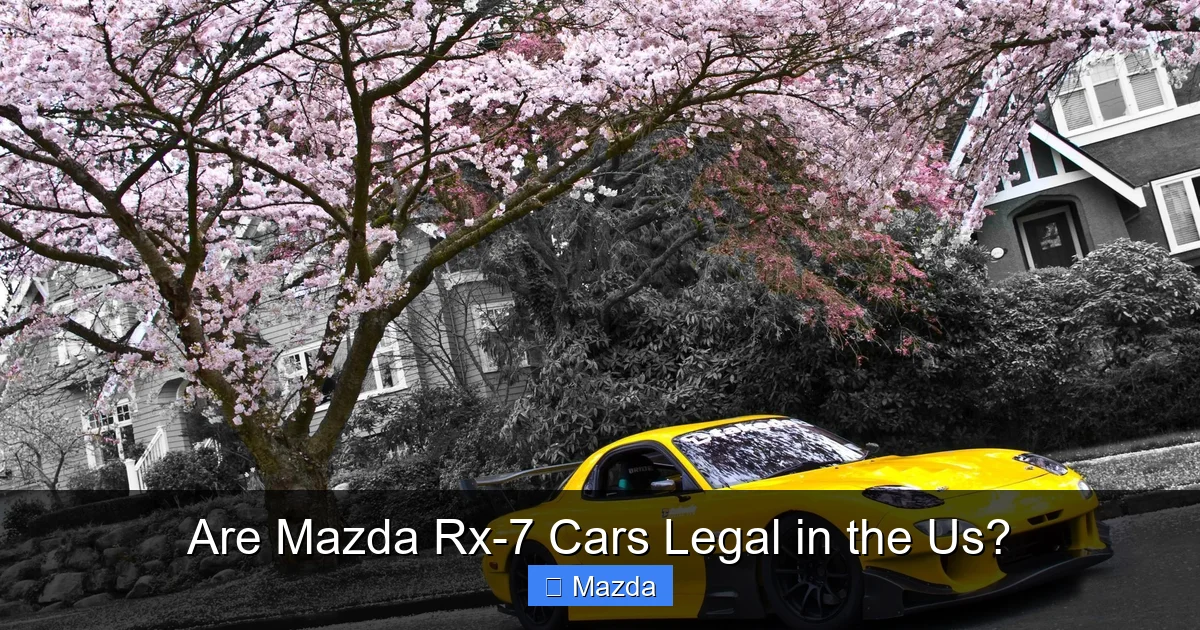
Visual guide about Are Mazda Rx-7 Cars Legal in the Us?
Image source: wallpapercave.com
Apex Seal Longevity and Emissions
We all know the rotary’s Achilles’ heel: apex seal wear, leading to compression loss and poor combustion. A rotary with worn seals will definitely fail an emissions test due to unburned hydrocarbons. Maintaining a healthy engine is not just a performance issue; it’s a legal one. You’ll need to budget for regular, meticulous maintenance, including frequent oil changes (using the correct oil), spark plug checks, and potentially a rebuild every 100,000 miles. A poorly running RX-7 is an illegal RX-7 in any state with emissions testing.
Parts Availability for US Compliance
If you own a US-spec RX-7 (1993-1995), finding emissions-related parts like oxygen sensors, catalytic converters, and EVAP system components is challenging but possible through specialty suppliers. For a JDM model, you’re hunting for Japanese-market parts that may not have direct US equivalents. This can make passing a state inspection, which may check for the presence of all original equipment, very difficult. An inspector might look for a catalytic converter and see a pipe where one should be, leading to a fail even if the tailpipe numbers are clean.
Practical Steps for the Prospective Buyer in 2026
So you’ve found a dream RX-7 for sale. How do you ensure it’s legal? Follow this checklist.
1. Verify the Exact Model Year and Origin
Get the full VIN. For an RX-7, the 10th digit is the model year code. You can decode this online or through services like CarFAX (if it has a history). More importantly, get the original Japanese title (or a certified translation). The “first registration date” or “date of first issuance” is what matters for the 25-year clock. A car manufactured in late 1991 could be a 1992 model year. If it’s a 1992 model, it turned 25 in 2017. If it’s a 1993 model, it turned 25 in 2018. Don’t rely on the seller’s word.
2. Understand the State You’ll Register In
Before you buy, research your state’s DMV policies on “25-year exemption” vehicles. Call them if necessary. Ask specifically about “emissions testing requirements for vehicles over 25 years old.” If you live in California or a CARB state, you must accept that a JDM RX-7 is almost certainly not legal to register. Your only legal options there are a US-spec FD (1993-1995) or, in very rare cases, a Canadian-market FD (which had slightly different specs but was US-compliant). If you’re in a non-emissions-test state (like many in the Midwest or rural areas), your path is much clearer.
3. Work with Reputable Importers
Do not try to navigate Japanese auctions, export, and US customs alone. Use a well-reviewed importer who specializes in JDM cars. They handle the bidding, shipping, export paperwork, and US customs clearance. They will ensure the EPA and DOT forms are filed correctly. A good importer will also warn you if a specific car has red flags, like a VIN that doesn’t match the title or evidence of major alterations. They are your first line of defense against a scam or a non-compliant vehicle. For example, when importing, they can advise on whether the car’s VIN indicates it was a US model (which would have different compliance requirements) or a true JDM model.
4. Pre-Purchase Inspection (PPI) by a Specialist
Never buy an RX-7 sight unseen. Pay for a pre-purchase inspection by a mechanic who knows rotaries inside and out. Have them check compression on all three rotors (this is the most important test), look for signs of overheating, check the condition of the catalytic converter, and verify all emissions-related components are present. A PPI will tell you if the engine is healthy enough to potentially pass a smog test. It will also reveal any hidden accidents or flood damage that could affect title clarity.
5. Budget for the Full Cost
The purchase price is just the start. Factor in:
- Importer fees (typically $1,000 – $2,500+).
- Shipping from Japan ($1,200 – $2,500).
- Port fees, customs brokerage, and marine insurance.
- Any necessary repairs to pass state inspection (tires, brakes, lights).
- State registration fees and taxes.
- Specialist rotary maintenance immediately after arrival.
It’s easy to spend $10,000-$15,000 on top of the car’s purchase price.
Conclusion: The Dream is Attainable, But Knowledge is Power
So, are Mazda RX-7 cars legal in the US in 2026? The answer is a qualified yes, but with massive asterisks. For the vast majority of enthusiasts, the path to legal ownership is clear: find a JDM-spec RX-7 with a model year of 2001 or older, ensure you have flawless Japanese title documentation, and plan to register it in a state without strict emissions testing (and certainly not in California). The 25-year rule is your friend, but it is not a magic wand. State laws, the rotary engine’s nature, and the absolute necessity of proper paperwork mean you must be your own advocate.
The allure of the RX-7 is timeless. Its 9000 RPM redline, perfect 50/50 weight distribution, and gorgeous design make it a legend. But that legend comes with complexity. Arm yourself with information, partner with experts, and never skip the due diligence. A legally imported, compliant, and well-maintained RX-7 is one of the most rewarding driving experiences on four wheels. A poorly researched purchase can lead to a garage queen that can never see the road, or worse, a seized asset by US Customs. Do it right, and you can join the ranks of rotary pioneers on American soil. The journey is part of the reward.
Frequently Asked Questions
Are all Mazda RX-7s from Japan illegal in the US?
No. RX-7s manufactured in 2001 or earlier are generally federally exempt from safety and emissions standards under the 25-year rule. However, state laws, especially in California, can still prohibit their registration if they don’t meet local emissions requirements.
Can I modify a non-compliant RX-7 to make it legal?
Federal compliance for non-exempt vehicles (like a 2002 model before 2027) requires extremely expensive and complex modifications to meet EPA and DOT standards, which is practically impossible for a private individual. For exempt vehicles, state-level modifications to pass emissions (like adding a catalytic converter) are sometimes possible but often fail due to the rotary engine’s unique characteristics and lack of approved parts.
Is insurance for an imported RX-7 difficult or expensive?
It can be. Not all insurers cover imported or grey market vehicles. You’ll need to shop with specialty insurers who understand JDM cars. Premiums are often higher due to the car’s performance, repair costs, and parts scarcity. Agreed value policies are highly recommended.
What is the biggest mistake people make when buying an RX-7 for the US?
Buying based on price or appearance without verifying the exact model year from the VIN and original Japanese title, and without confirming their state’s registration rules. Assuming a 1995 model is legal everywhere is a common and costly error, especially in CARB states like California.
Are rotary engines harder to pass emissions tests than piston engines?
Yes, often. Their combustion process and high exhaust gas temperatures can challenge certain testing equipment. More critically, the unavailability of CARB-compliant or even EPA-compliant catalytic converters for many JDM model years makes it nearly impossible to meet the most stringent state standards, even on a well-tuned engine.
Where is the safest place to buy a legal RX-7 in 2026?
The safest sources are reputable JDM importers with decades of experience, not random online sellers. They handle the compliance paperwork and can advise on state legality. Additionally, purchasing a US-spec RX-7 (1993-1995) that was originally sold in North America from a trusted domestic dealer is the simplest path, as it already meets all federal and (most) state standards.