
Are Kia Souls Safe?

The Kia Soul is generally considered a safe vehicle, earning strong safety ratings from major organizations like the IIHS and NHTSA. With standard advanced driver assistance systems and a solid build, it offers reliable protection for daily drivers and families alike.
Key Takeaways
- Top Safety Ratings: The Kia Soul has earned “Top Safety Pick” or “Top Safety Pick+” honors from the IIHS in recent model years, reflecting strong crashworthiness.
- Advanced Safety Features: Newer models come standard with forward collision warning, automatic emergency braking, lane departure warning, and more.
- Strong Structural Design: The Soul’s high-strength steel frame and strategic crumple zones help absorb impact energy during collisions.
- Good Visibility and Handling: Its boxy design provides excellent outward visibility, reducing blind spots and improving driver awareness.
- Reliable Airbag System: Includes front, side, and curtain airbags to protect occupants in various crash scenarios.
- Real-World Performance: Owners report confidence in the Soul’s stability and responsiveness, especially in urban and suburban driving.
- Regular Updates: Kia continuously improves safety tech with each model year, keeping the Soul competitive in its class.
📑 Table of Contents
- Are Kia Souls Safe? A Comprehensive Look at Safety Ratings and Features
- Crash Test Ratings: What the Experts Say
- Advanced Safety Technology in the Kia Soul
- Structural Integrity and Crashworthiness
- Real-World Safety: Owner Experiences and Reliability
- Driving Dynamics and Safety
- Comparing the Kia Soul to Competitors
- Tips for Maximizing Safety in Your Kia Soul
- Conclusion: Is the Kia Soul a Safe Choice?
Are Kia Souls Safe? A Comprehensive Look at Safety Ratings and Features
When it comes to choosing a car, safety is often one of the top concerns—especially if you’re driving with family, commuting daily, or navigating busy city streets. The Kia Soul, with its quirky design and practical interior, has been a popular choice among compact SUV buyers for over a decade. But beyond its fun exterior and spacious cabin, many potential buyers wonder: Are Kia Souls safe?
The short answer? Yes—especially in recent model years. The Kia Soul has consistently performed well in safety evaluations conducted by respected organizations like the Insurance Institute for Highway Safety (IIHS) and the National Highway Traffic Safety Administration (NHTSA). From crash test results to advanced driver assistance systems, the Soul has evolved into a well-rounded vehicle that prioritizes occupant protection.
But safety isn’t just about crash test scores. It’s also about how a car behaves on the road, how well it helps you avoid accidents in the first place, and how it protects you when things go wrong. In this article, we’ll dive deep into the safety credentials of the Kia Soul, breaking down everything from structural design to real-world performance. Whether you’re considering a new or used Soul, this guide will help you understand what makes this compact crossover a safe choice.
Crash Test Ratings: What the Experts Say

Visual guide about Are Kia Souls Safe?
Image source: autozonic.com
One of the most reliable ways to assess a vehicle’s safety is by reviewing its performance in standardized crash tests. These tests simulate real-world collision scenarios and evaluate how well a car protects its occupants. The two most trusted sources for this data in the U.S. are the IIHS and the NHTSA.
IIHS Ratings: Top Safety Pick Honors
In recent years, the Kia Soul has earned impressive recognition from the IIHS. For the 2023 and 2024 model years, the Soul was named a Top Safety Pick—and in some configurations, even a Top Safety Pick+, which is the highest honor awarded by the organization.
To earn this title, a vehicle must achieve “Good” ratings (the highest possible) in all six IIHS crashworthiness tests:
– Driver-side small overlap front
– Passenger-side small overlap front
– Moderate overlap front
– Side impact
– Roof strength
– Head restraints and seats
The 2023 Kia Soul scored “Good” in all these categories. Notably, it performed exceptionally well in the passenger-side small overlap test—a challenging scenario that mimics hitting a tree or pole on the right side of the vehicle. This is a significant improvement over earlier models and reflects Kia’s commitment to symmetrical safety design.
Additionally, the IIHS evaluates front crash prevention systems. The Soul equipped with Kia’s Forward Collision-Avoidance Assist (FCA) received a “Superior” rating for its ability to detect pedestrians and vehicles and apply the brakes automatically when a collision is imminent.
NHTSA 5-Star Safety Rating
The National Highway Traffic Safety Administration (NHTSA) uses a simpler 5-star rating system, where 5 stars indicate the highest level of safety. The 2023 Kia Soul earned an overall 5-star rating, with 5 stars in frontal crash, side crash, and rollover protection.
One standout feature in the NHTSA evaluation was the Soul’s performance in side barrier and side pole tests—both critical for urban driving where side impacts are more common. The vehicle’s side airbags and reinforced door beams contributed to its strong showing.
It’s worth noting that older models (pre-2017) didn’t perform as well, particularly in small overlap tests. If you’re shopping for a used Soul, aim for a 2019 or newer model to ensure you’re getting the latest safety improvements.
Advanced Safety Technology in the Kia Soul

Visual guide about Are Kia Souls Safe?
Image source: i.pinimg.com
Modern safety isn’t just about surviving a crash—it’s about avoiding one altogether. That’s where advanced driver assistance systems (ADAS) come in. The Kia Soul has made significant strides in this area, especially since the 2020 model year.
Standard Driver Assistance Features
Starting with the 2020 redesign, Kia made a bold move: equipping every Soul trim with a suite of standard safety technologies. This means even the base LX model comes with features that were once reserved for luxury vehicles.
Key standard features include:
– **Forward Collision-Avoidance Assist (FCA):** Uses radar and camera sensors to detect vehicles, pedestrians, and cyclists in front of the car. If a collision is likely, the system first warns the driver with visual and audible alerts. If the driver doesn’t respond, it automatically applies the brakes.
– **Lane Departure Warning (LDW) and Lane Keeping Assist (LKA):** These systems monitor lane markings and gently steer the car back into its lane if it begins to drift unintentionally.
– **Driver Attention Warning (DAW):** Tracks driving patterns and alerts the driver if it detects signs of fatigue or inattention.
– **Blind-Spot Collision Warning (BCW):** Alerts the driver when a vehicle is in the blind spot, especially useful during lane changes.
– **Rear Cross-Traffic Collision Warning (RCCW):** Helps when backing out of parking spots by detecting approaching vehicles from the side.
These features work together to create a safety net that supports the driver in everyday situations—whether you’re merging onto a highway, parking in a tight spot, or driving late at night.
Optional Upgrades for Enhanced Protection
While the base safety suite is impressive, higher trims like the EX and GT-Line offer even more advanced options:
– **Smart Cruise Control (SCC):** Maintains a set speed and distance from the vehicle ahead, even in stop-and-go traffic.
– **High Beam Assist:** Automatically switches between high and low beams based on oncoming traffic.
– **Safe Exit Assist:** Warns passengers if it detects an approaching vehicle or cyclist when opening doors.
These upgrades make long drives more comfortable and reduce driver workload, which indirectly improves safety by minimizing distractions.
How These Features Perform in Real Life
Many Kia Soul owners report that the safety systems are intuitive and effective. For example, the forward collision warning has helped prevent rear-end collisions in heavy traffic, while lane keeping assist provides gentle corrections on winding roads.
One owner shared: “I was driving on a rainy night when a car suddenly braked in front of me. The Soul’s automatic emergency braking kicked in before I even hit the pedal. It probably saved me from a fender bender.”
Of course, no system is perfect. Some drivers note that the lane departure warning can be overly sensitive on poorly marked rural roads. But overall, the technology adds a valuable layer of protection.
Structural Integrity and Crashworthiness
Visual guide about Are Kia Souls Safe?
Image source: allstardrivereducation.com
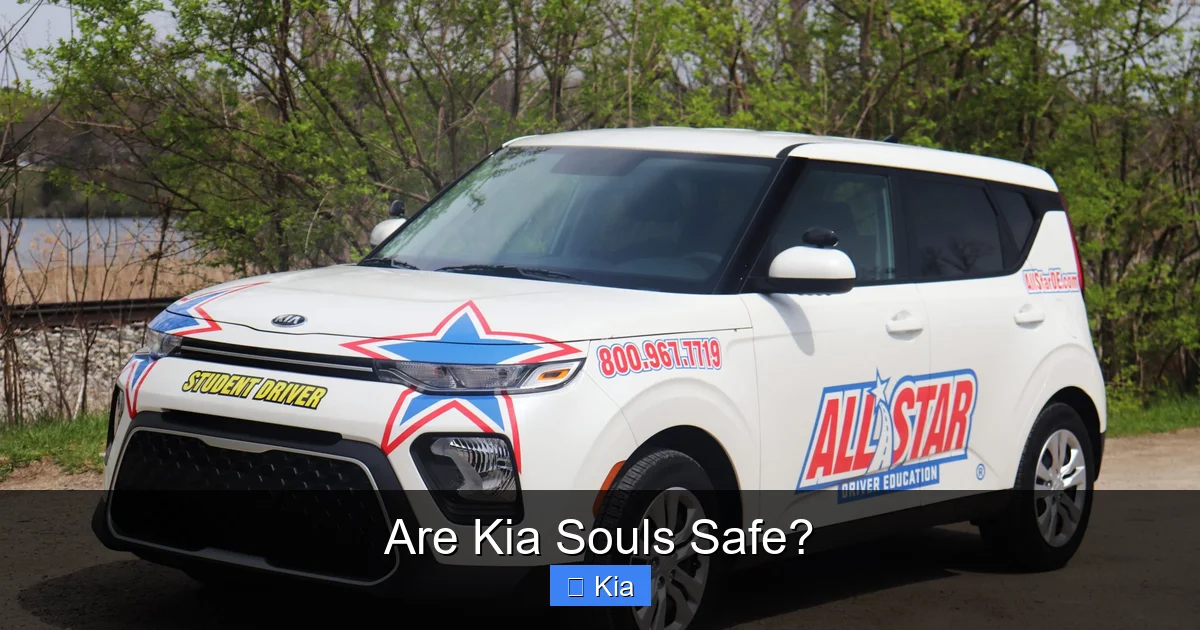
Beyond technology, a vehicle’s physical design plays a crucial role in safety. The Kia Soul’s body structure is engineered to absorb and redirect crash energy away from the passenger compartment.
High-Strength Steel and Strategic Design
The 2020 and newer Kia Souls feature an upgraded platform with a higher percentage of advanced high-strength steel (AHSS). This material is lighter yet stronger than traditional steel, improving both fuel efficiency and crash performance.
Key structural elements include:
– **Front and rear crumple zones:** Designed to deform in a controlled manner during impact, absorbing energy before it reaches the cabin.
– **Reinforced roof pillars:** Help maintain cabin integrity in rollover scenarios.
– **Side impact protection beams:** Located in the doors to shield occupants during side collisions.
The Soul’s boxy shape, often seen as a styling choice, actually contributes to safety. The upright design provides more vertical space for airbag deployment and better visibility, reducing the chance of accidents caused by blind spots.
Airbag System: Comprehensive Coverage
The Kia Soul comes equipped with a full suite of airbags:
– Dual front airbags
– Front seat-mounted side airbags
– Side curtain airbags for front and rear passengers
These airbags deploy based on crash severity and occupant position, helping to reduce the risk of head and chest injuries. The side curtain airbags, in particular, are designed to stay inflated longer to protect against multiple impacts or rollovers.
Rollover Protection
While the Soul isn’t a tall SUV, its relatively high center of gravity means rollover risk is a consideration. However, Kia has addressed this with:
– Electronic Stability Control (ESC): Standard on all models, ESC helps maintain vehicle control during sudden maneuvers.
– Rollover sensors: Trigger side curtain airbags if a rollover is detected.
In NHTSA rollover tests, the Soul earned a 5-star rating, indicating a low risk of rollover and strong protection if one occurs.
Real-World Safety: Owner Experiences and Reliability
Crash test ratings and tech specs are important, but how does the Kia Soul perform in everyday driving? Let’s look at real-world feedback from owners and reliability data.
Owner Satisfaction and Safety Perception
Surveys from sources like J.D. Power and Consumer Reports show that Kia Soul owners are generally satisfied with the vehicle’s safety. In the 2023 J.D. Power U.S. Vehicle Dependability Study, Kia ranked above the industry average, and the Soul was noted for its reliability.
Many owners appreciate the car’s visibility and handling. “I love how high up I sit in the Soul,” says one owner. “I can see over most cars, which helps me anticipate traffic changes.”
The compact size also makes it easy to maneuver in tight spaces, reducing the likelihood of low-speed collisions in parking lots or city streets.
Common Safety Concerns and Recalls
No vehicle is without flaws, and the Kia Soul has had a few recalls over the years. However, most are minor and quickly addressed by dealerships.
Notable recalls include:
– **2021 Recall (NHTSA Campaign #21V-567):** A software issue in the brake system could cause unintended braking. Kia issued a free software update to fix it.
– **2019 Recall (NHTSA Campaign #19V-432):** Potential fuel pump failure that could lead to engine stalling. Affected vehicles received a replacement fuel pump.
These recalls were proactive and covered under warranty, so owners weren’t left with out-of-pocket costs. Kia’s responsive approach helps maintain trust in the brand’s safety commitment.
Insurance and Repair Costs
Insurance companies often consider safety ratings when setting premiums. The Kia Soul typically falls into the mid-range for insurance costs—neither the cheapest nor the most expensive to insure. Its good safety record helps keep rates reasonable.
Repair costs after a collision are also moderate. Parts are widely available, and the vehicle’s design allows for relatively straightforward repairs, which can reduce downtime after an accident.
Driving Dynamics and Safety
Safety isn’t just about passive protection—it’s also about how a car handles in everyday driving conditions.
Visibility and Maneuverability
The Kia Soul’s tall, upright design gives drivers a commanding view of the road. Large windows and slim roof pillars minimize blind spots, which is especially helpful when changing lanes or reversing.
The short front and rear overhangs make parking easy, even in tight urban spaces. This reduces the risk of minor scrapes and bumps that can lead to costly repairs.
Suspension and Stability
The Soul’s suspension is tuned for comfort, but it also provides enough feedback to keep the car stable during emergency maneuvers. While it’s not a sports car, it handles curves and sudden lane changes confidently.
Electronic Stability Control (ESC) is standard and helps prevent skidding or loss of control, particularly in wet or icy conditions.
Brake Performance
The Soul comes with anti-lock brakes (ABS) and brake assist. In emergency braking tests, the car stops within a reasonable distance for its class. The inclusion of automatic emergency braking further enhances stopping power when needed.
Comparing the Kia Soul to Competitors
To truly understand the Soul’s safety, it helps to compare it to similar vehicles in the compact SUV segment.
Kia Soul vs. Honda HR-V
Both are boxy, practical crossovers. The 2023 Honda HR-V also earned a Top Safety Pick from the IIHS, but it lacks standard automatic emergency braking on lower trims. The Soul offers more standard safety tech across all trims.
Kia Soul vs. Nissan Kicks
The Nissan Kicks is another affordable option, but it has a lower roof strength rating and doesn’t offer lane keeping assist on base models. The Soul’s stronger structure and more comprehensive safety suite give it an edge.
Kia Soul vs. Hyundai Kona
As a sibling brand, Hyundai shares many platforms with Kia. The Kona is similarly safe, but the Soul offers more interior space and better visibility, which can contribute to safer driving.
Overall, the Kia Soul holds its own—and often outperforms—its rivals in safety.
Tips for Maximizing Safety in Your Kia Soul
Even the safest car needs a responsible driver. Here are some tips to get the most out of your Soul’s safety features:
– **Keep safety systems clean:** Dirt or snow on cameras and sensors can reduce their effectiveness. Regularly clean the front grille, windshield, and rear camera.
– **Stay updated on recalls:** Register your vehicle with Kia and check NHTSA’s website periodically for any new safety campaigns.
– **Adjust settings to your preference:** Customize alerts and sensitivity levels in the infotainment system to reduce annoyance without sacrificing protection.
– **Practice defensive driving:** Use the Soul’s visibility to your advantage—scan ahead, check mirrors frequently, and maintain a safe following distance.
– **Maintain your vehicle:** Regular brake, tire, and suspension checks ensure your car performs as designed in an emergency.
Conclusion: Is the Kia Soul a Safe Choice?
So, are Kia Souls safe? The evidence says yes—especially if you choose a 2020 or newer model. With top safety ratings, a robust suite of standard driver assistance features, and a well-engineered structure, the Soul offers peace of mind for daily driving.
It may not have the luxury badge of a Lexus or the rugged reputation of a Subaru, but in terms of value and safety, the Kia Soul punches above its weight. Whether you’re a first-time buyer, a parent, or someone who just wants a reliable, safe car for city commutes, the Soul is a smart choice.
Safety is a combination of technology, design, and driver behavior. The Kia Soul delivers on the first two, and with mindful driving, it can be a very safe vehicle for years to come.
Frequently Asked Questions
Are Kia Souls safe in a crash?
Yes, the Kia Soul has earned top safety ratings from the IIHS and NHTSA, with “Good” or 5-star scores in all major crash tests. Its strong structure and comprehensive airbag system help protect occupants in various collision scenarios.
Does the Kia Soul have automatic emergency braking?
Yes, starting with the 2020 model year, all Kia Souls come standard with Forward Collision-Avoidance Assist, which includes automatic emergency braking for vehicles, pedestrians, and cyclists.
What safety features come standard on the Kia Soul?
Standard features include forward collision warning, lane departure warning, driver attention warning, blind-spot monitoring, and rear cross-traffic alert. Higher trims add adaptive cruise control and high beam assist.
Is the Kia Soul safe for teenagers?
Yes, the Soul’s strong crash ratings, standard safety tech, and good visibility make it a safe choice for new drivers. Its compact size also helps with parking and maneuvering.
Has the Kia Soul had any major safety recalls?
The Soul has had a few recalls, mostly for software or component issues, but they were addressed promptly by Kia. No major structural or safety-critical defects have been reported.
How does the Kia Soul compare to other small SUVs in safety?
The Kia Soul often outperforms competitors like the Nissan Kicks and Hyundai Kona in standard safety features and crash test ratings, making it one of the safest options in its class.
